





- Drata works well for startups pursuing their first SOC 2 or ISO 27001, but teams scaling beyond one framework often hit pricing, flexibility, and audit-support limits.
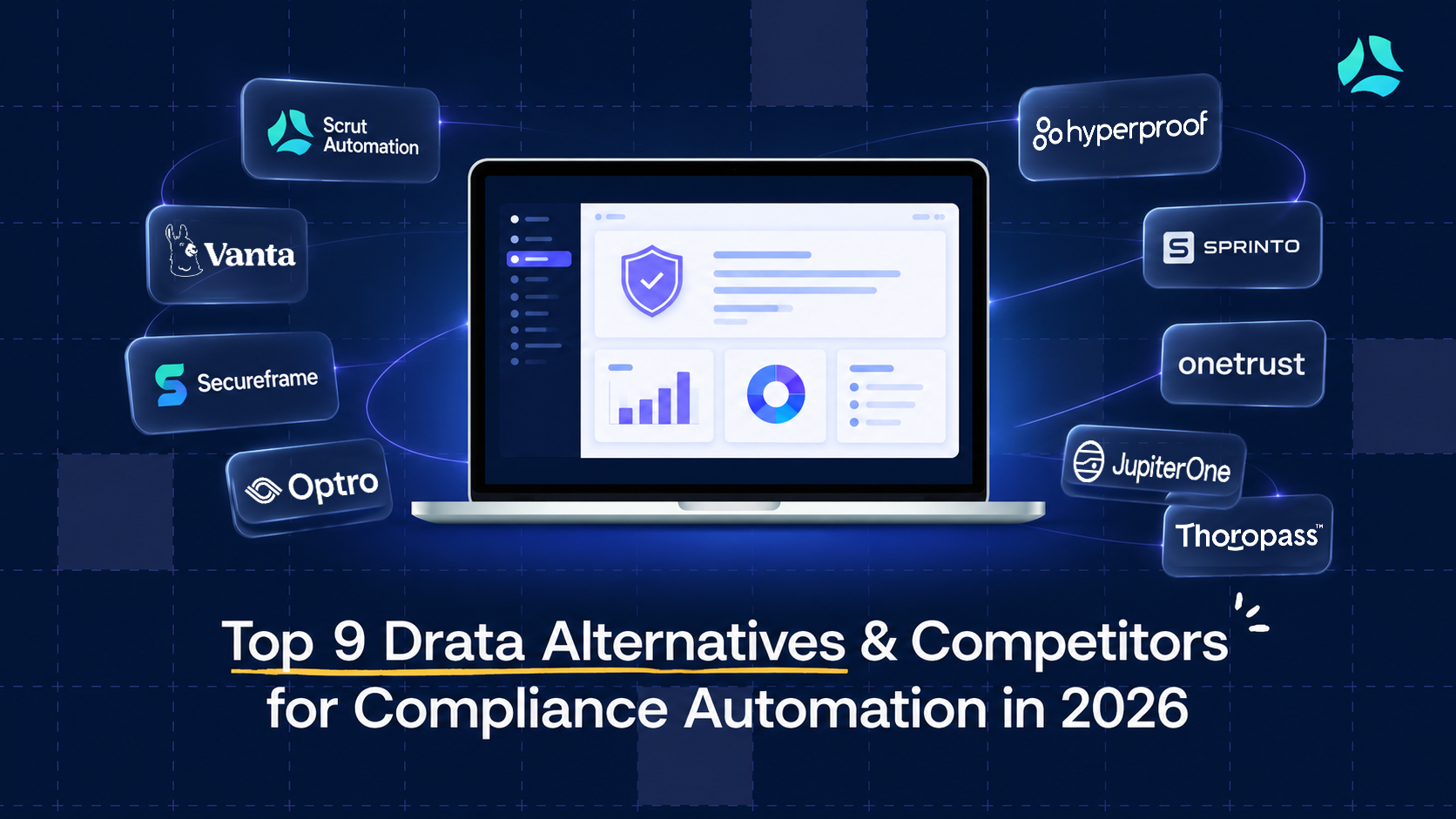
- This guide compares 9 compliance automation platforms across frameworks supported, pricing model, AI capabilities, cloud controls, and audit support.
- Scrut covers 70+ frameworks with transparent single-point pricing, 230+ CIS benchmark checks, and agentic AI for evidence gaps and questionnaire responses.
- The right alternative depends on your stage, framework mix, and how much hands-on support your team needs.
Choosing a compliance automation platform is easy when you only need one framework. It gets harder when you scale beyond that first SOC 2 or ISO 27001, start juggling multiple frameworks at once, or watch costs climb as your team grows.
Drata is a strong platform. It supports 50+ frameworks, offers Foundation, Advanced, and Enterprise tiers, and includes Audit Hub and AI Questionnaire Assistance across all tiers. In 2026, it also added AI Agent Governance (June 2026) and AIUC-1 support (July 2026). It works well for many teams but it might be not the right fit for every team.
This guide is for compliance and security leaders who are either evaluating their first platform purchase or weighing a switch. The nine alternatives below are compared on frameworks, pricing model, AI capabilities, cloud controls, and audit support, so you can match a tool to your actual situation rather than a feature list.
Why organizations look for Drata alternatives
Drata is a capable platform, but it is built around a particular buyer: a lean team pursuing one or two frameworks. As programs mature, several evaluation points tend to surface. The sections below separate what is observable about Drata from how Scrut frames the comparison.
Pricing model
Drata publishes its tier features at drata.com/plans without listing prices. The Foundation tier covers one framework and organizations with up to 50 FTEs. Teams that need additional frameworks, Trust Center features, or custom frameworks at scale may encounter additional costs depending on the tier they land on.
What to check: If your program is likely to add frameworks over the next 12 months, model the full cost across tiers before committing, rather than pricing only the entry point.
Framework coverage and flexibility
Drata supports 50+ frameworks, including SOC 2, ISO 27001, GDPR, HIPAA, ISO 42001, DORA, FedRAMP, and CMMC. That is broad coverage for most teams. The constraint shows up at the edges: teams with highly specific or emerging needs, such as DPDPA or APRA CPS 230 (added July 2026), or custom internal control sets, may find flexibility varies by tier.
What to check: If your framework mix is unusual, confirm custom-framework support and cost at your expected tier.
Cloud controls depth
The question is not just whether a platform runs cloud checks, but how many benchmark controls it tests automatically and how often. A platform that covers compliance-mapped controls may still leave gaps in broader cloud security posture coverage, which matters if security posture, not just audit readiness, is the goal.
What to check: If you run a complex cloud environment, evaluate the depth of automated checks across CIS benchmarks before you commit.
Audit support
Drata's Audit Hub connects you with auditors directly in the platform for sampling and evidence requests. That removes a lot of back-and-forth. Teams that want proactive SLA management and hands-on audit readiness coordination should ask, during evaluation, who owns the audit timeline: the platform, the auditor, or your own team.
What to check: The distinction to evaluate is how much coordination the platform drives versus what the auditor manages independently.
Policy support
In Scrut's comparative framing, Drata's policy module is strong on templates but lighter on review, editing, and customization support. Policy documents are only half the story. An auditor evaluates whether the policy's control actually operates.
What to check: Teams that want hands-on help tailoring policies to their environment, rather than self-serving from a template library, should confirm what level of policy support is included at their tier.
When to consider a Drata alternative
Top 9 Drata alternatives for compliance automation in 2026
The platforms below vary in depth, pricing model, and target org size. Use the quick-reference table immediately below to match each tool to your situation, then read the profiles that are relevant to you.
Drata alternatives at a glance
1. Scrut Automation
Scrut is a compliance automation and GRC platform built for cloud-native, growth-stage, and mid-market companies. It brings compliance, risk, and vendor management into one product, with a single transparent price rather than modules that cost extra as you scale.
The core pitch for teams leaving a single-framework tool is breadth without the per-module surcharge. Scrut supports 70+ frameworks, including SOC 2, ISO 27001, HIPAA, GDPR, PCI DSS, FedRAMP Moderate, CMMC L3, NIS 2, ISO 27701, and DPDPA, and lets you build custom frameworks at no additional cost.
Its Unified Controls Framework (UCF) maps risks and artifacts to a baseline set of controls, so when you add a new framework the platform only asks for evidence against the controls that were previously out of scope. That cross-framework reuse is what keeps a second or third audit from becoming a second or third project.
On the AI side, Scrut Teammates is an agentic layer that detects evidence gaps before auditors see them, maps policy documents to controls, and generates configuration fixes in Terraform, AWS CLI, or CloudFormation. Separately, Scrut runs daily automated checks against 230+ CIS benchmarks and includes native DAST with CVSS severity scoring and external-ready PDF reports. It adds unlimited AI-automated security questionnaire responses and automates up to 70% of evidence collection.
For audit and ongoing operations, Scrut supports BYOA (Bring Your Own Auditor) with auditor SLA tracking, a customer-facing Trust Portal for on-demand security documentation, built-in vendor risk management, and a risk register with custom fields and custom scoring formulas (CIA triad, Risk Priority Number, or org-defined).
It integrates with 150+ tools, including AWS, Azure, Google Workspace, and Jira, plus SIEM and EDR for incident management, and offers MCP with ready-to-use skills for developer-native workflows.
Best for: growth-stage to mid-market teams scaling past a single framework who want transparent pricing, deep cloud coverage, and agentic AI in one platform.
Recognition: Tekpon top compliance software; G2 Summer 2024 momentum leader (6 awards, 179 badges) and rated 4.9/5 rating by 1,300+ companies on G2.
Scrut capability snapshot
2. Vanta
Vanta positions itself as the "#1 Agentic Trust Platform." Founded in 2017, it has grown into one of the most widely adopted compliance automation tools for mid-market and enterprise teams. It supports 35+ frameworks and 400+ integrations and runs 1,400+ automated tests hourly, giving teams near-continuous visibility into control status rather than a daily snapshot.
In 2026, Vanta made its MCP Server generally available (April 2026) for developer-native GRC workflows and launched "AI Governance from Vanta" (July 2026).
Where teams should look closely is tiering and add-ons. In Scrut's comparative framing, several higher-end capabilities, including the vendor risk management portal, AI security reviews, automatic vendor discovery, and custom questionnaires, are available as add-ons on higher tiers rather than included across the board. Confirm which features sit in your tier before signing. One known limitation: encryption-status tracking can run into issues on Linux machines.
Best for: If continuous hourly monitoring and a 400+ integration library are your top criteria, Vanta is worth a serious look, particularly for teams already managing multiple frameworks.
3. Secureframe
Secureframe is a compliance automation platform aimed at startups and mid-market SaaS companies pursuing their first one or two frameworks. It covers SOC 2, ISO 27001, HIPAA, GDPR, and PCI DSS, with a guided flow that simplifies initial setup and a policy builder that saves teams from drafting in Google Docs.
A standout is built-in security awareness training, which lets smaller teams satisfy that control without buying a separate tool. On the government side, Secureframe completed a FedRAMP 20x Moderate pilot as one of 14 selected organizations.
In Scrut's comparative framing, the trade-offs are occasional sync bugs that require manual data entry and error messages that may not specify which component is affected. Costs may also rise as you add frameworks, so model the multi-framework price if you expect to expand.
Best for: For a startup doing its first SOC 2 or ISO 27001 with a lean team, Secureframe's guided flow and built-in training reduce the tool count you need to manage.
For a closer head-to-head, see our Secureframe vs Vanta comparison.
4. Optro (formerly AuditBoard)
AuditBoard rebranded to Optro in March 2026. It is an enterprise GRC and connected-risk platform that positions itself as an "agentic system of action" across audit, risk, InfoSec, and compliance. Its FairNow acquisition adds AI governance capabilities to the platform.
Optro operates at enterprise scale, trusted by more than 50% of the Fortune 500, and was named a Gartner Magic Quadrant Leader in 2025. It supports SOC 2, ISO 2700x, NIST, CMMC, and PCI DSS, plus custom frameworks, and is built around internal audit, SOX programs, and board-level reporting.
In Scrut's comparative framing, the gaps to evaluate are the absence of a built-in third-party or vendor risk management module, admin setup challenges when configuring new controls and users, and audit-plan progress that teams sometimes track in separate spreadsheets.
Best for: Enterprise teams because this is an enterprise tool built for enterprise problems. If you do not have a dedicated internal audit function, the platform's depth will work against you. For more options at this tier, see our AuditBoard alternatives guide.
5. Hyperproof
Hyperproof is a compliance operations hub built for mid-market and enterprise teams coordinating compliance across multiple stakeholders and frameworks. It supports 70+ frameworks and offers a no-code workflow builder, so teams can configure compliance processes without engineering support.
Its signature feature is Hypersync, which provides cross-framework evidence sharing and control reuse across 70+ integrations. Pricing is structured in per-user tiers (Starter, Professional, Business), which teams should factor in as the compliance function grows.
One limitation to plan around: Hypersync has known limits on the types of proof it can collect automatically for continuous monitoring, which means certain control types may require manual evidence supplementation.
Best for: mid-market teams managing multiple frameworks with a dedicated compliance operations function, who want a centralized workspace for controls, evidence, and risk.
6. Sprinto
Sprinto is a compliance automation platform for cloud-hosted companies and positions itself as the "World's first Autonomous Trust Platform." It covers 200+ frameworks digitized and 25+ automated, including SOC 2, ISO 27001, GDPR, HIPAA, PCI DSS, ISO 42001, and the EU AI Act, and serves 3,000+ customers across 75 countries.
Its 2026 AI capabilities are a key differentiator. The Fix-it Agent handles auto-remediation across monitors, and AI Governance is now a core product area covering ISO 42001, NIST AI RMF, and the EU AI Act, which matters for teams bringing AI governance into scope. Pricing is structured around Foundation and Growth tiers, with enterprise add-ons for Risk, TPRM, and AI Governance.
In Scrut's comparative framing, query response times can lag at times, the platform is perceived as expensive when pursuing multiple frameworks, and there is limited criteria to evaluate the effectiveness of security training.
Best for: Cloud-hosted companies at Series A to B pursuing SOC 2 or ISO 27001 will find Sprinto's AI governance additions relevant if that scope is coming into view.
7. OneTrust Risk & Compliance (formerly ZenGRC)
OneTrust Risk & Compliance is the platform formerly known as ZenGRC by Reciprocity. It is a privacy-first GRC and trust intelligence platform spanning privacy, governance, risk, compliance, ethics, and ESG, with the deepest data discovery, consent management, and DPIA tooling of the tools in this list.
OneTrust serves 14,000+ customers and supports 100+ frameworks, including GDPR, CCPA, LGPD, PIPEDA, ISO 27001, SOC 2, HIPAA, ISO 42001, and NIST CSF. Pricing is modular, licensed by product area across Privacy, GRC, Ethics, and Data Governance, which lets large organizations buy only the modules they need.
In Scrut's comparative framing, some views cannot display project due dates, subtasks do not auto-update when a parent task owner changes, and complex dashboard creation is more restricted and less intuitive than other parts of the toolkit.
Best for: large enterprises with privacy-heavy programs (GDPR, CCPA, LGPD) and organizations that want to license modularly by product area.
8. JupiterOne
JupiterOne is primarily a cyber asset management platform that maps and secures cyber assets across your environment to reduce attack surface. Compliance reporting is a capability it offers, not its primary use case. That distinction matters when comparing it to purpose-built compliance tools.
Its strength is breadth of asset data. JupiterOne collects and maintains relationship and asset data across SaaS apps, cloud providers, code repositories, IAM policies, security controls, endpoints, IP addresses, users, and devices. That asset graph gives security teams a strong foundation for attack surface visibility and asset-centric evidence.
Best for: If attack surface visibility is the primary need and compliance reporting is secondary, JupiterOne is the right tool. If you need a full GRC workflow, look elsewhere.
See our JupiterOne alternatives guide if asset management is your core requirement.
9. Thoropass
Thoropass combines compliance automation software with audit services in a single package, which sets it apart from tools that leave you to source an auditor separately. It supports SOC 2, ISO 27001, HIPAA, and PCI DSS.
For a lean team doing its first SOC 2, having one point of contact across preparation and attestation reduces coordination overhead considerably.
The trade-off is that Thoropass uses its own auditors, so you cannot bring an existing audit-firm relationship into the platform. If you need a specialized assessor, such as a QSA for PCI DSS or an accredited ISO certification body, confirm whether Thoropass supports that assessor before signing
Best for: The model suits startups that want software and auditors bundled, so the same vendor manages both the readiness work and the audit.
The profiles above cover the most common alternatives. The section below maps each to the stage and situation where it is most likely to be the right fit.
How to choose the right Drata alternative for your stage
Compliance maturity tracks far more closely to your risk profile, customer expectations, and data sensitivity than to headcount, so anchor your platform choice on those signals, not the longest feature list. A few patterns hold across stages.
If you are a startup pursuing your first SOC 2 or ISO 27001, prioritize speed, guided workflows, and transparent pricing. You do not need an enterprise GRC suite. You need a tool that gets you audit-ready without pulling engineers off the roadmap, and pricing you can predict as you add your second framework. Fast onboarding and built-in guidance matter more here than deep configurability.
If you are a mid-market team scaling from one framework to three or more, the deciding factor becomes cross-framework evidence reuse. Running SOC 2, ISO 27001, and GDPR as separate projects duplicates work and burns time. Look for a Unified Controls Framework or equivalent mapping, broad integration depth, and continuous monitoring so new frameworks inherit existing evidence rather than starting from scratch. This is where how to choose GRC software becomes a real evaluation exercise rather than a checkbox.
If you are an enterprise with a dedicated internal audit function and SOX obligations, your requirements shift toward board-level reporting, connected-risk views, and purpose-built audit workflows. And if AI governance is now in scope, in 2026 that increasingly means ISO 42001, NIST AI RMF, and the EU AI Act. You will want a platform with native AI governance frameworks rather than a bolt-on.
Match your situation to the right platform
For a broader market view, our roundup of the best compliance automation software and our guide to leading GRC platforms cover more options.
Scrut vs. Drata: key differences
Both tools are credible compliance automation platforms. The table below summarizes where they differ on the criteria that most affect a buying decision.
For most growth-stage teams, the deciding question is how many frameworks you expect to run within 12 months and how predictable you need pricing to be as you scale.
- Drata suits teams whose framework needs fit cleanly within its tier structure and who want in-platform auditor collaboration through Audit Hub.
- Scrut is the stronger fit when you are scaling across many frameworks, need custom risk scoring, or want native DAST and agentic AI for evidence gaps without paying for separate modules.