





- DORA compliance requirements apply to financial entities and their ICT third-party service providers operating in or serving the EU, with enforcement from 17 January 2025.
- A SOC 2 Type II report or ISO 27001 certificate demonstrates security control design and effectiveness. Neither satisfies DORA's specific ICT risk management framework, incident reporting timelines, or subcontractor register obligations.
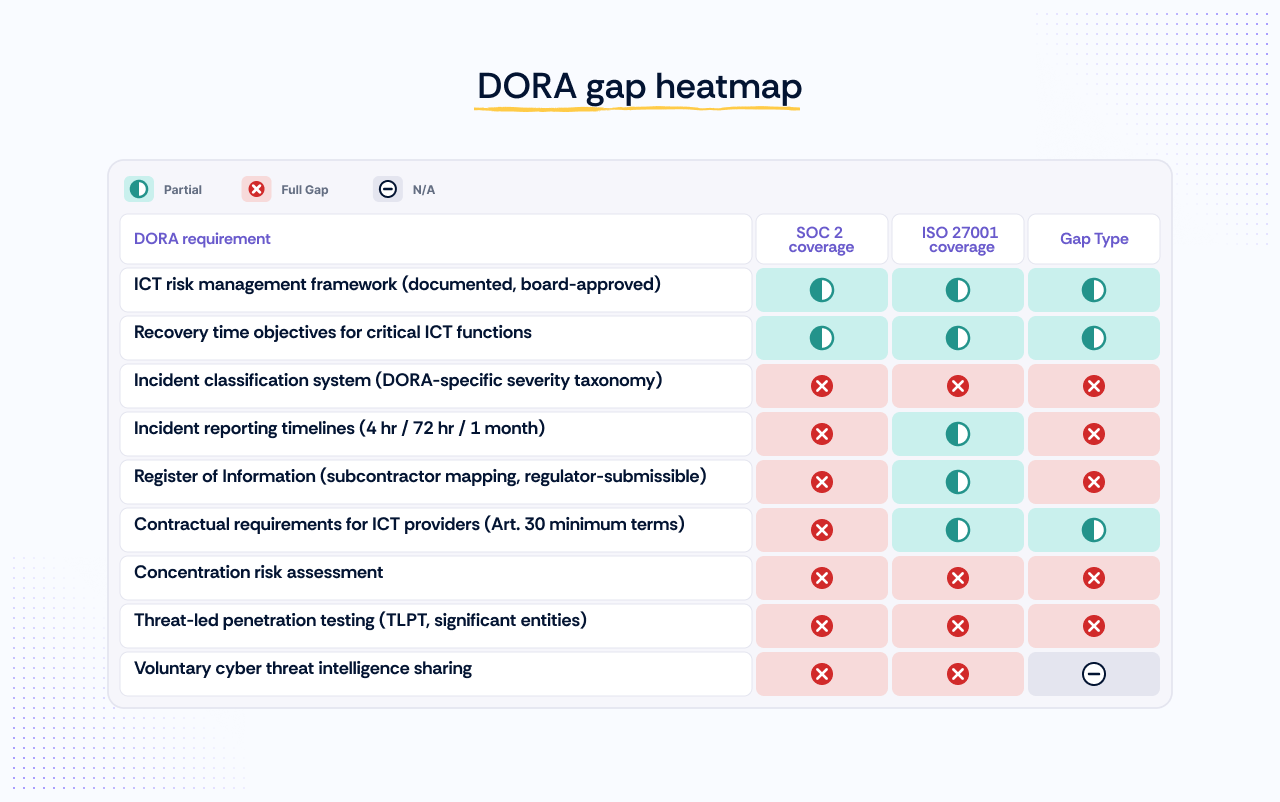
- DORA’s incident reporting clock is strict: an initial notification within 4 hours of classifying an incident as major (and no later than 24 hours after becoming aware of it), an intermediate report within 72 hours of that notification, and a final report within 1 month of the last intermediate report.
- The Register of Information requires a structured, regulator-submissible record of every ICT third-party arrangement. This is a materially different artifact from a standard vendor risk register.
- Fintech and insurtech vendors selling into the EU must treat DORA as a separate compliance workstream, not an extension of their existing GRC program.
Picture a fintech SaaS vendor serving European banks. They have ISO 27001 certification and a SOC 2 Type II report in hand. Their EU bank customer is now subject to DORA compliance obligations. The bank's procurement team sends over a DORA vendor questionnaire. The vendor's GRC manager opens it and thinks: "We've covered all of this." They haven't.
DORA is not a stricter version of SOC 2 or a European flavour of ISO 27001. It is a structurally different regulatory obligation that requires different artifacts, different workflows, and direct accountability at board level. Companies with SOC 2 or ISO 27001 have a foundation. They are not starting from zero. But the gap between that foundation and full DORA readiness is wider than it looks on the first read of the questionnaire.
This guide is written for the GRC and compliance leader at a fintech or insurtech vendor selling into the EU. It maps exactly where existing SOC 2 and ISO 27001 evidence holds up, where it breaks down, and what four artifacts your current program does not produce. For background on fintech compliance requirements in the EU more broadly, see our companion guide.
First, check which side of DORA you sit on. If you’re a payment institution, e-money institution, crypto-asset service provider, or another entity type DORA lists, every requirement below applies to you directly. If you’re an ICT provider to those entities, most obligations reach you through your customers’ contracts and questionnaires, and your job is to supply the evidence and data they need.
DORA applies to your customers, which means it applies to you
Most coverage of DORA’s scope leads with its 20 types of financial entities, from banks and insurers to crypto-asset service providers. What that framing misses is the downstream effect on ICT vendors.
If you provide ICT services to any in-scope financial entity, DORA shapes what that customer will demand from you in contracts, questionnaires, and incident response workflows. For vendors designated as Critical Third-Party Providers (CTPPs), direct regulatory obligations follow. The ESAs designated the first 19 CTPPs on 18 November 2025, mostly hyperscale cloud, data center, and infrastructure providers. Most mid-market fintechs below that threshold will not face direct ESA oversight, but they will feel the requirements through their customers' procurement and vendor risk management processes.
DORA also includes an explicit proportionality principle: obligations scale with entity size and risk profile. A small payment institution isn’t held to the same bar as a systemically important bank. For ICT vendors, proportionality shows up indirectly: the more critical your service is to a customer, the heavier their demands on you. See our guide to third-party risk management for how to structure that assessment.
The five DORA requirements and what each one demands in practice
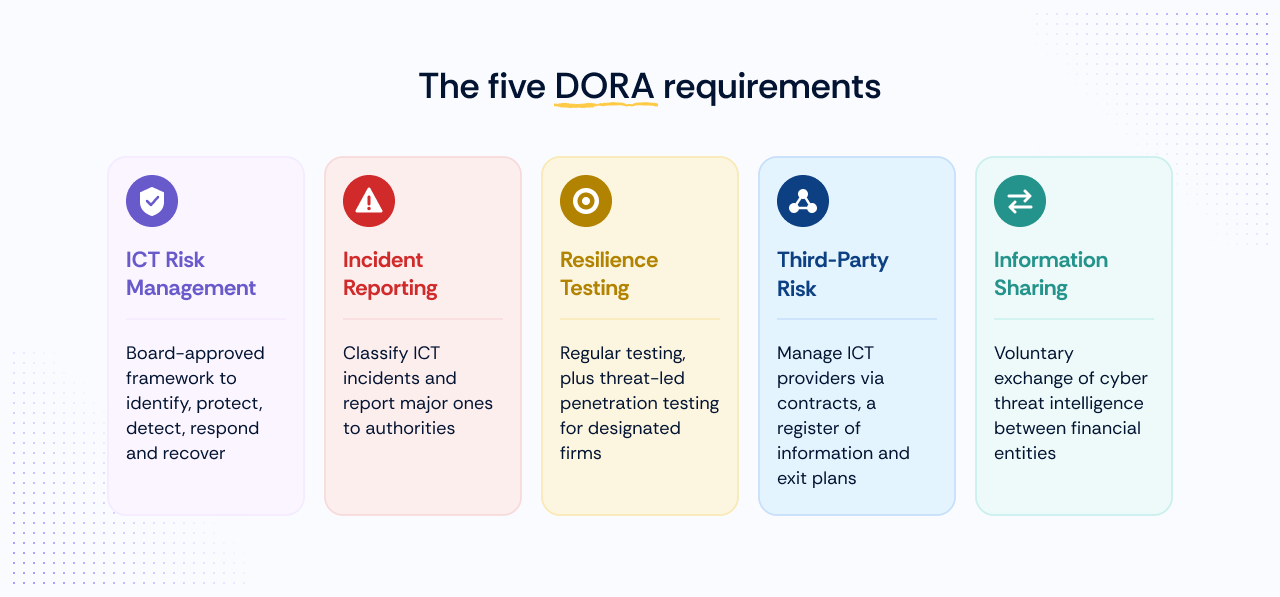
DORA is organised around five pillars. What distinguishes it from frameworks like SOC 2 is that each pillar specifies not just what you should do, but what evidence a reviewer will ask for. The question is not "do we have a risk management process?" but "do we have the specific artifact this pillar requires?"
ICT risk management framework
DORA requires a documented ICT risk management framework approved at board level. The framework must cover the full lifecycle (identify, protect, detect, respond, recover) and explicitly document recovery time objectives and recovery point objectives for each system supporting a critical function. This is not a generic information security risk assessment. The board, not just the CISO, must approve and be accountable for the framework. Operational continuity planning must address ICT dependency and concentration risk as distinct categories.
ICT incident reporting
Incident reporting under DORA follows a three-stage clock. The initial notification is due within 4 hours of classifying an incident as “major” under DORA’s RTS, and no later than 24 hours after you become aware of it. An intermediate report follows within 72 hours of the initial notification. The final report, with root-cause analysis, is due within 1 month of the last intermediate report. Reports go to the entity’s national competent authority, such as BaFin in Germany or the Central Bank of Ireland. A voluntary reporting channel for significant cyber threats also exists, separate from the mandatory track.
Digital operational resilience testing
Basic testing (annual vulnerability assessments, penetration testing, scenario-based testing) applies broadly. Threat-led penetration testing (TLPT) under the TIBER-EU methodology, updated in February 2025, applies to significant entities on a three-year cycle. Most mid-market vendors serving financial entities will face basic resilience testing requirements from their customers rather than direct TLPT obligations.
Third-party ICT risk management
DORA's third-party ICT risk pillar introduces two requirements that have no equivalent in SOC 2 or ISO 27001. The Register of Information is a structured, machine-readable record of every ICT third-party arrangement, submitted to competent authorities. The ESAs collected the first registers from national competent authorities by 30 April 2025. Article 30 sets mandatory minimum contractual requirements for ICT agreements, covering exit strategies, audit rights, SLAs, data location, security standards, and sub-contractor visibility. Entities must also assess concentration risk from systemic dependency on single providers.
Information sharing
DORA encourages voluntary participation in cyber threat intelligence sharing arrangements. Entities may share threat indicators, tactics, and techniques within trusted communities. There is no mandatory threshold equivalent to the incident reporting obligation. For most vendors, this pillar is a monitor-and-prepare rather than an immediate build requirement.
SOC 2 + ISO 27001 vs. DORA: where your evidence holds up and where it breaks down
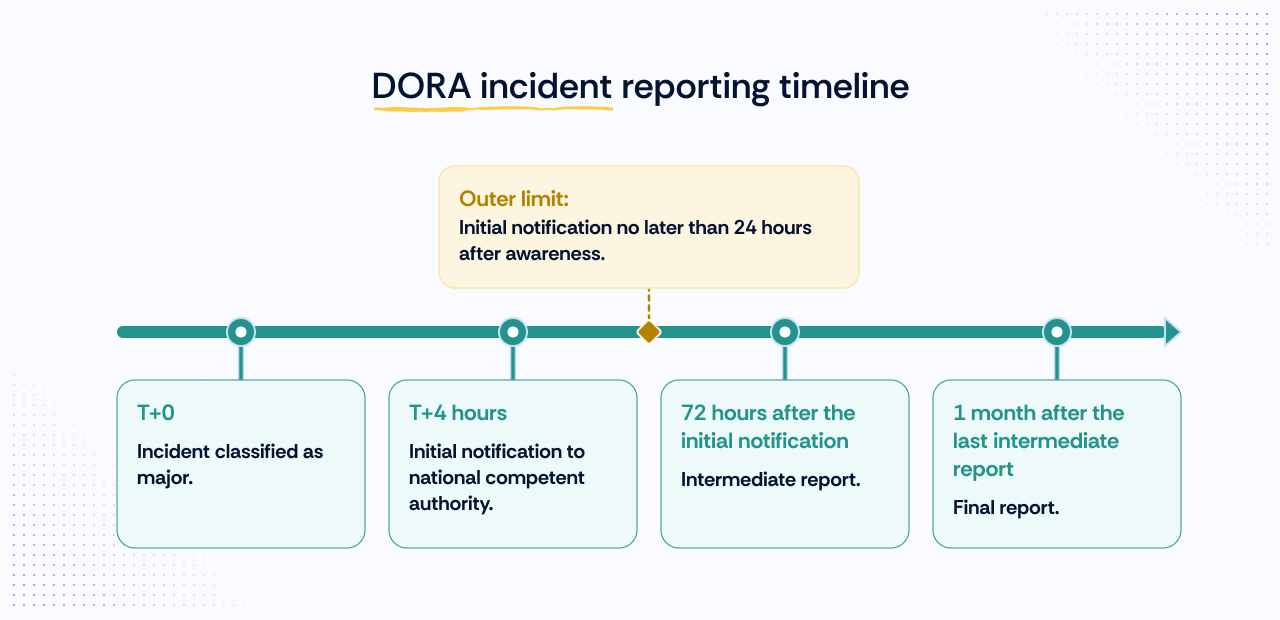
A fintech vendor with SOC 2 Type II and ISO 27001 certification will look at a DORA questionnaire and believe their evidence package answers it. The table below names the specific places where that holds and the specific places where it breaks down, with enough precision that a compliance manager can use it as a working checklist.
The table above shows nine gaps. Three of them consistently surprise compliance leaders when they first work through a DORA questionnaire: incident reporting timelines, the Register of Information, and ICT third-party contract requirements. The sections below cover each in enough depth to scope the remediation work.
Gap 1: incident reporting timelines
SOC 2 has no mandatory external reporting obligation. ISO 27001's A.16 covers incident notification to internal stakeholders. DORA requires financial entities to report to a national competent authority on a fixed clock. If you’re their ICT provider, your contracts will require you to notify them fast enough, and with enough detail, for them to meet it. It demands pre-built notification templates, designated owners with authority to contact regulators, and a classification decision fast enough to trigger the 4-hour clock. That clock starts at classification as “major,” with an outer limit of 24 hours from awareness, so delaying classification doesn’t buy time. A team without a standing classification procedure will miss it.
Gap 2: the Register of Information
A standard vendor risk register does not satisfy DORA's Register of Information requirement. The ESAs published ITS templates for the register in November 2024 (Commission Implementing Regulation (EU) 2024/2956). The register must be machine-readable, submitted to competent authorities, and cover specific fields including ICT service category, data sensitivity classification, substitutability assessment, and sub-contractor chains. Your existing vendor risk register is a solid starting point, but it has to be restructured to the ESA template. If you’re an ICT provider, expect customers to ask you for the fields they need, including details of your own subcontractors.
Gap 3: ICT third-party contract requirements
Many fintech vendors have MSAs and DPAs in place. DORA's Article 30 adds mandatory minimum terms that must appear in ICT contracts: exit strategies, audit rights for the financial entity and competent authorities, sub-contractor notification requirements, data location specification, and SLA terms tied to resilience objectives. A standard DPA or MSA template does not cover these. See our guide to SOC 2 compliance and third-party incident response management for how to position existing evidence alongside the DORA delta.
Four DORA artifacts your current GRC program doesn't produce
The gap analysis names the missing requirements. This section names the four artifacts that close them. Each builds on something your existing program likely already has. If you’re a financial entity, DORA requires all 4. If you’re an ICT provider, customers will expect artifacts 2 and 4 from you directly, plus the data that feeds their versions of 1 and 3. The work is identifying the specific delta and building it deliberately.
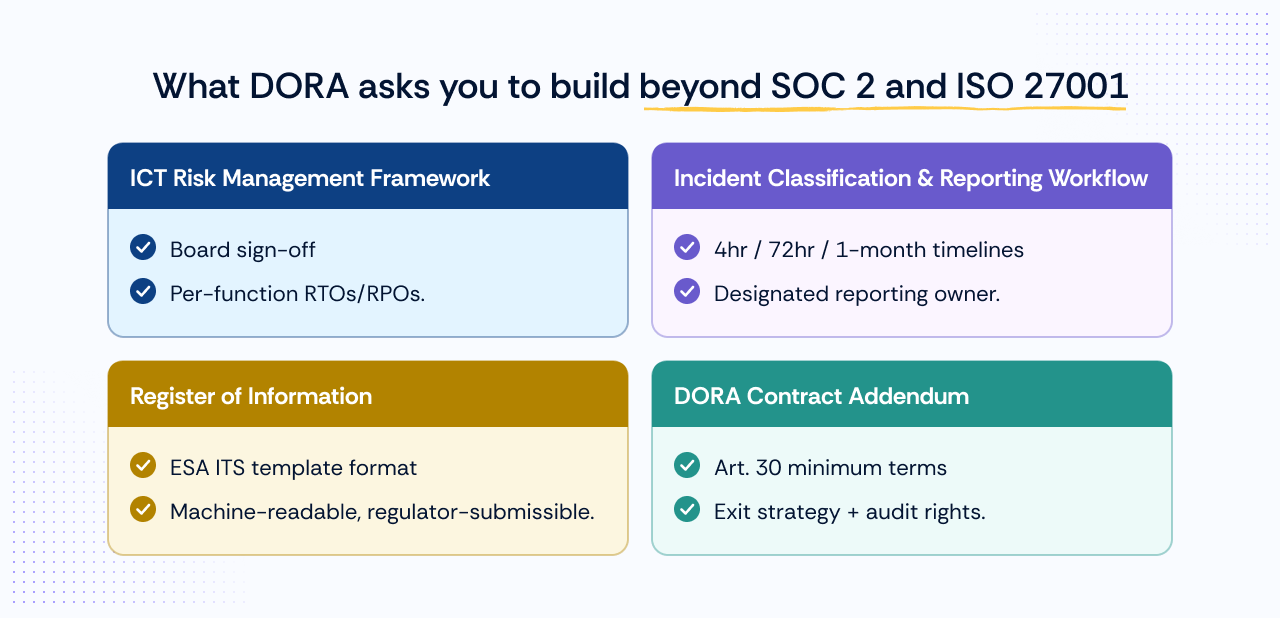
1. DORA-compliant ICT risk management framework document
What it is: a standalone document (not just a policy) that records ICT risk tolerance, critical functions, recovery objectives per function, and board approval. ICT risk management framework guidance covers the foundation.
- Builds on: ISO 27001 Clause 6.1 risk assessment and existing BCP policy.
- Net-new: an explicit ICT risk tolerance statement signed off at board level; per-function RTO and RPO documentation for systems supporting critical functions; an operational continuity plan distinct from disaster recovery.
- Board accountability is not optional. DORA's management body requirements are specific: the board must approve the framework, not just the CISO.
2. DORA incident classification and reporting workflow
What it is: a documented process mapping incident detection through classification, 4-hour notification, 72-hour intermediate report, and 1-month final report. See also: incident response workflow.
- Builds on: existing incident response runbooks.
- Net-new: the DORA severity classification taxonomy from the RTS on ICT incident classification; template-based reports to national competent authority; designated reporting owners with authority to notify regulators.
- Vendor note: financial entities report to their competent authority. ICT vendors may need to support their customers by providing timely incident data to populate those reports within DORA's windows.
3. Register of Information (subcontractor map)
What it is: a structured, regulator-submissible record of all ICT third-party arrangements, built to the ESA's ITS template format. See also: managing sub-processor risk.
- Builds on: existing vendor inventory or risk register.
- Net-new: machine-readable format aligned to ESA ITS template; fields for ICT service category, data sensitivity classification, substitutability rating, and sub-contractor chains; entity-level, sub-consolidated, and consolidated versions required for groups.
- Practical note: competent authorities collected the first registers from financial entities by 30 April 2025. ICT vendors should be prepared to provide the data their customers need to populate and maintain the register.
4. DORA-aligned ICT third-party contract addendum
What it is: a contract addendum or updated MSA template that incorporates DORA's Article 30 mandatory minimum terms. See also: vendor management policy.
- Builds on: existing MSAs and DPAs.
- Net-new: mandatory exit strategy provisions; audit rights for the financial entity and competent authorities; sub-contractor notification requirements; data location specification; SLA terms tied to resilience objectives.
- Commercial note: financial entities must renegotiate contracts that do not include these terms. ICT vendors should proactively offer a DORA addendum rather than waiting for customers to drive renegotiation.
DORA enforcement: fines, supervisory orders, and what they mean for vendors
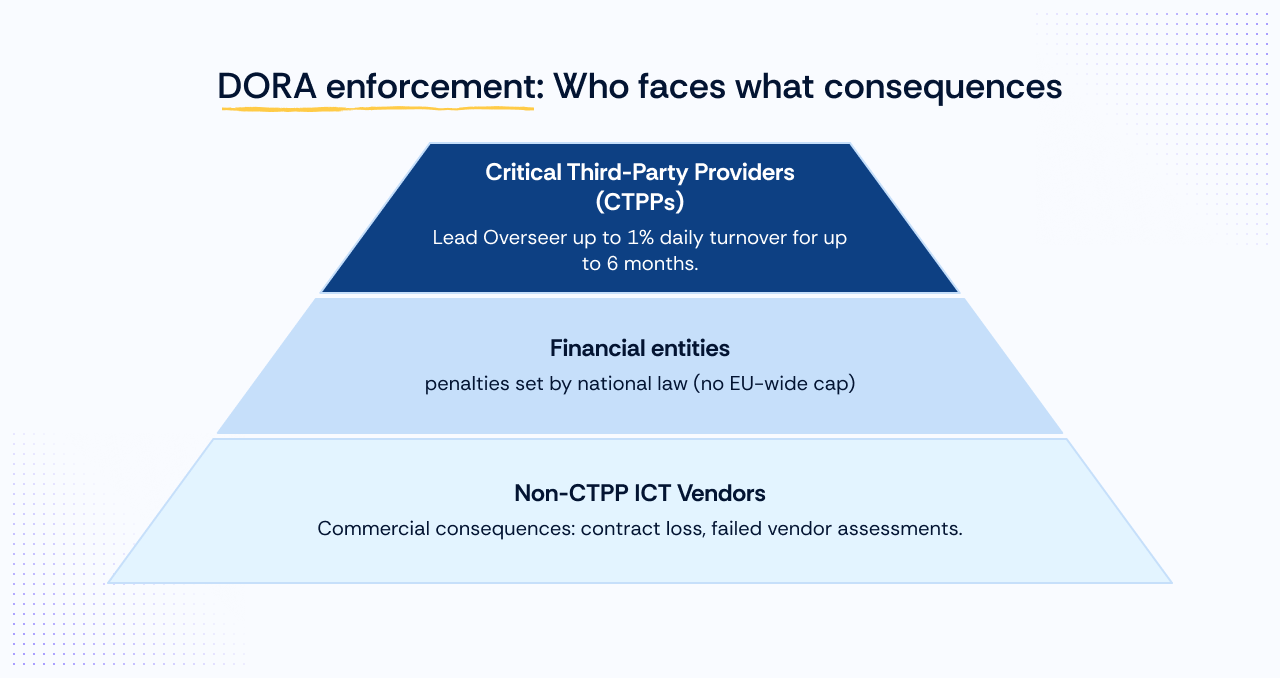
DORA's enforcement structure differs meaningfully from most comparable frameworks. Penalties for financial entities are set by national member states; ceilings vary by jurisdiction. For Critical Third-Party Providers designated by the ESAs, the Lead Overseer can impose periodic penalty payments of up to 1% of average daily worldwide turnover per day of non-compliance, for up to six months. Non-financial consequences include public disclosure orders, management bans, and license suspension. See the DORA compliance checklist for the full enforcement timeline.
The enforcement risk for most fintech and insurtech vendors is primarily commercial, not direct regulatory. Failure to meet DORA obligations will trigger contract termination or deal loss with EU financial entity customers before it triggers direct ESA enforcement. See our
compliance risk management guide for how to quantify and present this exposure internally.
A practical DORA readiness sequence for fintech and insurtech vendors
The compliance leader reading this already knows how to run a GRC program. What follows is a DORA-specific sequence, not a generic framework adoption guide. See our GRC implementation roadmap for the broader program context.
Step 1: scope and classify your exposure (weeks 1 to 2)
- Identify which EU financial entities you serve, current and prospective.
- Map which of your services constitute ICT services supporting critical or important functions from your customers' perspective. This determines which DORA obligations flow through contractually.
- Check whether any customer is likely to trigger CTPP designation for you. Most mid-market vendors will not reach this threshold, but it is worth confirming.
Step 2: audit your existing evidence against the gap matrix (weeks 2 to 4)
- Use the gap matrix from the section above as the audit framework.
- For each DORA pillar, document what existing evidence addresses it partially, what is missing entirely, and what needs to be restructured — for example, vendor register to Register of Information.
- Assign gap owners. The ICT risk management framework and Register of Information typically require different owners than your existing SOC 2 / ISO 27001 program.
Step 3: build the net-new artifacts (months 2 to 4)
- ICT risk management framework document with board sign-off.
- Incident classification procedure and reporting workflow.
- Register of Information, starting with your critical ICT providers. Use the risk register as the data source.
- DORA contract addendum template for use in new and renegotiated ICT agreements.
Step 4: operationalize and test (months 4 to 6)
- Run a tabletop exercise against the DORA incident reporting timeline: can your team classify, notify, and report within the required windows?
- If you’re a financial entity, validate your Register of Information against the ESA template. If you’re an ICT provider, validate the data you send customers for their registers.
- Brief the board or executive team on the ICT risk tolerance statement before it appears in a vendor questionnaire. Use compliance automation to track evidence against DORA controls alongside your existing SOC 2 and ISO 27001 frameworks and maintain continuous compliance posture.
Building the internal business case for DORA readiness
For compliance practitioners, the hardest part of DORA preparation is often not the technical audit. It is making the internal case for a budget line that was not in the original compliance program. Most GRC budgets at mid-market fintechs were scoped for SOC 2 and ISO 27001 tooling. DORA adds obligations that require additional work: incident classification infrastructure, board-level accountability documentation, the Register of Information, and DORA-specific contract addenda.
The business case has three components.
The commercial risk argument. Enterprise buyers inside regulated financial entities have started sending DORA-framed vendor questionnaires that sit alongside SOC 2 and ISO 27001 security reviews. Contracts with EU financial entities now carry DORA’s Article 30 terms. Procurement teams flag non-compliance as vendor risk. Being able to show DORA readiness quickly becomes a sales asset, not just a legal requirement.
The contract exposure argument. Financial entities must include DORA's Article 30 minimum terms in ICT contracts. Contracts that do not include those terms must be renegotiated. For an ICT vendor, that means either driving the renegotiation proactively or waiting for customers to do it under time pressure. Vendors with a DORA addendum ready accelerate the renegotiation cycle.
The efficiency argument. DORA's incident classification, breach reporting, and Register of Information obligations require process infrastructure. DORA has applied since 17 January 2025, so this infrastructure is already overdue for most teams. Building it on a compliance automation platform keeps the ongoing effort predictable, while running it manually means rebuilding evidence every cycle.
How Scrut helps you close the DORA gap
Scrut's GRC platform is built for the operational reality of multi-framework compliance programs. For organisations managing DORA alongside SOC 2 and ISO 27001, the control overlap is real. A single access control and encryption implementation satisfies DORA's Article 9 ICT security requirements, SOC 2 CC6, and ISO 27001 Annex A controls when mapped across frameworks from the start.
Scrut’s DORA framework comes pre-loaded and maps to the SOC 2 and ISO 27001 controls you already run, so you only build the delta. Vendor risk management holds the ICT provider inventory and assessments that feed a Register of Information, and the risk register keeps your ICT risks in one place. Scrut Teammates, our AI layer, helps draft responses to DORA-framed vendor questionnaires against your existing control evidence.
See how Scrut helps compliance teams build and evidence DORA readiness alongside SOC 2 and ISO 27001 from a single control library. Request a demo.
DORA - the Digital Operational Resilience Act (EU 2022/2554) — is an EU regulation that entered into application on 17 January 2025. It applies to more than 20 types of financial entities operating in the EU, including banks, payment institutions, insurance companies, investment firms, and crypto-asset service providers. It also applies to ICT third-party service providers that supply services to those entities, including vendors based outside the EU.
No. SOC 2 demonstrates that your security controls were designed and operating effectively during an observation period. DORA requires additional artifacts that SOC 2 does not produce: a documented ICT risk management framework with board accountability, a structured incident reporting workflow with regulatory notification timelines (4 hours, 72 hours, 1 month), a Register of Information mapping all ICT third-party arrangements, and contractual terms for ICT providers meeting DORA's Article 30 minimum requirements. SOC 2 evidence is useful raw material for the DORA program, but it does not satisfy DORA-specific deliverables on its own.
Partially. ISO 27001's Clause 6.1 risk assessment, supplier relationship controls (Annex A.5.19 to A.5.23), and incident management controls (A.5.24 to A.5.28) provide relevant foundations. However, ISO 27001 does not require DORA's specific ICT risk tolerance statement signed off at board level, DORA's severity classification taxonomy for incident reporting, the ESA-template Register of Information, or the regulatory notification timelines DORA mandates. Existing ISO 27001 work reduces effort but does not replace DORA-specific deliverables.
Under DORA, financial entities must submit an initial notification to their national competent authority within 4 hours of classifying an incident as “major,” and no later than 24 hours after becoming aware of it. An intermediate report follows within 72 hours of the initial notification. A final report is due within 1 month of the last intermediate report. These timelines apply to financial entities directly. ICT vendors serving them should build workflows that can supply the necessary data to their customers within these windows.
The Register of Information is a structured, machine-readable record of all ICT third-party arrangements maintained by in-scope financial entities. It must be submitted to national competent authorities and follows the ESA's ITS template format (Commission Implementing Regulation (EU) 2024/2956). The register documents ICT service category, data sensitivity, substitutability assessment, and sub-contractor chains. A standard vendor risk register does not satisfy this requirement without restructuring to the ESA format.