

%20(1).png)


%201.png)
Choose risk-first compliance that’s always on, built for you.
The cost of compliance doesn’t stop at the audit invoice. It’s also paid in engineering hours, manual work, and the time it takes to keep everything audit-ready.
We surveyed Scrut customers what changed after they automated compliance, across everything from team workload and audits to customer trust and fundraising.

Compliance used to be deferrable, something addressed after product-market fit, a major enterprise deal, or a funding milestone. That environment no longer exists.
SOC 2 and ISO/IEC 27001 increasingly gate enterprise deals, regulated markets, and investor diligence. The question is no longer whether compliance matters, but how it gets executed.
When run on spreadsheets and point-in-time audits, compliance taxes the entire business: unstable audit prep, diverted engineers, rising consultant costs, and slower trust-building with buyers and investors.
This report examines what changes when organizations ($0-$500M ARR) move from manual coordination to continuous, automated execution on the Scrut Platform. The pattern we saw is that respondents cut audit findings by half or more, engineering time returns to the roadmap. consultant dependence falls, customer trust forms earlier in the sales cycle, and fundraising diligence gets easier to clear.
The implication is direct: in a market where trust gates revenue and capital, compliance value now depends less on meeting requirements than on how continuously and efficiently they are executed.
For years, compliance tools were built to answer one question: can you prove this happened? That worked when audits were periodic and systems changed slowly. It no longer fits today's reality, where infrastructure changes daily, vendors are added rapidly, and AI introduces behavior that cannot be fully predicted. The gap isn't visibility anymore. It's action. That's why teams feel overwhelmed even when they look compliant on paper, and why every audit still becomes a scramble.

Manual compliance creates drag across the business. Move it out of spreadsheets and last-minute coordination, and audits get smoother, engineers reclaim time, consultant reliance drops, and audit readiness is easy to prove on demand.
This report evaluates reported business outcomes among organizations in the $0 to $500M ARR range after implementing the Scrut Platform.
We surveyed founders, engineering leaders, compliance managers, and security leaders across early-stage and mid-market companies to understand the operational and commercial impact of compliance execution.
The objective was to understand the business impact of compliance automation. Specifically, the study examined what changed when organizations moved away from manual, point-in-time compliance preparation and toward more structured, system-supported execution.
The results point to a clear shift in how compliance execution affects business performance.What was once treated as a periodic operational burden is increasingly shaping outcomes across:
Across revenue tiers and functional roles, the survey showed improvements in audit outcomes. lower engineering effort tied to compliance work, reduced reliance on external consultants, and stronger readiness in customer and investor-facing conversations.
All findings in this section are based on reported outcomes from organizations using Scrut to manage compliance workflows.
Among respondents who had completed at least one audit cycle after implementing the Scrut Platform:
Every audit finding carries a tail: remediation work, a second pass at evidence, and an auditor follow-up, almost always against the clock. Cut the findings, and the tail goes with them.
Scrut monitors your controls continuously, so a gap surfaces the moment it appears, not days before the audit. Evidence is collected automatically and stays current, so there is nothing to reconstruct when the auditor asks. And because controls are mapped once and reused across every framework you run, the work behind one audit carries straight into the next.

Fewer audit findings mean fewer surprises. When control gaps get caught and fixed before the auditor arrives, there is less to find and less to scramble over. Customers who completed an audit on Scrut reported exactly that: fewer findings and a smoother cycle than their last one. The audit becomes confirmation of work you have already done, not a search for work you missed.
Among respondents from engineering teams:
There is a cost to pulling engineers into an audit that never shows up on the compliance budget. It is buried in the work that did not happen: the release that slipped a sprint, the migration that waited, the fix that sat in the backlog while the people who would have done it were occupied elsewhere.
Because that cost is invisible, it goes unmanaged, and unmanaged costs are the ones that compound.
Before Scrut, engineers were pulled into compliance busywork: collecting evidence, validating controls, and fielding auditor questions. That is time off the roadmap. Engineering respondents reported that automation absorbed most of the manual load, so audit prep stopped pulling them away from product work.
Among respondents who reported relying on external compliance consultants prior to adopting the Scrut Platform:
The real problem with leaning on consultants is not what it costs. It is what it does to your team's ability to operate without them.
A consultant does the work for you, so your own people never build the muscle to do it themselves, and year two looks like year one: the same gaps, the same call to the same firm.
And because the work sits outside the company, so does the clock. Evidence turnaround, audit prep, and the answer to "are we ready yet" all move at the speed of someone else's calendar and someone else's priorities. Each engagement ends with the work done, and your team is no better equipped to do it next time.
Outside consultants are a recurring cost for work that is mostly coordination. Respondents who had been relying on them reported needing them less after Scrut, with tracking, framework mapping, and evidence now handled internally in one place. You spend less on external support, and you stop depending on someone else to stay audit-ready.
We used to rely on a third-party consultant who did the bulk of the work for us, but we never got the level of granularity or visibility into the policies and evidence that Scrut gives us. With a consultant, you get an Excel spreadsheet telling you what you haven't done. With Scrut, it's all in front of you, so by the time the audit comes around, there's really no prep, because it's already done.

Among respondents involved in enterprise sales or customer security reviews:
Reported establishing customer trust earlier in the sales cycle after implementing structured compliance processes using the Scrut Platform


Rated obtaining a SOC 2 attestation or ISO/IEC 27001 certification as "Critical" or "Very Important" to customers and investors
Enterprise buyers gate deals on proof of security. When certification progress and current evidence are available on demand, the security review stops being a bottleneck. Sales respondents reported earning buyer trust earlier, which means fewer deals stalling while a compliance answer gets chased down. Compliance readiness becomes a faster route through procurement.
Among respondents who had participated in investor due diligence processes:
Reported that compliance requirements were a mandatory part of investor due diligence
Of respondents said compliance readiness with Scrut played a role in fundraising or investor conversations
Fundraising diligence is no longer limited to market size, revenue quality, and product traction. For companies selling into enterprise or regulated markets, investors also evaluate compliance posture, not just certification, as part of operating maturity.
Weak compliance execution creates uncertainty when a company needs confidence. When a compliance program runs on point-in-time audit prep, it pulls teams into avoidable back-and-forth and makes the company look less mature than its growth story suggests.
Compliance readiness is not a badge. It is a signal that the business can scale without governance becoming a constraint.
Investors now read lack of governance as a risk signal, and most founders surveyed said compliance came up directly in diligence. When controls are maintained continuously rather than rebuilt under a deadline, you enter diligence with proof instead of promises. It will not win you the round, but it removes a reason for investors to hesitate.
Structure can turn compliance complexity into steady, measurable progress.
Had no formal compliance program before adopting Scrut, and it was their first structured compliance implementation
Of first-time implementers who completed an audit or certification, reported achieving it earlier than originally projected
First-time compliance programs often fail because momentum is hard to sustain. When scope, ownership, and progress are unclear, compliance competes with revenue priorities and can slip past the original timeline or stall before certification.
Among the first-timers who finished an audit or certification with Scrut, all reported reaching it ahead of their own timeline. The value is speed to a credential you can sell on: you hit SOC 2 or ISO/IEC 27001 compliance milestones sooner, so it starts unlocking deals sooner.
Scrut's automated evidence collection and control monitoring integrations made compliance checks far easier to run day to day. Evidence gets generated automatically, so there's no more chasing manual screenshots or creating artifacts from scratch.

Across applicable respondent groups, the survey shows a consistent pattern after implementation of the Scrut Platform: compliance execution became less manual, less reactive, and easier to demonstrate across audits, engineering workflows, consultant-supported work, customer reviews, and investor diligence.


The Scrut Business Impact Survey (2026) was conducted to quantify measurable operational and commercial outcomes from implementing the Scrut Platform.
The study evaluates five primary impact categories:
Findings are drawn from organizations with $0-$500M ARR that have implemented the Scrut Platform and use it to manage compliance programs across teams.

Responses were grouped by primary function, including Engineering, GRC, Sales, and Leadership, so each measure uses the relevant subgroup.
Quantitative results are self-reported and benchmarked against prior audit cycles, original implementation plans, or projected timeframes.
Respondents span early-stage startups through scaled enterprises across SaaS, Finance, Healthcare, IT Security, Manufacturing, and other sectors.
The majority were implementing a formal compliance program for the first time. Respondents manage a mix of standards and regulations in Scrut, including SOC 2, ISO/IEC 27001, ISO/IEC 42001, HIPAA, GDPR, and CCPA. Most manage two or more concurrently.
Each respondent identified one primary role. The survey routed questions by role so that each respondent answered the questions most relevant to their function.
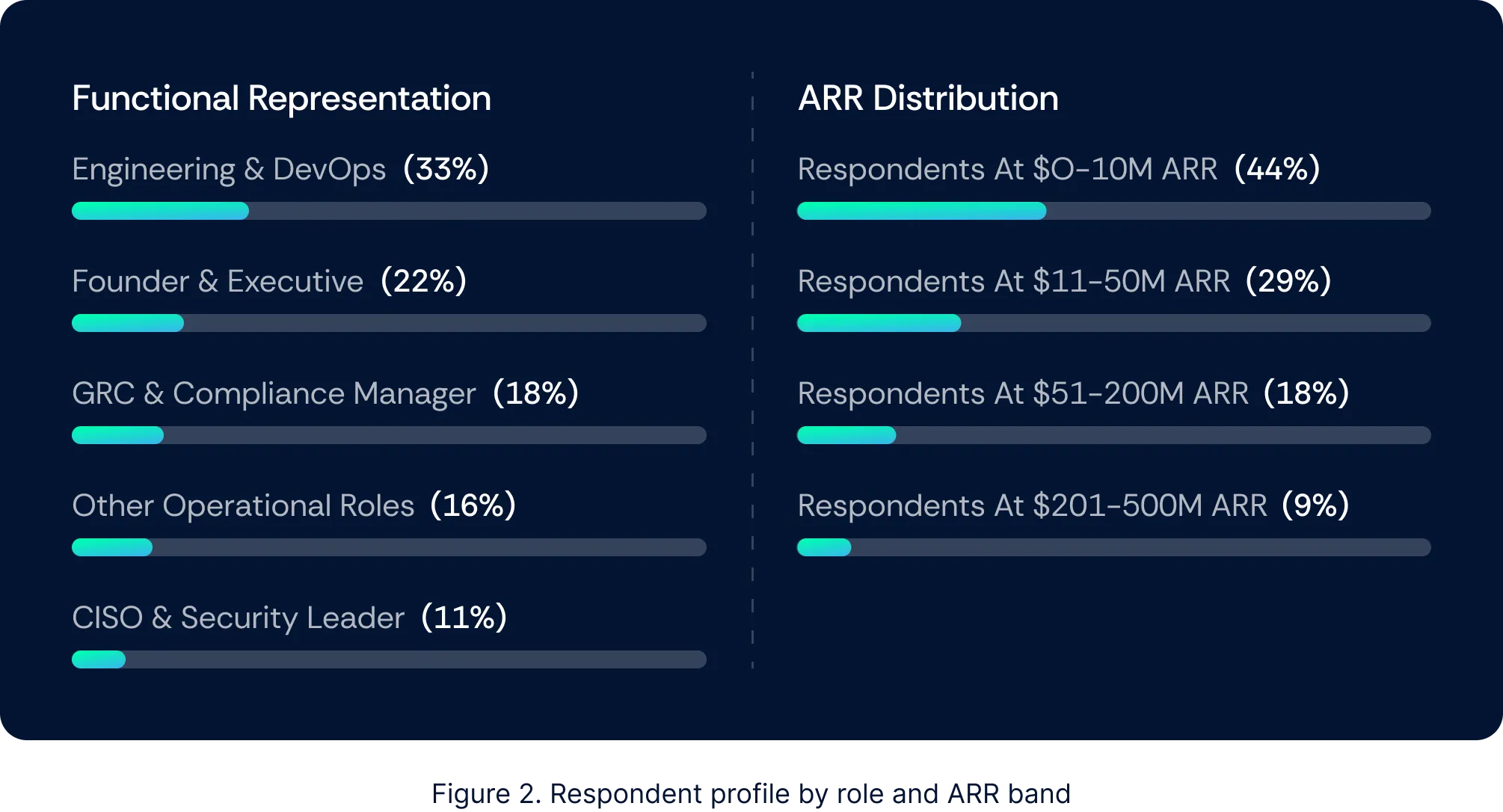
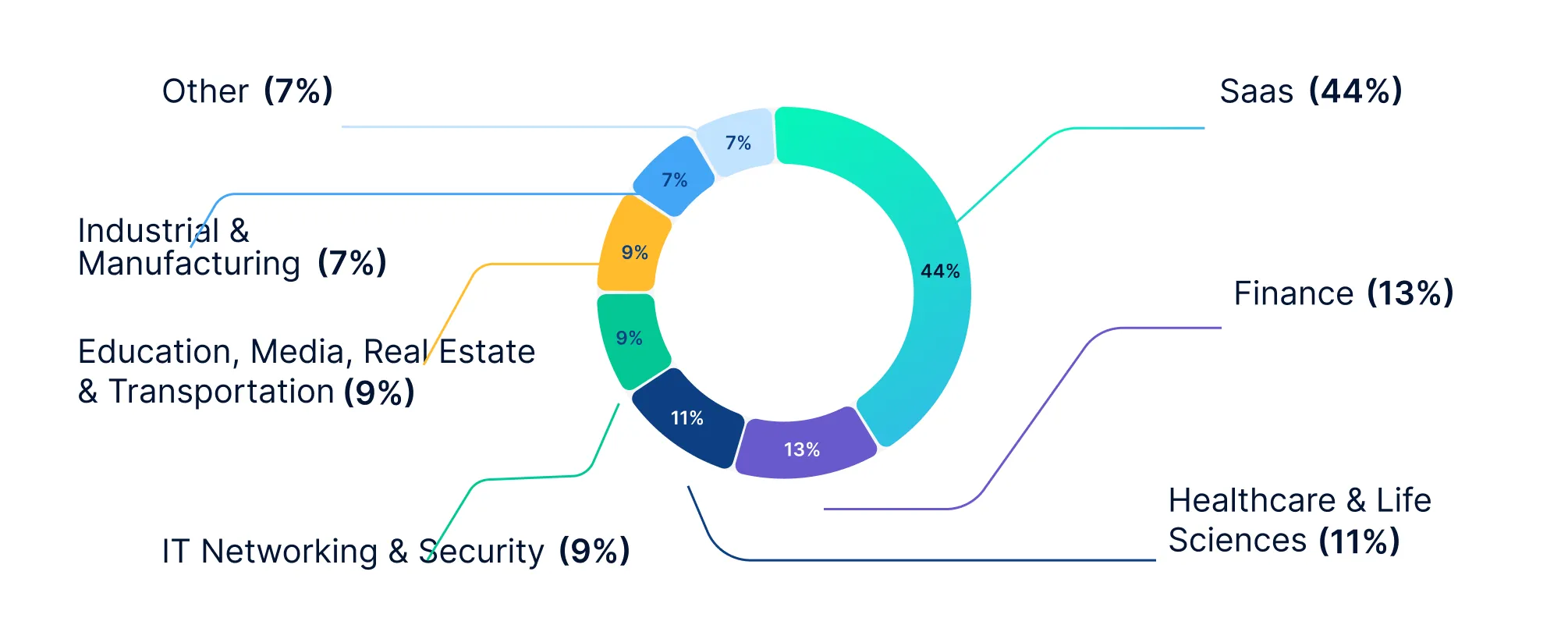
The respondent base spans software-led, regulated, and operationally complex sectors. SaaS represents the largest share, while finance, healthcare, IT/security, and industrial respondents add context from industries where compliance pressure is especially high.
Most respondents use Scrut beyond a single certification workflow. This indicates that the platform is used by both teams building their first compliance program and organizations managing more mature, multi-framework compliance operations.
We have a whole CISO team owning our security practices day-to-day, but from a management perspective, I still need a direct line of sight into what's happening. Before Scrut, that information was scattered across systems with no dashboard for our risk registers. Now it's all in one place, and I can check our posture at any time.

Modeled ROI calculations use conservative assumptions:
Directional outcomes reflect respondent-reported associations. Dollar figures are limited to engineering capacity savings where respondents provided quantitative hours data. Revenue, consultant spend, and fundraising dollar amounts were not captured in this survey.
The intent is not to present compliance automation as a single cause of business performance. It is to show how a more structured execution model can reduce friction across audits, engineering work, and growth-critical conversations.
Episodic compliance leaves gaps that surface under audit pressure. Continuous compliance is the game-changer. Controls stay mapped, evidence stays current, and remediation moves earlier, so audit prep becomes a confirmation of readiness, not a discovery exercise.
The survey results point to a pattern that documentation alone cannot explain. Audit stability improved. Findings declined materially. Engineering diversion decreased. These aren't incremental workflow optimizations; they reflect a change in execution model.
Survey-reported outcomes following implementation:
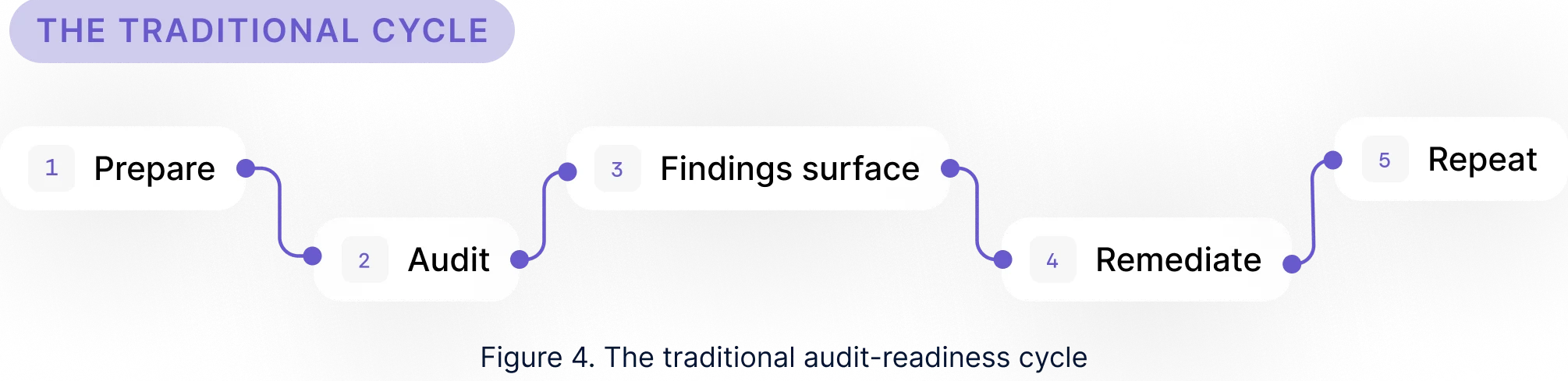
Traditional GRC platforms were built as systems of record. They centralize policies, catalog controls, and store artifacts. That improves organization. It doesn't eliminate volatility. Under a documentation-first model, compliance stays episodic. Effort compresses near audit windows. Gaps are discovered late. Remediation accelerates under deadline pressure. Consultants stabilize the surge. The cycle repeats.
With Scrut, you just connect your cloud accounts and it shows you the things we need to fix, and it explains what's wrong. We fix it, it synchronizes automatically, and you can see that you're compliant.

The data suggests that when execution changes, the outcomes change. Under traditional models, compliance follows a recurring cycle:
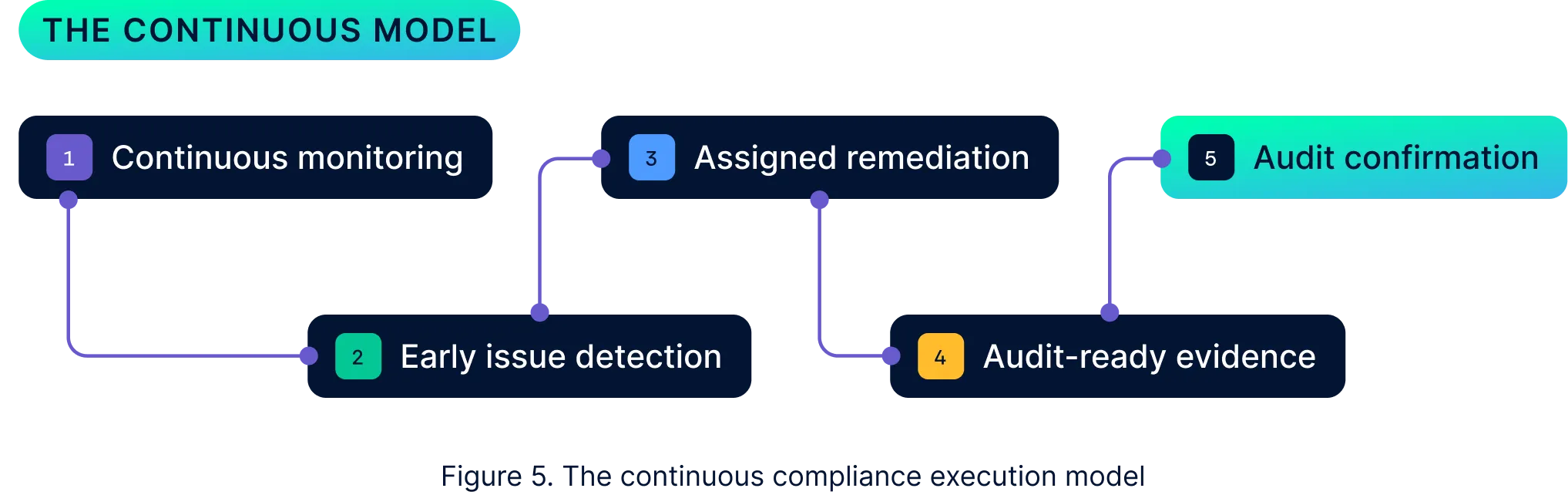
The Scrut Platform shifts compliance from periodic audit preparation to continuous orchestration. Controls can be mapped once and reused across frameworks, evidence is checked for completeness and freshness, deviations are surfaced earlier, and remediation is routed to the right owners.
That matters as programs scale. With 92% of respondents managing two or more frameworks or certifications on Scrut, reuse and continuous validation help reduce the coordination burden that typically grows with every added framework.
The survey suggests that when compliance is maintained continuously instead of reconstructed before an audit, audits become less about discovery and more about confirmation.
That is the execution shift.
Compliance is showing up earlier in customer, partner, and investor conversations. The commercial value is no longer just having certifications. It is being able to show credible proof of compliance before trust becomes a deal blocker.
The commercial implication is direct. Enterprise revenue increasingly requires third-party validation before procurement progresses. Investor capital increasingly evaluates governance posture before deployment. The survey reflects this repricing of trust.
Reported earning customer trust earlier in enterprise sales or security reviews after adopting Scrut
Rated SOC 2 attestation or ISO/IEC 27001 certification as critical or very important to customers and investors
Compliance is no longer a differentiator. It's an admission criterion. Earlier trust formation affects funnel progression. Security review friction declines when evidence is portable and continuously maintained. Revenue velocity is influenced upstream.
With Scrut we got SOC 2 and ISO 27001 done fast. The week we finished SOC 2 Type 1 we closed a major enterprise client whose procurement was already asking for it. Getting ahead of compliance early accelerates deals instead of slowing them.

Certification and attestation expand market access. They determine whether a company can even be considered for certain buyers, geographies, and regulated industries.
Compliance readiness doesn't just accelerate deals. It expands the set of deals that are even possible.
With every prospect you approach (and every compliance requirement you need to meet), it's not enough to be secure. You have to prove it with documentation that's standardized and audit-ready. Having a platform like Scrut helps us do that. Scrut has directly supported new customer acquisition because we can clearly say: we're compliant, we're deal-ready, and we can prove it.

Compliance execution is a resource-allocation decision. Before Scrut, operational drag showed up in manual task management, evidence collection, security configuration checks, and engineering follow-up. The issue was not just audit prep time. It was the recurring coordination load behind it.
Compliance execution is not just a governance decision. It is a resource allocation decision, and the resource it consumes is engineering time.
Of engineers reported reduced manual effort during compliance setup and audit preparation.
Compliance work does not disappear. The operating model changes. Instead of pulling engineers into ad hoc requests, manual evidence gathering, and repeated follow-ups, Scrut moves more of the process into structured, automated workflows with clearer ownership and human review where needed. Audit preparation becomes more predictable, less interrupt-driven, and less dependent on engineering bandwidth.
The business value is not just efficiency. It is protected execution capacity. Every hourengineers do not spend chasing compliance artifacts is time that can return to product delivery, infrastructure resilience, and customer-impacting work.
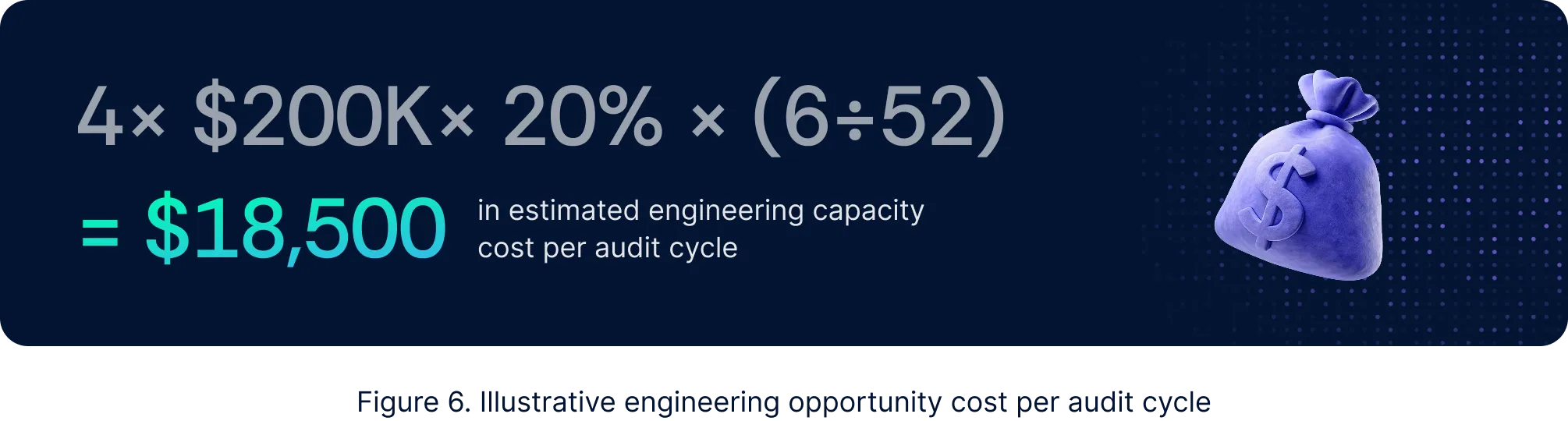
For companies operating annual audit cycles, this becomes a recurring operational drag. As organizations add frameworks (and 92% of respondents manage two or more), that drag compounds unless execution scales efficiently. The survey data indicates that structured compliance execution reduces manual engineering involvement. The financial implication is preserved innovation bandwidth.
"Managing multiple frameworks became significantly easier with Scrut because it brings them into one solution. When controls overlap across frameworks, we don't have to do the same work two or three times. We align to the requirement once, and Scrut automatically maps and maintains alignment across the related controls."

Reactive compliance models tend to rely on consultants to coordinate documentation, manage audit preparation, and stabilize late-stage remediation.

This points to a shift from consultant-mediated coordination to internally structured execution. Instead of relying on consultants to drive the process end-to-end, teams arerunning more of the workflow internally through structured control ownership, clearer tracking, and centralized evidence handling in the platform.
External support doesn't vanish. It becomes situational and used for specialized guidance or peak load, rather than functioning as the backbone of audit execution.
"Getting compliant is one thing. Maintaining it and renewing it is the real challenge. A consultant can help you get through one audit, but then you're stuck figuring out how to keep it running. Scrut made that continuity possible for us through the audit period, with minimal time and effort from a small, early-stage team."

Compliance is no longer a back-office obligation you can deal with after growth shows up. It now sits directly on the path to growth. The survey makes that clear: compliance posture affects audit stability, engineering capacity, customer trust, and investor scrutiny.
Companies that still manage it as a periodic documentation exercise are not being lean. They are absorbing avoidable drag. They pay for it in late findings, disrupted engineers, slower security reviews, heavier consultant dependence, and weaker readiness when deals or diligence are on the line.
The future of compliance is not more checklists. It is continuous readiness, backed by system- driven execution. Controls have to be visible, evidence has to stay current, ownership has to be explicit, and the system has to show what is working, what is missing, and what needs action next. In that model, compliance stops behaving like an annual event and starts behaving like infrastructure.
That is why compliance automation matters now. Not because certification suddenly became more important, but because the cost, time, and effort that goes into managing it manually have become too high. The next phase of compliance will belong to companies that operationalize it early, run it continuously, and stop treating readiness as something they assemble on demand.
Compliance has already been repriced by the market. The only question is whether execution models have caught up.
Compliance does not affect one team. It changes how every function proves readiness, protects time, and moves work forward.

76% said compliance with industry-accepted standards was mandatory or highly preferred during investor diligence. 73% said compliance readiness influenced fundraising conversations.
If an investor asked for compliance proof tomorrow, would your team have it ready or have to reconstruct it under pressure?

92% of respondents manage two or more frameworks on the platform.
Where are risks still hidden because control status is checked periodically instead of continuously?

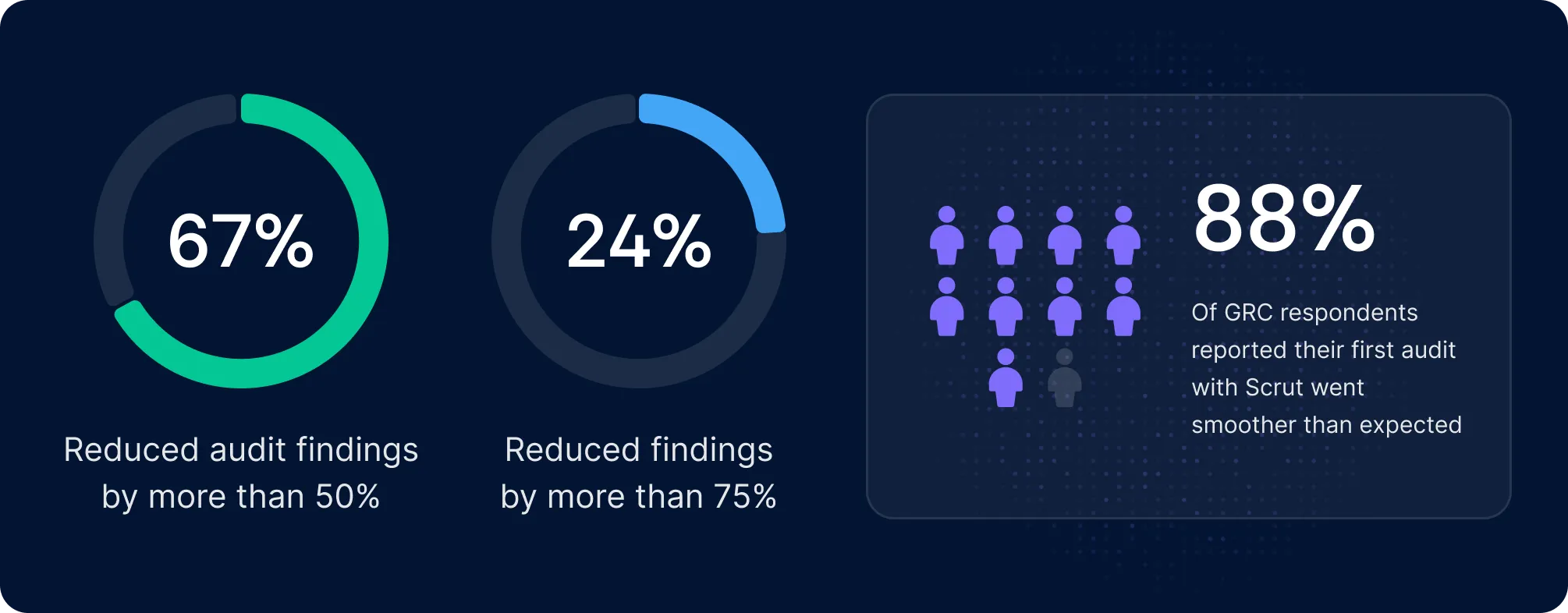
67% reduced audit findings by more than 50%. 88% of GRC respondents reported smoother audit execution versus prior cycles.
How much of your audit prep is true readiness, and how much is last-minute reconstruction?

80% reported earning customer trust earlier in the sales cycle. 87% rated SOC 2 or ISO 27001 as critical or very important for customer access.
How many deals slow down because security proof is not ready when the buyer asks for it?

85% of engineering-role respondents were materially involved in compliance tasks before Scrut, with 47+ hours spent on average. After Scrut, 87% reported reduced manual effort during setup and audit preparation.
How much roadmap time is compliance quietly taking from your engineering team?

Scrut Automation is an agentic GRC platform built for fast-growing, cloud-native companies that see compliance as part of a strong security program, not a once-a-year checkbox.
Scrut helps teams manage risk, monitor controls, collect evidence, and prep for audits from one centralized platform. Its Unified Control Framework maps a single set of controls across 70+ out-of-the-box frameworks, including SOC 2, ISO/IEC 27001, HIPAA, GDPR, and PCI DSS helping teams meet overlapping requirements without duplicating work.
Today, 2,500+ companies across 65+ countries use Scrut to build, manage, and scale their risk and compliance programs.

With Scrut, your security program isn’t just about keeping pace; it’s about setting the pace. Embrace the new kind of GRC that fuels growth and resilience.