



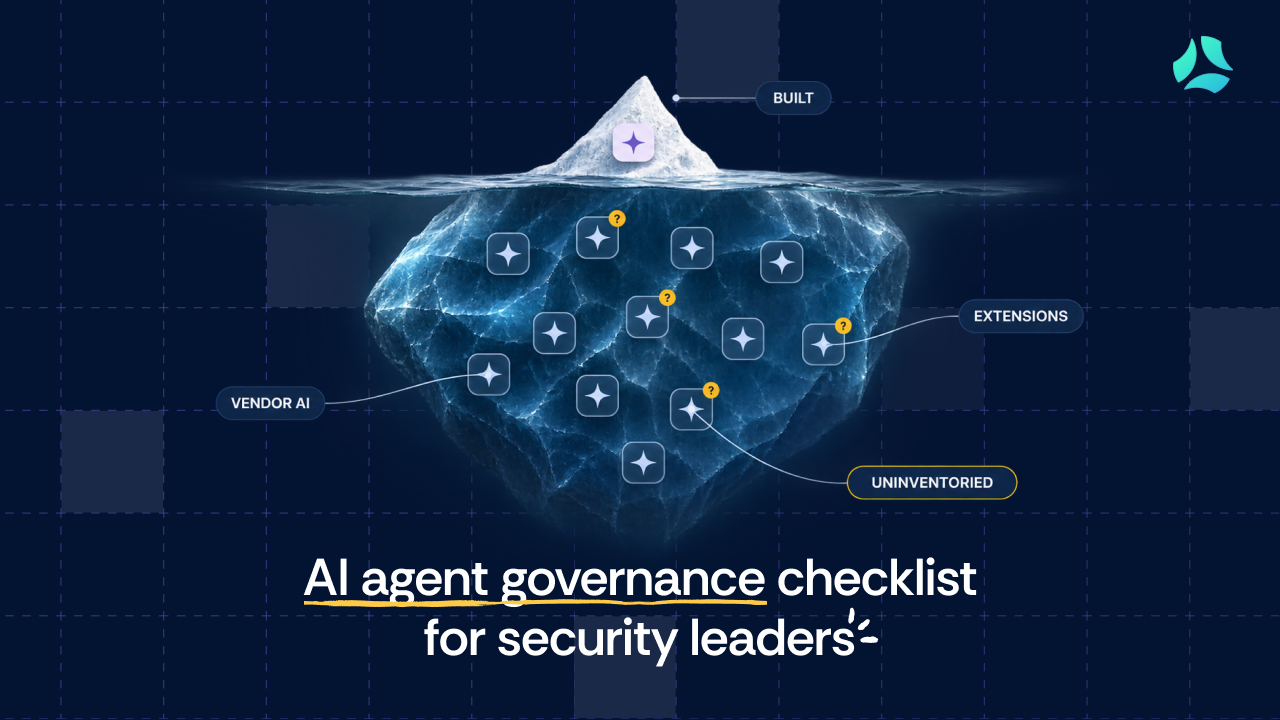


- AI agent governance means controlling what agents can access, act on, and change, across every agent you build, buy, or unknowingly run.
- Most governance programs focus only on internally built agents. Vendor-embedded AI and browser extensions represent the larger unmanaged surface.
- Start with an asset inventory tied to your existing asset register, not a new platform purchase.
- Governance without runtime controls, clear ownership, and audit trails is policy on paper only.
- A 200-person company's biggest agent risk is the AI nobody inventoried, not the one the engineering team deployed
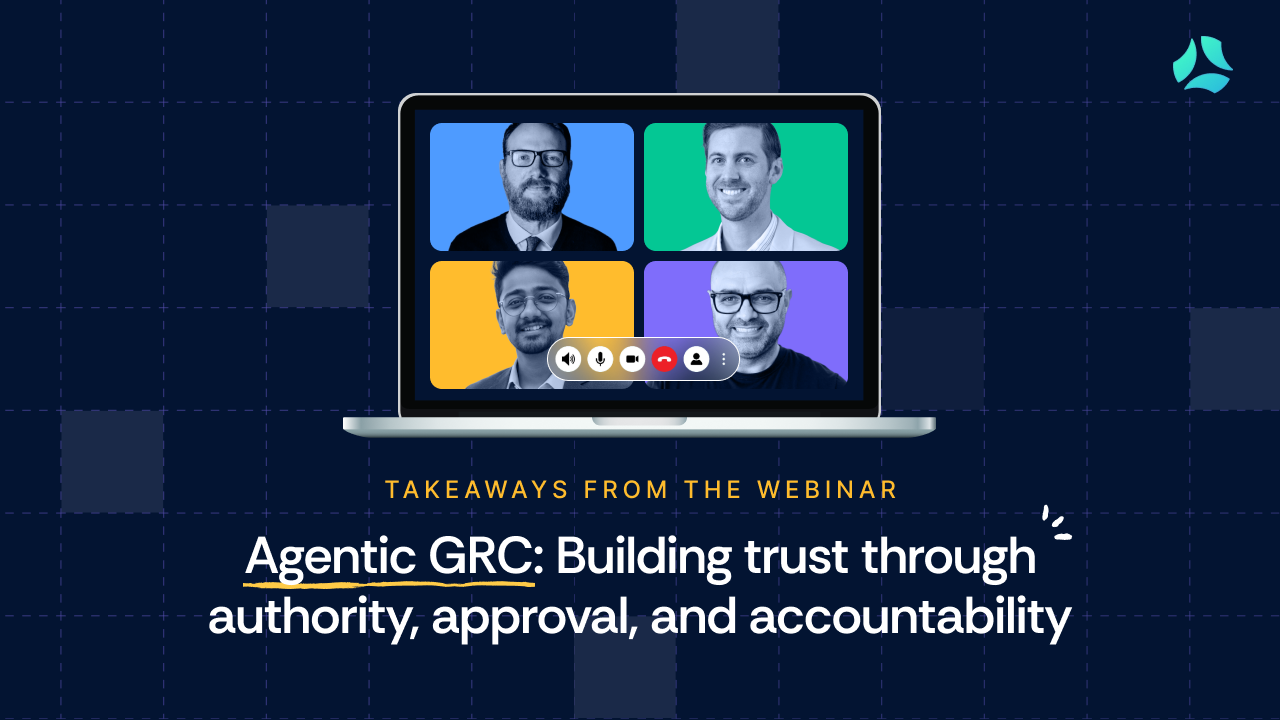
AI agents are no longer just generating responses. They make decisions, access sensitive data, and execute actions across business systems. As their autonomy increases, organizations need more than AI usage policies.
They need clear accountability, risk assessments, defined controls, and continuous oversight to ensure AI operates within acceptable boundaries.
Why AI agent governance is harder than it looks
Agent governance has to cover actions. An agent plans, calls tools, and runs multi-step workflows with limited supervision. It can send an email, change a record, or move data between systems before anyone reviews what it did.
Not every task needs an agent, either. Tanvi Anand, Lead Product Manager (AI Products) at Scrut Automation, draws the line simply: if the steps don't change every time, a rule or scheduled job will do it cheaper and more reliably.
The tension is speed. Adoption is moving faster than governance. Sandip Wadje, Managing Director at BNP Paribas, put it plainly on Risk Grustlers: "What's happening with AI, particularly, and we've all seen the pace of growth. It's changing every day."
This guide is for security leaders who have to close that gap without a large team. It covers which agents to govern, how to inventory them, the controls that matter, and how standards like the NIST AI risk management framework apply. It also covers where governance fits as GRC itself becomes more agentic.
You're governing 3 agent populations: Most programs see 1
AI governance must extend across every AI system an organization develops, purchases, or uses. Internally built agents, vendor-provided capabilities, and employee-adopted AI each introduce different levels of autonomy, data access, and operational risk.
Effective governance means setting consistent standards to assess these risks, assign ownership, and enforce controls, regardless of where the AI originates.
1. Agents your team built. Custom agents, internal automations, and LLM-powered workflows from engineering. Ownership is clear, so these are the easiest to govern.
2. Vendor-embedded agents. AI features inside tools you already pay for, such as meeting assistants, Atlassian Rovo, ADP Assistant, or Microsoft Copilot. Nobody made a separate procurement decision, and some are switched on without anyone noticing.
3. Browser-based and employee-adopted AI. ChatGPT, Claude, or Gemini used through personal accounts or browser extensions. No contract, no security review, and no visibility into where the data goes.
Walter Haydock, Founder and CEO of StackAware, has flagged vendors including Fireflies.ai, Atlassian, and ADP for turning AI features on by default.
The third group is shadow AI risk, and the data exposure is different in kind.
Governing the agents you build is table stakes. The bigger unmanaged risk usually sits in the other 2 groups, which is why vendor risk management belongs in the program from day 1.
The governance checklist starts with an inventory
Effective AI governance begins with understanding which AI systems operate within the organization, what decisions they influence, and who is accountable for them. An AI inventory should go beyond listing tools to document business purpose, data access, autonomy levels, risk classifications, and responsible owners.
This creates the foundation for consistent risk assessments, control enforcement, and ongoing governance reviews.
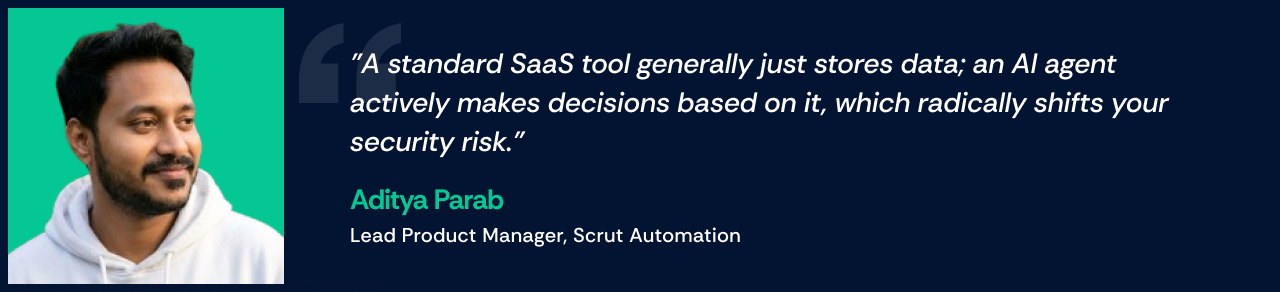
Most inventories catch the first population and miss the other 2. Aditya Parab explains why:
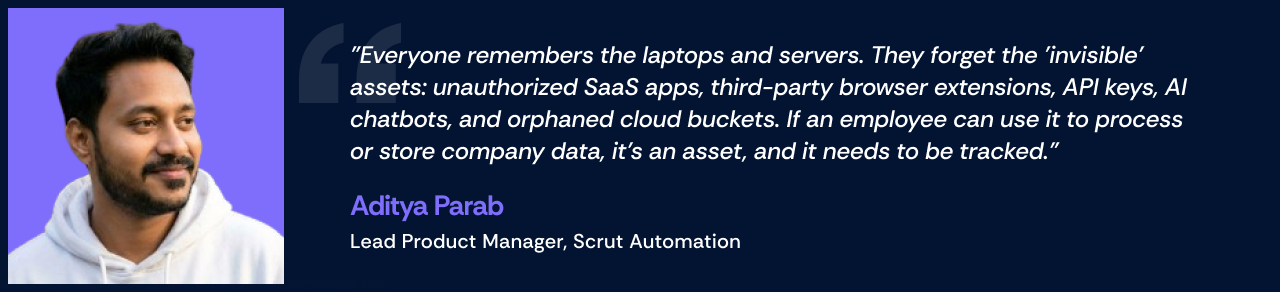
You can run a first inventory without buying anything. Aditya recommends 3 zero-cost moves:
- Audit OAuth grants in your identity provider. Review the third-party apps employees have authorized in Google Workspace, Microsoft Entra, or Okta. Sort by permission scope and look for AI-related names.
- Query existing DNS or proxy logs. Search for traffic to known AI endpoints such as api.openai.com or api.anthropic.com.
- Cross-reference expense reports. Recurring $20/month charges often point to consumer AI subscriptions that bypassed procurement. Pair this with a blameless survey of the tools teams rely on.
Record what you find in your existing asset inventory, not a separate AI spreadsheet. Agents need more fields than a standard SaaS entry.
The 2 fields that matter most are data scope, meaning what the agent can read or was trained on, and action permissions, meaning what it can do on its own.
The 3 manual moves give you a snapshot. Continuous discovery, such as Scrut's Shadow IT feature, keeps it current as part of continuous compliance monitoring.
The AI agent governance checklist: 15 controls, 4 domains
Once the inventory exists, run each agent through these 4 domains. Start with the agents that can change data.
Domain 1: Scope and authority controls
Every agent needs a written boundary before it gets access to anything.
- ☐ Every agent has a documented purpose, permitted actions, and prohibited actions
- ☐ Every agent has a named human owner who is accountable for its behavior
- ☐ A boundary statement exists: "[Agent] is authorized to [actions] using [data sources] within [systems]. It is prohibited from [restricted actions]."
- ☐ Escalation criteria define which decisions need human approval before execution
Tanvi Anand recommends a restrictive default for new agents.

Domain 2: Identity and access controls
An agent running on a person's login can't be told apart from that person in your logs.
- ☐ Each agent operates under a distinct identity, not shared credentials
- ☐ Agent permissions follow least privilege, scoped only to what the task requires
- ☐ Token lifetimes are defined and rotation is scheduled, with shorter cycles for high-risk agents
- ☐ Agent-to-agent trust relationships are explicitly defined and reviewed in your access reviews
Walter Haydock's advice applies directly: remove unused integrations and OAuth grants. In his words, "every forgotten API token, stale service account, or abandoned SaaS integration is another credential an autonomous attacker may be able to discover and exploit."
Domain 3: Runtime controls and monitoring
A rule in an agent's prompt is a request. A limit enforced in infrastructure is a control.
- ☐ Guardrails are enforced at the infrastructure layer, not just in the agent's own reasoning
- ☐ High-impact actions, such as financial transactions, bulk communications, or schema changes, require human approval
- ☐ All agent actions, tool calls, and data access are logged with full attribution
- ☐ A kill switch or suspension mechanism exists that doesn't need a code deployment, and it is part of your incident response plan
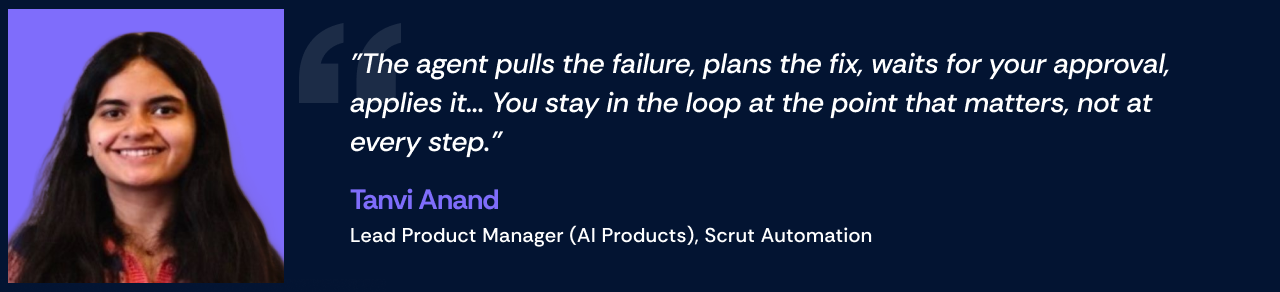
The approval point should sit where the risk is, not at every step.
Domain 4: Ongoing review
Agents change when their models, permissions, or vendors change.
- The AI agent inventory is reviewed on a defined cadence, with quarterly recommendations
- Re-assessment is triggered by major releases, model updates, authentication changes, or any material change to what the agent can access
- Vendor-embedded AI features are included in the next vendor risk assessment cycle
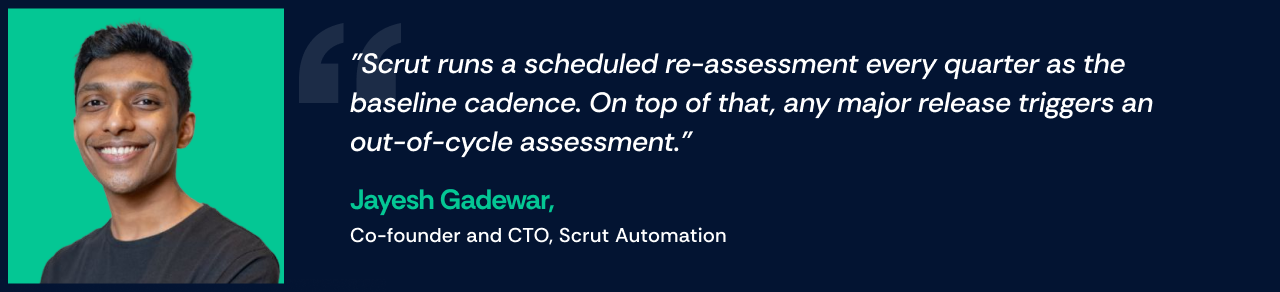
Jayesh Gadewar, Co-founder and CTO at Scrut Automation, describes the cadence Scrut uses for its own AI features:
Log agent risks you accept in the same risk management workflow as every other risk.

AI Governance Doesn't End at Deployment
The agents' engineering built went through some kind of review. The ones nobody noticed didn't.
Written AI policies fail here because of what Aditya Parab calls the tooling illusion. AI is no longer only a standalone download. It is a button inside SaaS tools people already use, and clicking "summarize meeting" doesn't feel like a policy violation.
Samsung learned this in 2023. Engineers in its semiconductor business pasted proprietary source code and internal meeting notes into ChatGPT to debug code and summarize discussions. Samsung responded by banning generative AI tools on company devices, citing how hard it was to retrieve and delete the uploaded data.
Traditional security tools are built to catch file attachments and USB transfers. A copy-paste into a browser tab usually triggers nothing.
Aditya points to 3 signals that shadow IT has an AI problem:
- OAuth grant spikes. Employees authorizing AI plugins, such as email assistants or meeting summarizers, with corporate credentials.
- Browser activity. High volumes of copy-paste events or file uploads to generative AI domains.
- Expense records. Recurring $20/month subscriptions that bypass procurement and security review.
The reflex response is a ban. It backfires.
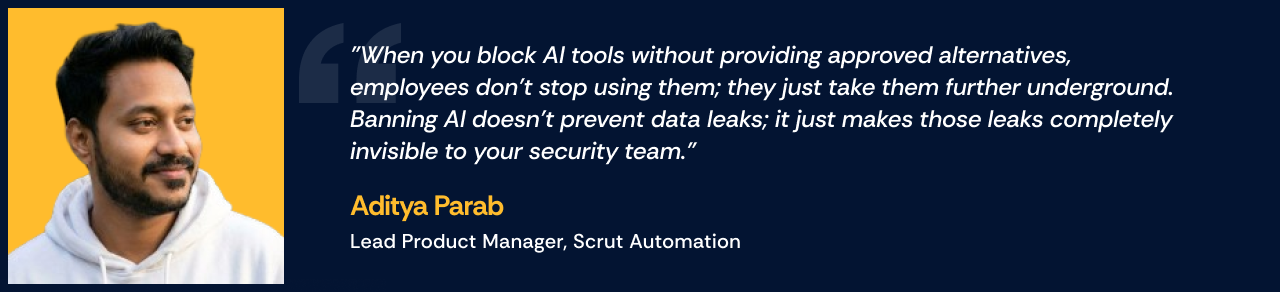
Walter Haydock makes the same point: a "don't use it" policy creates more shadow IT, and with it the same problems of asset identification and tracing data flows. Sandip Wadje's advice on Risk Grustlers is to protect your crown jewels and, beyond that, "create that collaborative kitchen."
For a 200-person company, reasonable shadow AI governance looks like this:
- An approved tool list that covers the main use cases, backed by a data classification policy
- A blameless survey that asks teams what they actually use
- An OAuth allowlist in your identity provider
- AI feature questions in every vendor risk assessment
What NIST AI RMF, ISO 42001, and the EU AI Act require
Most guides say "align with these frameworks" and stop. Here is what each one asks of agent governance, and where it leaves you on your own.
NIST AI RMF
The AI RMF is a framework, not a rulebook. Walter Haydock describes it as "high level, it's comprehensive, but it requires a lot of details to implement." It talks about risk appetite without giving you a road map to set it.
Nicholas Muy, CISO and VP of Engineering at Scrut Automation, adds that the value comes from making confident decisions about what applies to you.
ISO 42001
Scrut is ISO 42001 certified, so this is first-hand. Siddhi Vadhwana, GRC Engineer at Scrut Automation, says the AI system impact assessment was the biggest piece of new work. It covers organizational, individual, and societal impact, which made it a separate document, not a reworded risk assessment.
Auditors also asked for an AI tool inventory: "Do you have an inventory of all the AI systems that you're using to build your own AI system?"
Nicholas Muy flags the catch for SMBs. Most companies are customers of model providers, so they end up documenting what those providers do, much like early cloud adopters documenting AWS.
EU AI Act
For a 200-person company, the practical question is classification. If an agent influences hiring, credit, or health decisions, the obligations rise sharply. If it's an internal productivity tool, they are much lighter.
Ownership without a CISO: Who runs agent governance
Agents inherit the permissions of whoever deployed them. Without a named owner, "the agent did it" becomes the incident report.
The question gets sharper with Bring Your Own Agent (BYOA), where employees connect personal agents to company systems. Tanvi Anand splits accountability in 2: the person who asked the agent to do the work is accountable, and IT or security owns the system of record.
She uses 3 questions to test whether that holds:
- Whose identity did the action run under? Most personal agents run on the employee's own login, so the logs can't separate the person from the agent.
- Where does the log live? If it exists only on the vendor's side, you don't really own it.
- Who approved it? This is the question auditors actually ask.

At a 200-person company, a practical model needs 3 names per agent:
- An owner: the person accountable for the agent's behavior
- An approver: the role that signs off on high-impact actions
- A reviewer: the schedule on which someone checks the inventory entry, permissions, and logs
Without a CISO, this work usually lands with the Head of Security or the Head of Engineering.
That person can't own every agent. They can own the inventory, logs, and review cadence, while the teams that deploy agents own the agents.
The hard part is information, not policy. As Nicholas Muy puts it, "the hardest part is getting the information you need to just even complete the picture."
That is the case for running agent governance inside your existing GRC program. Agent risks go in the same risk register, and compliance automation handles the evidence instead of a parallel AI workstream.
How Scrut connects agent governance to your GRC program
AI agent governance is a GRC problem at its core. Most of what it needs already exists in a well-run compliance program.
Governance and risk management. Manage AI-related risks alongside existing organizational risks, not in a separate process. Scrut's risk management and compliance capabilities help teams document risks, associate them with relevant controls, and maintain supporting evidence within existing GRC workflows. This gives security teams a more structured way to track AI governance responsibilities and demonstrate oversight.
The risks. Agent risks belong in the same register as every other operational risk. Scrut's risk management platform keeps them there, linked to the controls that address them.
The vendors. Vendor-embedded AI surfaces through your vendor assessments. Adding AI feature disclosure questions to Scrut's vendor risk management module brings it into an existing review cycle.
The frameworks. Scrut supports ISO 42001 and the NIST AI RMF, so teams can map agent controls to structured requirements without starting from scratch.
Scrut also builds agents that help execute compliance work, not just track it. The same rules from this guide apply to them: scoped access, every action logged in Scrut, and a human approval step before anything changes the compliance record.
Where to start: Inventory first, framework second
Effective AI governance isn't about slowing down adoption. It's about establishing the accountability, controls, and oversight needed to use AI responsibly at scale.
Start by identifying AI systems and their owners, assessing risks based on data access and autonomy, and defining the controls required for safe operation. From there, integrate ongoing monitoring, periodic reassessments, and evidence collection into your existing GRC program.
The goal isn't simply to know where AI is being used. It's to ensure every AI system operates within defined risk boundaries, and that your organization can demonstrate it.
That gives you a first inventory tied to your existing asset register, before any new platform purchase.
From there, the program runs in sequence:
- Inventory every agent across all 3 populations
- Assign an owner, an approver, and a reviewer to each
- Apply the controls in the 4 checklist domains
- Monitor agent actions through logs you own
- Review on a set cadence, as part of continuous compliance

Want to see discovery, risk, and evidence in one place? Book a demo of the Scrut platform.
AI agent governance is the structured management of autonomous AI systems that plan and execute actions on behalf of an organization. It sets explicit boundaries on what agents can access, what actions they can take, and who is accountable when they act. Unlike traditional AI governance, which focuses on model outputs, agent governance must address action risk.
Accountability follows the delegation chain. When an agent acts on an employee's behalf, that employee remains accountable for the work, and IT or security owns the system of record. If you can't say whose identity the action ran under, where the log lives, and who approved it, nobody owns it yet.
Organizations can implement AI governance by establishing an inventory of AI systems, assigning clear ownership, assessing risks based on data sensitivity and autonomy, and defining policies for acceptable AI use. These policies should include access controls, human oversight, continuous monitoring, and periodic risk assessments. Integrating these activities into existing Governance, Risk, and Compliance (GRC) workflows helps organizations maintain accountability as AI adoption scales.
It should cover 4 domains: scope and authority, with a documented purpose and a named owner for every agent; identity and access, with a distinct identity per agent under least privilege; runtime controls, with guardrails enforced at the infrastructure layer and every action logged; and ongoing review, with a quarterly inventory review and re-assessment after material changes.
ISO 42001 is a certifiable standard for an AI management system. In Scrut's own certification, the auditor focused on the AI system impact assessment, an inventory of AI systems in use, the scope statement, and whether the organization acts as a provider, producer, or user of AI.