



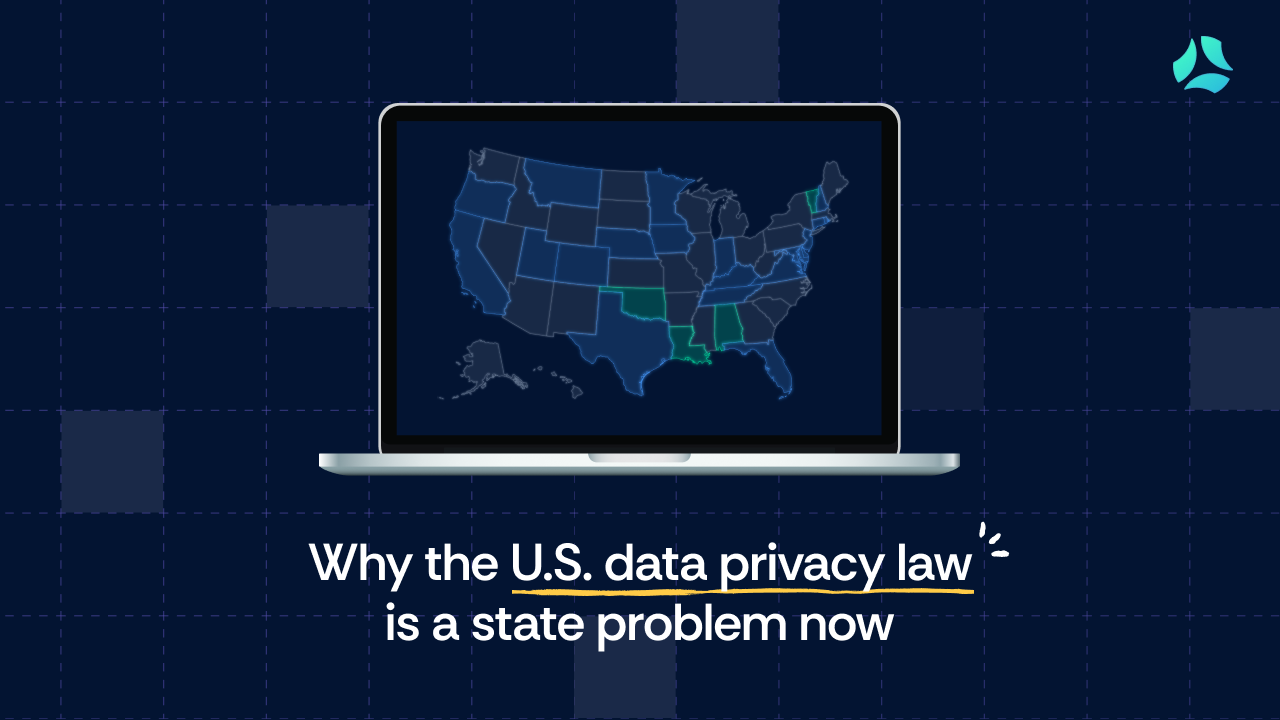


- U.S. data privacy law is no longer a GDPR or EU concern, more than 20 state laws are now in force, covering companies that have never sold internationally.
- Most state laws apply once you process the personal data of 100,000 residents of that state, or fewer if you also earn revenue from selling data. California adds a standalone revenue trigger of $26,625,000.
- Texas has no consumer or revenue threshold. The TDPSA applies to any business that processes or sells Texas residents’ personal data, unless it qualifies as a small business under SBA size standards.
- Unlike GDPR, U.S. state laws are opt-out by default. The operational burden is comparable.
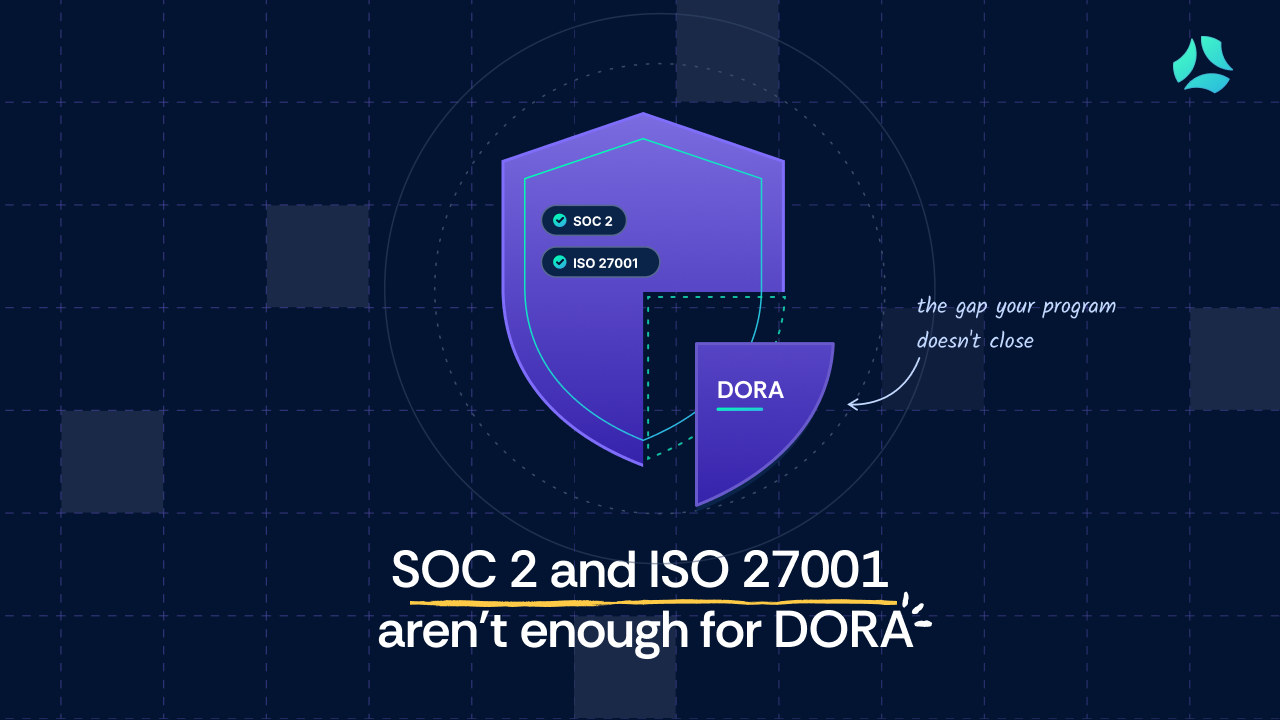
- If you hold SOC 2 or ISO 27001, most of the governance foundation is already in place. The gap is consumer-facing mechanics: opt-out mechanisms, rights request workflows, and state-specific notices.
The privacy law assumption that's quietly becoming a liability
Picture a 150-person SaaS company headquartered in Austin, Texas. They sell to U.S. enterprise customers. They process data on roughly 200,000 end users. Their legal team has never worked on privacy compliance because, in their view, privacy is a GDPR issue that EU customers care about. That assumption no longer holds.
If those users are its own customers, that Austin company is likely already covered by Texas’s TDPSA, which has no volume threshold. Depending on where its users live, Connecticut’s 35,000-consumer threshold and California’s CCPA could apply too. None of them needs a single EU customer to trigger.
GDPR has 11 chapters, 99 articles, and applies to roughly 450 million EU residents. The U.S. now has 20 comprehensive state privacy laws in force and 4 more enacted, each with its own thresholds, rights, and deadlines.. GDPR arrived as a single event that prompted a global compliance response. The U.S. patchwork grew state by state, and many companies did not notice until the thresholds found them. The question is not whether these laws apply. It is whether the company has built the mechanics to comply.
20 laws in force, 4 more enacted, no federal standard
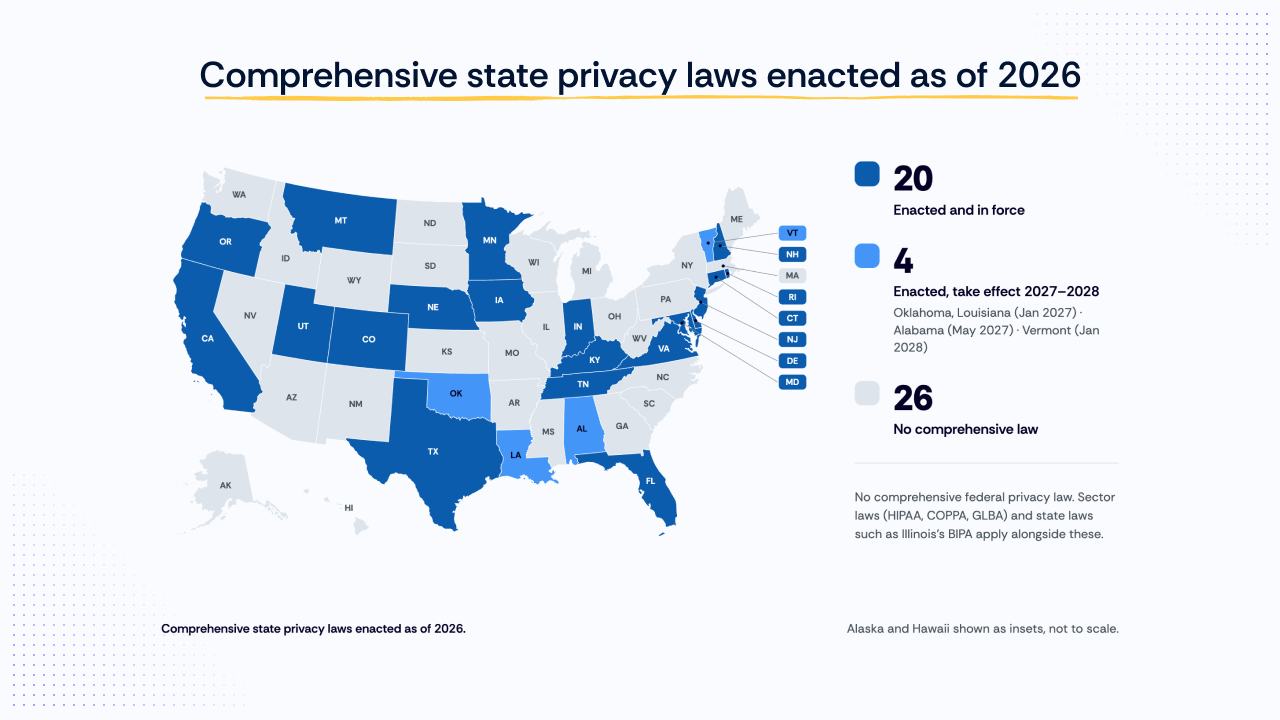
24 states have enacted comprehensive consumer privacy laws, and 20 are in force: California, Virginia, Colorado, Connecticut, Utah, Iowa, Indiana, Tennessee, Montana, Texas, Oregon, Florida, Delaware, New Hampshire, New Jersey, Nebraska, Maryland, Minnesota, Rhode Island, and Kentucky. Laws in Oklahoma, Alabama, Louisiana, and Vermont take effect from 2027. In parallel, federal sector laws (HIPAA, COPPA, GLBA) and state-specific laws such as Illinois’s Biometric Information Privacy Act (BIPA) add to the picture. They do not replace state laws.
The federal preemption gap is real. Congress still hasn’t passed a comprehensive federal privacy law. The latest attempt, the SECURE Data Act (H.R. 8413), was introduced on 22 April 2026 and would preempt most state privacy laws, but it lacks bipartisan support. State-by-state compliance is the operational reality. Designing a program around anticipated federal legislation is a planning error.
See how different privacy frameworks compare and the compliance framework landscape for broader context.
When do these laws actually apply to your business?
The threshold question is the first one every compliance leader needs to answer. Most state laws apply at 100,000 consumers per state, or 25,000 consumers plus revenue from selling personal data. California is the only one with a standalone revenue threshold that catches mid-sized companies. The table below shows the operative triggers for the most commonly applicable laws. Verify against current statutory text at time of review, as thresholds are amended.
Texas has no consumer or revenue threshold. The TDPSA applies to any business that operates in Texas or serves Texas residents, processes or sells personal data, and isn’t a small business under SBA size standards. That reaches further than the volume-based laws, including B2B SaaS companies that assumed they were below threshold.
2 nuances that most compliance teams miss.
First, processing isn’t the same as selling. Processing includes collecting, storing, using, disclosing, and sharing data, so you can meet a threshold without ever selling anything.
Second, check whose data it is. If you process end-user data on your customers’ behalf, you’re usually a processor (a service provider in California). Your customers carry the controller duties, and you owe them contractual and security obligations.
If you decide how that data is used, for example in your own product analytics or marketing, you’re the controller, and the thresholds apply to you. Outside California, most state laws exclude employee and B2B contact data. California has covered both since 1 January 2023.
See key data privacy terminology and compliance risk assessment for supporting guidance.
Six things a company that has never sold internationally must do now
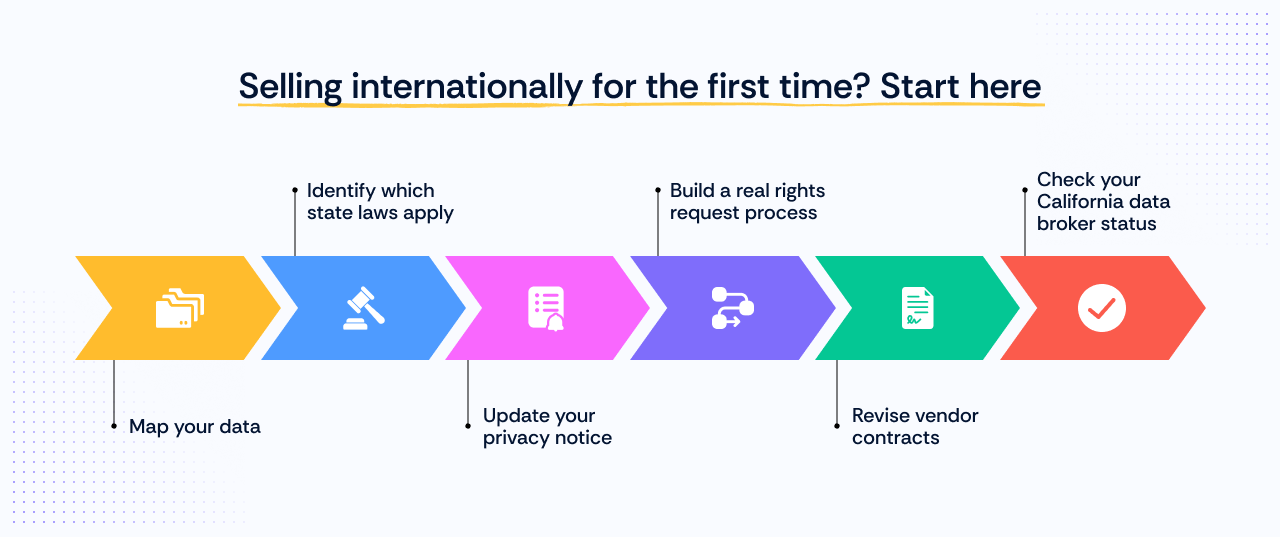
1. Conduct a data inventory and mapping exercise. Map what data you collect, from residents of which states, and what you do with it. A data inventory is the foundation for U.S. state privacy compliance. Most companies are surprised by what they find, particularly data collected incidentally through product analytics or marketing platforms.
2. Identify which state laws apply. Use the threshold table above. Map your consumer data volume by state. Texas has no threshold. The B2B carveout is narrower than most companies assume.
3. Audit your consumer-facing privacy notice. U.S. state laws require specific disclosures that GDPR does not: the right to opt out of sale and sharing, categories of third parties data is shared with, and state-specific consumer rights language. Your existing GDPR privacy policy almost certainly needs state-specific addenda. See the privacy notice and compliance checklist.
4. Build and test your consumer rights request process. Most state laws give you 45 days to respond to access and deletion requests, with one extension when reasonably necessary. Rights vary by state: Utah and Iowa, for example, have no right to correct. An email address in a footer is not a process. It must route requests, track completion, and produce an audit trail.
5. Update your vendor and processor contracts. CCPA, CPRA, and most other state laws require specific data use restrictions in service provider contracts. GDPR-era DPAs usually do not satisfy U.S. state law requirements. See managing sub-processor and vendor risk.
6. Confirm whether you’re a California data broker. Most SaaS companies aren’t, because the definition covers businesses that sell data about consumers they have no direct relationship with. If you are one, registration is due by 31 January each year, and since 1 August 2026 you must process deletion requests from the state’s DROP platform at least every 45 days. See California CPRA and data broker requirements.
See data mapping for privacy compliance for step one.
If you have SOC 2 or ISO 27001, here is your starting point
The governance foundation that SOC 2 and ISO 27001 build transfers to U.S. state privacy compliance in meaningful ways: access controls, vendor management, incident response, data classification, and risk assessment are all required by state laws. They do not need to be rebuilt from scratch.
What transfers: access control policies, vendor management frameworks, incident response procedures, data classification policies, and risk assessment documentation. What does not transfer: consumer rights request workflows (access, deletion, correction, opt-out), opt-out mechanisms for sale and sharing, state-specific privacy notices, data broker registration, and sensitive data handling under CPRA. The gap list in practical terms:
- Consumer-level data inventory and mapping: must build
- Consumer rights request process (access, deletion, correction, opt-out): must build
- Opt-out mechanism for sale and sharing: must build
- State-specific privacy notice addenda: must augment
- Vendor contracts with U.S. state-specific clauses: must update
- Data broker registration (California): evaluate and act
The work remaining is real but bounded. The governance skeleton is in place. The consumer-facing layer needs to be built on top of it.
See what SOC 2 and ISO 27001 cover for privacy, compliance automation for multi-framework programs, and data classification policy.
Where to start this week
Three immediate actions. First, run the threshold assessment against the table above to determine which state laws apply today. Second, audit your privacy notice against California CPRA requirements, then check state-specific rules such as Connecticut’s sensitive-data trigger. Third, confirm whether California’s data broker rules apply to you.
If you already run SOC 2 or ISO 27001 on Scrut, you can add CCPA from the out-of-the-box library and reuse the controls you’ve already mapped. For state laws outside the library, you can build them as custom frameworks on the same control set, so each new law extends your program instead of restarting it. See privacy compliance automation and the compliance automation platform for how this works in practice.
It depends on the state. Most state laws apply at 100,000 consumers per state, and California also applies above $26,625,000 in revenue. Texas has no consumer or revenue threshold, but it exempts businesses that qualify as small under SBA size standards. Some states are lowering thresholds: Connecticut dropped to 35,000 consumers on 1 July 2026 and now covers any business that processes sensitive data or sells personal data. Conduct a threshold assessment using the state-by-state table above before assuming you are exempt.
No comprehensive federal privacy law exists as of publication. The latest proposal, the SECURE Data Act, was introduced in April 2026 and would preempt most state laws, but it lacks bipartisan support.. U.S. privacy regulation remains a state-by-state patchwork. Companies should not design compliance programs around anticipated federal legislation. Build for the state laws in force today rather than for a bill that hasn’t passed.
SOC 2 gives you a strong governance foundation: access controls, vendor management, incident response, and documented policies. These map to the security controls required by U.S. state privacy laws. However, SOC 2 does not cover consumer-facing privacy obligations: opt-out mechanisms, consumer rights request workflows, state-specific privacy notices, or data broker registration. Companies with SOC 2 are starting from a strong position, but the gap table in the section above shows exactly what still needs to be built.