


%20(1).png)


- A risk management strategy is the structured approach your organization uses to identify, assess, respond to, and monitor risk. It is a continuous operating discipline, not a one-time document.
- There are five risk treatment responses: avoidance, acceptance, mitigation, transference, and sharing. Each suits a different risk profile.
- Most risk registers are built for auditors, not operators. Keeping one useful takes cadence, triage, and the right level of specificity.
- Compliance risk is not the whole risk picture. Conflating the two leaves operational, strategic, and financial risk undermanaged.
- Automation can surface signals and score risk categories, but escalation and acceptance decisions still need human judgment.
Most teams do not fail at risk management because they lack a framework. They fail because they treat the register as an audit artifact, focus only on compliance risk, and never revisit what they wrote down once the deadline passes. If you are a GRC manager, security leader, CTO, VP of Engineering, or risk owner, you have probably watched this happen firsthand.
The problem is rarely identifying that a risk exists. It is deciding how to respond, documenting that decision, and knowing who owns it when the risk materializes. Without a structured approach, teams react too late, spend on the wrong controls, or quietly accept exposures nobody signed off on.
According to IBM, the average cost of a data breach reached $4.88 million globally in 2024, a 10% increase over the prior year, and much of that cost traces back to gaps a real strategy would have surfaced.
This guide covers what a strategy actually is, the treatment responses and risk types that matter, a step-by-step framework for building one, and the traps practitioners consistently hit. It draws on the risk management process practitioners actually use and how a GRC platform supports it.
What is a risk management strategy?
A risk management strategy is the structured approach an organization uses to identify, assess, respond to, and monitor risk across its operations. It is the decision layer that tells you how to act when a threat emerges, how to document that action, and who owns accountability for each risk category.
Effective risk management is a continuous cycle, not a linear checklist. New risks emerge, existing risks evolve, and both have to be addressed with agility. Revisiting the strategy on a regular cadence is what keeps it tied to reality rather than to last year's assumptions.
A useful distinction to hold onto is the difference between inherent risk vs. residual risk. Inherent risk is your raw exposure before any controls exist. Residual risk is what remains after controls are applied. If a risk statement mentions a firewall or MFA, it is describing residual risk, not inherent risk. Applying a mitigation never eliminates a risk. It produces residual risk that must be reassessed.
A risk management strategy is not a compliance checklist, a vulnerability scan report, or a one-time risk assessment document. Those are inputs to a strategy or outputs of it, never the strategy itself.
Risk management strategy vs. risk management plan
Readers frequently confuse these two. They are not the same thing.
Risk management strategy vs. risk management plan
Strategy comes first and sets the boundaries. The plan operationalizes those boundaries.
The four sub-steps in practice
1. Identifying risks. Identification happens reactively, when an incident exposes a hidden weakness, or proactively, through periodic assessments. Mature programs favor proactive detection.
The honest test: did you identify the things with the greatest potential impact, or just the things that were easiest to define? A production database with customer data on it is an asset, but the risk you actually manage is the specific weakness in how it operates that your business model will not let you remove.
Frameworks such as ISO 27001, SOC 2, NIST SP 800-53, and PCI DSS require documented risk assessments, and a GRC platform can unify these so you are not duplicating work every audit cycle.
2. Assessing risks. Once identified, risks are evaluated on likelihood and impact. Some are highly probable but low-impact; others are unlikely but catastrophic. The assessment should be systematic and repeatable, with a minimum annual review as a baseline. For most companies, heat maps are the practical starting point, and that is fine.
3. Responding to risks. After assessment, you decide how to treat each risk. This is where the treatment responses come in: avoidance, acceptance, mitigation, transference, and sharing. The right response depends on the nature, likelihood, and impact of the risk.
4. Monitoring risks. Monitoring tracks known risks, catches emerging threats, and confirms that controls still work. When a risk's probability, impact, or scope changes, reassess promptly. Ongoing monitoring is what keeps decision-making fast as conditions shift.
Risk management is not the same as compliance. Compliance is the proof layer, the receipts that show you did what you said you would. Risk management is the decision layer that determines what you should do in the first place.
Types of risk every organization should track
Every organization faces multiple categories of risk. Treating compliance risk as the complete picture is one of the most common and costly mistakes, because operational and strategic exposures can seem abstract and far away right up until they surface as incidents.
1. Compliance risk: Failing to meet laws, regulations, or industry standards, leading to penalties, reputational damage, or lost business.
2. Cybersecurity risk: Unauthorized access, breaches, or attacks like ransomware and phishing that disrupt operations and compromise data.
3. Strategic risk: Poor business decisions, market shifts, or ineffective planning that undermine long-term competitiveness.
4. Operational risk: Failures in day-to-day processes, systems, or people that affect delivery and internal controls. This is also where the human and cultural risks live, the ones that stay invisible in a “crunchy” controls framework until they surface.
5. Financial risk: Losses from market volatility, credit issues, cash flow problems, or inaccurate reporting.
6. Third-party/supply chain risk: Exposure introduced by vendors and sub-vendors. A breach anywhere in the supply chain now ripples across large and small enterprises alike, and this is consistently top-of-mind for practitioners.
Operational risk domain taxonomy, ownership, and framework mapping
Who is responsible for developing a risk management strategy?
The honest answer is that it depends on company size, and in most growth-stage companies responsibility lands somewhere by default rather than by design.
In practice, integrated risk management is more aspiration than reality. Even at large companies, financial, operational, and cyber risk usually stay siloed under separate owners, and the "integrated view" is often just several risk committees meeting together once a quarter. For SMBs without a dedicated CISO, nobody truly owns the integrated view. The VP of Engineering or Head of IT ends up owning it, frequently because they are the one doing it for compliance.
It is also worth being precise about the CISO's role. A CISO typically owns the risk process and governance, not the entirety of business risk. They establish good governance, surface risk, and drive accountability, but mergers, product decisions, and financial exposures sit with other leaders.
Risk governance and ownership evolution across company stages
Building a strategy that scales well usually means moving from ad hoc ownership toward integrated risk management, supported by a clear GRC implementation roadmap.
What are the common risk responses or risk treatment approaches?
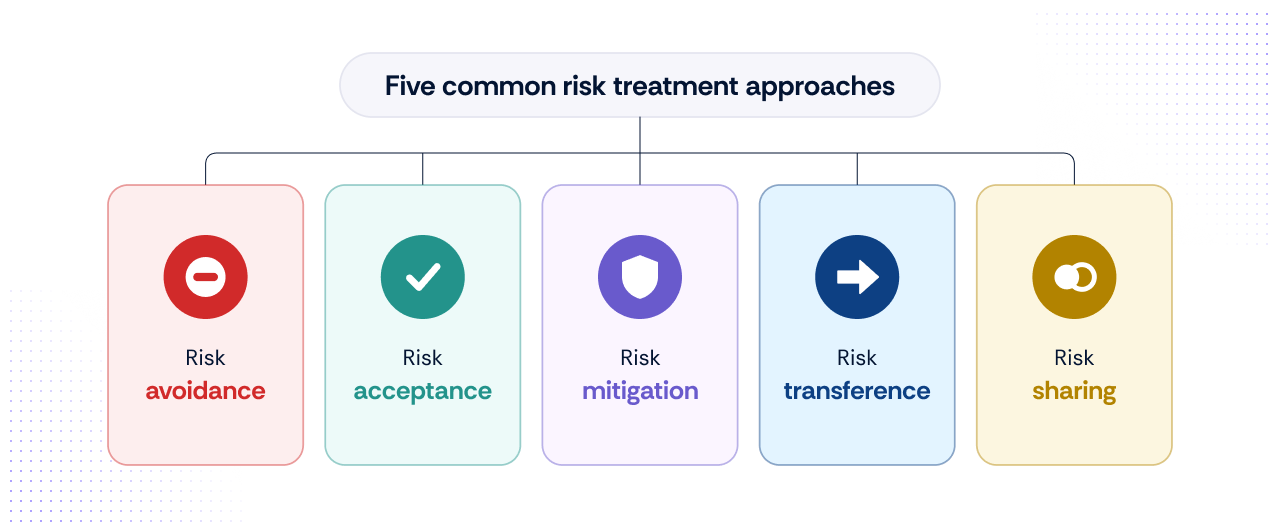
There are five treatment responses. Each fits a different risk profile, and each has a limitation you have to plan around.
1. Risk avoidance. Eliminate the possibility of the risk by changing plans or opting out of an activity. Use it when the potential consequences clearly outweigh the benefits. The caution: avoidance is rarely sustainable indefinitely, so revisit avoided risks periodically for a more workable approach. See risk avoidance vs. risk reduction for the distinction.
2. Risk acceptance. Acknowledge the risk without acting to reduce it, appropriate when impact is low or the cost of mitigation exceeds the potential damage. Use it for risks that do not threaten strategic goals. The caution: acceptance still requires ongoing monitoring in case conditions change.
3. Risk mitigation. Reduce likelihood or impact through targeted controls, the go-to for risks too severe to ignore but impossible to avoid. Use it when you can meaningfully lower exposure. The caution: mitigation produces residual risk that must be reassessed after the control is in place, and that reassessment is exactly the step most teams skip because there is always a new fire.
4. Risk transference. Shift responsibility to another party through outsourcing or insurance. Use it when you lack the internal capacity to manage the risk directly. The caution: transference does not eliminate the risk, and modern cyber insurers increasingly deny claims if they find you were negligent on baseline controls.
5. Risk sharing. Distribute risk across parties through joint ventures, partnerships, or shared arrangements, distinct from pure transference. Use it when a partner is better positioned to absorb part of the exposure. The caution: shared risk can diffuse accountability if ownership is not documented.
Standardized risk response strategies and operational boundaries
A note on accepting risk that security is uncomfortable with. This is where most of the friction lives. The business wants to keep an old, unencrypted database because upgrading costs money, but it holds records you need. Security is uneasy; the business signs on anyway.
The practical move is to be specific about who “the business” actually is. According to Nicholas Muy, CISO at Scrut Automation, people across every function use “the business” as a boogeyman, and accountability turns into a musical-chairs game where everyone points at someone else until the decision reaches the person who actually owns it.
One more thing on acceptance: It is not the absence of controls. When you genuinely accept a risk, you first ask whether there is anything reasonable you can do about it. Someone designs a control, explains what it costs, and the person accepting the risk decides whether the benefit still outweighs that cost.
If it does, you document the decision, the owner, and the escalation threshold, and you move on. Acceptance without that step is just unmanaged exposure with better branding. The cyber risk management guide covers how this plays out specifically for security decisions.
10 risk management strategies, and when to use each
The five treatment responses in the previous section tell you what to do with a risk. These 10 strategies tell you how to structure the work, the operating approaches that make a risk program functional rather than theoretical. Each suits a different context and maturity level.
Type 1: Business experiments. Simulate "what-if" scenarios to test how you would respond to a risk before it is real. A security team that runs tabletop exercise variants before a real incident is doing this, testing which response pathway produces faster containment without the cost of finding out the hard way.
Type 2: Theory validation. Use structured feedback to test an assumption before you rely on it. A GRC team that surveys employees after rolling out a new security awareness program validates whether behavior actually changed before assuming risk went down, rather than declaring victory on training completion alone.
Type 3: MVP development. Ship a minimal version to limit over-investment in features that may not deliver value. An MVP is a form of consciously accepted risk with a defined scope. Document what you are choosing not to cover yet in your risk register, the same way you would document any other acceptance decision.
Type 4: Isolating identified risks. Contain a vulnerability once it is found. After a penetration test flags a weakness in a cloud-based HR system, the team segments that component and disables external access while a patch is developed. Track the isolation decision and resolution timeline in your risk register so it does not quietly stay open.
Type 5: Building in buffers. Add protective margins for uncertainty. A team building in extra time for a milestone absorbs unexpected delays. Audit evidence collection is the obvious application, and it almost always takes longer than anyone budgets.
Type 6: Data analysis. Collect and analyze data to prioritize risks by likelihood and impact. The practical distinction is between qualitative analysis, which most SMBs start with, and quantitative risk assessment using methods like likelihood-times-impact scoring or FAIR. Ask whether the extra rigor would change any decision you would actually make. If it would not, skip it.
Type 7: Risk-reward analysis. Weigh potential gains against associated risks, including the opportunity cost of inaction. A SaaS company evaluating whether to enter a new regulated market before completing ISO 27001 certification is running exactly this analysis, balancing speed against exposure.
Type 8: Lessons learned. Capture insights after each project so you do not repeat mistakes. After an outage, the team documents contributing factors and tightens pre-launch checks. Feed those lessons back into the risk register so the learning survives the people who were in the room. Did the last incident actually change how you work, or just generate a document nobody reopened?
Type 9: Contingency planning. Prepare alternate courses of action for when the original plan fails. Connect this explicitly to business continuity and disaster recovery: a documented recovery plan that switches to cloud backups within hours of a data-center outage is contingency planning made operational.
Type 10: Leveraging established frameworks. Anchor your program to proven, industry-recognized methods rather than inventing your own. This means aligning to the NIST Risk Management Framework (NIST SP 800-37 and SP 800-30), ISO 27001's risk management requirements, and SOC 2's risk assessment requirements.
Established risk management frameworks give you a defensible structure and let you reuse work across standards, since any two frameworks typically share significant overlap, often 40 to 50% of controls per Scrut's framework mapping.
Strategic risk management techniques, applications, and organizational maturity
Why a risk management strategy matters, beyond compliance
A well-defined strategy delivers benefits that go well beyond passing an audit.
1. Operational effectiveness and business continuity. A SaaS provider that has mapped its availability risks and built redundant infrastructure stays online when its primary host fails. That redundancy was a deliberate choice, not an afterthought, and the strategy is what made it deliberate.
2. Protection of company assets. According to IBM, the average cost of a data breach reached $4.88 million globally in 2024, up 10% year over year. Organizations using AI and automation extensively in their security programs saved an average of $2.22 million compared to those without, according to the same report. A strong strategy reduces exposure to breaches, fraud, and system failures.
3. Customer satisfaction and loyalty. Customer trust is not a brand exercise. It is an operational outcome. A strategy that keeps systems available and data protected during disruptions is what lets you deliver reliably when competitors stumble. That reliability builds the kind of confidence that survives a competitor's pitch and reinforces retention.
4. Realizing benefits and achieving goals. Early risk assessment surfaces unprofitable initiatives before they consume budget, and that reallocation toward higher-ROI work is where the strategy pays for itself.
5. Increased profitability. Unmanaged risks lead to losses, litigation, and reactive spending. A documented strategy protects revenue by anticipating problems, and companies with documented mitigation programs often see lower insurance premiums.
6. Enabling informed risk acceptance decisions. Many organizations either avoid all risk, which stunts growth, or accept it implicitly, which creates hidden exposure. A documented strategy gives leadership a framework to accept risk consciously, with a named owner and a clear risk appetite.
This is often the single most valuable benefit, because it turns risk from something that happens to you into something you decide about. A risk-first approach also means you establish what actually matters to the business before you go shopping for tools, rather than letting vendors define your problems for you.
Why is risk management essential for information security?
Risk management gives information security a structured way to identify, assess, and address threats to the confidentiality, integrity, and availability of your systems. Without it, teams overlook vulnerabilities, misjudge impact, and allocate resources by guesswork. With it, you prioritize by likelihood and severity, reduce exposure to attacks, and support information security risk management that holds up under scrutiny.
Given that cybersecurity consistently ranks as the top ERM priority for most organizations, this is where the strategy earns its keep, and it pairs naturally with continuous compliance.
How to build a risk management strategy: A practical framework
A reader searching this term wants more than a definition. Here is a practitioner-grade framework you can actually execute.
Step 1: Start with risk appetite, not risk identification. Before you build a register, leadership must define which categories of risk they will and will not accept, and at what thresholds. This is a governance decision, not a security decision. Anchor it to risk appetite vs. risk tolerance: appetite is the strategic boundary; tolerance is the operational threshold that triggers action when it is crossed.
Step 2: Identify risks systematically across all domains. Do not limit this to IT and compliance. The single biggest determinant of a good assessment is getting the right people in the room. One person rarely understands how the whole company works, so bring in engineering, operations, finance, and legal. If you run the assessment on bad information, you get a bad assessment no matter how clean your methodology is.
Step 3: Score risks using a consistent methodology. For SMBs, qualitative heat maps are the practical starting point. For growth-stage companies, introduce likelihood-times-impact scoring. For mature programs, consider quantitative methods like FAIR or NIST SP 800-30. Ask whether the extra rigor would change any decision you would actually make, and use risk scoring that fits where you are. Do not over-engineer at the wrong maturity level.
Step 4: Map risks to controls. For each high or critical risk, identify at least one preventative, detective, or corrective control. For a high-severity risk like unauthorized access to production, for example, the preventative control is least-privilege IAM; the detective control is alerting on anomalous role assumptions; the corrective control is an IR runbook for credential rotation.
Then mind the gap between design and operating effectiveness, the same distinction SOC 2 draws between a Type I (design at a point in time) and a Type II (operating over a period). A documented control is not an implemented one. People are far better at making documents than at operationalizing them. A risk control matrix helps only if those layers are actually deployed, not just described.
Step 5: Set review cadence. For SMBs, a quarterly check-in with an annual top-to-bottom review is a reasonable minimum. For growing companies, move toward continuous monitoring with structured quarterly reviews. Frequency should track how fast your business actually changes. Updating a register daily means nothing if the underlying processes do not change that often.
Step 6: Maintain a living risk register. Capture risk owner, treatment decision, residual risk score, review date, and escalation threshold. Keep it strategic. A register of 200 entries is too many even for a multibillion-dollar company, because when everything is a strategic risk, nothing is. The register's value is in the decisions it forces, not the entries it contains.
If nobody is acting on what is in it, the register is a compliance artifact, not a risk tool. Risk management automation can help surface critical signals, but the judgment stays human.
Operationalizing the risk management lifecycle: Step-by-step implementation

Risk management strategy for SMBs: A minimal viable approach
Most competitor content is written for enterprises with a full risk function. If you are a CTO or VP of Engineering at a 50-to-200-person company without one, that guidance does not fit. Here is what minimal viable risk management actually looks like.
Three things need to be in place:
1. A defined risk owner. One person accountable, even if it is a hat they wear part-time.
2. A short but honest risk register. Ten to twenty-five items, focused on what would genuinely hurt the company, not a padded list of softball entries.
3. A review cadence that matches how fast the business changes. Quarterly is a sensible default; annual comprehensive review is the floor.
Three failure modes show up repeatedly. Building the register for auditors instead of operators. Treating compliance risk, essentially audit risk, as the complete risk picture, which leaves operational and strategic exposures undermanaged until they surface. And letting the register grow unchecked to hundreds of entries with no triage, at which point nobody reads it.
A realistic caveat: smaller organizations face structural barriers to implementing the same controls as enterprises, including budget, staffing, and expertise constraints that intent alone cannot overcome. The practical answer is to start with a standardized template and interpret your own risk context against it, treating the register as directional rather than exhaustive.
Graduate to a more formal risk management framework implementation when the business gets complex enough that the lightweight version stops giving you insight. A purpose-built approach to GRC for startups makes that transition smoother, and pairing it with compliance risk management keeps both sides honest.
What not to confuse with a risk management strategy
The PAA query is common enough to answer directly. A risk management strategy is not:
- A compliance checklist. Compliance is the proof layer; the strategy is the decision layer that tells you what to prove.
- A vulnerability scan report. Vulnerability management is an input to risk, not the strategy. The risk register is not a security Jira board.
- A one-time risk assessment. An assessment is a point-in-time exercise; a strategy is continuous.
- A security policy document. Policies govern; the strategy decides.
- A risk register alone. The register is what a strategy produces. Mistaking the output for the process is the most common conflation we see, and it is why vulnerability management so often gets shoved into a register where it does not belong.
Manage risk effectively with Scrut
Accurately identifying and assessing risk reduces costly mistakes and strengthens decision-making across teams. Spreadsheets make that hard: no version control, no checks and balances, and no clear view of what changed across the organization.
Scrut's risk management platform brings your risk register, scoring, and treatment decisions into one place with the accountability a real strategy requires.
- Centralized, version-controlled risk register with owner and escalation tracking
- Automated signal surfacing to prioritize the risks that actually move the needle
- Framework mapping so risk work carries across SOC 2, ISO 27001, and more
See how Scrut helps with risk management, or book a demo to see it in action.
A risk management strategy is the structured approach an organization uses to identify, assess, respond to, and monitor risks across its operations. Unlike a one-time risk assessment, it is a continuous discipline that defines how decisions are made when threats emerge, how responses are documented, and who owns accountability for each risk category.
A risk management strategy defines the organization's overall philosophy and approach to risk: what it will accept, mitigate, transfer, or avoid, and at what thresholds. A risk management plan is the operational document that translates that strategy into specific actions, owners, timelines, and controls for a given project or period. Strategy precedes and governs the plan.
A risk management strategy is not a compliance checklist, a vulnerability scan report, a security policy, or a risk register in isolation. Each of these is an input to or output of a strategy, not the strategy itself. The strategy is the decision-making framework that tells you how to use those tools.
Common approaches include implementing technical, administrative, or physical controls to reduce impact or likelihood; process improvements to close gaps; redundancy and backups for continuity; training and awareness to reduce human error; and monitoring and alerting to detect threats in real time.
Yes. As threats evolve, organizations must proactively identify, assess, and reduce cybersecurity risks to protect data, maintain trust, and meet regulatory obligations. See our guide to cyber risk management frameworks for how to structure it.


%201.png)



.png)