

%20(1).png)
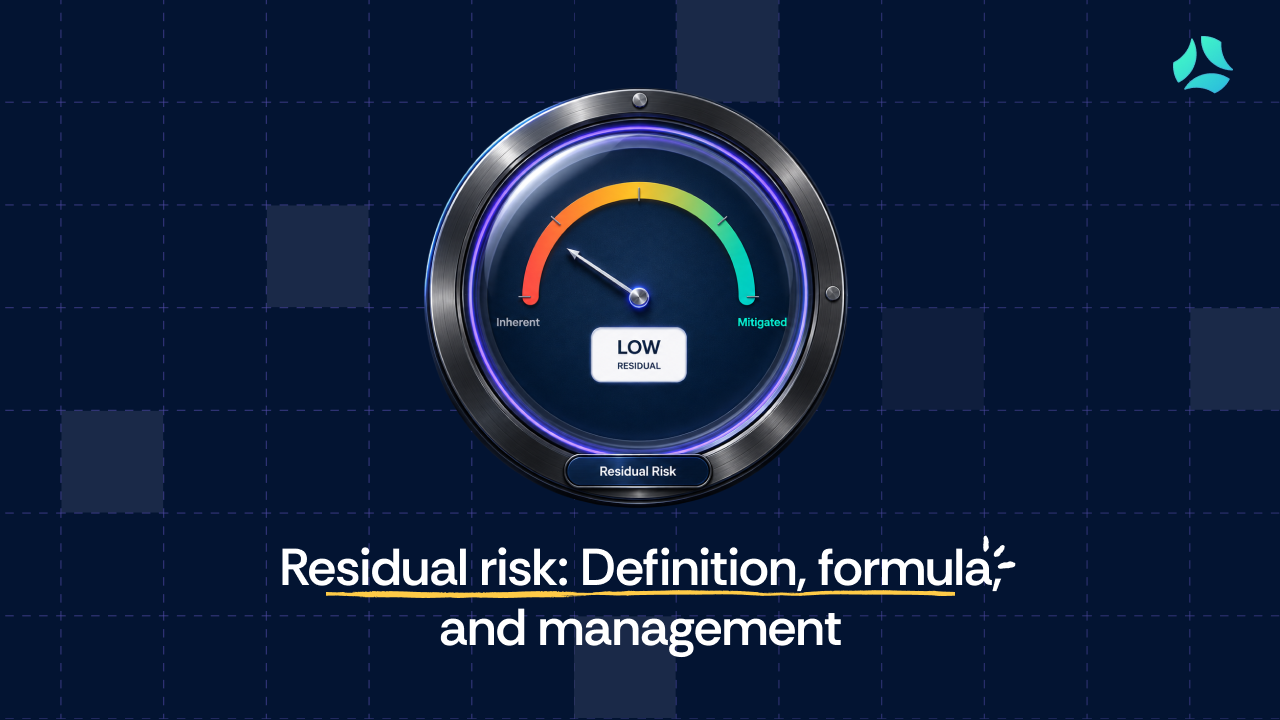


- Residual risk is the risk that remains after controls are applied. It is what you are actually carrying, as opposed to inherent risk, which is your raw exposure before any controls exist.
- The working formula is: Residual risk = Inherent risk − Impact of risk controls. Treat it as a directional starting point, not a precise number.
- When residual risk exceeds tolerance, you have four options: reduce it further, transfer it, accept it, or avoid the activity entirely.
- Residual risk is meaningless unless you compare it against a defined risk appetite. Without that threshold, the number tells you nothing.
- Continuous monitoring is what keeps residual risk from going stale as controls degrade and threats shift.
Every control you implement reduces risk, but never to zero. What remains after your firewalls, access reviews, and encryption are in place is residual risk, and how you manage it determines your actual security posture.
The problem is that most organizations either never reassess residual risk once controls are live, or they never define a risk appetite to measure it against, which leaves the number without meaning.
A risk assessment is supposed to give you a defensible way to identify and prioritize what matters in a world of scarce resources. Residual risk is the output that makes those trade-offs honest, and managing it well means knowing how to calculate it, when to accept it, and how to keep the number from going stale.
This guide covers the formula for calculating residual risk, how to tell it apart from inherent risk, risk appetite, and risk tolerance, the four ways to respond when it exceeds tolerance, and how to keep the number honest as controls and threats change.
What is residual risk?
Residual risk is the portion of risk remaining after security measures have been applied (NIST SP 800-30 Rev. 1; CNSSI 4009-2022). It is not the risk you started with. It is the risk you are left holding once your controls are doing their job. Under ISO 27001, residual risk is a formal output your risk treatment process must produce, document, and compare against your Statement of Applicability, with a named owner accountable for each accepted risk.
In the risk management process, residual risk is the output of the risk treatment step: the number you are left with after controls have been selected and applied, and the figure you compare against your risk appetite to decide whether to accept, escalate, or treat further.
A quick analogy makes the distinction concrete. Inherent risk is the flood risk of a river valley with no flood defenses at all. Residual risk is the flood risk after levees, drainage systems, and early warning tools are in place. The water threat never disappears. You have simply changed how much of it you are exposed to.
Inherent risk vs. residual risk
The inherent risk vs. residual risk distinction is where most confusion starts.
Risk posture evolution: Inherent vs. residual risk
Residual risk is also routinely conflated with risk appetite and risk tolerance. These are four different things, and mixing them produces risk registers that read well and mean nothing.
Risk posture parameters and governance relationships

Practical examples of residual risk
Here's what residual risk looks like across three common scenarios:
Cybersecurity. After deploying MFA, EDR, and network segmentation, the residual risk of a ransomware attack drops from critical to medium. It does not reach zero because social engineering, zero-day exploits, and misconfigured rules remain live gaps that no control set fully closes.
Compliance. An organization completes ISO 27001 certification. The certificate attests that controls were designed and operating effectively during the audit window. It does not eliminate the residual risk of unauthorized access through a compromised third-party vendor. That risk is accepted as within appetite and recorded in the risk register.
SaaS. A 150-person B2B SaaS company implements role-based access controls and quarterly access reviews. Residual risk of privilege escalation remains, because the review cadence is quarterly rather than real-time, and not every system is in scope.
What is residual risk in cybersecurity?
In a security context, residual risk is the likelihood and impact of a threat that survives your controls. After firewalls, encryption, EDR, and MFA are deployed, a residual risk of data breach persists through sophisticated attacks, human error, and gaps between control coverage. The goal is not zero. The goal is a residual level you can defend and have chosen to accept.
On prioritizing what gets fixed after controls are applied, Gary Hunter, Executive Director and Deputy Information Security Officer, Cybersecurity, has framed it this way: the business will only remediate so many findings given finite resources, so you have to make sure they are fixing the right things first. If you are not okay with something dropping off the bottom of the list, then you go back to the business and start the conversation about more resources.
Types of residual risk
Understanding which type you are carrying determines which response strategy applies.
Operational risk arises from day-to-day activities. Supply chain disruption, system failures, and human error all live here: the risks that accumulate even when your procedures are solid. External events fall here too. Managing it means continuous monitoring and process improvement.
Financial risk is often the one you formally accept rather than eliminate. Market fluctuations, credit exposure, and liquidity risk can be hedged and diversified, but a major client default or a sharp currency move will still cause losses that no internal control fully absorbs. The residual risk here is simply the cost of operating in a given market.
Compliance risk is the potential for breaches of laws, regulations, or internal policies. Even with rigorous programs and regular audits, residual compliance risk persists through regulatory change and differing legal interpretations. It is also frequently overweighted by SMBs because it is tangible and urgent: audit deadlines are visible, while operational and strategic risks feel distant until they materialize.

See compliance risk management and operational risk for deeper treatment.
Strategic risk involves long-term threats to your objectives: market shifts, disruptive competitors, and changing customer preferences. A new entrant with disruptive technology can render your product obsolete. In practice, strategic risk is the category most likely to be absent from a GRC-driven risk register entirely, because it rarely maps cleanly to a compliance control.
How to calculate residual risk
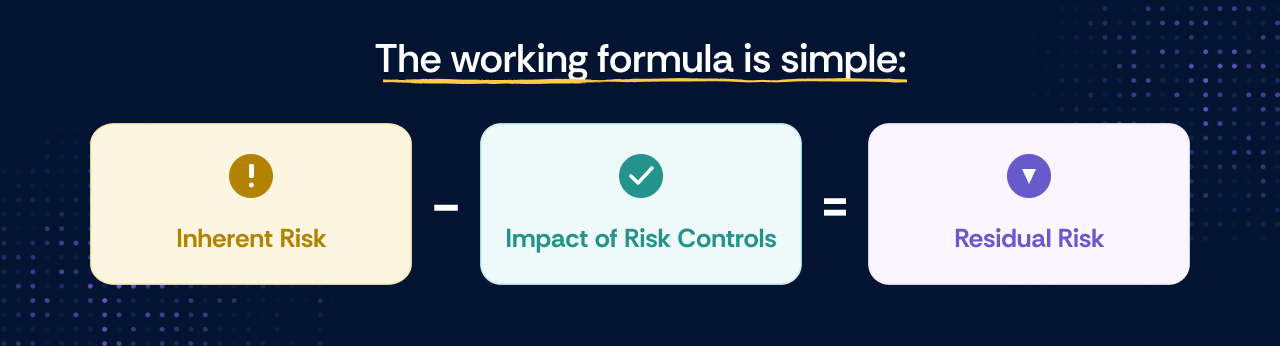
This gives you a directional score, not an absolute number. The calculation is only meaningful when you compare the result against a defined risk tolerance threshold. A residual score of "medium" tells you nothing until you know whether medium is inside or outside your appetite.
The four-step logic behind the formula:
1. Assign an inherent risk factor based on business impact and threat level, before any controls.
2. Define an acceptable risk percentage or qualitative threshold that reflects your appetite for this category.
3. Calculate maximum risk tolerance as the threshold that residual risk must stay under.
4. Compare residual risk against that threshold to decide whether to treat, accept, transfer, or avoid.
The six-step process that generates the inputs to the formula:
- Conduct a risk assessment. Identify inherent risks before controls, and analyze the likelihood and impact for each scenario.
- Implement risk controls. Apply mitigation measures and document each control and its expected effect.
- Evaluate control effectiveness. Test and audit the controls. A control that exists on paper but does not operate reduces nothing.
- Calculate residual risk. Apply the formula, then re-score likelihood and impact with controls in place.
- Compare with tolerance. Measure residual risk against your defined thresholds.
- Document and communicate. Record everything in the risk register and report to stakeholders.
Most SMBs do not run this quantitatively. Qualitative scoring using likelihood × impact heat maps is the most common approach at growth-stage companies, in the experience of practitioners who work with them. Quantitative risk assessment works well when the person running it has the experience to right-size it. Without that, teams tend to bite off more than they can chew.
Risk assessment methodologies: quantitative vs. qualitative approaches
For scoring mechanics, see risk scoring and how to set a risk tolerance threshold.

Managing residual risk: Choosing the right response
Which strategy applies depends on three variables: how far the residual risk exceeds your tolerance threshold, what further mitigation costs relative to the potential impact, and who in the organization has the authority to sign off on the decision.
Risk response mechanisms, criteria, and governance sign-off
Risk reduction means strengthening existing controls, adding new ones, and training people to cut human error. Risk transfer most often means cyber insurance, which is a real treatment mechanism that CISOs and CTOs encounter regularly. It does not eliminate the risk; it shifts a defined portion of the financial impact to an insurer, usually with underwriting conditions attached.
Risk acceptance is the most complex of the four decisions. Because it involves organizational authority, documentation, and board communication, it warrants a closer look in the section that follows.
For a deeper look at the trade-offs, see risk mitigation strategies and risk avoidance vs. risk reduction.
Frameworks such as ISO 31000, ISO 27001, NIST CSF, NIST RMF, COSO ERM, COBIT 2019, and FAIR each provide structure for these decisions. See cyber risk management frameworks for how they compare.
On managing residual risk that exceeds appetite, Nicholas Muy, CISO at Scrut Automation, notes that in practice you prioritize. You rank your risks, often using experience and institutional knowledge to decide which one is most likely to seriously hurt the company, and then you make trade-offs. Businesses have to run.
Monitoring residual risk: Cadence, ownership, and what actually changes
Residual risk goes stale the moment you stop looking at it. The control may have degraded, the threat landscape may have shifted, or the control was never fully implemented. Monitoring exists to catch that drift.
Cadence and triggers. Run a full top-to-bottom reassessment once a year, tied to your risk assessment cycle. Add a quarterly check-in to ask whether residual risk scores have changed due to new threats or control lapses. Out-of-cycle updates belong on the calendar when a control fails, a peer company is breached, a new regulation takes effect, or your business model materially changes.

Ownership and accountability. Someone has to own each residual risk entry by name. At SMBs without a dedicated CISO, this is often the VP of Engineering or Head of Security. The risk owner for each register entry should be named, not implied.
What to do when residual risk exceeds tolerance. This is the trigger point. When monitoring surfaces a residual score above threshold, it forces a decision: treat it, transfer it, or formally accept it with a named owner and a review date. Continuous compliance and risk management automation can surface the signal that a control has lapsed, but they cannot make the decision. That shift from periodic snapshots to ongoing signal is the whole point of moving from point-in-time to continuous risk management.
The failure mode is predictable: teams apply a control and never look again. The monitoring tool stops sending alerts, or the threat changes, and the residual score on paper no longer reflects reality.
Risk prioritization
You cannot treat everything at once. Prioritization decides what gets attention first. For most GRC managers at sub-500-person companies, four methods do the work.
- Probability and impact matrix (heat map). Plot each residual risk by likelihood and impact, assigning scores of 1 to 5 for each dimension. Those in the high-high quadrant get treated first. This is the most common method for a reason, and for most teams it is sufficient on its own.
- Qualitative expert judgment. Experienced practitioners rank risks using institutional knowledge and scenario analysis. Particularly useful when you do not yet have enough historical data to model probability distributions.
- Risk control matrix. Map risks against controls and their effectiveness to surface the risks that lack sufficient coverage.
Anything above your defined threshold needs either a treatment plan or a formal acceptance decision signed by a named owner, not an informal note that sits unreviewed in a shared document.
The risk register is the artifact that records these decisions. Each entry should include the inherent risk score, the controls applied, the residual risk score, the risk owner, and the acceptance or treatment decision.

A common failure is treating the register as an escalation shortcut. As Muy has described, people try to force items onto the register to get resources or attention, which pollutes it. A real entry has been through the full risk assessment process and represents a genuine strategic risk to the company.
Residual risk and risk acceptance: The conversation nobody wants to have
Every business carries accepted risk. A risk register with zero entries would mean you turned off all your technology. If you want to make money, you have to exist on the internet. If you exist on the internet, you have problems. Risk acceptance is not a failure of the security program. It is how the program stays connected to the business.
Formal risk acceptance is a documented decision, signed by a named owner with appropriate authority, that a residual risk is acknowledged and accepted as within tolerance. The key word is documented. A verbal "we're fine with it" is not risk acceptance.
The important question to ask is: who can accept which level of residual risk? A practical approach mirrors your existing financial approval thresholds. As Ross Young, CISO at Team8, described on the CISO Series podcast, you take the same approval amounts and authority levels the CFO already uses and apply them to cyber: if a risk looks like a $50,000 problem, it maps to one sign-off level; if it looks like a $200,000 problem, it needs a VP. A director-level risk maps to director-level authority.
When residual risk exceeds appetite but the business cannot afford more controls, the answer is prioritization, not paralysis. Document the gap, assign an owner, set a review date.
What good acceptance dialogue looks like is simple in structure. Someone asks whether anything can be done about the risk. The person who wants to design the control explains what it takes. The person who wants to accept it decides whether the benefits outweigh the costs. That exchange, not a silent sign-off, is the point.
Essential components of a formal risk acceptance record

Residual risk is also not just an internal metric. It is the input to board-level risk discussions and to cyber insurance underwriting. As Gary Hunter framed it, every board would say they cannot have any breach, but they will only invest so much into the security program, so there is always a level of risk that you are accepting. The security team's job is to make sure everyone understands the risk that is accepted and is comfortable with it, and if they are not, to explain what investment would reduce it.
For the underlying concepts, see risk tolerance vs. risk appetite and the effective risk management process.
Risk management frameworks that address residual risk
Frameworks do not change what residual risk is. They change how you document it, who authorizes it, and what artifact you produce at the end.
Framework-specific residual risk treatment and documentation outputs
For implementation, see the GRC implementation roadmap, NIST CSF 2.0, the broader IT risk management framework, and the ISO 27001 solution.
Residual risk in practice: What good looks like for a 50–500 person company
The guidance above is written at an abstract level. Here is what it actually looks like at a tech-native company of 50 to 500 people.
A minimum viable process. A risk register with fewer than 20 entries. Qualitative likelihood × impact scoring. Quarterly check-ins. A named owner for each high or critical entry. Documented acceptance decisions for anything above the tolerance threshold. That is enough to be defensible. Most companies at this stage start from a standardized template, four or five risk categories adapted to their environment, which is exactly what the audit requires and no more than what the team can realistically maintain.
The common failure modes. A risk register built once for a SOC 2 audit and never updated. Residual scores that were never re-assessed after controls went live. No formal risk tolerance defined, so there is no threshold to compare residual risk against. And the register used as a vulnerability escalation tool rather than a strategic risk artifact.
What automation can and cannot do. Automated control monitoring can surface the signal that residual risk has changed: a control lapsed, a new misconfiguration appeared. It cannot make the acceptance decision, assign the owner, or communicate the risk to the board. Human judgment owns those steps.
Conclusion
Even with extensive controls, some risk always persists. Assessing residual risk tells you whether that remaining exposure sits within your appetite or demands more work. Doing it well means comparing the number against a defined tolerance, assigning named owners, monitoring continuously, and documenting the acceptance decisions honestly.
A security program that manages residual risk honestly is one that holds up when the audit is over, and when it is not. If you want a platform that keeps the number honest without adding process overhead, see how Scrut's risk management platform works.
Residual risk is the portion of risk remaining after security measures have been applied (NIST SP 800-30 Rev. 1). It represents the vulnerabilities and threats that persist even after controls are in place
It is the likelihood and impact of a threat that survives your security controls. After deploying MFA, EDR, and network segmentation, the residual risk of a ransomware attack drops but does not reach zero, because social engineering, zero-days, and misconfigurations remain.
Use Residual Risk = Inherent Risk − Impact of Risk Controls. Treat the result as a directional score, and compare it against a defined risk tolerance threshold to decide whether to treat, transfer, accept, or avoid.
Reduce it further, transfer it (for example, through cyber insurance), accept it within tolerance, or avoid the activity entirely.
Operational, financial, compliance, and strategic. Each arises from a different area of the business and calls for a different response strategy.


%201.png)




.png)