


%20(1).png)


- This article answers how to implement a GRC program step by step, covering scope definition, framework selection, control ownership assignment, evidence collection automation, and internal audit preparation across a 90-day roadmap.
- It defines what GRC implementation actually looks like in practice, including the first 10 foundational controls shared across SOC 2, ISO 27001, NIST CSF, and HIPAA, and explains what auditors look for and what they most commonly reject.
- It addresses how long GRC implementation takes, what tools are needed, and how small security teams can build a complete program without a large headcount, using shared controls and early automation.
“The problem is there are silos,” says Michael Rasmussen, CEO of GRC Report and widely recognized as the father of GRC. The data confirms it: according to the Diligent Institute's Transaction Readiness Report, 60% of organizations operate with GRC and financial systems that are either completely siloed or only partially integrated, with just 4% achieving full integration.
Most organizations do not have a GRC problem. They have an operationalization problem. Policies exist on paper, a framework is on the roadmap, but controls have no owners, evidence is not flowing, and the audit date is approaching.
As Nicholas Muy, VP of Engineering, Platform and Security, and CISO at Scrut Automation, puts it: “Compliance gets us started, but it's not the end in and of itself.” That distinction matters. A GRC program that exists to pass an audit will pass one audit. A GRC program built as an operational system will scale with the organization.
This GRC implementation roadmap is built to close that gap. Unlike guides that stop at strategy, this one gives you 90-day sequencing, a practical ownership model, the first controls to implement, and a clear path to audit-readiness without burning engineering time. It is written for security leads, GRC managers, and CISOs scaling toward their first or second certification.
How can GRC be implemented? Here is the short answer:
- Define your scope and select one target framework before anything else.
- Assign named control owners across security, engineering, IT, and HR before building any controls.
- Implement foundational controls in the first 30 days, starting with access control and logging.
- Automate evidence collection by day 31 so your program runs continuously, not just at audit time.
- Run internal control testing before any external auditor engages, and document every finding.
The sections that follow turn each of these steps into a week-by-week roadmap you can act on from day one.
What a working GRC program actually looks like
Before mapping out the steps, it helps to be clear about the destination. A working GRC program is not a stack of approved policies or a completed framework checklist. It is an operational state that your organization maintains every day, not just in the weeks leading up to an audit.
In practice, that means every control has a single named owner: not a team or a department, but a specific person who is accountable for it. It means core controls are running continuously, with evidence being collected in the background rather than assembled in a rush when an auditor requests it.
Risks are logged in a live register, reviewed on a defined cadence, and updated as your threat landscape and infrastructure evolve.
It also means audits stop being a stressful discovery exercise. When evidence is structured, ownership is clear, and controls have been tested internally, an external audit becomes largely a confirmation of what you already know.
This is the operational state a mature GRC program delivers. When evidence collection is automated, control monitoring runs continuously, and gaps are surfaced before auditors find them, the entire compliance posture shifts from reactive to steady.
Everything in the GRC implementation roadmap that follows is built toward this picture. The goal is not to complete an implementation project. It is to reach an operational state and stay there.
Before you start: Scope your GRC program correctly
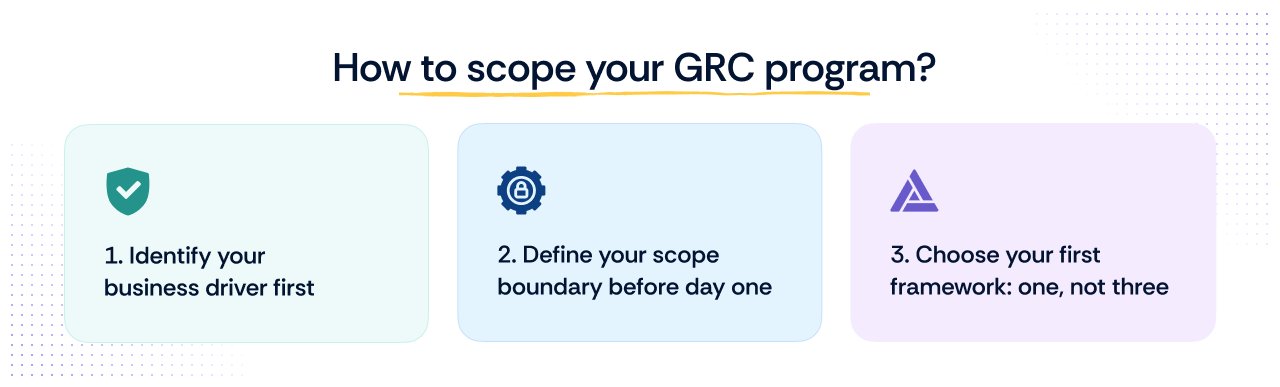
The most common reason GRC programs stall in the first 60 days is not a lack of effort. It is a lack of boundaries. Teams try to cover everything at once and end up with partial coverage across too many areas.
Scoping your program correctly before day one is what separates an implementation that builds momentum from one that collapses under its own ambiguity.
1. Identify your business driver first
The driver behind your GRC implementation determines which framework to prioritize and how aggressively to sequence the work. Being precise about this upfront saves weeks of misaligned effort later. The most common drivers are:
- A prospect or enterprise customer who asks for a SOC 2 report before they will sign
- A regulatory obligation, such as HIPAA, GDPR, or PCI DSS, that carries a legal or contractual consequence
- Board or investor visibility, where governance maturity is expected as part of a funding round or IPO readiness process
- M&A due diligence, where a buyer or partner wants documented evidence of your risk and compliance posture
2. Define your scope boundary before day one
Before any control is built or any owner is assigned, put your scope in writing. This document becomes the anchor for every decision that follows. It should specify which products and services are in scope, which cloud environments (AWS, GCP, Azure) and infrastructure components are included, which internal teams interact with in-scope systems, and which third-party vendors have access to in-scope data.
Scope creep is the single fastest way to stall a GRC program. When the boundary is undefined, every new system or team becomes a candidate for inclusion, and the program never reaches a stable foundation.
3. Choose your first framework: one, not three
The rule here is straightforward: select one framework, reach full control coverage, and then layer in a second.
Organizations that attempt to implement SOC 2, ISO 27001, and NIST CSF simultaneously in month one consistently find themselves with incomplete coverage across all three when the first audit arrives.
The output of this stage is a written scope document and a single confirmed framework decision. Without both, week one has no anchor, and the GRC implementation roadmap has no starting line.
Ownership model: Who runs what
A GRC program does not fail because the wrong frameworks were selected or the wrong tools were purchased. It fails because no specific individual is accountable for making controls work.
Distributed ownership, where responsibility lies with a team rather than an individual, is where most GRC programs quietly break down.
The table below maps ownership by function as a starting point. Every organization will have variations, but the logic holds regardless of size or structure.
The rule that makes this model operational is simple: every control must have a single named individual as its owner, not a team and not a function. “Engineering owns logging” is a statement that no auditor will accept and no engineer will feel accountable for. “Eric owns logging for AWS production” is a control owner.
To operationalize this, apply three fields to every control in your program:
- Control owner: The individual accountable for the control operating correctly
- Evidence owner: The individual responsible for collecting and storing proof that the control ran
- Review cadence: Monthly, quarterly, or annually, depending on the control type and framework requirement
A simple table mapping every control to these three fields is more practically useful than any governance policy document. It is also one of the first things an auditor will ask to see.
Build it in week one, before any controls are implemented, and maintain it as a live document throughout the program.
The 90-day GRC implementation roadmap: Week by week
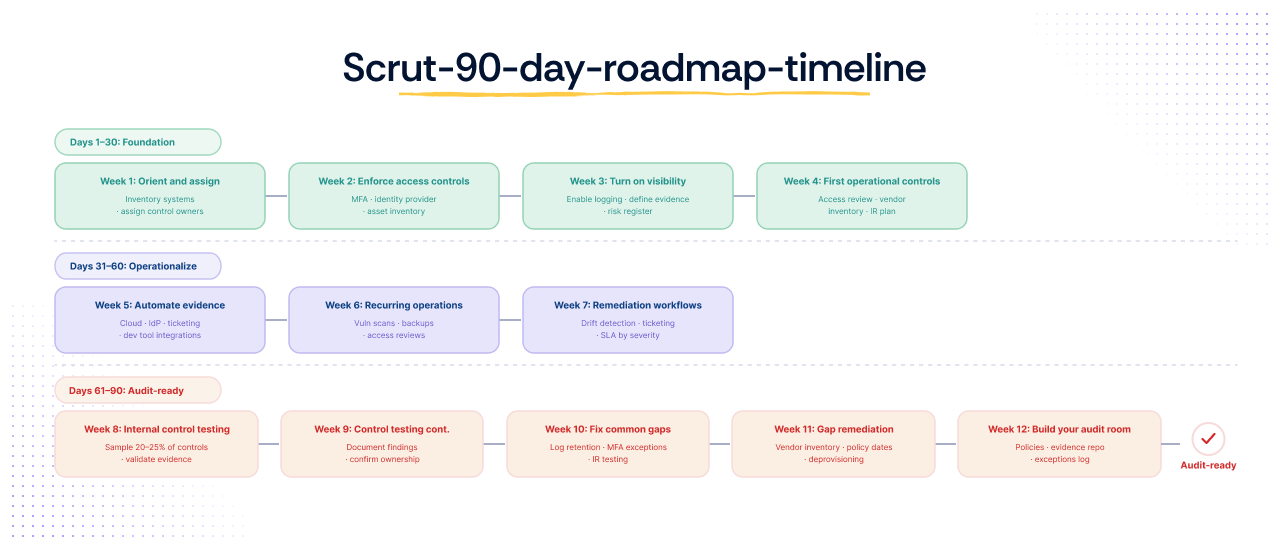
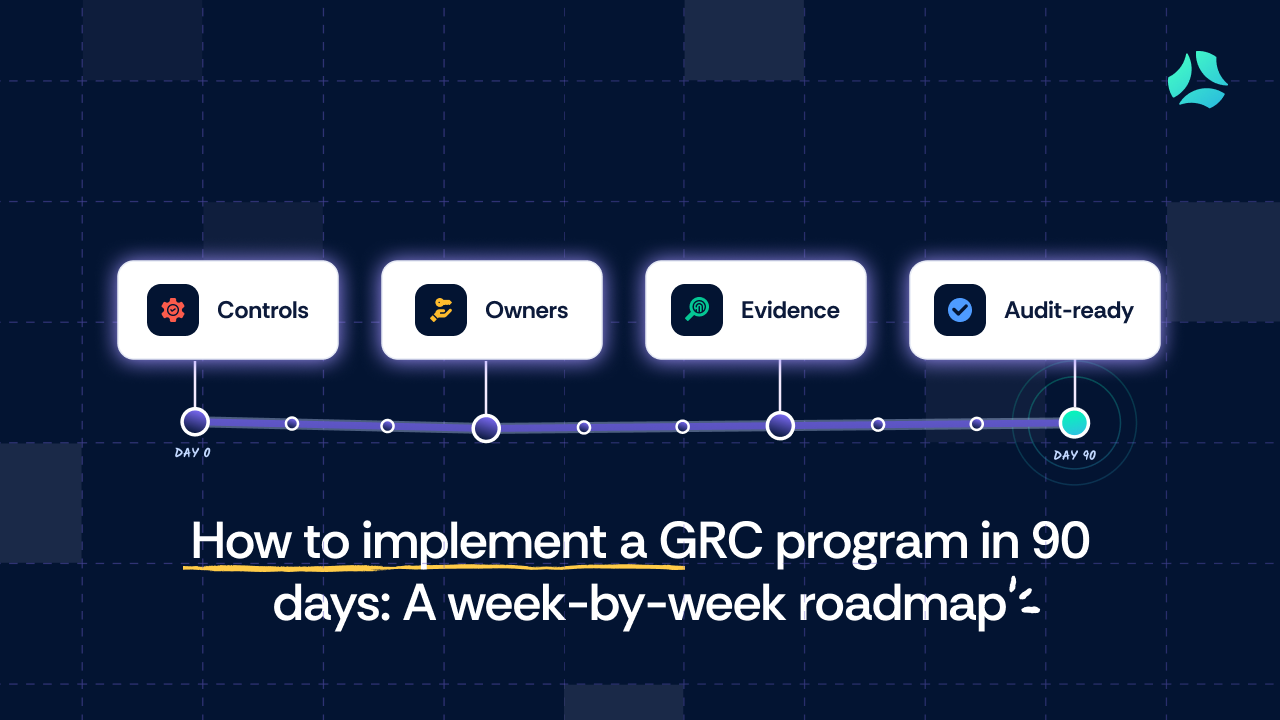
Most GRC programs stall not because the work is too complex, but because there is no clear sequence to follow. The roadmap below breaks the 90-day implementation into three phases, each building on the one before, so your team always knows what to do next and why it matters.
Follow the weeks in order: skipping ahead compounds the gaps that auditors are trained to find.
Days 1–30: Build the foundation
The first 30 days are about establishing two things every subsequent step depends on: visibility into what you have, and clarity on who is responsible for it. Execute the weeks in sequence. Each builds on the one before.
Week 1: Orient and assign
Pull an inventory of all in-scope systems, cloud environments, and data flows using integrations where possible. Then, before week one closes:
- Identify every in-scope stakeholder across security, engineering, IT, HR, and legal
- Assign a named owner to every control in your target framework, even controls not yet implemented. Ownership before implementation
- Create a single implementation tracker with five fields per control: name, owner, status, evidence source, and target completion date
Do not begin writing policies, evaluating GRC platforms, or mapping risks until the inventory and ownership assignments are complete.
Week 2: Enforce baseline access controls
- Enforce MFA across all in-scope systems with no exceptions, including engineers and administrators
- Centralize user access management through an identity provider if one is not already in place
- Begin the asset inventory: cloud resources, SaaS tools, and endpoints
- Launch the policy review cycle: catalog existing policies, flag outdated ones, and identify gaps. You are not writing policies yet. You are understanding what exists.
Week 3: Turn on visibility
- Enable logging for all key in-scope systems: cloud environments, identity provider, code repositories, and production infrastructure
- Define what evidence looks like for each control before collection begins: automated export, system-generated report, or documented manual process. Agree on this in writing.
- Create the risk register: top 10 to 15 risks with likelihood score, impact score, named owner, and current mitigation status
Week 4: First operational controls
- Run the first access review: document who has access to what, confirm it is appropriate, and obtain manager approval. Self-approved reviews are an audit failure point
- Build the vendor inventory: list every third party with access to in-scope data and assign a risk tier to each
- Document and formally approve the incident response workflow, then run at least one tabletop exercise before month two begins
Days 31–60: Operationalize controls
The first 30 days establish what you have and who owns it. Days 31 through 60 answer a different question: Is any of it actually running? This phase is where GRC implementation moves from setup to operation.
Three things need to happen in this window: evidence collection needs to become systematic, recurring control operations need a defined cadence, and every gap found needs a closed loop to resolution.
Week 5: Automate evidence collection
By day 31, evidence collection must shift from manual to structured or automated. Connect your core systems so evidence flows continuously. Priority integrations:
- Cloud environments: AWS CloudTrail, GCP Audit Logs, and Azure Monitor
- Identity systems: Okta, Azure AD, and Google Workspace
- Ticketing systems: Jira or Linear for change management evidence
- Dev tools: GitHub for code review and deployment approval records
Week 6-7: Launch recurring control operations
By day 45, every recurring operation needs a named owner, a defined frequency, and a calendar entry:
- Vulnerability scans: Weekly or biweekly, with every finding tracked to a remediation owner and an SLA
- Backup verification: Restore tested and documented at least quarterly
- Access reviews: Quarterly, run by the control owner, approved by a manager
- Policy attestations: All staff confirm they have read current policies on a defined schedule
Week 7: Build remediation workflows
Every gap needs a closed loop. No open finding should exist without an owner and a due date:
- Drift detected: Monitoring alert or manual finding surfaces a gap
- Ticket created: Opened immediately with full context on the affected control
- Owner assigned: Named individual with an SLA tied to finding severity
- Closure verified: Closed only when evidence confirms the control is operating correctly again
Days 61–90: Become audit-ready
The final 30 days before an external audit are not the time to build your GRC program. They are the time to verify that it works. Organizations that treat this window as a construction phase consistently find themselves presenting incomplete evidence, scrambling to assign owners, and discovering gaps that should have been caught six weeks earlier.
The three activities in this phase assume the foundation is already in place and focus entirely on validation, gap resolution, and organized presentation.
Week 8-10: Run internal control testing
- Sample evidence across 20 to 25% of controls, prioritizing access control, logging, and incident response.
- Check for the most common gap: control documented and owned, but no evidence that it ever ran.
- Validate ownership in practice: confirm named owners know what evidence they are responsible for and where it lives.
- Document every finding in a remediation log. This log is itself audit evidence of a mature program.
Week 10-11: Fix the gaps that auditors most commonly reject
- Log retention under 12 months for in-scope systems
- Access reviews completed, but no manager approval on record
- An incident response plan exists, but has never been tested
- MFA is enforced for most users, but undocumented exceptions exist
- Vendor inventory covers a fraction of in-scope vendors
- Policies with review dates older than 12 months
- Access deprovisioning is delayed beyond 24 hours with no documented reason
Week 12: Build your audit room
- Policies: Current, version-controlled, with approval dates and reviewer names.
- Evidence repository: Organized by control, not by date or team.
- Risk register: Timestamped to show active maintenance, not assembled for the audit.
- Exceptions log: Every gap documented with a reason, a remediation owner, and a target date.
A well-maintained exceptions log that shows gaps were found and fixed is stronger audit evidence than a program with no exceptions. Auditors trust the former more.
The first 10 controls to implement
One of the more useful things to know about GRC frameworks is that, beneath the structural differences in how SOC 2, ISO 27001, NIST CSF, and HIPAA are organized, they share a common set of foundational expectations.
Implementing the right 10 controls first means your foundational coverage applies across multiple frameworks simultaneously, which matters when a second certification is on the roadmap.
These 10 controls appear across SOC 2, ISO 27001, NIST CSF, and HIPAA. Getting them operational first is the fastest path to foundational coverage across all four.
Common GRC implementation mistakes that waste months
Most GRC programs do not fail because of a wrong framework choice or a bad tool selection. They fail because of process decisions made in the first few weeks that compound quietly until an audit makes them visible.

That observation applies as much to starting a GRC program late as it does to treating it as an annual exercise.
- Starting with too many frameworks simultaneously: You get 30% coverage on three frameworks instead of full coverage on one. None is audit-ready.
- Writing policies before ownership is clear: Policies go unenforced, and auditors immediately identify the accountability gap.
- Buying a GRC tool before the control set is defined: The platform becomes a document repository, not a compliance engine.
- Collecting evidence manually via screenshots: This exceeds 20 controls and consumes the team by month three.
- Having no executive sponsor: Remediation tickets get deprioritized, and infrastructure-level controls stay broken.
- Excluding engineering from week one: Security teams can define controls, but cannot implement infrastructure-level ones alone. Remediations stall.
- Treating GRC as an annual exercise: Controls activated only before an audit are performances, not controls. Experienced auditors recognize the difference.
How automation accelerates your GRC roadmap
Automation does not replace the judgment calls at the center of a compliance program. Decisions about scope, ownership, and which controls to prioritize still require human input. What automation removes is the operational overhead that accumulates once those decisions are made.
Here is what it specifically changes:
- Collect once, satisfy many: A single integration to AWS generates logging evidence that satisfies SOC 2, ISO 27001, and NIST CSF requirements simultaneously. No duplicate collection, no reformatting, no manual exports.
- Continuous monitoring: Automated monitoring alerts your team when a control drifts before an auditor or a breach surfaces. A user with MFA disabled, a logging gap on a production system, and a lapsed vendor assessment are found by the monitoring layer, not during audit preparation.
- Faster audit cycles: When evidence is organized by control and continuously updated, audit preparation becomes a retrieval exercise, not a construction project.
- Lower engineering lift: On the vendor risk side specifically, Muy notes that agentic teammates can “exhaustively assess all the vendors to actually determine which ones are the ones to go deeper on.” The same principle applies to cloud findings, control monitoring, and remediation guidance. Engineers focus on fixing the issues surfaced by the monitoring layer, not on pulling screenshots and exporting logs on request.
The organizations that reach audit readiness fastest are not the ones with the largest GRC teams. They are the ones where evidence collection runs continuously, and control monitoring does not depend on someone remembering to check.
To explore how this works in practice, see how Scrut Automation handles integrations across your cloud and security stack, supports multi-framework compliance from a unified control library, and what a SOC 2 or ISO 27001 implementation looks like on the platform.
Ready to put this roadmap into action? See how Scrut Automation helps you implement GRC faster, with automated evidence collection, continuous control monitoring, and built-in support for 60+ frameworks.
Start by defining your scope and selecting one target framework. Assign named control owners before implementing anything. Build foundational controls in the first 30 days, automate evidence collection by day 31, and run internal testing before any external auditor engages. The order of operations, scope, ownership, controls, evidence, and testing is the part most GRC implementation guides skip entirely.
Three phases: foundation (days 1 to 30), operationalization (days 31 to 60), and audit readiness (days 61 to 90). The foundation covers system inventory, ownership assignment, and baseline controls. Operationalization automates evidence collection and launches recurring control operations. Audit readiness covers internal control testing, gap remediation, and audit room preparation.
A focused GRC program with a defined scope and one target framework can reach audit readiness in 60 to 90 days. Timelines extend when the scope is undefined, ownership is unclear, or evidence collection remains manual throughout. Organizations targeting multiple frameworks simultaneously typically take 6 to 12 months to reach readiness for the first audit.
At minimum: an identity provider for access control, a cloud logging solution, a vulnerability scanner, and a system for tracking controls and evidence. GRC platforms like Scrut Automation consolidate these workflows into a single environment, automate evidence collection across integrations, and map controls to multiple frameworks simultaneously. (Source: https://www.scrut.io/)
Yes, with tight scoping, shared controls, and early automation. One security lead and an engaged engineering partner can build a complete SOC 2 or ISO 27001 program. The constraint is not headcount. It is sequencing. Small teams that attempt everything simultaneously run out of capacity before reaching audit readiness.


%201.png)


.png)