


%20(1).png)


- Most founders choose the wrong compliance framework first because they copy competitors or default to what sounds credible, not what their buyers actually require during procurement. Framework selection is a business decision first and a security decision second.
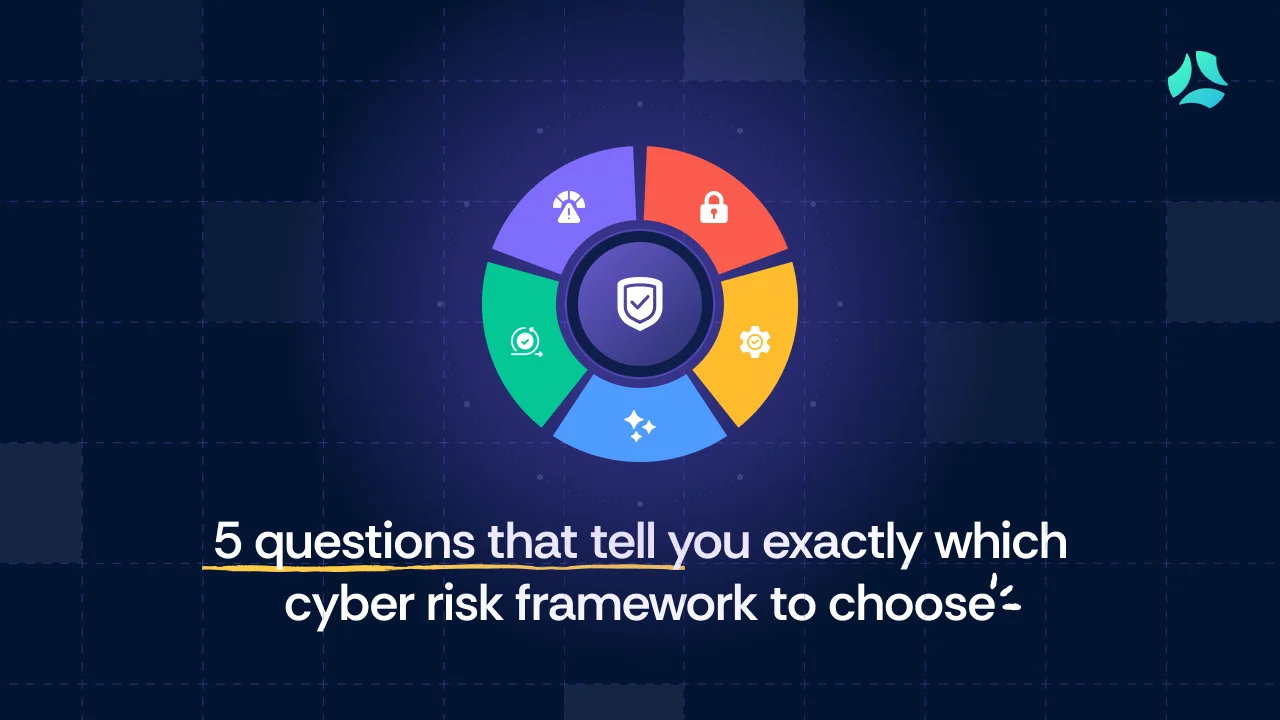
- Five questions — buyer type, geography, timeline, team size, and business goal — are all it takes to identify the right starting framework from SOC 2, ISO 27001, NIST CSF, NIST RMF, and HIPAA.
- Frameworks are not permanent choices. Most companies start with one, earn the commercial credibility it unlocks, and layer others as they scale. The first framework is the starting point, not the ceiling.
Imagine this. You are three weeks from closing a deal that could redefine your growth trajectory. Then the buyer’s procurement team sends over a security questionnaire. No security team on your side. No framework in place. The deal does not stall because your product is insecure. It stalls because there is no proof that it is not.
This situation is more common than most founders expect. According to Verizon’s 2025 Data Breach Investigations Report, third-party involvement in breaches doubled from 15% to 30% in a single year.
Enterprise buyers are not just curious about vendor security. They are accountable for it. Cyber risk management frameworks have quietly become the first credibility test a growing company faces in an enterprise sales cycle. Picking the right one is only step one, though; the lasting advantage comes from turning that framework into continuous risk management, where controls are monitored in real time rather than revisited once a year at audit.
Most guides explain cyber risk management frameworks. This one tells you which one to choose so you don’t lose deals or look unprepared.
The five questions ahead will get any founder, CEO, or CISO to a clear starting point in under three minutes.
What are cyber risk management frameworks?
A cyber risk management framework is a structured set of guidelines that helps organizations identify, assess, and reduce cybersecurity risks. Frameworks/standards like NIST CSF, ISO 27001, and SOC 2 define the controls, processes, and standards a company must meet. They also serve as proof to customers, partners, and regulators that security is taken seriously.
Frameworks exist for three interconnected reasons: to standardize security controls across an organization, to create a systematic approach to managing cyber risk, and to demonstrate trustworthiness to buyers, auditors, and regulators who require documented evidence before they engage.
Three related but distinct concepts are worth separating here.
- Security practices refer to what an organization does internally to protect its systems and data.
- Compliance is what gets documented and verified through audits and certifications.
- Operational trust is what enterprise buyers evaluate during procurement, and it is the concept that most directly affects deal outcomes.
Mature organizations eventually build integrated cyber risk management frameworks that run SOC 2, ISO 27001, and NIST CSF within a single connected program rather than treating each standard in isolation.
For a growing company, the starting point is more immediate: passing a framework audit is often the difference between winning and losing an enterprise deal.
What is the difference between a cyber risk framework and compliance?
A cyber risk framework is the broader structure an organization adopts to identify, assess, and manage cybersecurity threats. Compliance is the process of proving adherence to a specific framework’s requirements through audits, documentation, and certifications.
In short, the framework defines what good looks like. Compliance is how an organization demonstrates it has achieved it.
What are the functions of the NIST Cybersecurity Framework?
NIST CSF 2.0, released in February 2024, is organized around six core functions: Govern, Identify, Protect, Detect, Respond, and Recover. The addition of Govern is the most significant change from the previous version, which referenced only five functions.
Govern addresses cybersecurity strategy, risk management policy, and leadership-level oversight. Most content published before 2024 still references five functions, making this an important distinction for any organization working from older guidance.
Why most companies choose the wrong framework first
Founders who come to us after failing their first enterprise security review almost always make the same mistake. They chose the framework that sounded most credible, not the one their buyers were actually asking for.
The patterns repeat across company stages and industries. Some founders copy the framework a well-known competitor announced on LinkedIn, without checking whether their buyer profiles are remotely similar.
Others default to ISO 27001 because it sounds appropriately global and serious, before they have a single European customer to justify a 12 to 18 month investment. Some pursue NIST RMF without an active government pipeline, taking on a framework that is heavy, slow, and commercially irrelevant to most early-stage sales motions.
A particularly common trap is attempting SOC 2, ISO 27001, and NIST simultaneously after an investor mentions all three, and stalling on all of them. Others buy GRC tooling before understanding what their buyers are actually requesting during procurement.
The smarter approach starts with five factors: who the buyers are and what they require during vendor security reviews, where those buyers are located geographically, what industry they operate in, how urgently deals need to close, and how much security resourcing the company has right now. Framework selection is a business decision first and a security decision second.
The five questions below are designed to get to the right answer in under three minutes. Answer based on where the company is today, not where it hopes to be.
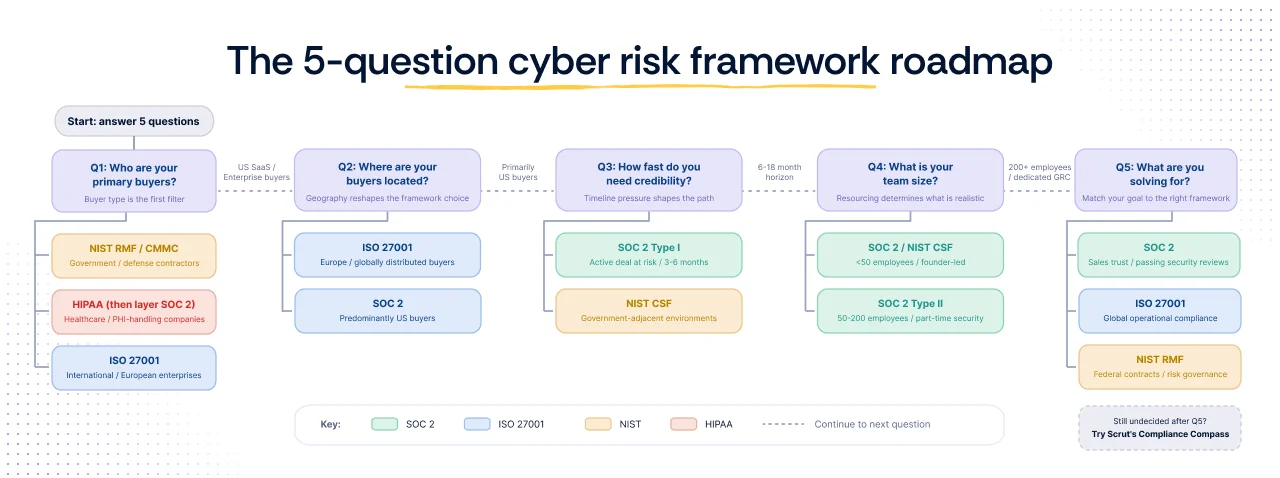
The 5-question cyber risk framework decision tree
Before reading about individual frameworks, answer these five questions based on where the company is today. The answers, not best practices and not what a competitor chose, determine the right starting point.
Question 1: Who are your primary buyers?
Procurement teams are not security experts. When an enterprise buyer sends a vendor security questionnaire, they are not conducting a technical assessment. They are using a recognized framework as a standardized trust signal, a shorthand for organizational maturity that legal and procurement teams can act on without needing deep security knowledge to interpret.
Match the buyer type to the framework:
- US SaaS or tech companies: SOC 2 is the starting point. It is the most commonly requested framework in US B2B procurement and the fastest path to passing a security review.
- Enterprise buyers with heavy procurement processes: SOC 2 or ISO 27001, depending on geography. If those buyers are US-headquartered, SOC 2 comes first in almost every case.
- Government agencies or defense contractors: NIST RMF or CMMC. Federal sales require federal-grade frameworks, and there is no credible shortcut.
- Healthcare organizations: HIPAA is mandatory before anything else. SOC 2 can layer on top once HIPAA is in place.
- International or European enterprises: ISO 27001 carries more weight globally than SOC 2. If the pipeline is predominantly European, ISO 27001 is the stronger first move.
The security questionnaire typically arrives during legal review or vendor onboarding, often three to six weeks before a deal is expected to close. That is the moment most founders are unprepared for.
If 90% of the current pipeline is US SaaS, start with SOC 2 and revisit everything else at Series B.
Question 2: Are your buyers mainly in the US or globally distributed?
Geography is one of the most overlooked variables in framework selection. It directly shapes which standards carry credibility with the buyers that matter most.
- Predominantly US buyers: SOC 2 is usually sufficient in the early stages. Most US enterprise buyers recognize and accept it without requiring ISO certification.
- European or internationally distributed buyers: ISO 27001 often carries considerably more weight. European procurement teams frequently require it where their US counterparts would accept SOC 2.
Two clarifications worth holding onto:
- GDPR is not a certification framework. It is a regulatory requirement and cannot replace SOC 2 or ISO 27001 as a trust signal in vendor security reviews. ISO 27001 implementation does, however, significantly support GDPR compliance documentation, which is why the two commonly appear together in European vendor requirements.
- If the company is US-focused today but planning European expansion in the next 12 to 18 months, building the SOC 2 program with ISO 27001 compatibility in mind is a practical decision. The two frameworks share approximately 60-70% control overlap, meaning the groundwork laid for SOC 2 carries forward.
Question 3: How fast do you need enterprise credibility?
Timeline pressure shapes framework selection as much as buyer type does. The right framework depends not only on who the buyers are, but on how much runway exists before the next deal closes.
- Active deal at risk or security review blocking close within three to six months: SOC 2 Type I is the fastest credible signal available. It is a point-in-time audit, achievable in approximately three months from readiness, and recognized by most US enterprise procurement teams.
- Building toward a six to eighteen-month horizon: SOC 2 Type II or ISO 27001. Type II covers a six to twelve-month audit period and carries significantly more weight than Type I. ISO 27001 takes nine to eighteen months to obtain initial certification, but positions the company for global commercial credibility.
- Government-adjacent or highly regulated environments: NIST-oriented maturity programs are required regardless of timeline preference.
Approximate timelines for reference:
One practical note: If a deal is closing in eight weeks, no framework will save it. The right move is to complete the security questionnaire with existing documentation and start the SOC 2 program in parallel.
Question 4: Do you have a dedicated security team, or are founders leading this?
Resourcing determines which frameworks are realistic today and which ones will stall before they are complete.
- Founder-led or lean operations (fewer than 50 employees, no dedicated security hire): Start narrow. SOC 2 or NIST CSF alignment is both manageable without a full-time security function. ISO 27001, at this stage, risks operational overload. The documentation requirements alone can stall a small team for months.
- Part-time security ownership (50 to 200 employees, one person across multiple responsibilities): SOC 2 Type II is achievable. ISO 27001 is also possible with the right tooling and external implementation support.
- Dedicated GRC or security function (200 or more employees): Broader integrated cyber risk management frameworks become realistic. NIST CSF, ISO 27001, and framework stacking across multiple standards are all executable at this stage.
Two points worth holding: Founders who attempt three frameworks simultaneously often complete none, and the procurement blocker that started the conversation remains active six months later. The right GRC platform reduces the resource burden significantly, but it should be purchased after identifying the right framework, not before.
Question 5: Are you solving for sales trust, operational compliance, or deep risk governance?
The final question is the most clarifying. Most founders conflate three genuinely different goals, and selecting a framework that serves the wrong one is the root cause of the misalignment described earlier in this blog.
The distinction worth understanding: passing a security review through SOC 2 is not the same as achieving operational security maturity through ISO 27001, and neither is the same as building formal risk governance depth through NIST RMF. All three are legitimate goals. The right one is determined by where the company is today, not where it aspires to be.
If the five questions above still leave room for doubt, Scrut's Compliance Compass is worth a few minutes. It runs a short assessment based on your business priorities and outputs a personalized framework recommendation along with a downloadable report on what to do next. Useful as a second opinion before committing to a program.
Your likely framework path
Most framework decisions are not actually complicated. They feel complicated because the advice available is generic. Here is a faster read based on where the company sits today.
You probably need SOC 2 first if:
- You are a US SaaS company selling to mid-market or enterprise buyers
- Your deals are slowing or stalling because of security questionnaires
- You have fewer than 200 employees and no dedicated security function
- Speed of credibility matters more than depth of governance right now
Do not bother with ISO 27001 yet unless a buyer has asked for it explicitly and in writing.
You probably need ISO 27001 first if:
- Your buyers are primarily in Europe or are global enterprises operating under international procurement standards
- You are building a long-term operational security program rather than trying to pass a single review
- You have the resourcing, internal or through a GRC platform, to sustain a 12 to 18-month implementation
Do not pursue NIST RMF unless federal contracts are actively in the pipeline.
You probably need HIPAA first if:
- You handle, store, or transmit protected health information in any form
- Any of your current or target customers are healthcare providers, payers, or insurers
This is not optional. Layer SOC 2 on top once HIPAA is established.
You probably need NIST RMF if:
- You are selling into US federal agencies, DoD contracts, or pursuing FedRAMP authorization
- Your buyers operate in environments that require prescriptive risk management documentation
Do not start here without an active federal pipeline. The investment is significant, and the commercial return is narrow outside government sales.
The major cyber risk management frameworks explained
Now that you know which direction to go, here is what each one actually involves, so you go in with accurate expectations, not assumptions.
One clarification before diving in: a framework is a structured set of guidelines and best practices that organizations can voluntarily adopt and adapt to their context.
A standard is a formal set of requirements, developed by a recognized body, that organizations must satisfy to achieve certification or demonstrate compliance.
Not everything in this list is a framework. Two are standards, one is a federal regulation, and the distinction matters when you are explaining your compliance program to auditors or enterprise buyers.
NIST Cybersecurity Framework (CSF 2.0)
Type: Voluntary framework | Requirement: Recommendatory
- What it is: Voluntary US framework, updated in February 2024 to six functions: Govern, Identify, Protect, Detect, Respond, and Recover
- Commercial unlock: Credibility with US enterprise and government-adjacent buyers; strong foundation before pursuing FedRAMP
- Realistic timeline: 3 to 6 months for initial alignment; ongoing maturity improvement thereafter
- Certification: No formal certification, but widely recognized as an assessment standard
ISO 27001
Type: International standard | Requirement: Recommendatory, though frequently mandatory in European and global enterprise procurement
- What it is: An international standard for an information security management system; it requires formal implementation and a third-party audit
- Commercial unlock: European and global enterprise trust; often the only framework international buyers accept in vendor onboarding
- Realistic timeline: 9 to 18 months for initial certification
- Certification: Yes, issued by an accredited certification body
SOC 2
Type: Auditing standard | Requirement: Recommendatory, though functionally mandatory for US SaaS companies selling to enterprise buyers
- What it is: US auditing standard from the AICPA; Type I is point-in-time, Type II covers a 6 to 12 month period; covers security, availability, confidentiality, processing integrity, and privacy
- Commercial unlock: Removes US enterprise procurement blockers and accelerates deal closure
- Realistic timeline: Type I in approximately 3 months; Type II in 6 to 12 months
- Certification: SOC 2 report issued by a licensed CPA firm
HIPAA
Type: Federal regulation | Requirement: Mandatory for any organization that handles, stores, or transmits protected health information
- What it is: US federal law governing protected health information; mandatory for healthcare-adjacent companies
- Commercial unlock: Access to the healthcare market; without it, selling to covered entities is not possible
- Realistic timeline: 3 to 6 months for compliance program establishment
- Certification: No formal certification; compliance is demonstrated through documentation and audit readiness
NIST RMF
Type: Voluntary framework | Requirement: Mandatory for US federal agencies and contractors; recommendatory for all others
- What it is: A seven-step framework covering Prepare, Categorize, Select, Implement, Assess, Authorize, and Monitor for federal information systems; the basis for FedRAMP
- Commercial unlock: US federal government contracts and agency sales
- Realistic timeline: 12 to 24 months or more; significant resourcing required
- Note: Do not start here without an active federal pipeline
What are the 5 frameworks of NIST?
NIST produces multiple distinct frameworks, not a single unified standard. The five most commonly referenced are:
How frameworks overlap and evolve over time
Choosing a framework is not a permanent decision. Most companies start with one, earn the commercial credibility it unlocks, and layer others as the business scales into new markets or customer segments. The first choice narrows the path forward; it does not close it.
The most common progression points are worth understanding before you commit.
- SOC 2 to ISO 27001: Roughly 60-70% of controls overlap between the two. Existing SOC 2 policies, evidence, and risk register carry forward directly. Budget an additional 6 to 9 months rather than treating ISO 27001 as a ground-up rebuild.
- NIST CSF to SOC 2: NIST CSF alignment builds a strong control baseline. SOC 2 adds the formal third-party audit layer on top. Build the program with NIST CSF; certify it with SOC 2.
- ISO 27001 to ISO 31000: ISO 27001 governs information security risk. ISO 31000 broadens the scope to enterprise-wide risk management, covering financial, operational, and reputational dimensions. The two are additive, not duplicative.
- SOC 2 and HIPAA together: the most common pairing for healthcare SaaS companies. SOC 2 covers security posture broadly; HIPAA governs PHI handling specifically. If healthcare is the target market, plan for both from the start.
The underlying principle across all of these is what GRC practitioners call “collect once, map many.” Once evidence collection processes are running on a well-implemented GRC platform, the same controls map across multiple frameworks simultaneously, reducing duplication significantly as the compliance program scales.
Common mistakes founders make when adopting a framework
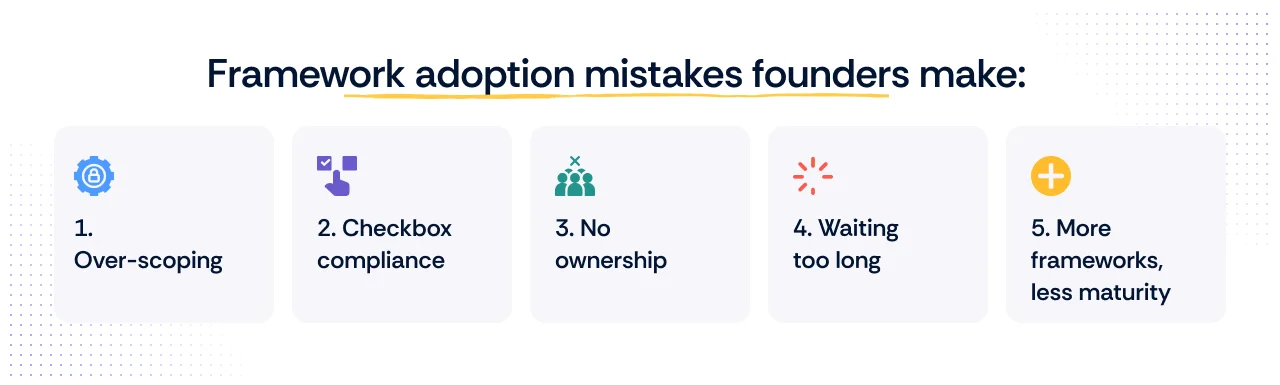
Most compliance programs do not fail because of technical gaps. They fail because of operational ones.
The pattern that shows up most consistently across companies working through their first audit cycle: the founders who move fastest are almost never the ones who started with the most documentation. They are the ones who assigned clear ownership within the first week and treated the framework as a business process problem, not a security project.
The mistakes that cause the most damage are predictable.
- Over-scoping too early. Committing to three frameworks simultaneously and completing none of them is far more common than it should be.
- Treating compliance as a checkbox. Collecting evidence for an audit without building the underlying operational habits that sustain it over time means starting from scratch every cycle.
- Ignoring ownership. Frameworks require cross-functional accountability across security, engineering, legal, and HR. Without named owners, implementation stalls regardless of tooling.
- Waiting until procurement blocks a deal. By the time a deal is lost, the cost is already real.
- Assuming more frameworks equals more maturity. A company with SOC 2 Type II fully operationalized is more credible to enterprise buyers than one with five frameworks in progress and none complete.
Three things that actually help:
- Start with what the next ten buyers will ask for in security reviews,
- Build evidence collection habits early because they compound over time
- Keep processes lightweight initially and add rigor as the team grows.
How Scrut helps founders move faster
Knowing which framework to pursue is the first problem. Executing against it without a dedicated security team is the second, and it is the one that slows most companies down.
The gap most founders hit is not strategic. It is operational. They know SOC 2 is the right call, or ISO 27001, or HIPAA, but they underestimate what comes next: evidence collection, policy documentation, vendor risk assessments, security questionnaire responses, and audit prep, all running in parallel, often owned by people who have full-time jobs that are not compliance.
Scrut is an AI platform powered by autonomous agents that operationalize continuous compliance and security, replacing audit chaos with scalable execution. For founders who have worked through the five questions in this blog and still want a sharper, personalized read on which framework fits their specific business priorities, Scrut's Compliance Compass runs a short assessment and outputs a tailored framework recommendation along with a downloadable report on what to do next.
And if the business does not fit neatly into any of the standard frameworks covered here, Scrut supports custom frameworks too. Build one from scratch using prebuilt controls, or upload your own via CSV, no engineering support required.
The goal is not to become a compliance expert. It is to pass the review, close the deal, and get back to building.
ISO 31000 is a principles-based, globally applicable, sector-agnostic risk management framework. NIST SP 800-37 (the Risk Management Framework) is a prescriptive, step-by-step process designed specifically for US federal information systems. For organizations that are not federal contractors, ISO 31000 is the more flexible and broadly applicable starting point for enterprise risk governance.
The seven commonly cited types are: accept (tolerate the risk), avoid (eliminate the activity that creates it), transfer (shift it to a third party via insurance or contracts), mitigate (reduce likelihood or impact), monitor (observe without acting yet), exploit (pursue a risk deliberately for upside), and share (distribute risk across parties). In cybersecurity practice, the four most operationally relevant responses are accept, mitigate, transfer, and avoid.
Yes, but sequencing matters more than speed. Most companies are better served by completing one framework before layering a second. The exception is SOC 2 and HIPAA together for healthcare SaaS, where control overlap is high and the business requires both to operate in its target market.
Cybersecurity covers the tools and controls used to protect systems and data. Cyber risk management is the broader discipline of identifying, assessing, and prioritizing risks in a way that aligns with business objectives. A company can have strong security tools and still lack a risk management program, which is why enterprise buyers ask for frameworks, not just tool lists.
Three things need to be in place: a defined scope, documented policies covering the relevant trust service criteria, and evidence that controls are being followed consistently. Most companies underestimate the gap between having security practices and having practices that are documented, owned, and auditable. A readiness assessment before engaging an auditor will surface the actual gaps.

%201.png)


.png)