



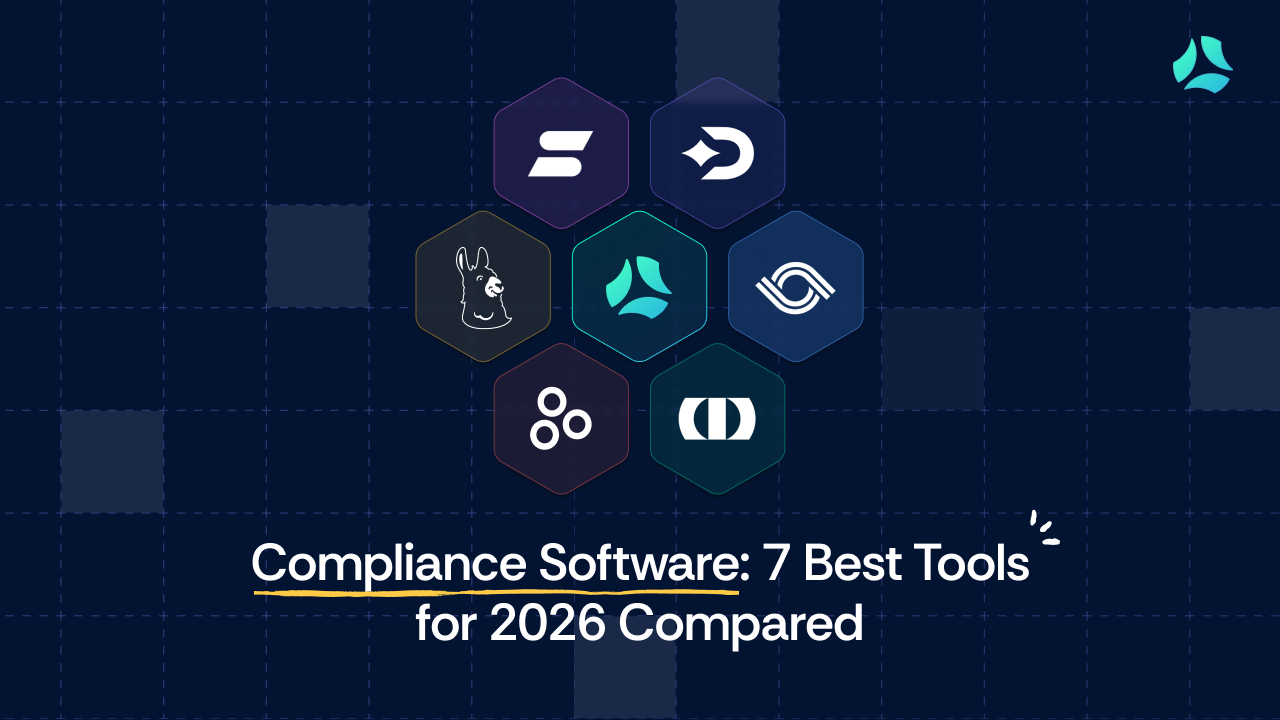


- Compliance software helps you monitor controls, automate evidence collection, and prove adherence to security standards and regulations. This guide compares the 7 best tools for 2026.
- Three features are non-negotiable: continuous monitoring, multi-framework support, and automated evidence collection.
- The tools fall into three groups: compliance automation platforms (SOC 2 / ISO 27001), privacy and data governance platforms, and enterprise GRC suites. Pick the category that matches your obligation.
Meeting compliance in 2026 is harder than it has ever been. Regulatory scrutiny is tightening across industries, cyber threats keep evolving, and most teams are juggling several frameworks at once. A reactive, spreadsheet-driven approach no longer holds.
Consider what happened in August 2025. Attackers stole OAuth tokens from Salesloft’s Drift integration and used them to access Salesforce data from more than 700 organizations, including security leaders like Palo Alto Networks, Zscaler, and Cloudflare (Google Threat Intelligence Group, 2025). The stolen data became fuel for follow-on phishing; FINRA issued a formal alert warning firms of exactly that risk. Every one of those companies met baseline compliance requirements, yet a single trusted third-party integration still left an opening.
In 2026, that pressure is compounding. DORA in financial services, the DPDPA in India, and NIS 2 across Europe have turned compliance from a nice-to-have into a condition of doing business. Compliance software helps teams keep pace by automating control testing, risk monitoring, and reporting instead of chasing evidence by hand.
This guide compares the 7 best compliance software tools for 2026, with features, pros, cons, and pricing for each.
What is compliance software?
Compliance software is a category of tools that helps organizations monitor, manage, and demonstrate adherence to regulatory requirements and security standards. It integrates with your existing systems to track compliance continuously, automate evidence collection, and generate audit-ready documentation, replacing manual, spreadsheet-based processes.
Not every tool in this category does the same job. The market splits into three groups, and the distinction matters because it decides which tool you actually need. One group automates voluntary, opt-in standards. Another manages mandatory privacy law. A third covers enterprise-wide risk, audit, and compliance.
That third column is where most buyers go wrong. SOC 2 and ISO 27001 are opt-in standards you choose to pursue. GDPR, CCPA, and the DPDPA are laws; you comply because jurisdiction requires it, not because a buyer asked.
A platform can help you operationalize either, but completing a GDPR module is not the same as holding a certificate, because no such certificate exists for a regulation. If you want the full picture of how compliance frameworks differ, or how a broader GRC software suite fits above all of this, those breakdowns go deeper.
The software surfaces the evidence and the gaps. Your team still owns the judgment calls: control effectiveness, risk acceptance, and the management attestation.
Key features to look for in compliance software
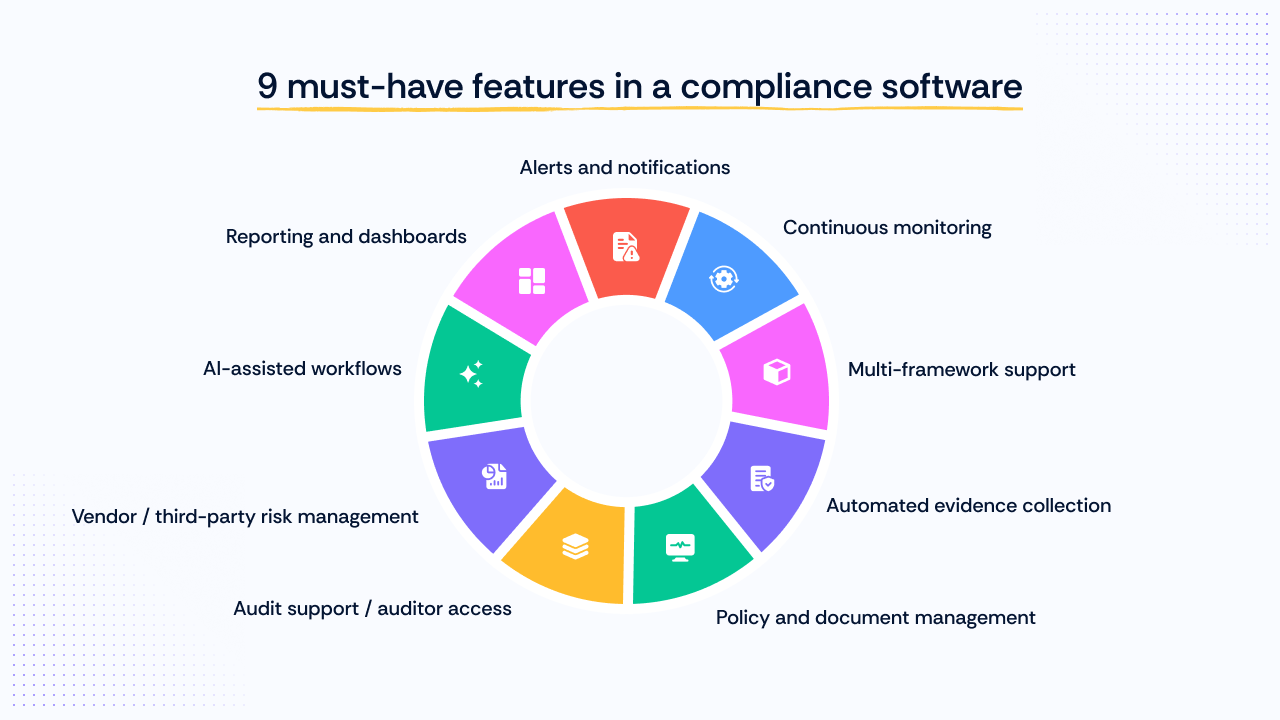
Most compliance tools share a core feature set but differ on price, automation depth, and how well they scale. The hard part is not finding features on a datasheet. It is finding a platform that plugs into your existing stack, carries evidence across multiple frameworks, and grows with you without constant friction.
Watch for vendors that promise "100% compliance"; no tool delivers that, and the claim is a signal to look harder at the fundamentals below.
Continuous monitoring
Controls drift between audits. An access review that passed in January can quietly fail by March when a departing engineer keeps production access. Continuous monitoring catches that drift as it happens, not at your next audit. The minimum bar is automated checks running at least daily against your live environment. Anything less is a point-in-time snapshot wearing a real-time label. Read more on how compliance monitoring works in practice.
Multi-framework support
Most growing companies do not stop at one framework. SOC 2 leads to ISO 27001, which leads to HIPAA or GDPR as you enter new markets. Frameworks overlap heavily; at least 40% to 50% of requirements are shared across any two standards, so re-collecting the same evidence for each is wasted effort. Look for evidence reuse across frameworks through a shared control set, so one piece of proof satisfies every standard it maps to.
Automated evidence collection
Manual evidence collection means engineers taking screenshots of AWS consoles at 11 pm before an audit. Automated evidence collection pulls that proof directly from your cloud, identity, and device-management systems on a schedule. Look for deep integrations with AWS, Azure, GCP, IAM tools like Okta, and MDM platforms, so evidence flows in without anyone chasing it.
Policy and document management
Auditors evaluate implemented controls, not just the existence of a policy PDF. That means version control, approval workflows, and a direct link between each policy and the control it governs, so when an auditor asks for both, they are in the same place. Look for a pre-built template library (Scrut ships 100+), version control, and approval workflows.
Audit support and auditor access
Audit prep is where most of the manual pain concentrates. A platform that gives your auditor secure, scoped access to the evidence they need removes the back-and-forth of exporting and emailing files. Look for a dedicated auditor portal or collaboration module, ideally one that lets auditors pull samples and raise requests inside the platform rather than over email threads.
Vendor and third-party risk management
Enterprises now demand security assurance from every vendor in their supply chain. Upstream attacks have made third-party risk one of the top compliance exposures. Your platform should centralize vendor contracts and SLAs, automate security questionnaires, and continuously track vendor posture, because a vendor that passed onboarding in January can introduce a new exposure by March, and you will not know until the next audit if you are not watching. See how to structure vendor risk management end to end.
AI-assisted workflows
Small GRC teams carry disproportionate manual load, and this is where 2026 platforms differentiate. The useful applications are concrete: auto-drafting responses to security questionnaires, detecting evidence gaps before an auditor does, and flagging control failures with suggested fixes. Treat "AI" as a feature to interrogate, not a badge. Ask what it actually automates.
Reporting and dashboards
Your board and your auditors need different views of the same program. Executives want posture at a glance; auditors and engineers need the control-level detail. Look for dashboards that serve both, with risk heatmaps and trend lines that are actionable rather than decorative. A green dashboard that nobody can drill into tells the board nothing useful.
Alerts and notifications
Between audit cycles, unresolved control gaps stack up silently. By the time you notice, the backlog is a finding. Threshold-based alerts stop that accumulation before it starts, pushing notifications into Slack or email the moment a control drifts. Look for configurable thresholds by framework and control type, not just a single global alert.
> In practice: Toddle, an EdTech platform handling children's personal data, moved from periodic reviews to real-time tracking and threshold alerts, and quarterly audits became routine rather than reactive. SplitMetrics took the same approach ahead of its market expansion. The pattern is consistent: teams that monitor continuously spend less time in audit prep and more time on the work that matters.
With those criteria in hand, here is how the 7 tools in this guide stack up at a glance, before the full entries.
2026 compliance software at a glance
1. Scrut Automation
Scrut is a GRC and compliance automation platform built for cloud-native, growth-stage, and mid-market companies in SaaS, fintech, and healthtech. It brings compliance, risk, and vendor management into one product, and it is one of the few platforms in this list that publishes transparent, all-inclusive pricing rather than routing every buyer through a sales call.
Where legacy tools trade usability for feature count, Scrut aims for both: audit-ready workflows that don't require a dedicated compliance team to run.
The platform's design goal is to keep teams continuously audit-ready, so compliance stops being a quarterly fire drill and runs in the background while engineering ships product.
Key capabilities
Beyond these, the platform supports 70+ compliance frameworks, with custom framework creation at no extra cost, 100+ pre-built policy templates, and up to 70% automated evidence collection.
Automated tests run every 24 hours across compliance artifacts, logging every change to maintain a clean audit trail. It connects to 150+ tools across your stack, including AWS, Azure, Google Workspace, and Jira, through its compliance automation integrations. It also supports MCP for developer-native workflows.
Three modules go deeper than the table above. They cover the exposures that surface most often in post-audit retrospectives: risk, people, and vendor.
- Risk management. The risk management module consolidates risk identification, assessment, and monitoring into one place. It scans your codebase, infrastructure, applications, vendors, and access points, then auto-populates mitigation tasks with mapped controls. You can build a risk register from a pre-built library or custom profiles, and score risk using the CIA triad, Risk Priority Number, or your own formula.
- People compliance. Access reviews, device monitoring, and security training run as automated workflows. Onboarding and offboarding tie access rights to role, reducing unauthorized access. A 30-minute prebuilt infosec course is customizable from the dashboard.
- Vendor risk management. Security surveys, risk scoring, and vendor paperwork run from a single dashboard. You can send questionnaires, collect responses through a web portal, and share results with customers and auditors.
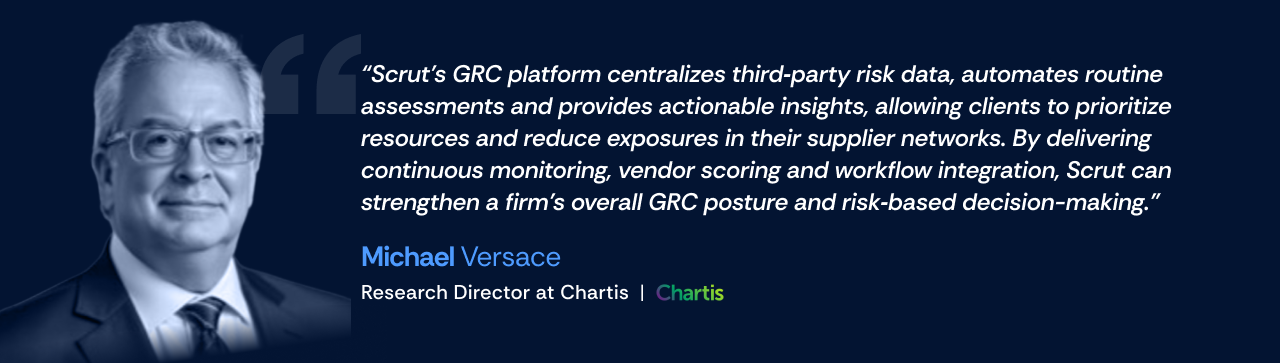
Scrut was also recently named a Category Leader in the Chartis RiskTech Quadrant® for TPRM Solutions, 2026 and this is what Michael Versace, Research Director at Chartis, had to say about Scrut:
Pros and cons
Best for: Growth-stage and mid-market SaaS, fintech, and healthtech teams that want multi-framework coverage and transparent pricing.
Pricing: Transparent tiers (Foundation / Growth / Scale), all modules included. Contact the team for a custom enterprise quote. See how continuous compliance works on the platform.
2. Vanta
Vanta automates security and compliance for startups, SMBs, and scaling SaaS companies. It is a common first platform for teams racing toward SOC 2 or ISO 27001. It covers 35+ frameworks and connects through 400+ integrations, so for most modern cloud stacks, the connectors you need are already there.
Key features
- Automated evidence collection across 400+ integrations, including GitHub, Google Workspace, and AWS
- Continuous monitoring of security controls in real time
- Customizable policy templates
- VantaGov for FedRAMP
- AI Governance from Vanta, launched July 2026
- Developer-native GRC via MCP Server, GA April 2026
Pros and cons
Best for: Startups and scaling SaaS companies pursuing SOC 2 or ISO 27001 quickly.
Pricing: Tiered pricing; contact Vanta for a custom quote.
3. Drata
Fast-growing SaaS teams that need continuous monitoring across 50+ frameworks tend to land on Drata. The platform covers SOC 2, ISO 27001, GDPR, HIPAA, ISO 42001, DORA, FedRAMP, CMMC, and Cyber Essentials, and it positions itself as "The Agentic Trust Management Platform."
Key features
- Automated evidence collection across integrations [VERIFY integration count]
- Real-time compliance monitoring
- Audit Hub, which brings auditors into the platform for sampling and requests
- AI Questionnaire Assistance, included across all tiers
- AI Agent Governance for AI system compliance, launched June 2026
- AIUC-1 support (the first AI agent compliance standard) and APRA CPS 230, both added July 2026
Pros and cons
Best for: Fast-growing SaaS companies and enterprises needing continuous monitoring across many frameworks.
Pricing: Tiered plans (Foundation, Advanced, Enterprise); pricing on request at drata.com/plans.
For a closer look at the trade-offs, see these Drata alternatives.
4. Optro (formerly AuditBoard)
Optro, which rebranded from AuditBoard in March 2026, is an enterprise GRC and connected-risk platform. It positions itself as an "agentic system of action" across audit, risk, InfoSec, and compliance, and it is built for large organizations with complex, cross-functional audit needs. Its FairNow acquisition added AI governance capability to the platform.
Key features
- Centralized risk assessments with real-time insights
- Automated audit workflows and evidence collection
- Compliance management across SOC 2, ISO 2700x, NIST, CMMC, and PCI DSS, plus custom frameworks
- AI governance via the FairNow acquisition
- Collaboration tools across teams and stakeholders
Pros and cons
Best for: Enterprise and Fortune 500 organizations with complex audit and risk programs.
Pricing: On request. For alternatives, see this guide to AuditBoard alternatives.
5. OneTrust
If data privacy is the core obligation, GDPR, CCPA, LGPD, OneTrust is the deepest tool in the market. It is a privacy-first GRC platform spanning privacy, governance, risk, compliance, and ethics, with the market's strongest data discovery, consent management, and DPIA tooling.
It serves 14,000+ customers and supports 100+ frameworks, including GDPR, CCPA, LGPD, PIPEDA, ISO 27001, SOC 2, HIPAA, ISO 42001, and NIST CSF. Its former ZenGRC product, acquired from Reciprocity, is now "OneTrust Risk & Compliance."
Key features
- Automated data privacy workflows and assessments
- Third-party risk evaluation and monitoring
- Incident management and resolution tracking
- Centralized policy creation and distribution
- AI governance module
Pros and cons
Best for: Large organizations with significant data privacy and GRC complexity.
Pricing: Modular licensing by product area (Privacy, GRC, Ethics, Data Governance); pricing on request.
For alternatives to the former ZenGRC product, see these ZenGRC alternatives.
6. Hyperproof
Hyperproof works well for mid-market GRC programs that have outgrown spreadsheets but do not need a full enterprise suite. Its strength is cross-framework evidence sharing and control reuse, so work done for one standard carries into the next. It supports 70+ frameworks.
Key features
- Cross-framework evidence sharing and control reuse via Hypersync, with 70+ integrations
- No-code workflow builder
- Continuous compliance monitoring
- Centralized evidence and control management
Pros and cons
Best for: Mid-market teams running multiple frameworks that want evidence reuse without enterprise complexity.
Pricing: Per-user tiers (Starter, Professional, Business); pricing on request. For alternatives, see these Hyperproof alternatives.
7. Sprinto
Cloud-first SaaS companies that want broad framework coverage with automated remediation often shortlist Sprinto. The platform positions itself as the "World's first Autonomous Trust Platform" and serves 3,000+ customers across 75 countries. Its framework coverage is among the widest here: 200+ frameworks digitized and 25+ automated, including SOC 2, ISO 27001, GDPR, HIPAA, PCI DSS, ISO 42001, and the EU AI Act.
Key features
- Fix-it Agent for auto-remediation across monitors
- AI Governance as a core product area (ISO 42001, NIST AI RMF, EU AI Act)
- 200+ frameworks digitized, 25+ automated
- Continuous monitoring across cloud environments
Pros and cons
Best for: Cloud-first SaaS companies and fast-growing startups seeking broad framework coverage and automated remediation.
Pricing: Foundation and Growth tiers, with enterprise add-ons for Risk, TPRM, and AI Governance; pricing on request.
Why teams choose Scrut for compliance
Most teams hit the same wall: one audit done, controls documented, then the next cycle arrives, and the evidence chase starts over. Scrut is built to break that cycle. Continuous monitoring and multi-framework evidence reuse run in the background, so your team keeps shipping while staying audit-ready.
The harder problem is not passing one audit. It is managing compliance without slowing development velocity or forcing a choice between innovation and control. Multi-framework coverage, always-on monitoring, and a built-in risk register mean compliance runs continuously, not as a quarterly scramble. See how Scrut helps you stay audit-ready and strengthen security.
Book a demo today.
Compliance software helps organizations monitor controls, automate evidence collection, and demonstrate adherence to security standards and regulations. It integrates with your existing systems to replace manual, spreadsheet-based tracking with continuous, audit-ready documentation.
Three categories cover most needs: regulatory compliance (meeting mandatory laws like GDPR or HIPAA), internal compliance (enforcing your own governance and policies), and risk management (identifying and treating threats). Tools tend to specialize in compliance automation for opt-in standards, privacy management for mandatory regulation, or enterprise GRC across all of it.
Prioritize the three non-negotiables: continuous monitoring that catches control drift daily, multi-framework support with evidence reuse, and automated evidence collection through deep integrations. After those, weigh policy management, auditor access, vendor risk, and reporting against your specific obligations.
No tool issues a credential. SOC 2 produces an attestation report from a CPA firm, not a certificate. ISO 27001 produces a certificate from an accredited certification body. GDPR and HIPAA are laws with no official certificateat all —a platform helps you operationalize and evidence your obligations, but you earn and maintain the attestation, certification, or legal compliance.