

%20(1).png)


- Pick the framework that unblocks your most immediate deal: the wrong choice first costs three to six months with nothing to show the prospect.
- SOC 2 is the default for U.S. enterprise sales; ISO 27001 for global markets; HIPAA and PCI DSS are mandatory when relevant data is in scope.
- Most frameworks share 43% of the same evidence requirements (A-LIGN benchmark): one control implementation can satisfy SOC 2, ISO 27001, HIPAA, and PCI DSS simultaneously.
- Organizations that automate evidence collection and monitor controls year-round pay a lower cost per framework than those reconstructing evidence before each audit.
A prospect sends a 300-question vendor security questionnaire. Your sales team flags it as a deal blocker. Legal wants to know your compliance posture. And you are staring at a list of acronyms, SOC 2, ISO 27001, HIPAA, PCI DSS, NIST CSF, GDPR, wondering which one actually unblocks the conversation.
Most organizations eventually carry 3 to 5 frameworks. Sequence matters more than coverage.
The wrong framework first wastes three to six months and does not unblock the revenue that triggered the compliance conversation in the first place.
The right one builds a control foundation that makes every subsequent framework cheaper to implement.
What a compliance framework actually is, and what it is not
A compliance framework is a structured set of controls, policies, and processes designed to manage a specific category of risk. Frameworks give auditors, customers, and regulators a common language to evaluate your security posture.
The distinction between a framework, a standard, and a regulation matters. NIST CSF is a voluntary framework with no issuing body and no certificate. ISO 27001 is a certifiable standard with third-party audits. HIPAA is a federal law with mandatory enforcement. Conflating them leads to misplaced compliance investments.
The decision of which framework to pursue first is a revenue and risk decision. Start with the framework that unblocks the most immediate business constraint.

The major compliance frameworks, explained for decision-makers
SOC 2
SOC 2 is the de facto trust standard for SaaS and cloud companies selling to U.S. enterprise buyers. Issued by the AICPA, it evaluates security controls across five trust service criteria.
SOC 2 Type 1 evaluates control design at a point in time. Type 2 evaluates operating effectiveness over a three to twelve month observation period. Enterprise buyers overwhelmingly prefer Type 2.
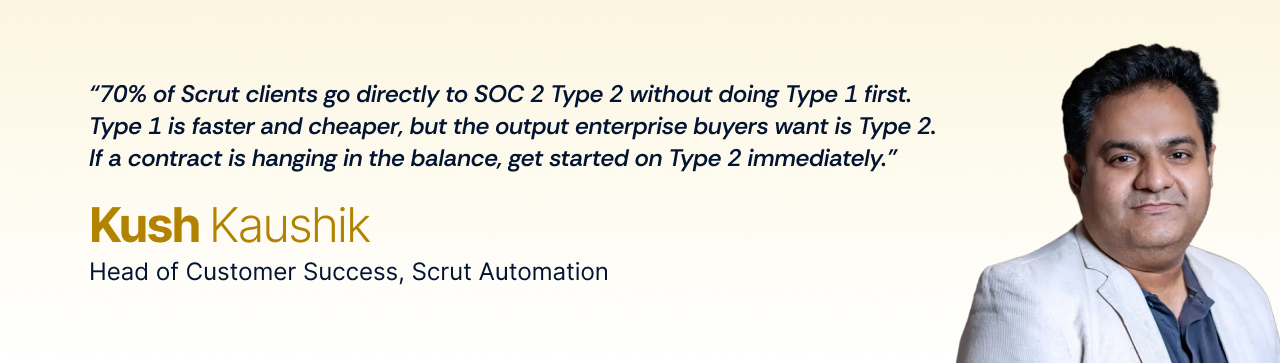
Budget six to nine months for a first Type 2 audit; first-year total cost typically runs $30,000 to $100,000 depending on scope. See SOC 2 scope guide and how much engineering time SOC 2 costs for planning baselines.
ISO 27001
The international standard for information security management systems, recognized across Europe, the UK, Asia-Pacific, and the Middle East. Unlike SOC 2, ISO 27001 produces a certificate issued by an accredited certification body after a two-stage audit. The 2022 version contains 93 controls across four themes.
According to the A-LIGN 2024 Compliance Benchmark Report, SOC 2 and ISO 27001 share 43% of evidence requirements, meaning teams with SOC 2 in place can reuse a substantial portion of existing evidence when adding ISO 27001.
See the State of Compliance Quality eBook for a deeper analysis of multi-framework evidence reuse. First-year costs typically run $20,000 to $80,000.
HIPAA
A U.S. federal law, not a framework you opt into. If your organization creates, receives, maintains, or transmits protected health information (PHI) as a covered entity or business associate, HIPAA compliance is mandatory.
There is no certificate and no annual audit requirement. Compliance is demonstrated through documented policies, a completed risk analysis, workforce training, and executed business associate agreements (BAAs) with every vendor touching PHI.
With OCR running 22 enforcement actions in 2024 and 21 in 2025, treating HIPAA as a documentation exercise is an expensive mistake.
See healthcare cybersecurity frameworks guide for the full regulatory picture.

PCI DSS
Applies to any organization that stores, processes, or transmits payment card data. Version 4.0.1 is the current active standard. Compliance level is set by annual transaction volume.
- Level 1 merchants complete a formal Report on Compliance (ROC) with a Qualified Security Assessor (QSA).
- Levels 2 through 4 complete a Self-Assessment Questionnaire (SAQ).
- The most effective strategy is scope reduction: tokenization and outsourced payment processing remove systems from the cardholder data environment (CDE) and reduce the assessment burden at every future cycle.
See who needs PCI DSS compliance to determine your level and obligations.
NIST frameworks
- NIST CSF: A voluntary risk management framework widely adopted across U.S. sectors. No certificate; produces an internal maturity assessment.
- NIST SP 800-171: Governs the protection of Controlled Unclassified Information (CUI) in non-federal systems. Baseline for most Department of Defense contractors. See NIST SP 800-171 guide for implementation detail.
- CMMC: Layers a certification requirement on top of 800-171 for the defense industrial base.
- FedRAMP: Mandatory cloud security authorization for providers selling to U.S. federal agencies. Requires a full Third-Party Assessment Organization (3PAO) assessment. Timelines run 12 to 24 months, with first-year costs commonly exceeding $500,000.
GDPR
The General Data Protection Regulation governs the personal data of EU and UK residents and applies to any organization handling such data, regardless of location.
- Fines reach four percent of global annual revenue.
- For SaaS companies with European customers or employees, GDPR is a baseline legal obligation.
- Compliance is built on documented legal bases for processing, data subject rights
How to decide which framework to pursue first
The right framework is determined by three questions, answered in order.
- Who is blocking the deal? The framework your most immediate prospect requires is the one to pursue first. Enterprise sales cycles stall most often on security questionnaires. The framework that unblocks the most immediate revenue is the correct starting point.
- What data do you handle? If you handle PHI, HIPAA is mandatory. If you process payment card data, PCI DSS is mandatory. If you hold CUI under a federal contract, NIST 800-171 obligations exist independent of any customer request. Mandatory frameworks cannot be sequenced after voluntary ones.
- Where are your customers? U.S. enterprise buyers predominantly require SOC 2. European and global enterprise buyers predominantly require ISO 27001. Federal government buyers require FedRAMP or CMMC, depending on the contract.

In practice, most SaaS companies start with SOC 2 because it unlocks the most U.S. enterprise deals. ISO 27001 follows when international expansion accelerates. HIPAA and PCI DSS are added when data handling creates mandatory obligations. FedRAMP and CMMC are pursued when federal revenue is a specific strategic target.

A company that pursues FedRAMP before they have a single federal prospect has committed to 18 months of work that will not unblock a single deal. According to the 2026 Business Impact of Compliance Automation report, 92% of organizations on the Scrut platform manage two or more frameworks. Building a reusable control foundation on the first framework is the only way to scale compliance without proportionally increasing headcount.
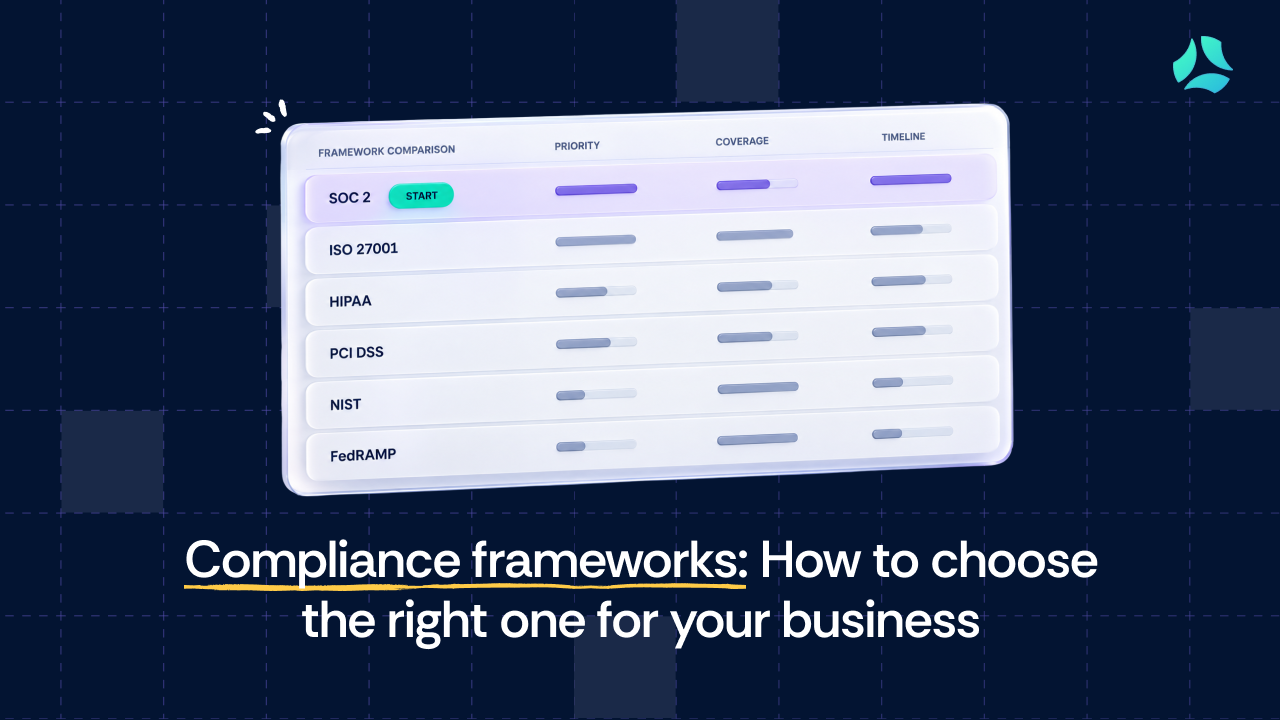
Framework comparison: At a glance
Why your second framework costs less than your first
The most expensive compliance mistake is treating each framework as a separate project.
Most frameworks share the same foundational controls: access management, encryption, incident response, risk assessment, vendor management, and audit logging.
A single encryption-at-rest policy can simultaneously satisfy SOC 2 CC6.1, ISO 27001 Annex A 8.24, HIPAA Section 164.312(a)(2)(iv), and PCI DSS Requirement 3.
The A-LIGN 2024 Compliance Benchmark Report puts the evidence overlap between SOC 2 and ISO 27001 at 43%. The State of Compliance Quality eBook provides a deeper breakdown of where reuse is highest and where frameworks diverge.
Teams that map controls across frameworks during the first implementation typically reuse the majority of evidence for each subsequent one. If your first framework costs $80,000 to implement, the second should cost considerably less, not another $80,000.
This only works if compliance is treated as an ongoing operational discipline, not an annual audit event. Evidence collected in the weeks before an assessor arrives is inconsistent and reflects a snapshot of what was true on audit day. Controls drift. Patch timelines slip. Access permissions accumulate.
Organizations that automate evidence collection and monitor controls year-round maintain a defensible posture continuously, reduce audit preparation time from weeks to days, and accumulate multi-framework evidence simultaneously.
How Scrut helps organizations build and scale compliance programs
Scrut is built for the operational reality that most compliance teams face: limited headcount, layered framework obligations, and customers asking for evidence of compliance posture at any point in the sales cycle.
The platform automates evidence collection from the infrastructure and tools organizations already use, maps controls across SOC 2, ISO 27001, HIPAA, PCI DSS, NIST, FedRAMP, GDPR, and other frameworks simultaneously, and surfaces control drift before it becomes an audit finding.
- Risk analysis workflows are structured and documented.
- Vendor compliance tracking is centralized.
- Audit preparation becomes a review process with evidence already organized and ready.
See how Scrut approaches continuous compliance for the operational model in practice.
The organizations that scale compliance programs efficiently build a reusable control foundation with the first framework and extend it for every framework that follows. Scrut is built to make that operationally achievable from the first implementation.
A regulation is a legal requirement enacted by a government or regulatory body. HIPAA, GDPR, and PCI DSS (enforced through card brand rules) are regulatory obligations with mandatory compliance and penalties for violations. A framework is a structured set of controls and practices organizations adopt voluntarily or as market requirements. SOC 2 and ISO 27001 are frameworks backed by industry bodies with market-driven consequences. NIST CSF is a voluntary framework with no mandatory compliance requirement for most organizations. See cybersecurity compliance overview for a broader taxonomy.
SOC 2 does not produce a certification. It produces an audit report. A SOC 2 Type 1 report evaluates the design of controls at a point in time and typically takes three to six months from readiness work to report issuance. A SOC 2 Type 2 report evaluates control effectiveness over an observation period and requires a minimum three-month observation window; the earliest realistic timeline from starting readiness work to receiving a Type 2 report is six to nine months. Most enterprise buyers require Type 2 reports. See SOC 2 audit best practices for a phase-by-phase preparation guide.
Yes, and this is how mature compliance programs are built. Most frameworks share a common set of foundational controls: access control, encryption, incident response, risk assessment, vendor management, and audit logging. A single policy or control implementation can satisfy equivalent requirements across SOC 2, ISO 27001, HIPAA, and PCI DSS when properly documented and mapped. The key is building a control library with explicit framework cross-references from the first implementation. See the SOC 2 control list for a starting reference on controls with cross-framework coverage.
Neither is categorically better. They serve different markets and produce different outputs. SOC 2 is the standard recognized by U.S. enterprise buyers and produces a report. ISO 27001 is recognized globally and produces a certificate. For a U.S.-focused SaaS company, SOC 2 typically unblocks more deals faster. For a company with European or global enterprise revenue, ISO 27001 may be the higher-priority investment. Many organizations pursue both, and the control overlap makes the second framework considerably cheaper than the first.
For HIPAA, non-compliance discovered through an OCR investigation or audit can result in corrective action plans, settlement payments ranging from $5,000 to over $1.9 million per violation category depending on culpability, and multi-year monitoring obligations. For PCI DSS, non-compliance discovered after a breach can result in fines from card brands, increased transaction fees, and in severe cases, loss of the ability to accept card payments. For both, financial exposure compounds with the size of the breach and the degree to which the organization can demonstrate that it had a genuine compliance program in place before the incident.


%201.png)


.png)