


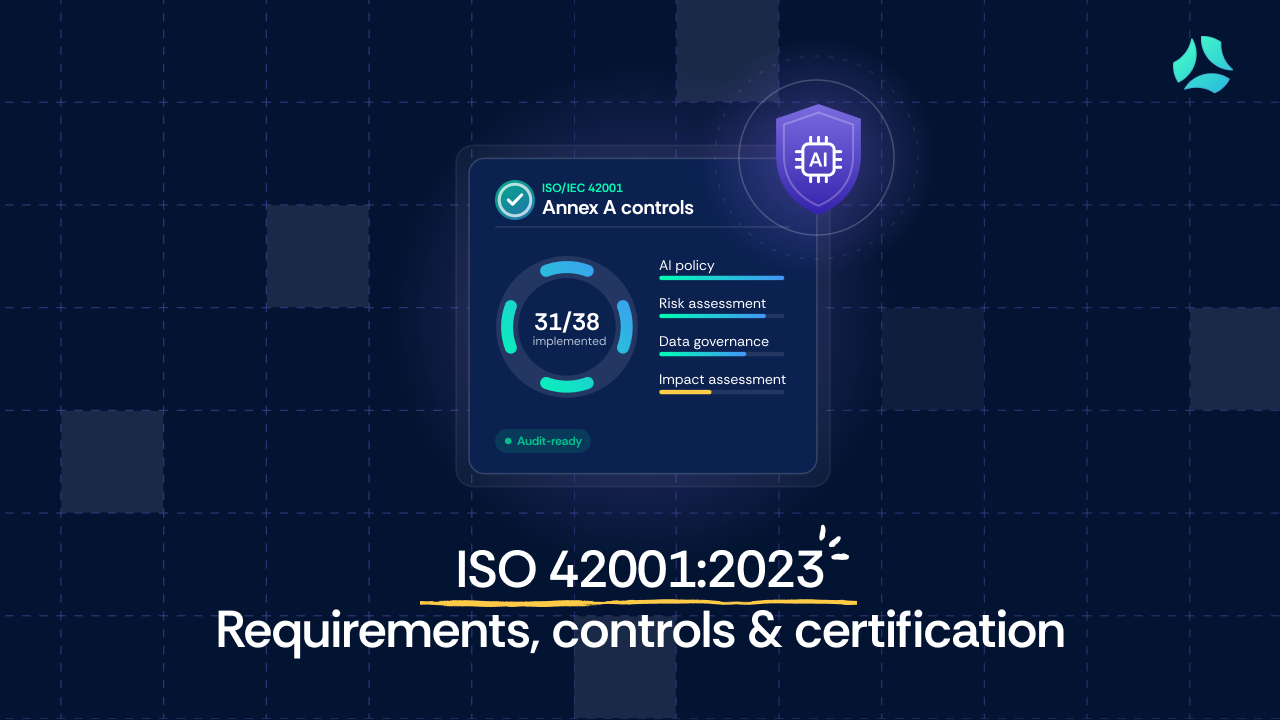


- ISO 42001:2023 is the first international standard specifying requirements for an Artificial Intelligence Management System (AIMS), applicable to any organization that develops, deploys, or uses AI.
- The standard contains 38 Annex A controls spanning AI policy, data governance, system impact assessment, and human oversight.
- Structurally, it mirrors ISO 27001, so organizations already certified can carry over most clause-level documentation with targeted edits.
- Certification requires an accredited third-party audit; scope your AIMS tightly (to a specific feature or product) before engaging a certification body.
- The AI system impact assessment, covering organizational, individual, and societal impacts, is the most substantively new artifact that ISO 27001 does not pre-build for you.
If you build, deploy, or sell products that use AI, the pressure to prove you govern it responsibly is no longer theoretical. It arrives from enterprise procurement teams, boards, investors, and regulators, often before a deal closes.
Buyers increasingly want a third-party-verified answer rather than a self-assertion. ISO/IEC 42001:2023 is the standard built for exactly that moment. It specifies requirements for an Artificial Intelligence Management System (AIMS), a structured way to establish, run, and continually improve how your organization manages AI.
Unlike a voluntary framework such as the NIST AI Risk Management Framework, ISO 42001 is certifiable, which is what makes it useful as a market-facing credential.
This guide covers what ISO 42001 requires, which Annex A controls are genuinely new if you already run ISO 27001, what auditors actually ask for, and how to get certified.
What is ISO 42001:2023?
ISO/IEC 42001:2023 is the first international standard that specifies requirements for an AI management system. It does not prescribe what to build. It specifies how to govern what you build, and how to prove you are doing it. The standard is designed to help organizations manage AI-related risks and demonstrate responsible development, deployment, and use, while leaving the specific implementation to each organization based on its context and risk exposure.
One detail auditors ask about early: which role your organization plays. ISO 42001 recognizes distinct organizational roles for AI, including provider, producer/developer, and user. A company can occupy more than one role depending on the system.
You have to determine which role or roles apply, because that decision drives your risk assessment and your statement of applicability for the AI governance controls.
A company fine-tuning and shipping its own model is not in the same position as one consuming a third-party model through an API, and the standard expects you to document which you are.
ISO 42001 does not work in isolation. It references a family of related standards for detailed guidance:
ISO 42001 supporting standards and technical specifications
When is ISO 42001 the right call versus NIST AI RMF alignment without formal certification? If your customers expect a third-party-certified attestation, or you operate in a regulated or enterprise-procurement-heavy market, ISO 42001 certification is worth pursuing. If you are primarily structuring internal AI governance and no one is asking you to prove it externally yet, aligning to the NIST AI RMF may be sufficient for now.
Who does ISO 42001:2023 apply to, and what does “scope” actually mean?
ISO 42001:2023 applies to organizations of any size or sector that develop, deploy, or use AI systems. But applying to you does not mean your entire enterprise has to be in scope. Scoping is a deliberate decision, and getting it right early saves substantial effort later.
You do not need to put every AI system in your company into your AIMS at once. When Scrut pursued its own ISO 42001 certification, the scope was limited to a single feature, the AI security questionnaire system, rather than the whole product. Confining the scope that way kept implementation and audit readiness focused and manageable. For a first certification, a tightly defined scope is usually the smarter path.
Defining scope means answering three things clearly: which AI systems are in, what role you play for each, and where your boundary sits with third-party model providers. That last point matters more than teams expect. If you build on foundation models from OpenAI, Anthropic, or others, you carry a documentation-heavy burden because you have to explain what those providers do that you do not control.
The parallel is the early days of cloud adoption, when companies suddenly had to explain to their own customers that compute and storage lived with AWS.
You now do the same for the models you consume. The catch is that model providers change behavior on their own schedule and with limited transparency, so you document what you can and manage the rest as third-party risk management.
Audit readiness Q&A mapping for ISO/IEC 42001 (AIMS)
For the risk work that flows from scoping, see our guide to AI risk assessments.
Key components of ISO 42001:2023
ISO 42001:2023 has two parts that matter for implementation: the main clauses, which set out how your AI management system must operate, and Annex A, which lists the AI-specific controls you select and apply. For teams already certified to ISO 27001, the distinction is useful because most of the familiar work sits in the clauses, while the genuinely new effort sits in Annex A.
The clause structure (Clauses 4–10)
ISO 42001:2023 follows the same Harmonized Structure as ISO 27001 and ISO 9001, the common clause architecture that ISO now applies across its management system standards.
Clauses 4 through 10 cover context, leadership, planning, support, operation, performance evaluation, and improvement. If you already operate an ISO 27001 ISMS, this is good news: the clauses are structurally the same, and most clause-level documentation carries over with minor edits, such as changing "ISMS" to "AIMS."
In Scrut's own implementation, the same ISMS clause documents were reused for ISO 42001 with only small changes. The clauses are not where the new work lives.
Annex A: The 38 AI-specific controls
The new work concentrates in Annex A, which contains 38 AI-specific controls organized across domains covering AI policy, organizational roles and responsibilities, resources for AI systems (data, tooling, computing), AI system impact assessment, AI system lifecycle, and responsible AI practices.
Not all 38 are net-new. Controls related to policy, roles, and the risk assessment process map cleanly from ISO 27001, with content shifting to AI while the structure holds. The genuinely new work concentrates in a handful of artifacts. The table below separates them.
ISO/IEC 42001 (AIMS) gap analysis for ISO 27001-certified organizations
If you already run an ISO 27001 program, the left column is largely done. The right column is where the new effort concentrates. Three artifacts stand out as the most distinct: the AI system impact assessment, the AI tool inventory, and the AI system lifecycle documentation. None of these has an ISO 27001 equivalent.
For the framework comparison behind these control choices, see ISO 42001 vs NIST RMF.
The AI system impact assessment (AIIA): the most important new artifact
The single most common friction point in an ISO 42001 audit is the AI system impact assessment. Teams often assume it is a relabeled risk assessment. It is not, and auditors will point that out.
The AIIA evaluates how an AI system affects three distinct areas: organizational impact (how the AI affects your own organization), individual impact (how it affects the people using the system), and societal impact (how it affects communities and society more broadly).
If an AI system generates a selection of a particular individual or community, for example, its outputs could be biased toward or against a specific group. That is a societal-impact concern the assessment has to surface.
The societal dimension is what separates the AIIA from every other artifact in your ISO 27001 program. A security risk assessment asks what could go wrong with your systems. The AIIA asks what could go wrong for the people and communities your AI system affects, including people who never interact with it directly.
That is a different analytical frame, and most teams do not have a template for it. AWS makes a similar case, describing the AIIA as a companion to the standard risk assessment that matters most for high-risk AI, since it brings ethical, legal, and societal consequences into view. A risk assessment tells you where your systems are exposed. An AIIA tells you who could be harmed and how.
In practice, the AIIA is a structured document that walks through each impact dimension with a documented assessment and a rationale. The auditor reviews it as a primary artifact, not as supporting evidence for another control, and not as an appendix to your risk register.
Everything else in Annex A is built around the assumption that you have done this assessment first. Skip it, and the rest of the controls are floating. The AIIA feeds your broader AI risk assessments and the responsible AI practices that the rest of Annex A exists to support.
Benefits of ISO 42001:2023 compliance
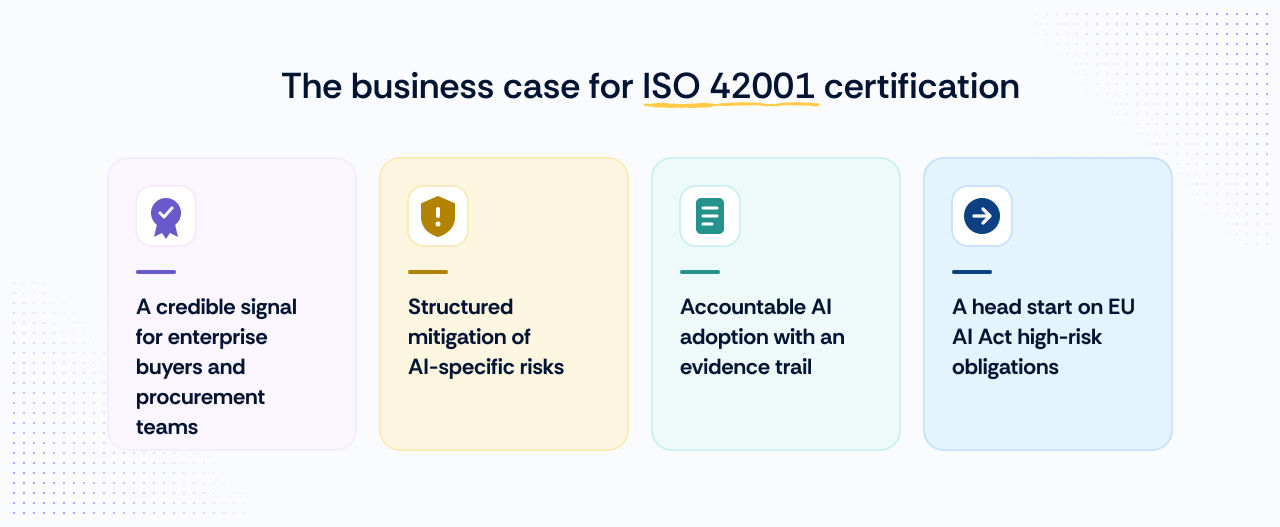
ISO 42001 certification takes real effort, so it helps to be clear about what you get in return. The payoff shows up in four places: how quickly you can answer buyers’ AI governance questions, how well you manage the risks AI introduces, how credibly you can back up your responsible AI claims, and how prepared you are as AI regulation takes effect.
A credible signal for enterprise customers and procurement teams
The most immediate benefit is commercial. Enterprise buyers increasingly ask what AI governance you have in place before they sign, and a certificate answers the question without a drawn-out back-and-forth.
Ziyad Basheer, founder and CEO of Aide, an AI-powered customer support platform, saw this play out with security compliance. Aide’s AI agents work through emails and chats that often contain sensitive customer details such as names and addresses, so prospects routinely asked about SOC 2, HIPAA, or GDPR compliance before moving forward.
As Basheer put it, “No one’s going to come and seek you out just because you have this type of compliance or that type of compliance. People come and seek you out for the features you offer. And then not having compliance could tank the deal.”
Compliance, in other words, works less as a door-opener and more as loss prevention. ISO 42001 does the same job one layer up. SOC 2 answers “Can we trust your security?” ISO 42001 answers “Can we trust how you govern your AI?” Third-party attestation is what lets you answer both with confidence.
Structured mitigation of real AI risks
The 38 controls exist because AI introduces failure modes that a standard IT risk assessment does not surface: prompt injection, unintentional training and data leakage, data or model poisoning, and hallucination in decision-making contexts. These are not abstract. Early risk identification today can save you significant cost tomorrow if a penalty or incident follows. For an ongoing approach, see continuous risk management for AI.
Improved trust, transparency, and accountable AI adoption
As Teri Green-Manson, VP of technology at Elevate, put it on Risk Grustlers: “AI is artificial. You are the intelligence.” That is not a philosophical point. It is a governance principle: the people deploying AI remain accountable for what it does. ISO 42001 gives that principle a paper trail, turning aspirational claims about fairness and oversight into evidenced ones.
ISO 42001 gives that principle a paper trail. Aspirational claims about fairness and oversight become evidenced ones.
Regulatory readiness ahead of EU AI Act enforcement
The regulatory trajectory is clear. If you use generative AI, you are assuming some risk, and identifying it early is cheaper than absorbing a penalty later. ISO 42001 gives you a structured head start on the documentation and governance that emerging regulation will expect. See our guides to the EU AI Act and broader AI compliance.
ISO 42001:2023 vs. NIST AI RMF: Which do you need?
Most teams ask this question when a customer or board first raises ISO 42001. The short answer: these frameworks are complementary, not competing. ISO 42001 is a certifiable standard; the NIST AI RMF is a voluntary framework. Many organizations use the RMF to structure their governance thinking first, then pursue ISO 42001 certification when a customer or market demands proof.
They do not conflict. NIST publications like the AI RMF are frameworks by design: not prescriptive. You are meant to apply them to your own context to structure your decision-making. ISO 42001 is different: it looks across everyone and expects you to have something that fulfills the role of an AI management system, even if you implement it differently.
One gives you a way to think; the other gives you a way to prove.
ISO/IEC 42001 vs. NIST AI RMF structural mapping
The practical question, when does certification justify the investment over framework alignment alone, usually has a clear answer. If a customer asks you for it, the decision is easy. If you operate in a business where customers expect transparency and third-party-certified attestations, that expectation is usually enough of a trigger on its own. A major product change or upcoming release that adopts new AI capability is another common prompt.
For deeper comparisons, see ISO 42001 vs NIST AI RMF and applying the NIST AI RMF.
What ISO 42001:2023 auditors actually ask for: evidence checklist
This is where first-hand experience matters more than theory. The following is grounded entirely in Scrut's own ISO 42001 audit, scoped to its AI security questionnaire feature.
The table below captures what was checked and questioned closely. Two items are worth calling out before you read it.
First, the AI system impact assessment was reviewed as its own standalone artifact, distinct from the risk assessment. The two are not interchangeable. Second, the data provenance and lineage controls were marked out of scope because Scrut was not training on customer data.
That single scoping decision meaningfully reduced the evidence burden, and it is a useful calibration point when you plan your own effort.
Evidence requirements for ISO/IEC 42001 (AIMS) audit readiness
For related material, see our guides to AI risk assessments, types of audit evidence, and running a compliance audit. Scrut's own path is documented in its ISO 42001 certification announcement.
AI risks ISO 42001:2023 is designed to govern
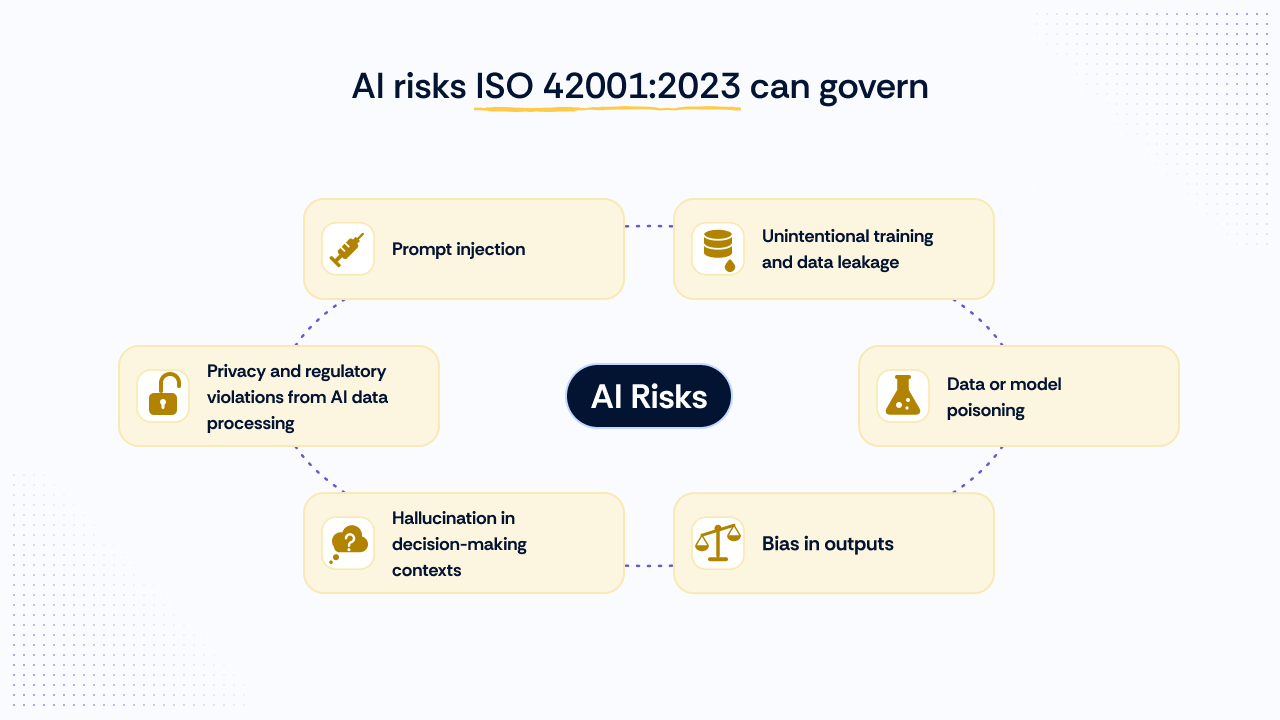
Traditional security controls were built for systems that behave predictably, where the same input produces the same output. AI breaks that assumption. Models can be manipulated through ordinary language, absorb flaws from the data they learn from, and produce errors that look entirely credible. The risks below are the ones ISO 42001’s controls are built to address, and understanding them makes it easier to see why the standard asks for the artifacts it does.
Prompt injection (direct and indirect)
Prompt injection is a form of input injection that uses a system to violate its own security policy. As Walter Haydock, founder and CEO of StackAware, explained, “Prompt injection is a specific form of input injection that uses a system to violate its own security policy. It's much more difficult to mitigate because with SQL injections, there is a finite number of acceptable inputs for a certain use case, but that's not really the case, especially with generative AI tools.”
Direct prompt injection comes from a malicious user; indirect prompt injection comes from a good-faith operator who stumbles onto maliciously crafted content, such as instructions hidden in a web page. There is no complete fix. Only layered mitigating controls.
Unintentional training and data leakage
Anything you send to a third-party model may become part of its training data, and what a model learns, it can repeat. Sensitive information shared today could resurface later in responses to the vendor or to other users. This risk has already played out at large companies.
Samsung banned employee use of ChatGPT after engineers reportedly uploaded sensitive internal source code to the tool. At Amazon, a corporate lawyer warned employees not to share confidential information with ChatGPT after seeing outputs that closely resembled internal company material. The mitigation starts with a clear policy on which data can go into which models, backed by redaction or pre-processing before anything sensitive reaches an external model.
Data or model poisoning
Unlike prompt injection, poisoning assumes the model itself has been corrupted, either through poisoned training data that changes the model's operation, or a maliciously seeded model introduced into your supply chain. It is a high-difficulty, high-payoff attack, and it is why lifecycle and provenance controls exist.
Bias in outputs
Historical data carries the decisions humans made, including the bad ones. Feed that into a model, and the model learns the pattern, not the exception. A hiring tool trained on a decade of approvals from a homogeneous workforce will not magically produce diverse shortlists. The AIIA's societal impact dimension exists precisely because this failure mode is invisible until it is not.
Hallucination in decision-making contexts
Generative AI produces confident, fluent output regardless of accuracy. Taking that output at face value puts an organization at risk of not just consuming inaccurate information but perpetuating it.
Anything that can sound really clear and confident and be completely wrong is genuinely dangerous. That is precisely why human-in-the-loop review is a documented control requirement in ISO 42001, not an optional add-on.
Privacy and regulatory violations from AI data processing
AI processing amplifies the liability of over-collection. The guiding principle is to collect and process the minimum data necessary for the task, which connects directly to ISO 42001's data governance controls. Every additional data point you hold is additional surface area the AI can amplify. See vendor risk assessment AI challenges for how this plays out in practice.
For more depth, see generative AI security risks, AI hallucinations in GRC, and large language models and third-party risk.
Achieving ISO 42001:2023 certification
ISO/IEC 42001:2023 was published in December 2023, and accredited certification has been available since. In July 2025, ISO/IEC 42006 followed, setting out requirements for the certification bodies that audit AI management systems, including auditor competence and how audit time is calculated.
That gives buyers more confidence that an ISO 42001 certificate means the same thing regardless of who issued it. Scrut has itself achieved ISO 42001 certification.
Understanding the risks ISO 42001 governs makes the certification question easier to answer: if these are the failure modes your customers and regulators care about, a third-party-verified management system is the most credible way to demonstrate you have addressed them.
The path breaks into four practical steps:
1. Define your AIMS scope. Decide which AI systems are in scope and which organizational role you play for each. A tight scope, a single feature or product, is the recommended starting point.
2. Conduct a gap analysis against Annex A controls. Separate what carries over from ISO 27001 (policy, roles, risk assessment process, supplier management) from what needs new work.
3. Implement the genuinely new artifacts. These have no ISO 27001 equivalent. Budget time for them separately from your clause-level work: the AI system impact assessment, the AI tool inventory, and your system implementation documentation. The AIIA is the highest-effort item of the three.
4. Engage an accredited certification body. The audit runs in two stages: Stage 1 (document review) and Stage 2 (operational effectiveness). If you have been through a SOC 2 Type II audit, the two-stage structure will feel familiar. Our SOC 2 readiness assessments guide draws the structural parallel.
On whether to certify or simply align: the clearest trigger is customer demand. If your customers expect third-party attestations, or you are in a regulated or enterprise procurement context, certification earns its cost.
How can Scrut help in the implementation of ISO 42001:2023?
Scrut has been through ISO 42001 certification itself, which is a more credible signal than any feature list. We have done the work, hit the friction points, and documented what auditors actually check. That experience shapes how the platform supports implementation:
- Pre-built AIMS control framework that maps ISO 42001 Annex A controls against your existing ISO 27001/SOC 2 controls, identifying carry-over versus new work so teams avoid duplicating effort.
- AI system impact assessment workflow: A guided documentation path for the AIIA, the artifact that most often causes audit friction, covering organizational, individual, and societal impact dimensions.
- AI tool inventory and evidence collection that automates evidence for AI-specific controls, tool inventory, system documentation, and human-in-the-loop confirmation, so evidence collection runs continuously rather than as a pre-audit scramble.
See how Scrut approaches the AI management system and the platform's broader GRC automation.
Conclusion
ISO 42001:2023 is the operational backbone for organizations that need to prove responsible AI governance, not just claim it. The regulatory trajectory is set: the EU AI Act continues to roll out in phases, with high-risk obligations now due from December 2027, and customers increasingly expect AI governance documentation during procurement. ISO 42001 is the only international standard that lets an independent auditor certify how your organization governs AI.
If you already run an ISO 27001 program, most of the clause-level work is done, and the new effort concentrates in a handful of AI-specific artifacts. The harder part is not compliance. It is knowing which artifacts are genuinely new and building them well.
See how Scrut maps ISO 42001 controls to your existing responsible AI and compliance program. Book a demo today.
ISO 42001:2023 is a certifiable international standard producing a third-party certificate. The NIST AI RMF is a voluntary U.S. framework with no certification output. They are complementary: many organizations use the NIST AI RMF to structure internal governance thinking before pursuing ISO 42001 certification. Neither conflicts with the other; ISO 42001's Annex A controls can be mapped to the AI RMF's four functions (Govern, Map, Measure, Manage).
ISO 42001:2023 Annex A contains 38 AI-specific controls. Organizations already certified to ISO 27001 can carry over a significant portion with modifications, including policy structure, roles, and the risk assessment process. The genuinely new controls center on AI system impact assessment, AI tool inventory, data provenance, and lifecycle documentation.
The clause structure (Clauses 4–10) is structurally identical, so most clause-level documentation carries over with minor edits, such as replacing "ISMS" with "AIMS." The genuine new work concentrates in Annex A: the AI system impact assessment (a new three-dimensional document covering organizational, individual, and societal impacts), AI tool inventory, data provenance documentation, and AI system lifecycle documentation. Expect a handful of new artifacts that have no ISO 27001 equivalent.
Yes. Scope definition is a required first step in AIMS implementation. You can define scope narrowly, for example, to a single customer-facing AI feature, rather than covering the entire enterprise. Tight scoping reduces the certification burden significantly and is a recommended approach for initial certification. Scrut's own first certification was scoped to its AI security questionnaire feature.
Auditors focus on the AI-specific artifacts: the AI system impact assessment (organizational, individual, and societal impact), a dedicated AI risk assessment covering guardrails and customer data isolation, an AI tool inventory of the models and systems you use to build your own AI, system implementation documentation (infrastructure, design rationale, human-in-the-loop review), your AIMS scope statement, and your documented role determination. Data provenance controls may be marked out of scope if you do not train on customer data.