





- California’s data broker registration law sits alongside CCPA as a separate obligation, and passing a CCPA review doesn’t tell you whether it applies.
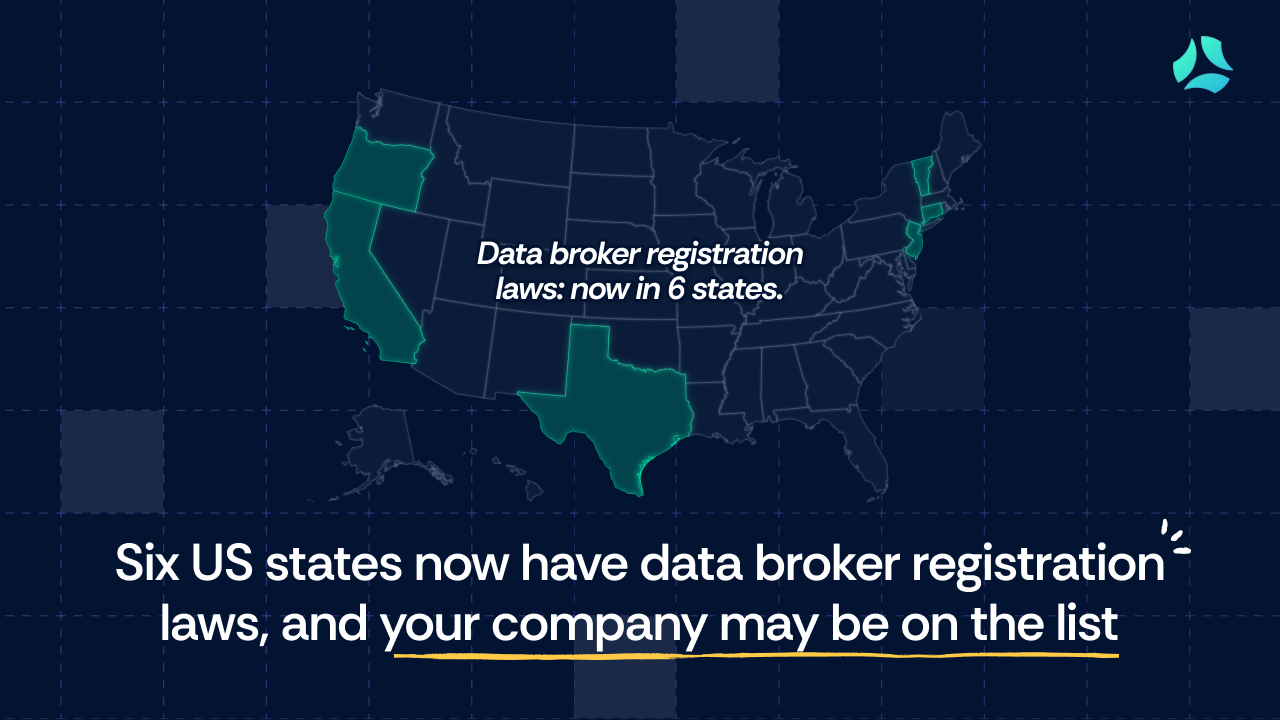
- Vermont, Texas, Oregon, Connecticut, and New Jersey have also enacted data broker laws, so this is now a 6-state obligation.”
- 'Data broker' is defined more broadly than most legal teams assume: if your product sells or licenses consumer data without a direct relationship with those consumers, you likely qualify.
- CCPA compliance does not satisfy data broker registration. These are separate, additive obligations.
- New Jersey's law, signed June 30, 2026, immediately banned the sale of sensitive data and set registration fees up to $1.5 million annually, the highest in the country.
You probably think this doesn't apply to you. Read the definition again.
A compliance leader at a B2B analytics company receives a vendor questionnaire. One question asks: is your company registered as a data broker in California? Their legal team has never considered it. They passed a CCPA compliance review and assumed that settled the matter. It did not. California Civil Code §§1798.99.80–1798.99.88 defines a data broker as a business that knowingly collects and sells to third parties the personal information of a consumer with whom the business does not have a direct relationship.
That definition exists independently of CCPA and has been in force since January 1, 2020. Failing to register costs $200 per day, plus unpaid fees and the agency’s investigation costs. Many CCPA-compliant companies have never evaluated this separately. See data privacy regulations for the broader landscape.
This piece is a follow-up to our earlier blog on the U.S. privacy law patchwork, which covered the general state privacy law landscape. This one focuses specifically on data broker registration laws, which are a distinct and growing category of obligations that most compliance programs have not yet absorbed.
California's data broker law: Registration, deletion, and the Delete Act
California's data broker framework has two layers. The original 2020 registration law (Civil Code §§1798.99.80–1798.99.88) requires annual registration, a fee, and name and website disclosure. The California Delete Act (SB 362, October 2023) expanded this with the DROP platform (live 2026), which lets consumers submit a single deletion request triggering all registered brokers simultaneously. Brokers must process DROP requests every 45 days. Independent audits are required from 2028.
Administration of the data broker registry transferred from the California Attorney General to the California Privacy Protection Agency under the Delete Act. The CPPA has materially more enforcement capacity and budget than the AG previously applied to data broker enforcement.
See CPRA and its implications and data privacy terminology for supporting context.
The definition is wider than you think, and your legal team may have missed it
The statute definition hinges on two conditions: the business knowingly collects and sells personal information to third parties, and the business does not have a direct relationship with the consumer whose data it collects. If both conditions are met, the business is a data broker under California law regardless of how it describes itself.
Business models that commonly trigger data broker registration: analytics and enrichment platforms that license aggregated consumer data; marketing technology companies that sell audience segments or targeting data; HR tech platforms licensing candidate data from third-party sources; AI training data companies that compile and license consumer datasets; and advertising technology intermediaries facilitating data transfers without a direct consumer relationship.
The key definitional lever is 'direct relationship.' A company that collects data about consumers from third-party sources and then sells or licenses it likely meets both conditions, even if the company considers itself a B2B enterprise software vendor whose customers are businesses, not consumers.
Quick applicability test: if you collect consumer data from third-party sources (purchased, scraped, from partners) and sell or license that data to others, you likely qualify in every state with a data broker law. If you process only data your customers give you directly and do not resell it, you likely do not. The grey area: platforms that aggregate data across clients and license aggregated insights. Get legal counsel for that case.
See mapping your data flows for how to conduct the inventory that precedes this applicability analysis.
Vermont was first. 5 states followed. Here’s the list.
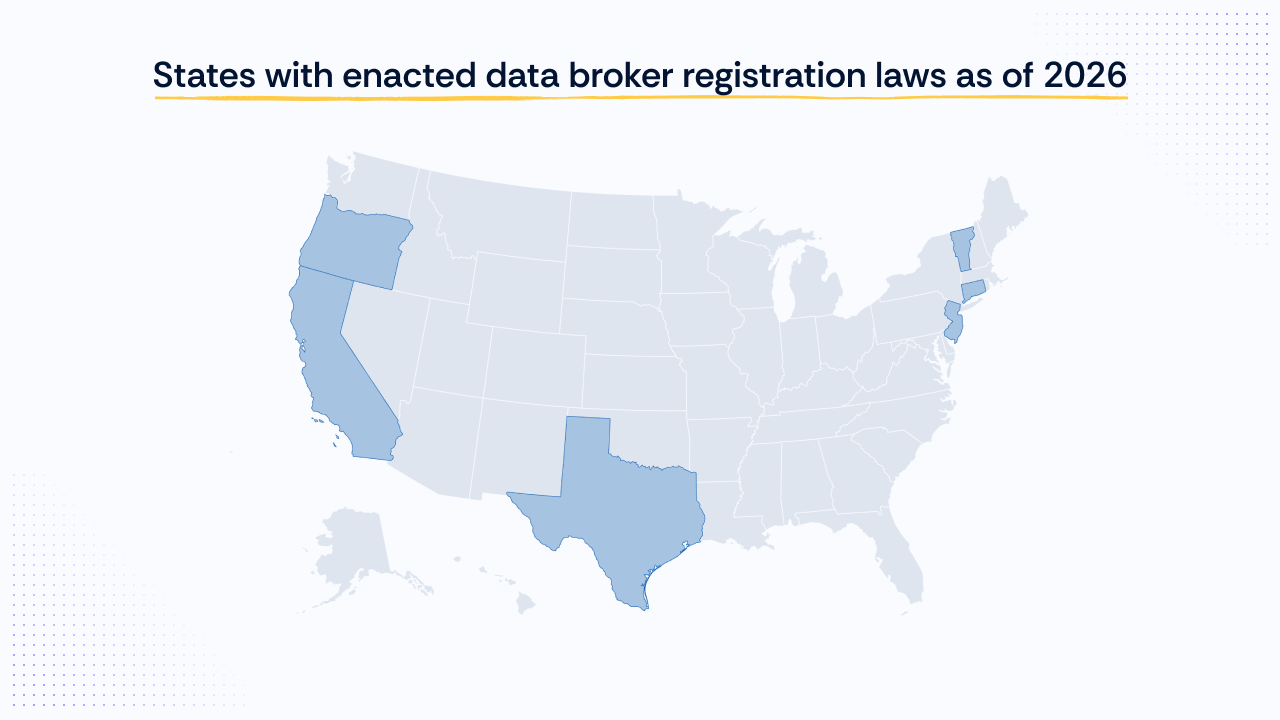
Six states have now enacted data broker registration laws as a distinct category of obligation, separate from their general consumer privacy frameworks. Vermont was first in 2018. California followed in 2020. Texas and Oregon added their laws in 2023. New Jersey enacted the most sweeping version yet in June 2026.
New Jersey's law introduces a category that no other state has: 'data collectors,' defined as businesses that collect personal data directly from consumers and sell it to data brokers. This means companies with a direct consumer relationship that sell that data onward may now face registration obligations in New Jersey that did not apply under any other state's data broker law. Registration fees are also the highest in the country: up to $1.5 million annually for the largest data sellers.
Watch for centralized deletion requirements. Connecticut has directed the creation of a universal deletion mechanism by 2028. . Enactment has sped up. Vermont’s 2018 law was joined by California’s in 2019, then 4 more states passed laws between 2023 and 2026.
See 2026 data privacy trends and compliance across jurisdictions for the broader multi-state compliance picture.
CCPA compliance does not cover your data broker registration obligation
It’s easy to assume CCPA or CPRA compliance covers data broker obligations. It doesn’t. A company can be fully CCPA-compliant with a valid privacy notice, a working opt-out mechanism, and a functioning DSAR process, and still be unregistered as a required data broker.
A B2B data platform that completed CCPA compliance typically built three things: a privacy policy, a 'do not sell my personal information' link, and a process for responding to consumer rights requests. None of these constitute registration under California Civil Code §§1798.99.80–1798.99.88. Registration is a separate filing obligation that requires payment of a fee, annual renewal, and, under the Delete Act, a process for honoring deletion requests arriving through the DROP platform.
The concrete difference: CCPA compliance typically produces a privacy policy, an opt-out link, and a DSAR response process. None of those constitute registration under Civil Code §§1798.99.80–1798.99.88. Registration requires a separate filing, an annual fee, and a deletion request workflow tied to the DROP platform. “CCPA has revenue and data-volume thresholds. California’s data broker registration has none, so your business model is the trigger, not your company size. Texas is the exception, with thresholds of its own. .See framework overlap and gaps and compliance risk assessment for how to map additive obligations in your existing program.
If you qualify as a data broker, here is what you need to build
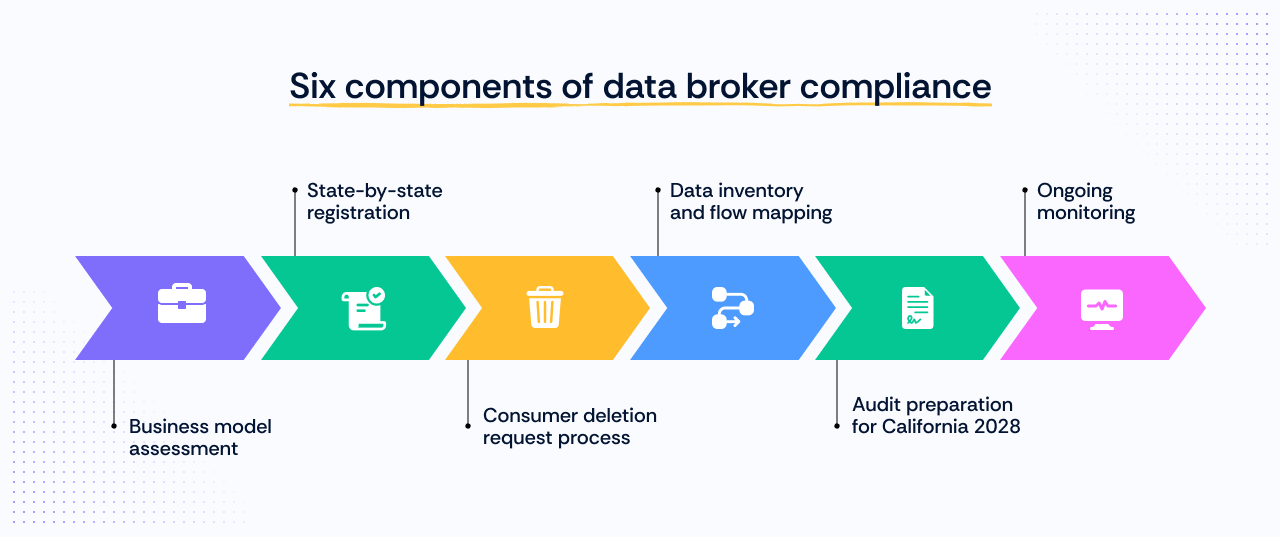
The minimum viable data broker compliance program has six components. Legal counsel is required for the applicability assessment; the remaining components are operational.
1. Business model assessment. Does your business sell or license consumer personal information to third parties? Do you have a direct relationship with those consumers? If yes to the first and no to the second, conduct a formal applicability analysis with legal counsel in each state where you may qualify.
2. State-by-state registration. Identify which of the five states apply to your business model. Complete annual registration in each applicable state and build a renewal calendar. California and Vermont require renewal by 31 January. Texas renews on your registration anniversary. Confirm Oregon’s annual window, and add Connecticut (from 1 January 2027) and New Jersey (first window 1 April to 30 June 2027).
3. Consumer deletion request process. Map how consumers will submit deletion requests in each state. In California, the DROP platform is now live and deletion requests must be processed every 45 days. Document each request and its disposition.
4. Data inventory and flow mapping. Know what consumer data you collect, from whom, and to whom you sell or license it. This is the evidentiary foundation for applicability analysis, registration, and audit readiness. See data flow mapping.
5. Audit preparation for California 2028. California's Delete Act requires independent audits of data brokers from 2028. Companies that register now and build clean documentation are better positioned when audits begin.
6. Ongoing monitoring. Delaware, Michigan, and Alaska have data broker legislation in development. Build a process for tracking new state enactments.
Minimum viable data broker compliance checklist:
- Business model assessment completed with legal counsel
- Applicability determination documented per state (CA, VT, TX, OR, NJ)
- Registration filed in applicable states; annual renewal calendar set
- Consumer deletion request workflow built and tested; California DROP integration confirmed
- Data inventory and flow map current
- State data broker law monitoring process in place
Data broker obligations belong in your GRC program, not only in your legal tracker
Data broker registration requirements have the same structural characteristics as other GRC obligations: annual renewal cycles, evidence requirements (registration records, deletion request logs, audit documentation), multi-jurisdictional complexity, and enforcement risk. Companies that treat this as a one-time legal exercise handled by outside counsel will miss renewal deadlines, fail to update registrations as laws change, and have no audit trail when the CPPA or a state AG requests records.
Scrut's compliance framework mapping and continuous monitoring capabilities allow privacy and GRC teams to track data broker registration obligations alongside ISO 27001, SOC 2, and GDPR programs in one place, with reminders, evidence collection, and named owners for each obligation. See continuous compliance monitoring, GRC automation, and privacy compliance in Scrut for how this works in practice.
Your next 30 days: a practical starting point
1. Evaluate your business model against the California data broker definition (Civil Code §1798.99.80) and, where applicable, Vermont, Texas, Oregon, Connecticut, and New Jersey definitions. Do this with legal counsel.
2. Check the California data broker registry (cppa.ca.gov) to confirm whether your company is currently registered or should be. The registry is public.
3. Audit your deletion request workflow. The California DROP platform is now live. Can your workflow handle requests arriving through that platform every 45 days?
4. Add data broker registration renewals to your compliance calendar. Treat them like SOC 2 or ISO 27001 renewal milestones: named owner, deadline, evidence required.
5. Monitor new state enactments. Delaware, Michigan, and Alaska have legislation in development. This list will grow.
See compliance risk management and continuous compliance program for the operational model.
California's data broker law (Civil Code §§1798.99.80–1798.99.88, effective January 1, 2020) requires businesses that knowingly collect and sell personal information of consumers with whom they have no direct relationship to register annually with the California Privacy Protection Agency. The California Delete Act (SB 362, 2023) strengthened this law by adding a unified consumer deletion platform (DROP, live 2026) and independent audit requirements from 2028.
CCPA compliance focuses on consumer rights: access, deletion, and the right to opt out of data sales. Data broker registration is a separate, additive obligation: businesses that sell consumer data without a direct consumer relationship must register with the state, pay an annual fee, and process deletion requests. A company can be fully CCPA-compliant and still be unregistered as a required data broker.
As of 2026, 6 states have enacted data broker registration laws: Vermont (2018), California (2019, strengthened 2023), Texas (2023), Oregon (2023, effective 2024), Connecticut (2026, registration from 2027), and New Jersey (2026). Vermont was the first. California's regime is the most comprehensive. New Jersey's law, signed June 30, 2026, has the highest registration fees in the country (up to $1.5 million annually) and also applies to 'data collectors,' a new category no other state has defined.