


%20(1).png)
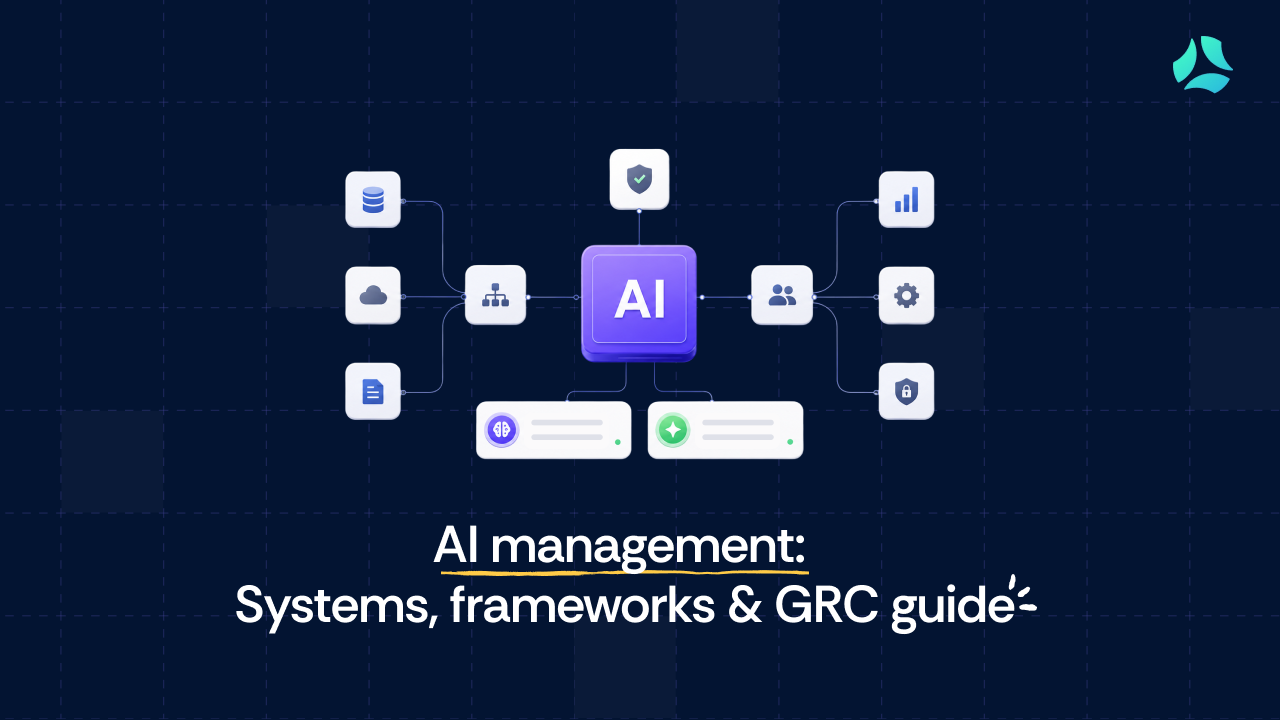


- An AI management system (AIMS) is a structured approach for governing AI systems throughout their lifecycle, including development, deployment, operation, and monitoring. It helps organizations manage AI risks, compliance requirements, data governance, transparency, and accountability.
- Key references for building an AIMS include ISO/IEC 42001, the NIST AI Risk Management Framework (AI RMF), and AI regulations such as the EU AI Act. Together, they guide organizations on responsible AI governance, risk management, and control implementation.
- GRC and Security teams play a central role in operationalizing AIMS by maintaining AI inventories, assessing AI risks, implementing controls, assigning ownership, monitoring systems, and maintaining audit-ready evidence.
- Without effective AI governance, organizations may face risks such as prompt injection, data exposure, biased outcomes, AI hallucinations, privacy violations, and regulatory non-compliance.
McKinsey’s recent research shows that AI is delivering measurable value at the use-case level, with organizations reporting cost and revenue benefits from AI deployments. However, as adoption grows, organizations are also facing expanding AI governance and regulatory requirements.
For GRC Managers and Security Managers, this creates a growing squeeze. AI systems are being adopted across the business faster than governance frameworks can track them, and you are being asked to design controls for tools you had no hand in procuring. The starting point is a structured approach: an AI management system.
This blog explains what an AI management system is, how it works, and why AI governance requires extending your existing GRC practices with AI-specific controls and processes.
What is an AI management system (AIMS)?
An AI management system is a structured approach for establishing, implementing, maintaining, and improving processes to oversee the development, deployment, operation, and risk management of AI systems across an organization. It applies to any AI system used in organizational decision-making, including internal operational tools and not just customer-facing applications.
The reason AIMS exists as a distinct approach from traditional IT governance is that many AI systems introduce new types of uncertainty and risk.
Traditional software is usually designed around defined logic and expected behavior. Teams can test inputs, validate outputs, and manage changes through established software lifecycle processes.
AI systems, especially generative AI, work differently. They generate outputs based on patterns learned from data, which means outputs can vary, change over time, or produce inaccurate information. AI systems can also introduce risks around transparency, accountability, and human oversight.
You cannot validate an AI system once and assume it will remain reliable forever. Governance needs to be continuous, with controls for monitoring, risk assessment, output validation, and human review built into the AI lifecycle.
An effective AI management system typically addresses areas such as:
Risk management
Identifying, assessing, and mitigating AI-specific risks, from data leakage and security threats to reliability and bias risks. These risks are then translated into treatment decisions for each AI system.For public safety applications, gunshot triangulation technology also requires careful evaluation of accuracy, privacy concerns, and the potential consequences of false alerts.
Regulatory compliance
Aligning AI deployments with relevant standards and regulations, such as ISO 42001, the NIST AI RMF, and applicable requirements from the EU AI Act. This helps define governance expectations, audit scope, and evidence requirements.
Ethical oversight
Establishing processes for fairness, transparency, accountability, and responsible AI use to reduce the risk of harmful or discriminatory outcomes.
Performance monitoring
Continuously evaluating AI system performance, monitoring for drift or unexpected behavior, and maintaining audit logs to support traceability and review.
Data governance
Managing training data quality, data lineage, privacy obligations, and controls for third-party AI services. Organizations need visibility into how AI vendors handle submitted data, including retention, processing, and model improvement practices.
Accountability structures
Defining clear ownership for AI oversight activities. Governance processes need assigned responsibilities to be enforceable and effective.
The AI governance approaches GRC teams need to understand
Three widely referenced approaches shape AI governance discussions globally: ISO/IEC 42001, the NIST AI Risk Management Framework (AI RMF), and the EU AI Act. They overlap on core principles such as risk management, accountability, transparency, and responsible AI use. However, they differ significantly in purpose: one is a certifiable management system standard, one is a voluntary risk management framework, and one is a regulation with legal obligations.
That distinction matters for GRC teams because each approach changes what you need to implement, document, monitor, and prove.
ISO/IEC 42001
ISO/IEC 42001:2023 is the first international management system standard focused specifically on artificial intelligence. It provides requirements for establishing, implementing, maintaining, and continuously improving an AI management system.
It follows the Plan-Do-Check-Act (PDCA) approach:
Plan: Define the scope of your AI management system, identify AI risks, set objectives, and establish policies and processes.
Do: Implement controls, operational processes, and safeguards across the AI lifecycle, including areas such as data governance, risk treatment, and accountability.
Check: Monitor AI system performance, evaluate whether controls are effective, and conduct reviews and audits.
Act: Address gaps, improve processes, and update controls based on changes in AI systems, risks, or business requirements.
For GRC teams, the key distinction is that ISO/IEC 42001 can lead to certification through an accredited certification body. The certification demonstrates that an organization has implemented an AI management system aligned with the standard. It is not a regulatory approval or a one-time “AI compliance badge.”
NIST AI Risk Management Framework (AI RMF)
The NIST AI RMF is a voluntary framework designed to help organizations identify and manage AI risks. Unlike ISO/IEC 42001, it is not certifiable. Instead, it provides guidance that organizations can adapt based on their AI use cases and risk tolerance.
The framework is built around four functions:
Govern: Establish governance structures, define accountability, set risk tolerance, and create policies for responsible AI use.
Map: Identify where and how AI is being used, understand the context, and document the risks associated with each system.
Measure: Evaluate AI risks through appropriate testing, monitoring, validation, and performance assessments.
Manage: Prioritize and address identified risks through mitigation plans, controls, and ongoing monitoring.
The NIST AI RMF is intentionally flexible. It defines desired outcomes rather than prescribing exact implementation steps. For GRC teams, this means it can complement existing risk management practices while allowing organizations to adapt controls based on their environment.
It also works alongside the NIST Cybersecurity Framework (CSF), where AI risk management and cybersecurity practices intersect.
EU AI Act
The EU AI Act is a regulation that establishes legal requirements for AI systems based on their level of risk. It classifies AI systems into categories such as prohibited AI, high-risk AI, limited-risk AI, and minimal-risk AI, with stricter obligations applying to higher-risk systems.
Depending on the classification and use case, organizations may need to address requirements related to:
- Risk management processes
- Technical documentation
- Transparency and information requirements
- Human oversight
- Monitoring and reporting obligations
Unlike ISO/IEC 42001 and the NIST AI RMF, the EU AI Act creates mandatory legal obligations and includes penalties for non-compliance. It can apply to organizations outside the EU if their AI systems are placed on the EU market or affect individuals in the EU.
For GRC teams, the challenge is translating these requirements into practical controls, ownership models, evidence collection, and ongoing monitoring.
What these approaches have in common: The GRC Manager’s lens
While ISO/IEC 42001, NIST AI RMF, and the EU AI Act serve different purposes, they emphasize similar governance principles.
Risk management
Each approach requires organizations to identify, assess, and address AI-related risks throughout the AI lifecycle.
GRC implication: Your risk register needs to account for AI-specific risks, not just traditional security and compliance risks.
Accountability and ownership
AI governance requires clearly defined responsibilities for managing AI systems and related risks.
GRC implication: Controls need assigned owners, documented processes, and evidence trails that remain effective even when teams or systems change.
Transparency and responsible AI
Each approach emphasizes transparency, oversight, and responsible AI practices.
GRC implication: Activities such as AI assessments, monitoring, and reviews become ongoing control activities that require documentation and proof.
The AI risks your governance program needs to account for
The risks below are not hypothetical. They come from practitioners running live AI deployments, and each one has a control response that belongs in your risk register.
Prompt injection (direct and indirect)
Direct prompt injection is a user manipulating a model into producing outputs or executing actions the operator never intended, for example, by jumping a model’s safety layers through payload splitting. Indirect prompt injection is subtler: an autonomous agent navigates to a web page with embedded malicious instructions and acts on them, even though the operator is a good-faith actor. Both need to be classified, assessed for likelihood in each deployment context, and met with documented controls.
Unintentional training and data leakage
When employees submit sensitive data, including PII, PHI, trade secrets, or credentials, to a third-party model, that data may be retained and surfaced to other users.
Samsung and Amazon have both reportedly been affected by versions of this. The control response is an AI Acceptable Use Policy plus pre-processing controls such as anonymization before submission.
Algorithmic bias
Models trained on historical data inherit the biases in that data. Amazon’s AI recruitment tool, which penalized resumes containing words such as “women’s,” is the widely cited example. Trained on historically male-dominated hiring data, it perpetuated that pattern. GRC teams need bias auditing protocols, diverse training data requirements, and stakeholder review.
AI hallucinations in decision-making
Generative AI is designed to produce an output even when it lacks grounding. When a hallucinated output informs a business, legal, or safety decision, the consequences are material. The reported Japanese police custody case, where an AI-influenced decision preceded a child’s death, illustrates the stakes. The control response is output validation and clear documentation of where AI outputs may and may not be used autonomously.
Data poisoning
Data poisoning refers to intentional corruption of training data to manipulate model behavior. It can be subtle: a model that behaves normally 99% of the time but executes a malicious action under specific trigger conditions. GRC teams must assess supply chain risk for any externally sourced model and validate training data provenance.
Privacy regulation violations specific to AI
GDPR, HIPAA, and CCPA apply to AI-generated and AI-processed data. Key risks include failure to honor right-to-erasure once data has been used in training; biometric processing triggering enhanced GDPR obligations; and overcollection of personal data during AI onboarding. These are laws with enforcement penalties, not certifications. There is no "GDPR certified" credential a platform checklist can produce.
An AI management system helps operationalize these controls by defining ownership, risk assessment processes, monitoring activities, and evidence requirements across the AI lifecycle.
How to use AI in project management: What GRC teams need to govern
AI can support project management through task automation, predictive scheduling, risk identification, resource planning, and meeting summarization. Each use case introduces governance considerations, including access control, output validation, human oversight, bias assessment, and data protection requirements.
The use cases below are where many teams start, along with the governance considerations attached to each:
These use cases sit on a spectrum of decision autonomy, from AI that assists human decision-making to systems that can take actions independently. An AI management system provides the governance structure needed to classify each use case, assess its risks, assign ownership, and apply appropriate controls so AI improves project workflows without introducing unmanaged risk.
How to implement an AI management system: A practical starting point for GRC teams
If you have been handed the AIMS mandate and need to know where to start, the sequence below uses concepts from ISO/IEC 42001’s PDCA approach and the NIST AI Risk Management Framework as practical guidance for building an AI governance program.
Phase 1: Define context and scope
Inventory every AI system in use, including shadow AI: tools employees have adopted without formal IT approval, as well as AI capabilities embedded in existing business applications. For each system, document its intended purpose, deployment context, data inputs, output usage, and whether outputs influence decisions independently or with human review.
Defining context first makes the rest of the program possible because the context determines the risk profile for everything downstream.
Phase 2: Establish AI risk governance structure
Establish an AI governance structure with clearly assigned ownership and accountability. Develop an AI Risk Policy that defines acceptable and prohibited AI uses, risk tolerance, approval processes, and escalation paths.
Document responsibilities across relevant teams, including GRC, Security, Legal, Privacy, Engineering, and business owners.
Phase 3: Risk assessment and register
Conduct a risk assessment for each in-scope system, using the NIST AI RMF functions as a reference for identifying and assessing risks. Produce an AI risk register documenting identified risks, likelihood, impact, treatment decisions, and residual risk.
Keep the underlying distinctions clear: inherent risk is your exposure before controls; residual risk is what remains after controls are applied; risk appetite is the level of risk leadership is willing to accept; risk tolerance defines operational thresholds that trigger action.
Phase 4: Control design and implementation
Design controls across three layers for each identified risk:
- Preventative: data minimization, masking or anonymization where appropriate, access controls, AI acceptable use policies, and input safeguards.
- Detective: audit logging, AI system monitoring, drift detection, bias evaluations, and output reviews.
- Corrective: AI incident response procedures, remediation workflows, and processes for updating or retiring AI systems.
Then document applicable regulatory and contractual requirements based on your operating environment and AI use cases.
Phase 5: Audit, review, and continuous improvement
Establish a review cadence to evaluate whether AI controls remain effective as systems, models, and risks change. For certified organizations, ISO/IEC 42001 audits involve ongoing assessment activities, including surveillance audits.
Maintain evidence of control operation over time, not just control design. Similar to the distinction between SOC 2 Type I and Type II, demonstrating that controls operate effectively provides stronger assurance than documenting intended processes alone.
Document testing activities, metrics, monitoring results, and validation records for each AI system.
Common challenges in implementing AI management systems
An AI management system helps bring structure to AI adoption, but implementation comes with practical challenges such as:
Keeping pace with a fragmented, evolving regulatory landscape
AI regulation is evolving rapidly, with requirements emerging at different speeds across jurisdictions. For GRC teams, this creates a challenge: building governance processes while expectations continue to change. A practical approach is to anchor AI governance around stable standards such as ISO/IEC 42001 or the NIST AI Risk Management Framework, while maintaining regulatory mappings as living documents.
Governing AI tools you did not procure
Employees adopt AI tools regardless of formal approval processes. When AI capabilities are introduced across teams, organizations often discover gaps in data classification, access management, and acceptable use practices. The governance response is pragmatic: identify what AI systems are being used, classify their risks, and enable responsible adoption rather than pushing usage into unmanaged channels.
Third-party AI risk and vendor supply chain exposure
Third parties may use AI to generate code, process customer data, or support business operations, and organizations may have limited visibility into these practices. A vendor using AI for software development creates a different risk profile than one using AI for internal documentation. Extend vendor risk assessments with AI-specific questions covering model usage, data handling, retention practices, and output validation processes.Weighing Baseten alternatives for hosted inference forces the conversation about infrastructure ownership, regional routing, and data residency that vendor risk reviews often skip.
Detecting and mitigating algorithmic bias in deployed models
Bias can enter through training data, system design, or implementation choices and create unfair outcomes throughout the AI lifecycle. Amazon’s recruitment tool is a commonly cited example of how historical data patterns can influence AI-driven decisions. For GRC teams, this means bias management cannot exist only as a policy. It requires ongoing testing, monitoring, documentation, and stakeholder review.
Balancing innovation velocity with governance rigor
The business wants to move quickly, while governance teams are responsible for managing risk. The goal is not to eliminate risk entirely, but to manage it based on business impact and risk appetite. A low-risk internal productivity tool may require different controls than an AI system influencing customer decisions, hiring outcomes, or autonomous actions. Applying proportional controls helps organizations adopt AI without creating unmanaged exposure.
How Scrut supports AI management system implementation
The five challenges above are real, and none of them has a purely technical solution. Where a platform helps is in reducing the manual evidence work and giving the GRC Manager continuous visibility, so the program does not depend on one person's memory or a quarterly spreadsheet.
Streamlined compliance management: Scrut tracks requirements across the NIST AI RMF, ISO 42001, and the EU AI Act in one place. When a new framework comes into scope, controls you already have evidence for are mapped across automatically, so you are only asked to address the net-new requirements. That shrinks the duplicate work that comes with multi-framework programs.
Risk management and mitigation: Scrut supports the risk register and treatment workflow described in Phase 3, giving GRC teams a single source for identified risks, treatment decisions, and residual risk, rather than a spreadsheet that goes stale.
Comprehensive auditing and reporting: The platform generates audit trails and evidence packages, so you can demonstrate control effectiveness, not just control design, to an auditor or enterprise reviewer.
Continuous monitoring: Scrut surfaces control drift and compliance gaps as they occur, not on your next quarterly review. That is what the Phase 5 cadence requires between formal audits.
Operational efficiency: By consolidating AI governance and compliance into one platform, Scrut reduces the administrative overhead of running an AIMS program, so the GRC team spends time on judgment calls rather than evidence collection.
Conclusion
For GRC and Security Managers, an AI management system creates three core obligations: continuous risk governance across the AI lifecycle, documented evidence of control effectiveness for regulatory and audit purposes, and clear accountability structures that remain effective through organizational changes.
The NIST AI Risk Management Framework, ISO/IEC 42001, and the EU AI Act provide important reference points for shaping these practices. None of this is a one-time project. AI governance requires continuous oversight because AI systems, risks, and regulatory expectations continue to evolve.
To see how Scrut can support your AI governance and compliance workflows, book a demo.
An AI management system (AIMS) is a structured approach for establishing, implementing, maintaining, and improving AI governance processes across the AI lifecycle, including development, deployment, operation, and monitoring. It helps organizations manage AI risks, define accountability, meet applicable requirements, and demonstrate responsible AI practices.
Organizations need AI management systems to manage the risks, regulatory obligations, and operational challenges that come with AI adoption. An AIMS helps teams establish processes for risk assessment, data governance, human oversight, transparency, and ongoing monitoring of AI systems.
AI can support project management through task automation, scheduling, risk identification, resource planning, and meeting summarization. Each use case introduces governance considerations such as access control, output validation, human oversight, bias assessment, and data protection. An AI management system helps teams adopt these tools while keeping risks visible and controlled.
AI governance defines the principles, policies, roles, and processes organizations use to manage AI responsibly. An AI management system puts those governance practices into operation by creating a structured way to identify risks, implement controls, monitor performance, and continuously improve AI oversight.
ISO/IEC 42001 certification is not mandatory for organizations using AI. However, it provides a structured approach for building an AI management system and demonstrating that AI risks, responsibilities, and controls are being managed systematically.


%201.png)



.png)