


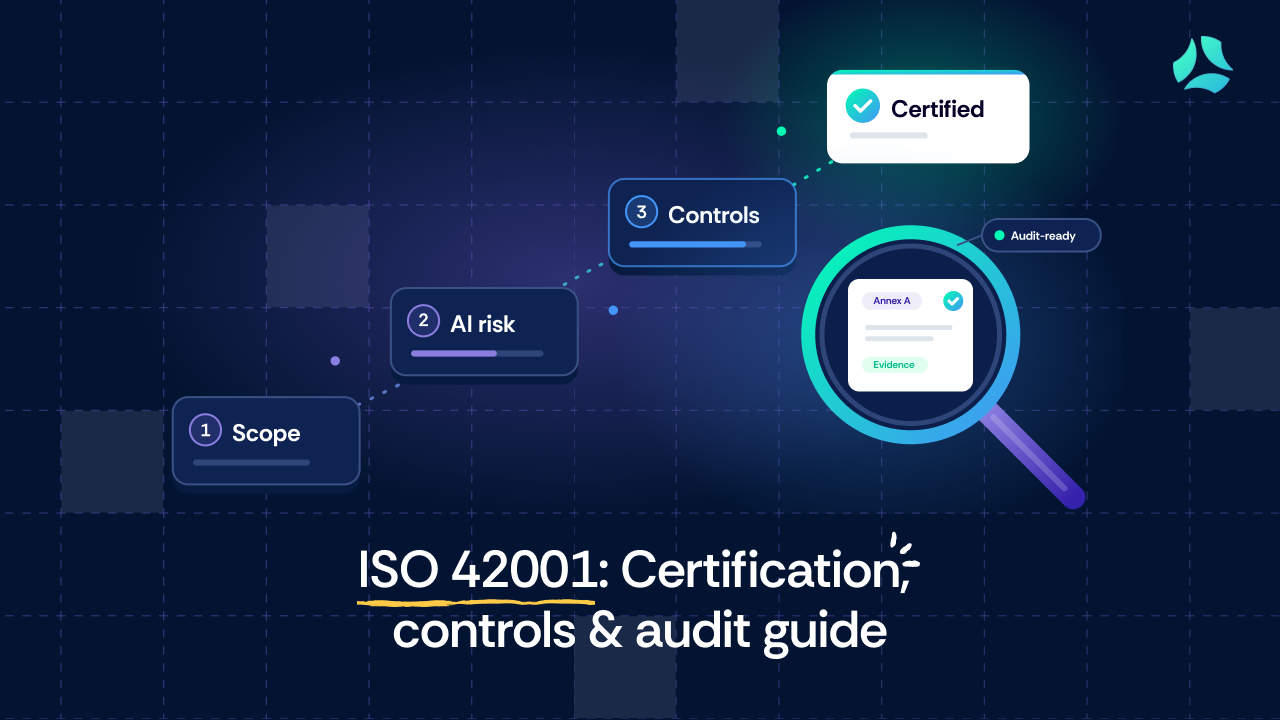


- ISO 42001 (formally ISO/IEC 42001:2023) is the world's first AI management system (AIMS) standard, applicable to any organization that develops, provides, or uses AI.
- Certification follows a Plan-Do-Check-Act cycle and requires a two-stage external audit by an accredited certification body.
- Of the 38 Annex A controls, several, including the AI system impact assessment and AI tool inventory, require genuinely new documentation even for ISO 27001-certified organizations.
- ISO 42001 is voluntary, unlike the EU AI Act; it complements, not replaces, NIST AI RMF.
- Surveillance audits are annual; recertification happens every three years.
If you build with or run AI in your product, the pressure to prove responsible governance is no longer theoretical. Enterprise buyers ask for it in procurement. Boards ask about it between funding rounds. Regulators are drafting rules faster than most teams can read them. ISO 42001 is the only internationally recognized management system standard that gives you something verifiable to point to.
This guide is for Compliance Managers, GRC leaders, CTOs, and founders building AI-powered products who need the specifics: the certification process, which controls auditors actually check, the evidence they ask for, and how the standard sits next to NIST AI RMF and the EU AI Act.
AI adoption is running ahead of the AI management system discipline most organizations have in place, and ahead of regulation. ISO 42001 is how you close that gap on paper and in practice. For the wider context, see our work on NIST AI RMF and responsible AI governance.
What is ISO 42001?
ISO/IEC 42001:2023, published in December 2023, is the world's first Artificial Intelligence Management System (AIMS) standard. It was authored jointly by the International Organization for Standardization (ISO) and the International Electrotechnical Commission (IEC), and it follows the same Plan-Do-Check-Act (PDCA) cycle you'll recognize from other ISO management system standards.
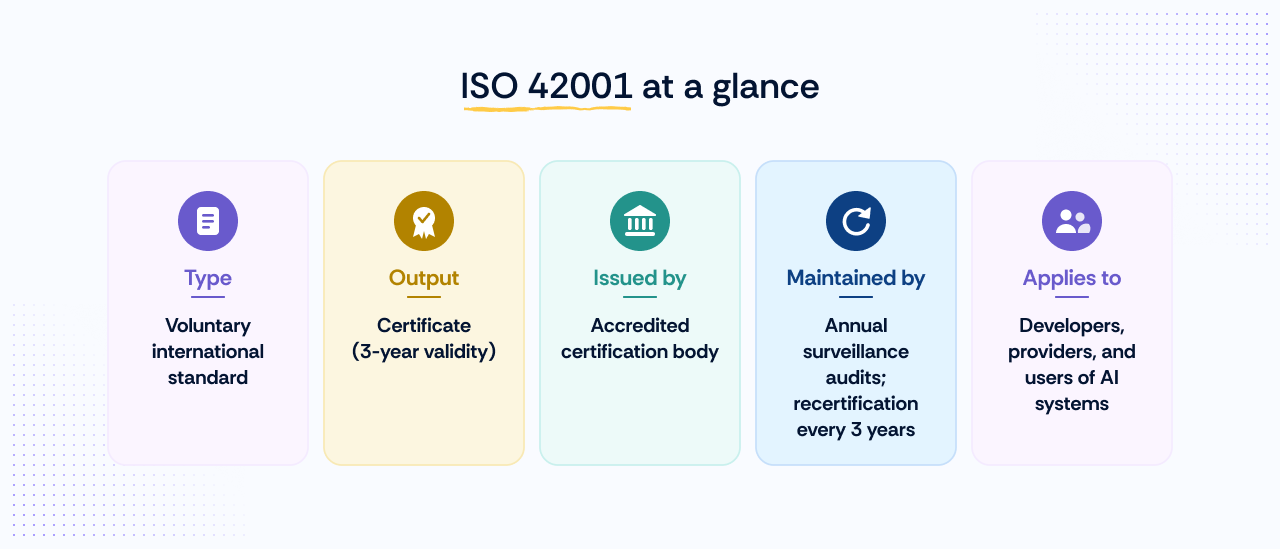
One distinction matters more than any other for your buyers: ISO 42001 produces a certificate, not an attestation report like SOC 2. The certificate is issued by an accredited certification body, valid for three years, and maintained through annual surveillance audits. When an enterprise customer asks whether you are "ISO 42001 certified," there is an actual document that answers that question.
The standard covers three organizational roles: AI system developer, AI system provider, and AI system user. Which role or roles apply to you determines the scope of your AIMS and which controls you have to implement. A company that fine-tunes and ships its own model carries different obligations than one that embeds a third-party model in its product.
ISO 42001 is voluntary. Unlike the EU AI Act, there is no legal penalty for not certifying. But certification is increasingly demanded by enterprise customers and regulators as proof of responsible AI governance, which is why "voluntary" rarely feels optional once you're selling to the enterprise. For the full treatment, see our ultimate guide to ISO 42001.
Why is ISO 42001 crucial in AI management?
ISO 42001 gives you a structured way to manage AI risk, assign accountability, and align with global regulatory expectations. What makes it useful rather than decorative is that each benefit maps to a specific clause or control area you have to implement and evidence.
- AI governance and accountability (Clauses 5 and 6). Leadership has to own AI policy and assign responsibility for AI-related decisions, so oversight is documented rather than assumed.
- Structured AI risk management (Clause 6). You have to identify and assess AI-related risks, including bias, security vulnerabilities, and decision-making transparency, before deployment, not after an incident.
- Controlled AI operation (Clause 8 and Annex A). Design, development, deployment, and monitoring all run against defined controls, including the security guardrails around your AI systems.
- Continuous improvement (Clause 10). Models change. Regulations change. The AIMS has to keep up, which is why Clause 10 exists.
The AI risks ISO 42001 is built to address
The threats that make governance urgent are concrete. When employees paste sensitive data into a third-party model, that data can surface later to other users. Practitioners call this unintentional training, and it is one of the clearest arguments for documented guardrails around what goes into a model.
Prompt injection lets an attacker manipulate a model into violating its own security policy, and it is far harder to fully close than traditional input injection because generative systems are built to accept unstructured input. Add bias in outputs, copyright exposure in generated content, and model hallucination, and you have a risk surface that ISO 42001's controls are specifically designed to make you assess and mitigate. See our detailed coverage of AI risk management and how these map to broader AI regulations.
The commercial case for certification, specifically, not just framework alignment, is worth naming plainly. Compliance rarely wins you a deal on its own; nobody buys you because you hold a certificate. But the absence of one can tank a deal at procurement. Framed that way, certification is loss prevention: it keeps enterprise, regulated, and security-conscious buyers from walking away before they see the product.
What is the structure of ISO 42001?
ISO 42001 uses the Harmonized Structure shared across ISO management system standards, which makes it easier to integrate with frameworks you may already run, such as ISO 9001 and ISO 27001. It consists of foundational clauses, core requirements, and annexes.
Foundational clauses
Clause 1 - Scope: Defines applicability: any organization, regardless of size or industry, that develops, provides, or uses AI systems. It sets the boundaries for your AIMS.
Clause 2 - Normative references: Lists the documents referenced in interpreting and applying the standard.
Clause 3 - Terms and definitions: Standardizes terminology so organizations, auditors, and stakeholders apply requirements consistently.
Core clauses
Clause 4 - Understanding the organization's AI landscape: Analyze internal and external factors affecting your AI systems, including regulatory requirements, stakeholder concerns, and ethical considerations.
Clause 5 - Leadership and accountability: Top management establishes AI governance policy, defines roles, and owns compliance with ethical and regulatory requirements.
Clause 6 - AI risk management and planning: Identify, assess, and mitigate AI-related risks; set clear objectives and evaluate risks on an ongoing basis.
Clause 7 - Resources and operational support: Allocate the people, infrastructure, and documentation needed to run the AIMS.
Clause 8 - AI system operation and control: Manage design, development, deployment, and monitoring so AI systems align with ethical standards, business objectives, and compliance requirements.
Clause 9 - Performance monitoring and evaluation: Assessments, audits, and reviews confirm the AIMS is working, not just that it exists.
Clause 10 - Continuous improvement: Learn from nonconformities and refine the AIMS as technology and regulation evolve.
Annexes
Annex A - AI-specific controls: Annex A contains 38 AI-specific controls organized across control domains, including AI system impact assessment, data governance, AI tool inventory, and human oversight mechanisms. This is where most of the genuinely new work concentrates.
Annex B - Guidance for implementing controls: Expands on Annex A with detailed explanations and implementation practices.
Annex C - AI risks and operational considerations: Covers fairness, bias, security vulnerabilities, and decision-making transparency, with mitigation guidance.
Annex D - Integration with existing management systems: For organizations already certified to ISO 9001 or ISO 27001, this annex guides you on folding AI governance into your existing system. In practice, most clause-level documentation carries over with minor changes, often as small as renaming your ISMS to an AIMS, which is a significant time-saver for ISO 27001-certified teams.
Which Annex A controls require genuinely new work?
Even if you hold ISO 27001, several Annex A controls demand documentation and processes you almost certainly do not have yet. These are the four that practitioners consistently flag as new.
1. AI system impact assessment. This is the one that teams most often misjudge: it is not a risk assessment. It covers three distinct dimensions: organizational impact, individual impact, and societal impact, including whether an AI system's selection criteria could bias outcomes against a particular community. It requires a separate document and a separate process.
2. AI tool inventory. Structurally similar to a vendor inventory, but specific to the AI systems and tools you use to build and operate your own AI features. You need a complete record of what you're using and why.
3. Data provenance controls. Governing where training and input data comes from, how it's handled, and whether customer data is used. These can be marked out of scope in specific, documented cases. More on that in the audit section.
4. AI-specific security assessment. Documentation of how guardrails are implemented around your AI systems: how customer data is isolated, how you prevent data creep into model training, and how human-in-the-loop review is built in.
The table below maps where each of these areas sits relative to ISO 27001 and how much new work each requires.
ISO/IEC 42001 vs. ISO/IEC 27001 implementation gap analysis
The clause structure tells you what the standard requires. The next section tells you what an auditor actually does with it.
What does an ISO 42001 audit actually look like?
This is where most published guidance goes quiet, and where the difference between passing and getting questioned shows up. The following is grounded in first-hand certification experience.
The two-stage audit process. Stage 1 is a documentation review: the auditor examines your AIMS documentation, scope statement, statement of applicability, and policies to confirm the system is designed correctly.
Stage 2 is an assessment of implementation and effectiveness. The auditor checks that the controls you documented are actually operating. Both stages are conducted by an accredited certification body.
Defining your AIMS scope. You do not have to certify the entire organization. You can limit scope to specific AI systems or features.
When Scrut pursued its own initial certification, it scoped only its AI security questionnaire feature, which confined implementation and audit readiness to that single system and simplified the whole exercise considerably.
A narrow first scope is a valid and common approach.
Determining your organizational role. You must declare whether you are an AI system developer, provider, or user. This declaration drives your statement of applicability and which Annex A controls fall in scope. Get this wrong, and your whole applicability set is off.
What auditors actually asked for. In practice, the evidence requests centered on:
- The AI system impact assessment, covering organizational, individual, and societal dimensions, explicitly distinguished from a risk register.
- A separate AI risk assessment and an AI-specific security assessment documenting how guardrails are implemented, how customer data is isolated, and that customer data is not used to train models.
- The AI tool inventory, the same discipline as a vendor inventory, applied to the AI systems used to build your own.
- System documentation for AI features: infrastructure, compute resources, design rationale (the reasoning behind specific design decisions), ethical and responsible use considerations, and the human-in-the-loop review element.
- The scope statement and AIMS role declaration.
The AI system impact assessment gets mistaken for a risk assessment more than any other requirement. Auditors distinguish between the two, and the impact assessment specifically has to address societal and individual impact, not just organizational risk. Teams that treat it as a security risk assessment with the labels swapped fail this control.
What was scoped out, and why documenting that matters. Scrut marked data provenance controls out of scope because it did not train models on customer data; its data was synthesized externally rather than drawn from customer inputs. That exclusion was explicit and justified in the AIMS.
Clearly defining what is out of scope is not a shortcut. It's part of a defensible audit. Prepare the artifacts you don't need too, so you can show the auditor why they're excluded.
For the broader audit discipline, see our guide to the compliance audit process, our explanation of the statement of applicability, and the details behind Scrut's ISO 42001 certification.
The ISO 42001 certification process
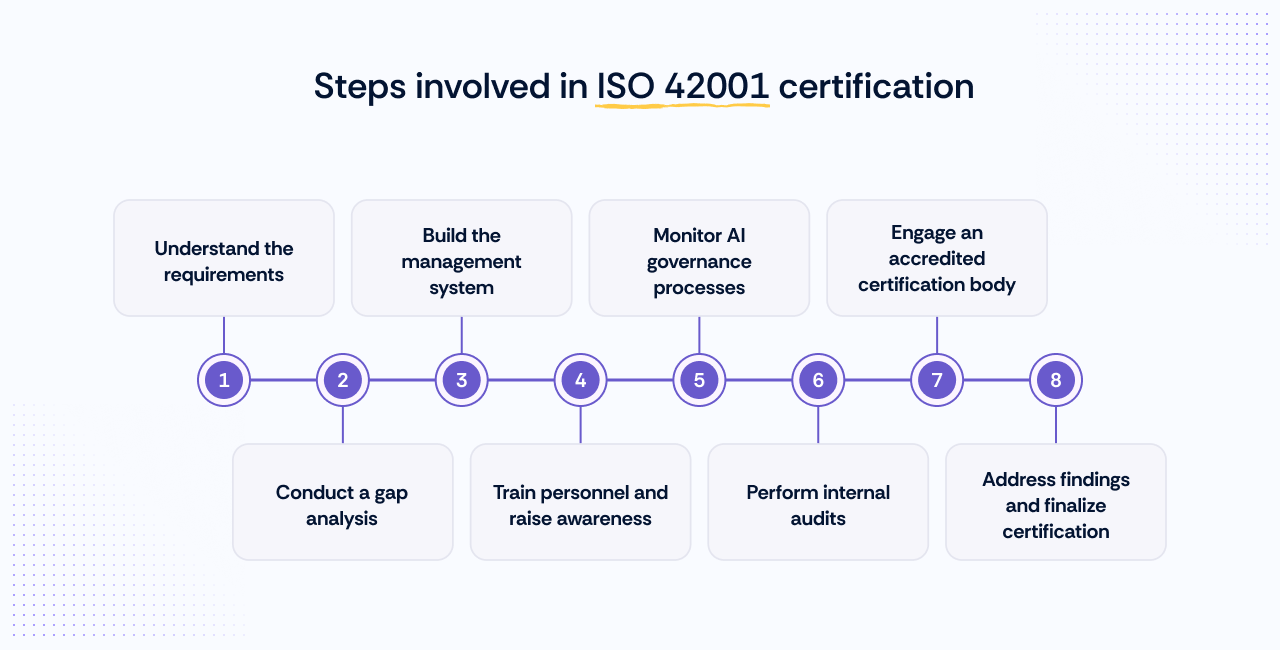
Certification is an eight-step arc, but the order and the judgment calls matter as much as the steps themselves.
1. Understand the requirements. Read the standard before you scope anything. Familiarize yourself with the clauses and Annex A controls so you can make deliberate decisions rather than reactive ones.
Before moving to the gap analysis, define your scope. Decide which AI systems are in scope for the AIMS. Starting narrow, a single AI feature or product line, is a legitimate and common approach for initial certification, and it keeps the first audit manageable.
2. Conduct a gap analysis. Assess your current state across four categories: (a) policy and governance gaps, (b) AI system impact assessment readiness, (c) AI tool inventory completeness, and (d) human-in-the-loop documentation. If you hold ISO 27001, most clause-level documentation carries over; the real work concentrates in Annex A's AI-specific controls. See our approach to gap analysis.
3. Build the management system. The auditor will ask why decisions were made, not just whether controls exist. Build the management system, policies, assigned responsibilities, the controls, and document your design rationale as you go. That documentation is the difference between a control that passes and one that gets questioned.
4. Train personnel and raise awareness. Make sure everyone understands their role in AI governance and knows the policies and procedures that apply to them.
5. Monitor AI governance processes. Establish mechanisms to track control effectiveness and maintain the evidence that demonstrates compliance over time.
6. Perform internal audits. Run internal audits to catch nonconformities before the external body does.
7. Engage an accredited certification body. Verify accreditation before you engage. As of 2026, only a limited number of certification bodies are accredited for ISO 42001. The standard is new, and accreditation is still expanding. Confirm a body's accreditation status (for example, against UKAS, ANAB, or RvA) before signing anything.
8. Address findings and finalize certification. Close out any findings with corrective action, then receive your certificate.
Initial certification typically takes 6 to 12 months, depending on organizational complexity and whether ISO 27001 controls carry over. Annual surveillance audits follow, with recertification every three years.
Certification vs. framework alignment: what triggers the decision
You don't always need the certificate. Framework alignment, following the controls without an external audit, is a valid interim position. The trigger for full certification is commercial: when your customers expect third-party-certified attestations and assurances, or when a major AI product release creates a new governance obligation.
If a customer asks, that's usually decision enough. If no one's asking yet, alignment buys you the posture without the audit cost. Compare against NIST AI RMF when deciding your sequence.
Challenges in implementing ISO 42001
The standard gives you a framework; aligning your processes to it is where the friction lives. These are the challenges teams actually hit.
1. Adapting to evolving AI regulations. ISO 42001 does not care which jurisdiction you operate in, and that is by design. But if you are in the EU, the AIMS does not discharge your EU AI Act obligations. You still have to map your controls to the Act's risk categories. The two programs run in parallel.
2. Integrating with existing management systems. If you already run ISO 27001 or ISO 9001, a substantial portion of clause-level documentation carries over directly. The genuine new work sits in Annex A's AI-specific controls: impact assessment, AI tool inventory, data provenance. Plan your effort there, not across the whole standard.
3. The risk assessment is the load-bearing wall. Bias, transparency gaps, and model-specific security vulnerabilities all demand assessment processes most teams have never built. Everything else in the program depends on getting this right
4. Allocating necessary resources. Implementation takes financial, technical, and human resources. For smaller teams, the constraint is rarely budget alone. It is the absence of a person who can own the AIMS without it becoming a second job layered on top of an existing engineering or compliance role.
5. Ensuring continuous monitoring and improvement. The AIMS you build for certification is not the AIMS you run in year two. Models change behavior, regulations add obligations, and your own AI footprint grows. Ongoing audits and reviews are not optional maintenance. They are the mechanism that keeps the certificate meaningful.
6. Managing stakeholder expectations. Leadership wants speed. Legal wants documentation. Engineering wants to keep shipping. Aligning them around one program is its own project.
7. Third-party model documentation burden. If you use foundation models from providers like OpenAI or Anthropic rather than training your own, ISO 42001 still requires you to document how those models are used, what guardrails are in place, and how customer data is isolated.
This is harder than it sounds: providers offer limited transparency into how and when they change their models, and they may not notify you when they do. You end up documenting behavior you can only partly observe. It is the same shift teams went through when cloud made "someone else runs our infrastructure" a compliance reality.
8. The AI system impact assessment is not a risk register. It is the most commonly misunderstood requirement and the most common audit failure point.
For continuous coverage of this problem, see AI risk management and how GRC automation reduces the manual load.
How ISO 42001 supports ethical and responsible AI in practice
ISO 42001 does not hand you a universal set of AI ethics principles. It requires you to define your own AI objectives and document how ethical considerations are embedded in your design and deployment decisions. The auditor checks for evidence of that process, not adherence to some external ethics standard.
In practice, the controls that govern ethical AI cluster around a few Annex A domains:
- Bias mitigation: assessing whether outputs disadvantage particular individuals or communities.
- Human oversight: documented human-in-the-loop mechanisms. In Scrut's own AIMS implementation, AI output is treated as a draft until a named human owner reviews and approves it, which keeps accountability with a person rather than a model.
- Explainability: being able to account for how AI-driven decisions are reached.
- Data governance: controlling what data feeds the system and how it's handled.
The scrutiny organizations face is shifting. It is moving away from "is your AI secure?" toward how AI is actually used in running your business: the ethics, fairness, and responsibility dimensions. ISO 42001 gives you the documented process to answer that scrutiny, and it works alongside NIST AI RMF and the EU AI Act as complementary frameworks.
See our take on building responsible AI.
ISO 42001 vs. NIST AI RMF vs. EU AI Act
The practical question is not which framework to choose. It is which to sequence. NIST AI RMF is a thinking tool: it gives you a structure for asking the right questions about your AI risk, and it deliberately leaves the answers to your organizational context. ISO 42001 is a certification target: it gives you a document that a customer can verify. They answer different questions.
An ISO 42001 certificate can serve as evidence of governance maturity inside a NIST AI RMF alignment effort and EU AI Act compliance documentation, which is why sequencing them is more useful than choosing between them.
Go deeper on the comparison in ISO 42001 vs NIST AI RMF, the EU AI Act, and applying the NIST AI RMF.
ISO 42001 and AI risk: What to monitor after certification
Certification is a starting line, not a finish. Annual surveillance audits require evidence that your AIMS is operating effectively, not just that it was built once.
Post-certification monitoring is not optional. The surveillance cycle checks that controls are still working. Stop maintaining them the day the certificate arrives, and the next audit finds it.
Quarterly reassessment as a baseline. For AI features in production, a quarterly reassessment of AI-specific risks is a practical baseline cadence. On top of that, any major release, a change to model architecture, authentication mechanisms, or data flows, should trigger an out-of-cycle assessment.
Tracing model drift and data changes. For organizations using third-party foundation models, monitoring is complicated by limited model transparency. Document what the model is actually doing, not just what the provider claims. Log prompts, tool calls, and model responses with a dedicated AI observability tool.

The point is concrete: the moment you log a full prompt and response, you may be logging usernames, PII, even access tokens passed into context. Redaction at the logging layer keeps your monitoring from becoming a new exposure.
Know your re-assessment triggers. Each of the following signals that the AI system's behavior, inputs, or risk surface has materially changed, which means your last assessment no longer reflects current reality. Reassess when any of these occur:
- A major model version change by a third-party provider.
- A new AI feature launches.
- A significant change to data inputs.
- A prompt injection vulnerability is identified.
- A data protection authority or sector regulator in a jurisdiction where you operate issues new AI-specific guidance that raises the bar for what your AIMS must demonstrate.
For the operational side, see AI risk management, continuous compliance, and risk management automation.
Simplifying AI and cybersecurity compliance with Scrut
Scrut is itself ISO 42001 certified, which means the platform was tested against the standard it helps you meet. For ISO 42001 specifically, Scrut handles multi-framework control mapping so ISO 27001 controls carry over and new AI-specific controls surface as gaps, manages your AI tool inventory, collects evidence for AI-specific controls, and monitors for control drift after certification. It integrates with your existing stack and supports SOC 2, ISO 27001, GDPR, HIPAA, and more from one place.
Learn more about the AI compliance platform and compliance automation. You can also book a demo with us.
Yes. ISO 42001 includes AI risk management as a core component, providing guidelines for identifying, assessing, and mitigating AI-related risks.
ISO 42001 strengthens AI risk management by introducing structured governance, transparency, and accountability measures. It helps organizations proactively assess AI risks and implement controls to ensure ethical and responsible AI deployment.
No. While ISO 42001 is designed for AI governance across industries, its application depends on an organization’s risk profile, regulatory requirements, and AI use cases.
An AI Management System (AIMS) is a structured framework that organizations implement to ensure the responsible, transparent, and ethical development and deployment of AI technologies.
Yes. ISO 42001 provides a structured approach to evaluating AI governance maturity, helping organizations assess their preparedness for AI compliance and risk management. However, for a comprehensive readiness evaluation, organizations may need to supplement it with additional frameworks like NIST AI RMF.