


%20(1).png)
%201.png)
Choose risk-first compliance that’s always on, built for you.
.png)
Most SOC 2 projects start the same way: an enterprise deal stalls at procurement, or a buyer sends a 100-question security questionnaire your team cannot credibly answer.
For a 50 to 100-person SaaS company, a first SOC 2 Type 2 audit typically costs between $30,000 and $100,000, depending on scope, auditor tier, and whether you use automation. Enterprise-scale programs, or engagements with a Big Four firm, can reach into the hundreds of thousands.
This breakdown is written for founders, CTOs, and compliance managers preparing for a first audit or a renewal, and it maps where the money actually goes.
A SOC 2 Type 1 report assesses whether your controls are suitably designed at a single point in time. The report reads “as of” a specific date and confirms the design of your systems, tools, and security strategy. A SOC 2 Type 2 report goes further: it assesses whether those controls operated effectively over a defined period, usually 3 to 12 months.
Type 1 is cheaper because the auditor’s testing effort is lower, not because the compliance program is lighter. The controls behind a Type 1 are fully implemented. The auditor verifies design as of one date rather than testing evidence across a multi-month window, so fewer auditor hours are billed. Treating Type 1 as “SOC 2 lite” is the most common misconception, and it is wrong.
The standard advice has always been: “Start with Type 1, then upgrade to Type 2.” In practice, that advice no longer holds for most companies. Across Scrut’s client base, roughly 70% skip Type 1 and go straight to Type 2 after a short practice period.
A typical path: run a gap assessment, close the gaps within a month, practice the full framework for at least 3 months, then set a Type 2 observation window and get audited. Type 1 still makes sense when controls are freshly implemented, and an enterprise deal is closing before a Type 2 observation period is feasible.
The minimum observation period for Type 2 is 3 months, and the common recommendation is 6 months. That floor exists for a specific operational reason: access reviews run on a quarterly cadence, so the AICPA set the minimum window long enough to capture at least one full review cycle.
Before you commit to a report type, it helps to first define your SOC 2 scope and run a SOC 2 readiness assessment so you know which controls are already stable enough to survive an observation window.
Cost ranges vary heavily by auditor tier. A Type 1 typically costs between $15,000 and $40,000 all-in. A Type 2 ranges from $30,000 to $80,000, though a Big Four engagement can push well beyond that.
SOC 2 costs vary by country because of differences in local market rates, auditor fees, and operational expenses. One caveat before you read the table: these are auditor-fee-only estimates. They do not include tooling, pen testing, or internal resource costs, which together often exceed the audit fee itself.
U.S. figures vary by auditor tier. A Big Four engagement for a 100-person company can reach $50,000 or more for the audit alone.
These figures are approximate and vary based on organization size and complexity. U.K. and India figures are market approximations. Verify with local auditors before budgeting.
Your total cost depends heavily on your chosen method, manual or automated.
A gap assessment is not a policy checklist. Done properly, it covers three layers at once: cloud misconfigurations, vulnerability findings, and policy or procedure gaps. Each layer surfaces different work. Cloud misconfigurations are tested against benchmarks like CIS, vulnerability findings come from VAPT scans, and policy gaps come from reviewing your documented controls against the Trust Services Criteria.
Manual: A consultant-led readiness assessment costs between $5,000 and $15,000, and the cloud-layer testing usually requires a separate specialist because most general consultants do not run infrastructure scans.
Automated: A compliance automation platform handles the cloud-layer testing against CIS benchmarks and runs the policy gap scan as part of the subscription, keeping the cost roughly around $10,000 to $15,000 annually or folding it into the platform.
Three controls account for the majority of auditor time and the majority of first-audit gaps: CC 6.1, CC 7.1, and CC 8.1. CC 6.1 covers logical and physical access control, including access reviews and identity management. CC 7.1 covers configuration and vulnerability management. CC 8.1 covers change management and the software development lifecycle.
These are the highest-effort technical controls for a first-time company because they require working integrations, not just documented intent.
Tooling adds up here. An MDM solution costs $5,000 to $10,000 and is required for hybrid or remote environments. An XDR or EDR solution (SentinelOne, CrowdStrike, Sophos) is priced per user, so the cost varies widely based on headcount and how you procure the license.
A standalone Nessus license costs $6,500 per year for infrastructure testing alone. A small organization running seven or eight physical servers can get the same testing done for as little as $1,500. That gap exists because companies buy the license and then underuse it. Worth knowing before you budget.
Pen testing and vulnerability scanning overlap more than vendors admit. Scope one without understanding the other, and you will overpay. For the distinction, see penetration testing vs. vulnerability scans.
Pen testing cost rises with product complexity, and the reason is structural. VAPT happens at two levels, so two products becomes four test reports. A real external vendor quote for a mid-size company with two products came in at $14,000, which is a fair price for thorough work.
There is a split worth understanding. Infrastructure-level pen testing (cloud testing against CIS benchmarks) can be handled by a GRC automation platform. Application-level pen testing still requires a third-party vendor. Scrut is CREST-accredited for penetration testing, which matters when you want the infrastructure layer covered inside your platform rather than as a separate line item.
If cloud testing is already included in your GRC platform, a standalone Nessus license is redundant.
There are four categories of firms: Big Four, boutique CPA firms, small CPA firms, and independent auditors. Pricing spreads are large. A Big Four Type 2 audit for a 100-person company can cost $50,000 for the assessment alone, while a boutique firm charges considerably less for a comparable scope. Quality among smaller firms varies, so price is not the only filter.
One criterion is non-negotiable: only firms enrolled in the AICPA peer review program can sign a SOC 2 report. SOC 1 and SOC 2 are attestation engagements, and an independent CPA cannot sign off on either. Before you shortlist auditors, check their peer review status on the AICPA website. For how to weigh the trade-offs, see our blog: Big Four vs. boutique audit firm.
Auditor fees are also lower when you use a compliance automation platform. Audit partners provide reduced pricing for clients on automation because automated evidence they can pull directly cuts their man-days.
An external consultant is rarely cheap. A consultant working on a SOC 2 project spends at least 20 working days, roughly 160 hours. At an entry-level rate of $100 to $125 per hour, that is $16,000 to $20,000. Senior InfoSec consultants charge around $400 to $500 per hour. For a small organization, the whole project rarely comes in under $25,000.
Engineering time is the hidden cost. Evidence collection, integration setup, and audit coordination pull engineers off the roadmap, and this is routinely underestimated because it never arrives as an invoice.
For a fuller picture, see the engineering time cost of SOC 2 compliance. Athenium, a software company, projected a $50,000 minimum for their manual process before switching to automation.
A GRC automation platform ranges from $10,000 to $30,000 annually, with a possible one-time onboarding fee. The useful way to read this line is as a net cost reducer, not an additional expense. Automation reduces auditor fees (audit partners price lower for automated evidence), internal resource costs, and consultant dependency.
What automation does not replace: the auditor fee, the management assertion, and the human judgment calls on risk acceptance. No platform signs your assertion letter or decides which risks you accept.
Contentstack reduced its ISO 27001 audit timeline by about 4 weeks and its SOC 2 controls timeline by roughly 2 months after moving away from spreadsheets.
Sounding Board went from spending 5 to 25 hours per security questionnaire to a fraction of that once evidence and policies lived in one place.
SOC 2 is not a one-time effort. You maintain controls and recertify annually. Without automation, ongoing monitoring, re-certification audits, and repeated prep effort cost $20,000 to $50,000 per year.
The hidden costs section below shows where that figure comes from, line by line. Automation platforms include continuous compliance monitoring, which reduces this recurring burden by keeping you audit-ready between cycles.
Take a U.S.-based SaaS company with 50 to 100 employees, going for SOC 2 Type 2 directly, and scoping three trust service criteria: security, availability, and confidentiality. That three-criteria baseline is a sensible default. If security alone costs X, all three together cost roughly 1.2X, so the marginal cost is small, and most enterprise buyers expect the broader coverage.
Processing integrity and privacy are added only when the business handles large batch processing or PII, respectively.
All figures are illustrative ranges based on practitioner experience. Actual costs vary by scope, auditor selection, and organizational complexity.
The clearest example is redundant tooling. A company running just seven or eight physical servers buys a $6,500 Nessus license when the same testing can be done for as little as $1,500, wasting the difference because they never fully use it.
AWS Inspector is another overspend trap. Its licensing runs high for what it delivers, and a GRC platform covers the same cloud testing while also handling policy automation and evidence collection, often at the same or lower total cost. Overspending on XDR is also common. You can pass a SOC 2 audit with Microsoft Defender; a premium XDR is a security choice, not an audit requirement.
Pen testing scope is the most common underspend. Two products means four test reports, and as the $14,000 external quote in the pen testing section shows, that is a fair price for thorough work, not a number to negotiate down. Internal resource time is the other, routinely underestimated, because it does not arrive as an invoice.
Build your scope against a real SOC 2 control list and use these best practices to prepare for your SOC 2 audit, so neither line of questioning surprises you.
The cost table above tells you what to budget. What it cannot tell you is where that budget gets consumed unexpectedly, and that happens inside the audit process itself.
The process starts with the description of your system, Section III of the report. You provide this, not the auditor. It covers your services, the scope of the system, subservice organizations (your cloud providers, any outsourced activities), physical and logical access controls, the org chart, and network and vulnerability details. From that description, the audit firm defines the controls and the test procedures that the audit runs on.
Behind the scenes, the CPA firm builds a full stack of work papers, often 400 to 500 documents, including control testing matrices, sampling papers, and exception logs. Most of that is invisible to you, but it is part of the firm’s own quality management system and their peer review obligations.
Once the assessment is done, the firm drafts the report with findings. There is no pass or fail in SOC 2. You receive a report, and it will have no findings, some findings, or a qualification. An exception is a single control gap. A qualification is more serious: it means an entire criterion failed, and it is named in the opinion.
The worst outcome is an adverse opinion, which is what happens when an auditor senses evidence was manufactured. It is rare, but it does happen. One more step is human by design: the management assertion letter is signed by top management, stating in writing that you follow what the system description commits to. No platform signs it for you.
Where the process stalls:
Scoping problems are the most common source of audit surprises, and they almost always trace back to this document.
The 3-month observation minimum exists because of this cadence; if reviews are not happening, the evidence is not there.
A claim that a test happened is not evidence. Auditors want the record.
This is the fastest route to an adverse opinion and the one entirely within your control to avoid.
Getting the SOC 2 audit setup right, understanding the types of audit evidence auditors accept, and following a full guide to mastering the SOC 2 audit are practical ways to keep the process from stalling.
Automation does not replace compliance. It changes the economics of proving it.
The clearest way to see the difference is to compare how evidence used to work with how it works now.
Before automation, a CISO would send a ZIP file of policies via email with the message “approved.” Did anyone read them? Who published them? There was no tracking. After automation, there is a full, immutable log: the policy was drafted on this date, reviewed, and published. Auditors can see it, and that visibility translates directly into cost.
Automation helps most on technical controls, the areas where auditors historically struggled to verify operating effectiveness over time. Antivirus compliance logs, access review trails, BCP test evidence: these accumulate automatically. If the audit period was January to December and the auditor is checking in February, a manual process cannot easily prove the antivirus was working in a given month. Automated logs settle that question, and the auditor’s comfort level rises.
That comfort level is the cost mechanism. Audit partners provide lower pricing and faster opinions when they can pull evidence directly from a platform, because it cuts their man-days. This is a direct cost reduction, not just an efficiency claim.
There is a caveat worth naming: the “compliance-in-a-box” illusion. Automation works when the organization actually runs the underlying processes, the access reviews, and the BCP tests. If the platform just stores uploaded PDFs without real process execution, an experienced auditor will sense it. The automated evidence collection has to reflect real work.
The customer evidence bears this out. Contentstack cut its SOC 2 controls timeline by roughly 2 months. Rencata described audit prep as “color by numbers, step one, step two” because everything was already in the platform, no scramble.
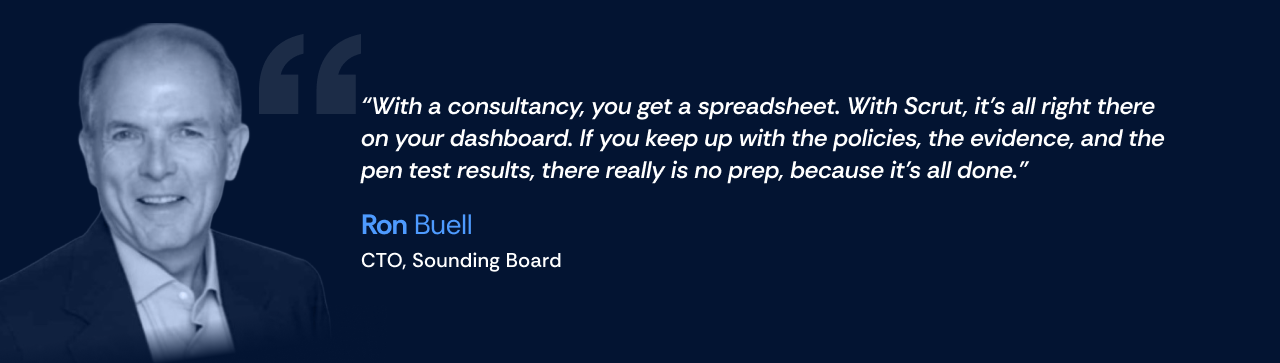
As Ron Buell, CTO of Sounding Board, put it in a testimonial with Scrut:
That “no prep” outcome, and the continuous compliance posture behind it, is where the real cost difference lands.
Beyond the headline line items, a few recurring and hidden costs catch first-timers off guard.
SOC 2 is annual. The $20,000 to $50,000 annual figure from the cost breakdown above breaks down as follows: re-certification audits run approximately $15,000 to $25,000 for Type 1 and $20,000 to $40,000 for Type 2 (consistent with first-audit ranges; actual re-certification fees vary by auditor and scope), on top of ongoing monitoring and preparation. Automation keeps you audit-ready between cycles and absorbs most of the prep cost.
Security awareness training is mandatory. Evaluation is not mandated, but it is an industry best practice, and phishing simulation goes a step further as a behavioral test. What changed is verification.
Before automation, attendance was captured on paper forms and presented at audit time. After automation, an LMS creates an immutable record of completion and evaluation scores, so an auditor reviewing in October can confirm training that happened in January actually happened and was effective.
This is one reason security training and device monitoring belongs inside your compliance system rather than in a shared drive.
Vetting auditors takes more time than most first-timers budget, and occasionally money too. The checklist is short but strict:
An auditor who cannot understand your automated evidence is a real risk, even if your compliance is sound.
If a control fails or an incident occurs, remediation costs can range from $10,000 into the millions, depending on severity. Per IBM’s 2024 Cost of a Data Breach Report, the global average cost of a data breach reached $4.88M in 2024. Strong access reviews are one of the highest-leverage controls in this category.
A personalized quote conversation covers three things: a scope assessment to confirm which trust service criteria and systems belong in your audit, an auditor connection if you still need a peer-review-enrolled firm, and a walkthrough of how the platform automates evidence and control monitoring. You leave knowing your realistic cost range and timeline, not a generic estimate.
Book a demo to get your quote. If you want to prepare first, start with a SOC 2 readiness assessment or explore how SOC 2 compliance works end-to-end on the platform.
1. Do SOC 2 costs change over time with rules and policies?
Yes. Framework updates can shift costs. The AICPA's 2022 revised Points of Focus updated the guidance auditors apply to the Trust Services Criteria, which can affect how controls are scoped and tested. Budget for periodic adjustment rather than a fixed one-time cost.
2. Can I get a free checklist or template for SOC 2?
Free SOC 2 checklists exist online, but they are generic and rarely map to your specific environment. For a grounded starting point, work from a real SOC 2 control list rather than a one-size template.
3. What is the penalty for not being SOC 2 compliant?
There is no direct financial penalty, because SOC 2 is not a legal requirement. The real cost is commercial: stalled or lost enterprise deals, longer sales cycles, and buyers who will not proceed without a report.
4. Can a SOC 2 consultant help me reduce cost?
A consultant adds value for gap identification and coordination, but they are expensive, $16,000 to $30,000+ for a project. A compliance automation platform replaces much of that function by automating the gap scan, evidence collection, and policy work, which is why many companies use a platform instead of, or alongside, a lighter consultant engagement.
5. How long is a SOC 2 report valid?
Most buyers treat a SOC 2 report as meaningful for about 12 months from issuance, which is why companies re-certify annually. A Type 2 report covers its stated observation period; buyers generally expect a fresh report each year.
6. Does SOC 2 cost vary by number of employees?
Yes. During the assessment, auditors sample employees who joined and left during the period. More employees means more samples, which means more auditor hours. Larger, more complex organizations therefore cost more.
7. Is automation better than manual for SOC 2?
Directionally, yes. Automation cuts time and manual effort on technical controls and reduces auditor man-days. One trap: if the platform just stores uploaded PDFs without real process execution, an experienced auditor will sense it. Automation helps most when you actually run the underlying processes.
8. What does a SOC 2 audit actually include, step by step?
The process starts with you, not the auditor. You provide the system description (Section III), which covers your services, infrastructure, subservice organizations, and controls. The auditor defines controls and test procedures from it, runs the assessment, and drafts a report with findings. Top management signs a management assertion letter. You receive a report with no findings, some findings, or a qualification. There is no pass or fail.
9. Should I go straight to SOC 2 Type 2, or start with Type 1?
If your controls have been running for 3+ months, go straight to Type 2. That is what most enterprise buyers expect. Roughly 70% of companies going through Scrut skip Type 1. Choose Type 1 only when controls are freshly implemented and a deal is closing before a Type 2 observation window is feasible.
10. What is the difference between a Big Four SOC 2 audit and a boutique CPA firm?
Both must be peer-review-enrolled to sign the report. The difference is price and scale. A Big Four Type 2 audit for a 100-person company can run $50,000 for the assessment alone; a boutique firm charges considerably less for comparable scope. Quality among smaller firms varies, so vet the individual auditor's credentials.
11. How does a compliance automation platform reduce my SOC 2 audit cost?
Three budget lines shrink when you automate: auditor fees drop because audit partners price lower for automated evidence they can pull directly; internal resource time drops because evidence collection is automated; and consultant dependency drops because the platform handles the gap scan and policy work.
12. What is the minimum observation period for SOC 2 Type 2?
Three months. The AICPA set that floor because access reviews run on a quarterly cadence, so the window has to be long enough to capture at least one full review cycle. Six months is the common recommendation.
{
"@context": "https://schema.org",
"@type": "FAQPage",
"mainEntity": [{
"@type": "Question",
"name": "Do these costs change over time with the change of rules and policies?",
"acceptedAnswer": {
"@type": "Answer",
"text": "Yes, SOC 2 compliance costs can change over time. The latest update in 2023 introduced enhanced \"Points of Focus\" by AICPA, which may increase costs for control updates, readiness assessments, and tools."
}
},{
"@type": "Question",
"name": "Can I get a free checklist or template to do a manual check for the SOC 2 framework?",
"acceptedAnswer": {
"@type": "Answer",
"text": "Yes, free SOC 2 checklists and templates are available online to help organizations conduct manual checks. However, these are often generic and may not fully address the specific requirements of your organization's compliance needs.
For a comprehensive checklist tailored to SOC 2 compliance, check out our SOC 2 Checklist for detailed guidance."
}
},{
"@type": "Question",
"name": "What is the penalty charge for not being SOC 2 compliant?",
"acceptedAnswer": {
"@type": "Answer",
"text": "There is no direct financial penalty for not being SOC 2 compliant, as it is not a legal requirement. However, the consequences can be significant, including:
Loss of business opportunities, especially with enterprise clients.
Damaged reputation and reduced customer trust.
Increased difficulty in entering competitive markets."
}
},{
"@type": "Question",
"name": "Can a SOC 2 consultant help me reduce the cost?",
"acceptedAnswer": {
"@type": "Answer",
"text": "Yes, a SOC 2 consultant can help reduce costs by streamlining the compliance process. They provide expert guidance, identify gaps efficiently, and help avoid costly errors during audits. However, hiring a consultant also adds to upfront expenses, so their cost-effectiveness depends on your organization's readiness and internal resources."
}
},{
"@type": "Question",
"name": "What is the relevance of the SOC 2 report?",
"acceptedAnswer": {
"@type": "Answer",
"text": "The SOC 2 report is relevant for 12 months from the date of issuance. Organizations must undergo an annual re-certification audit to maintain their compliance status.
Cost to renew:
Type 1 re-certification audit: $15,000 to $25,000.
Type 2 re-certification audit: $20,000 to $40,000.
The renewal cost may also include ongoing monitoring and preparation expenses, which can range from $5,000 to $15,000 annually."
}
},{
"@type": "Question",
"name": "Does the cost of the SOC 2 framework vary based on the total number of employees in an organization?",
"acceptedAnswer": {
"@type": "Answer",
"text": "Yes, the cost of SOC 2 compliance can vary depending on the size of the organization. Larger organizations with more employees often face higher costs due to the increased complexity of their operations, more extensive controls, and additional evidence requirements. Conversely, smaller organizations typically incur lower costs as their operations and compliance needs are less complex."
}
},{
"@type": "Question",
"name": "Is automation better than the manual process for SOC 2 certification?",
"acceptedAnswer": {
"@type": "Answer",
"text": "Yes, automation is generally better than the manual process for SOC 2 certification. Automation streamlines evidence collection, control monitoring, and audit preparation, significantly reducing time and manual effort. It minimizes errors, ensures scalability, and simplifies compliance management, making it a more efficient and cost-effective choice, especially for growing organizations."
}
}]
}