

%20(1).png)


- The SOC 2 scope is a business decision, not just a compliance formality. What you include determines your control count, evidence burden, timeline, and which teams get pulled into the audit.
- For most first-time audits, a Security-only scope covering your production environment is enough to unblock mid-market deals, with staging, internal tools, and additional TSCs added only when there is a clear customer or contractual driver.
- A seven-step scoping framework helps you define boundaries across systems, environments, personnel, and Trust Services Criteria before you engage an auditor or touch a GRC tool, avoiding the rework that mid-readiness scope changes create.
A sales call ends well. The prospect is ready to move. Then their security team sends a vendor questionnaire, and one question stops everything: “Do you have a current SOC 2 report?”
And the moment you start figuring out how to get one, the harder question surfaces immediately: what exactly are we attesting? Does staging count? Are contractors in scope? Do all three AWS accounts your team manages need to be included?
This is where most first-time System and Organization Controls 2 (SOC 2) journeys stall. Not at the audit itself, but at the decision that comes before it.
The stakes are real on both sides. Over-scope your SOC 2, and you multiply your control count, drag engineering into months of evidence collection, and stretch your timeline considerably.
Under-scoping, on the other hand, risks auditor pushback, gaps in customer assurance, and damage to your credibility with the customers you are trying to win.
This guide provides a decision framework for what to include, a system-by-system inclusion guide, and a consequences map for every major scope call, so you make the right call before you touch a single tool. Once scope is settled, the right SOC 2 compliance software is what carries it forward, mapping each in-scope system to its controls, automating evidence collection, and keeping the boundary you defined consistent through the audit and beyond.
What SOC 2 scope actually means (and what it does not)
The SOC 2 scope is the defined boundary that tells your auditor exactly which services, systems, people, and data will be evaluated. Not your entire company. Not every tool in your stack.
What is the SOC 2 scope in practice? It is the perimeter drawn around what is necessary to deliver your service to customers, built across five components the AICPA identifies as the building blocks of any in-scope system, which includes:
- Infrastructure: this covers the servers, cloud environments, and network devices that support your service.
- Software: it includes your product application, monitoring tools, and logging systems.
- People: refers to the personnel who operate and maintain in-scope systems.
- Procedures: these are the documented controls and operational steps that people follow.
- Data: this is the customer information that flows through, is stored in, or is processed by in-scope systems.
What is included in the SOC 2 scope? Only what is necessary to deliver your service and meet your customer commitments. Everything else is a candidate for exclusion. Scope follows your service delivery chain, not your IT inventory.
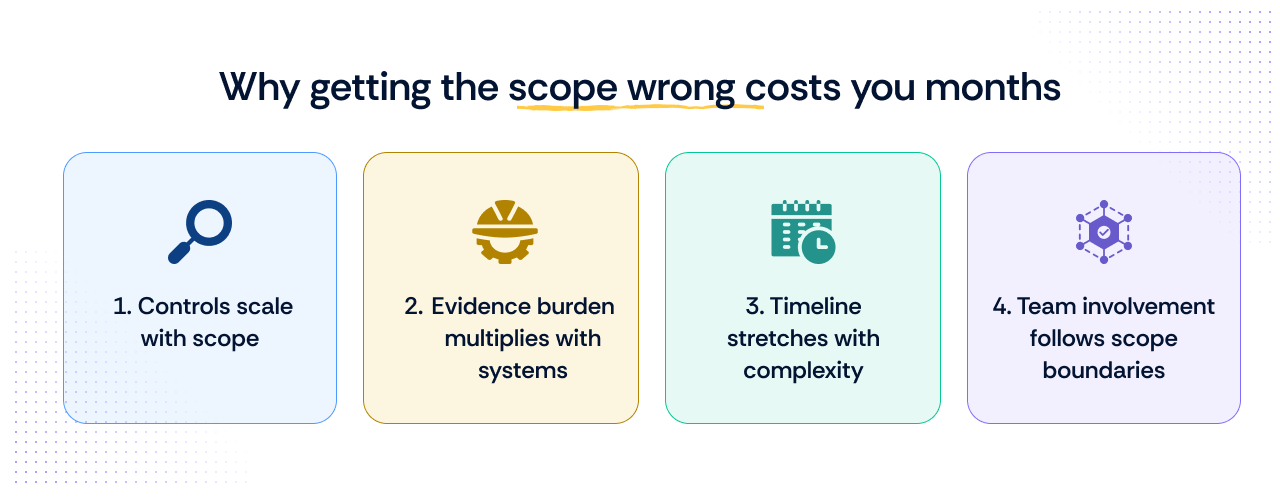
Scope is not just a scoping document. It is the multiplier for everything that follows. Get it wrong in either direction, and the consequences compound across your entire readiness effort.
Four consequences flow directly from scope decisions, and they scale with every system you add.
- Controls scale with scope. Every system you include brings its own set of required controls. There is no fixed number to plan around. The count is entirely a function of what you include, which of the five trust service criteria (TSCs): Security, Availability, Processing Integrity, Confidentiality, and Privacy, you select, and how many systems, people, and processes fall within your defined boundary.
- Evidence burden multiplies with systems. More in-scope systems mean more evidence-collection touchpoints, more integrations to configure, and more manual collection in places where automation cannot reach. Each additional subservice organization adds its own documentation layer on top.
- Timeline stretches with complexity. A well-scoped first-time audit moves considerably faster than a sprawling one. Type I fieldwork for a tightly scoped environment can wrap in weeks. The same audit with an over-scoped environment drags into months, and a Type II in a bloated scope can run well past a year from start to report.
- Team involvement follows scope boundaries. Scope determines which teams get pulled in. Over-scope and you pull engineering, DevOps, HR, and IT into compliance work simultaneously, at a direct cost to product velocity.
Then there are the second-order effects no one warns you about. Mid-readiness scope changes require re-mapping controls and re-collecting evidence already gathered. Auditors flag inconsistencies when scope documentation does not align with actual system boundaries.
An over-scoped first audit becomes the baseline for year two, harder to maintain and harder to scale down without raising questions. The right scope decision happens before readiness begins, not during it.
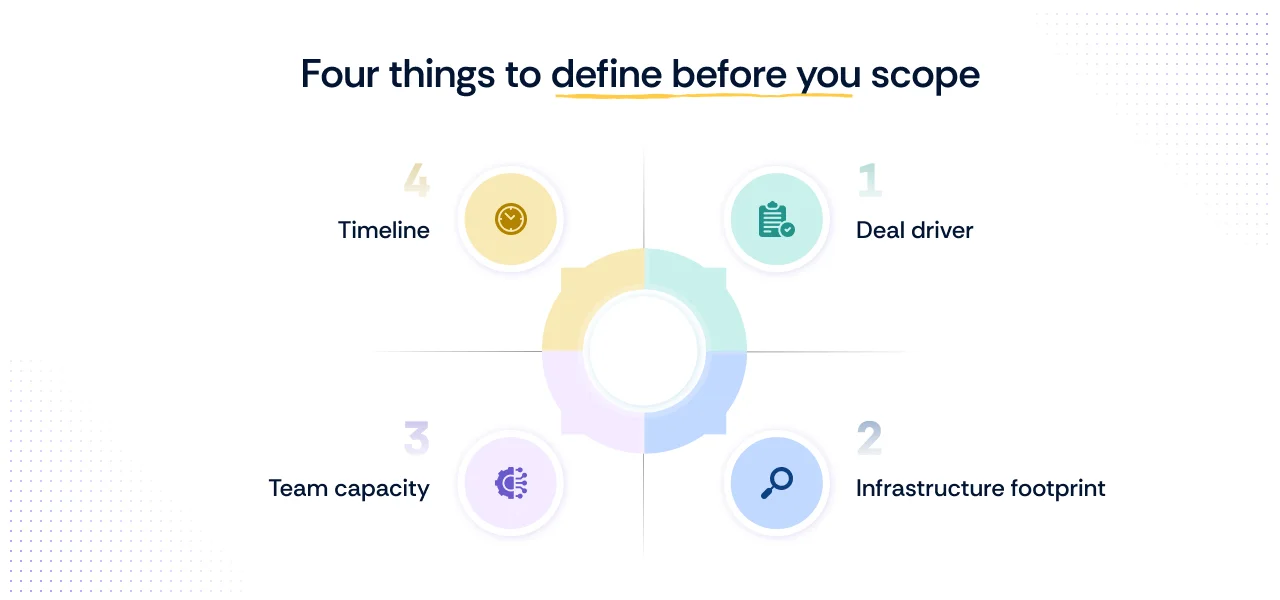
Most SOC 2 guides jump straight to what to include. The more useful question is what kind of organization are you, and what are you trying to achieve? Before you define scope, define your situation across four variables.
- Deal driver
Are you scoping to unblock one specific deal or to pass broad enterprise procurement? If the goal is a single deal, a minimal scope is viable and the fastest path to a report.
If you are targeting broad enterprise procurement across multiple verticals, a moderate scope is necessary to satisfy the range of security questionnaires you will face.
- Infrastructure footprint
How many environments and cloud accounts touch customer data? If you run a single production environment, your scope boundary is naturally contained. If you operate across multiple accounts or cloud providers, each one that processes or stores customer data must be evaluated individually for inclusion.
- Team capacity
How many people can realistically own controls, collect evidence, and respond to auditor requests? If your team is under 10 people, every additional function you pull into scope directly costs you product velocity. Scope tightly and expand as your compliance function matures.
- Timeline
A SOC 2 Type I for a well-scoped, well-documented environment can be completed in two to three months. A Type II, which requires controls to operate over an observation period before the formal audit begins, typically runs six to fifteen months in total. Scope bloat stretches both timelines significantly.
Minimum viable scope: What you actually need to close deals
Minimum viable scope (MVS) is the tightest scope that satisfies what your prospect's security team is actually evaluating. Not what feels safest. Not what looks most thorough. What the buyer is genuinely checking.
In most cases, that comes down to your production environment, your core product, how customer data is handled, and who has access to it. Start there.
What MVS typically includes:
- Production environment and all systems directly supporting it
- Security TSC, the only mandatory criterion, which on its own covers access controls, encryption, incident response, and change management
- Core engineering and DevOps personnel with production access
- Key subservice organizations whose failure would breach your service commitments, such as AWS, Stripe, and Twilio. Note them in your scope documentation, even if you apply the carve-out method
What can safely be excluded at MVS:
- Staging and development environments, unless they handle real customer data
- Internal tools with no connection to customer data or production systems
- HR systems, expense platforms, and non-customer-facing software
- Contractors with no production access
A security-only Type I audit on your production environment is enough to satisfy the vast majority of vendor security questionnaires and unblock most mid-market deals. Enterprise deals with specific regulatory exposure may require additional TSCs, but that is a later decision, not a first-audit decision.
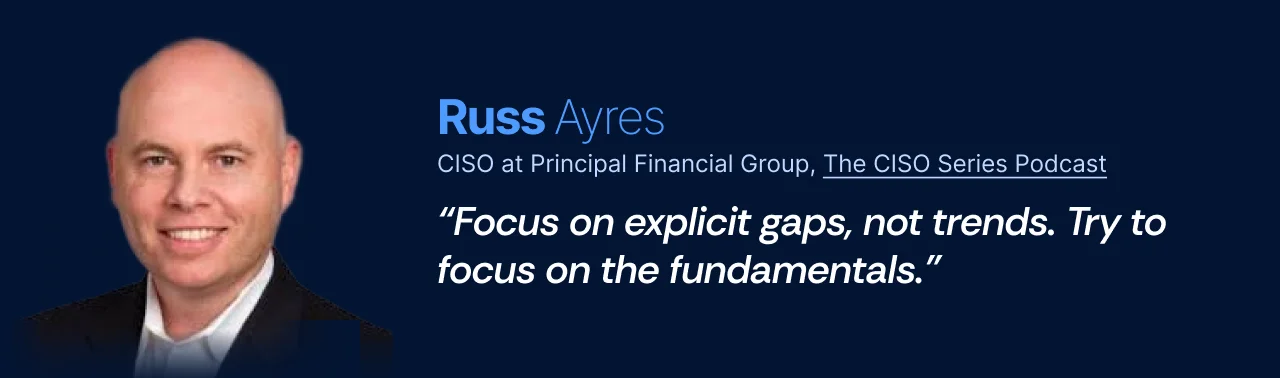
That principle applies directly to scoping. Start with what is real and material. Expand only when there is a clear driver.
Step-by-step guide to defining your SOC 2 scope
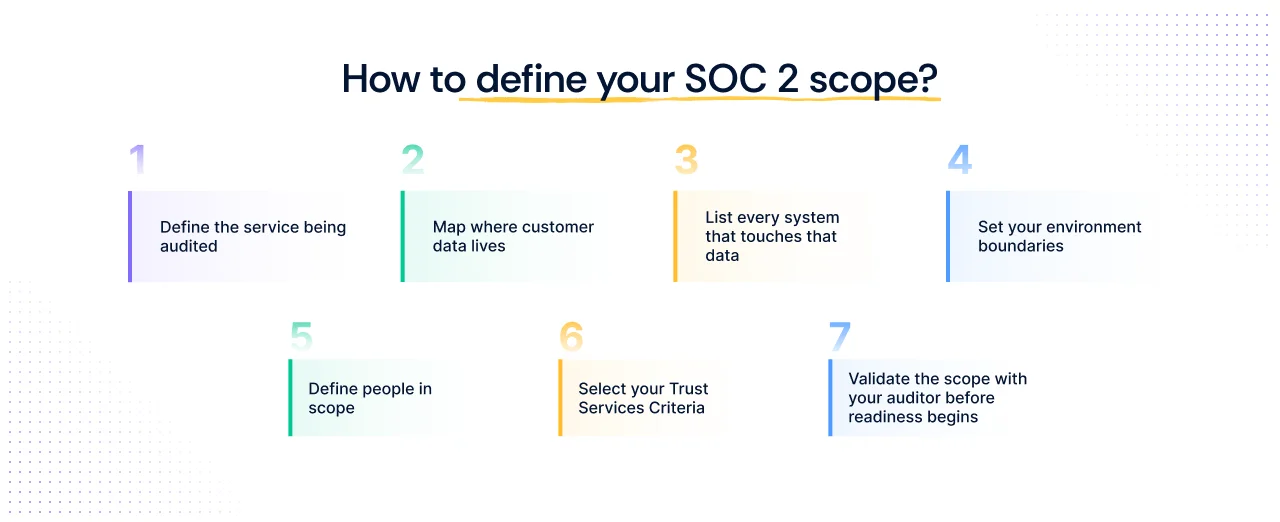
Defining your SOC 2 scope is not a single conversation. It is a sequential process, and each step builds on the one before it. Move through these seven steps in order before you engage a GRC tool or begin any readiness work.
Step 1: Define the service being audited
- What to do: Write one sentence describing what your product does and what it promises customers in terms of data security.
- What to include: The service boundary, meaning what you are certifying, not everything your company builds or operates.
- What to question: If you have multiple products, confirm whether they are delivered from the same infrastructure before drawing a single scope boundary.
- Common mistake: Scoping the entire company instead of the specific service that processes customer data.
Step 2: Map where customer data lives
- What to do: Trace the full data flow from customer input through storage, processing, and output across every system it touches.
- What to include: Every system that stores, transmits, or processes customer data, including systems that interact with it only temporarily.
- What to question: Are there undocumented caches, copies, or replicas in systems that did not make your initial list?
- Common mistake: Mapping only the primary database while overlooking logging infrastructure, data warehouses, and backup environments that hold the same data.
Step 3: List every system that touches that data
- What to do: Build a system inventory covering cloud accounts, databases, third-party tools, and subservice organizations.
- What to include: Production cloud accounts, your application stack, monitoring and logging tools, and any vendor whose failure would breach your service commitments, such as AWS, Stripe, or Twilio.
- What to question: For each third-party tool, does it process customer data, or does it merely transmit it without storing or transforming it?
- Common mistake: Listing tools by default without confirming their actual role in the data flow.
Step 4: Set your environment boundaries
- What to do: Draw a clear line between production and non-production environments and document the rationale for each boundary decision.
- What to include: All production environments and cloud accounts where customer data lives or transits.
- What to question: Does your staging environment process real customer data, or does it connect directly to production pipelines in ways that bring it into scope?
- Common mistake: Including staging by default because no one explicitly excluded it during the initial scoping conversation.
Step 5: Define people in scope
- What to do: Identify roles with access to in-scope systems, not a list of all employees or all departments.
- What to include: Engineering, DevOps, and security personnel with production access, along with executive leadership for governance and oversight controls.
- What to question: Do any contractors or third-party workers have production access, because if they do, their access must be governed by your controls, regardless of employment status?
- Common mistake: Scoping the entire company because HR and finance happen to use tools that share a single sign-on with production systems.
Step 6: Select your Trust Services Criteria
- What to do: Choose TSCs based on what your customers contractually require or explicitly ask for, not based on what appears most comprehensive.
- What to include: Security is mandatory for every SOC 2 audit; add Availability if uptime SLAs appear in your customer contracts; add Confidentiality if you handle sensitive non-personal data such as proprietary business information; add Processing Integrity if your service involves financial transactions or health data processing; add Privacy if customers specifically ask how personal information is collected and retained.
- What to question: Is there a documented customer or contractual driver for each additional TSC you are considering?
- Common mistake: Adding all five TSCs on a first audit because it appears more credible, when each addition extends your timeline and control count significantly.
Step 7: Validate the scope with your auditor before readiness begins
- What to do: Share your draft scope document with your chosen auditor during the planning phase, well before any readiness work begins.
- What to include: Your service description, system inventory, environment boundaries, personnel list, and selected TSCs in a single reference document.
- What to question: Are there systems sitting on the boundary of your defined scope that your auditor would consider in-scope based on your stated service commitments?
- Common mistake: finalizing scope entirely internally and discovering mid-readiness that your auditor interprets a boundary system differently, which requires re-mapping controls and re-collecting evidence already gathered.
The real cost of every SOC 2 scope addition
No scope decision is cost-free. Every addition brings a specific set of downstream consequences. Before you include any of the following in your SOC 2 scope, understand what you are committing to.
SOC 2 scoping in practice: Three business scenarios
Scope decisions look different depending on who is making them and why. These three composite profiles illustrate what good scoping, necessary scoping, and over-scoping each look like in practice.
Scenario 1: 15-person B2B SaaS startup
A small SaaS company with one AWS production account, a single product, and minimal personally identifiable information (PII) had one enterprise deal stalled pending a SOC 2 report.
The team made a deliberate MVS decision: Security TSC only, production environment, five in-scope personnel, AWS noted as a subservice organization under the carve-out method. Engineering was involved for two weeks. The Type I report was completed in approximately two months. The deal closed. No staging, no internal tools, no HR involvement.
This is what a correctly executed minimum viable scope looks like.
Scenario 2: 90-person fintech
A fintech processing payment data across two AWS production environments, with Stripe and Plaid integrations and uptime SLAs written into enterprise contracts, needed broader coverage.
Scope decision: Security plus Availability plus Processing Integrity; both production environments in scope; Stripe and Plaid listed as subservice organizations; 25-person engineering and DevOps team in scope. The Type II was completed in approximately six months, at the lower end of the typical range, because the scope was precisely matched to what regulated enterprise customers required.
The broader scope was justified. Every addition had a direct customer driver.
Scenario 3: Over-scoping failure
A 40-person SaaS company included staging, all internal tools, the entire company as in-scope personnel, and all five TSCs on their first audit. The rationale was that including everything felt safer. Audit prep stretched to eight months.
Engineering was pulled from product work for six weeks. Evidence collection for staging alone generated approximately 30 additional control activities. The auditor raised exceptions for two staging controls that lacked formal procedures, further delaying the Type II report. In year two, the scope was revised to reflect what customers had actually asked for.
The cost of over-scoping was months of lost product velocity and an audit exception that could have been avoided entirely.
SOC 2 Type I vs Type II: Does the scope change?
The short answer is no, not significantly. The same systems, people, procedures, and Trust Services Criteria apply to both a SOC 2 Type I and a SOC 2 Type II audit. Your SOC 2 scope does not need to be redefined when you move from one to the other.
What changes is the nature of the evaluation, and its consequences for your evidence burden:
- A SOC 2 Type I scope assessment evaluates whether your controls are designed correctly at a single point in time.
- A SOC 2 Type II scope assessment evaluates whether the same controls operated effectively over a defined observation period, typically 6 to 12 months. Type II requires evidence of consistent control operation across that entire period, meaning every in-scope system must produce documentation continuously, not just at audit time.
The practical implication: defining your SOC 2 scope correctly matters significantly more for a Type II than a Type I. Every system you include must produce evidence across the full audit window. Type I is the right starting point when you need to unblock a deal quickly and have not yet built a history of control operations.
Common SOC 2 scoping mistakes to avoid
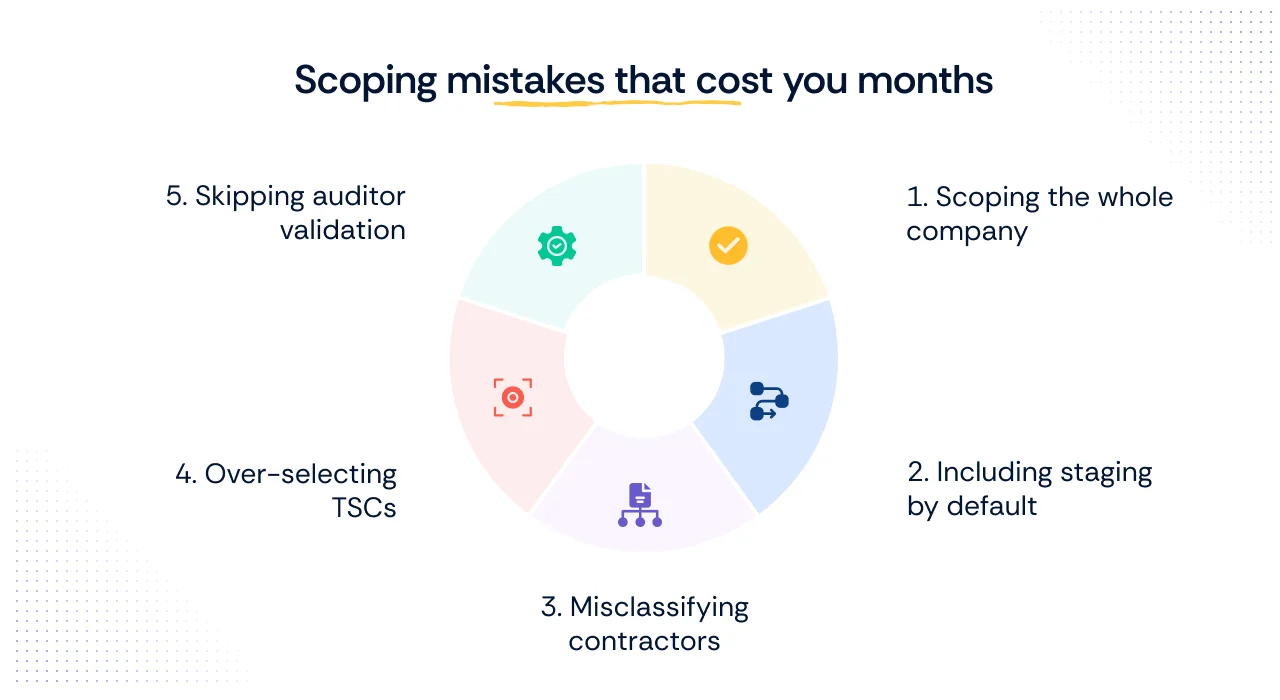
Five patterns recur in first-time SOC 2 audits. Each one is avoidable with deliberate early decisions.
- Scoping the whole company rather than the service delivery system feels safer, but results in months spent controlling systems that no customer ever asked about.
- Including staging by default because no one explicitly excluded it adds controls, evidence, and audit exposure to an environment with no customer data and no contractual relevance.
- Treating contractors as automatically out of scope ignores the reality that production access makes them directly relevant to access-control evidence, regardless of their employment status.
- Choosing TSCs based on what sounds comprehensive rather than what customers have contractually required adds months to your timeline and evidence burden with no corresponding increase in deal-closing value.
- Finalizing scope without auditor input and discovering, mid-readiness, that your auditor considers a boundary system in scope forces control remapping and evidence rework at the most costly stage of the process.
How automation changes the SOC 2 scope calculus
The common assumption is that a tighter scope means less work. That is partially true. Automation changes the rest of the equation.
Continuous monitoring, automated evidence collection, and policy management collapse the manual hours that make a wider scope feel unmanageable. Without automation, adding a single additional cloud environment means manually pulling configuration evidence, access logs, and change records each time your auditor requests them.
With automation, the same environment is continuously monitored, and evidence is collected without manual intervention at each audit cycle.
This means the over-scoping fear, while legitimate, is partly a tooling problem. The right platform does not change what should be included in your SOC 2 scope. It changes the cost of maintaining that scope year over year.
Scrut Automation offers an AI platform powered by autonomous agents that operationalize continuous compliance and security. The platform replaces audit chaos with scalable execution, enabling growing businesses to build trust at scale and manage cyber risk effectively.
The scope decision remains yours. The execution burden does not have to be.
If you are defining your SOC 2 scope and want to see how Scrut maps controls, collects evidence, and keeps you audit-ready continuously, take a product tour or talk to the team.
The SOC 2 scope covers the systems, people, procedures, and data involved in delivering your service to customers. This typically includes your production environment, core application stack, in-scope personnel with system access, and any subservice organizations whose failure would breach your service commitments. It does not automatically include your entire company, internal tools, or non-production environments.
Yes, in most cases. Staging can be excluded if it does not process real customer data and does not connect directly to production pipelines. Including it by default adds controls, evidence, and audit exposure without meaningful benefit to your customers. The test is simple: Does staging touch customer data? If not, leave it out.
No, not significantly. The same systems, people, procedures, and TSCs apply to both report types. What changes is the nature of the evaluation. Type I assesses control design at a point in time. Type II assesses whether those controls operated effectively over an observation period of typically six to twelve months, which substantially increases the evidence burden for the same scope.
Start with Security, which is mandatory. Add other TSCs only when there is a documented customer or contractual driver. Add Availability if uptime SLAs appear in your contracts, Confidentiality if you handle sensitive non-personal data, Processing Integrity if your service involves financial or health data processing, and Privacy if customers specifically ask about personal data handling. Each additional TSC extends your control count and timeline.
Not for most deals. A Security-only Type I audit covering your production environment is enough to satisfy the majority of vendor security questionnaires and unblock most mid-market enterprise deals. A broader scope becomes necessary only when customers have specific regulatory requirements or when contractual obligations demand additional Trust Services Criteria. Start lean and expand with intent.

%201.png)


.png)