

%20(1).png)
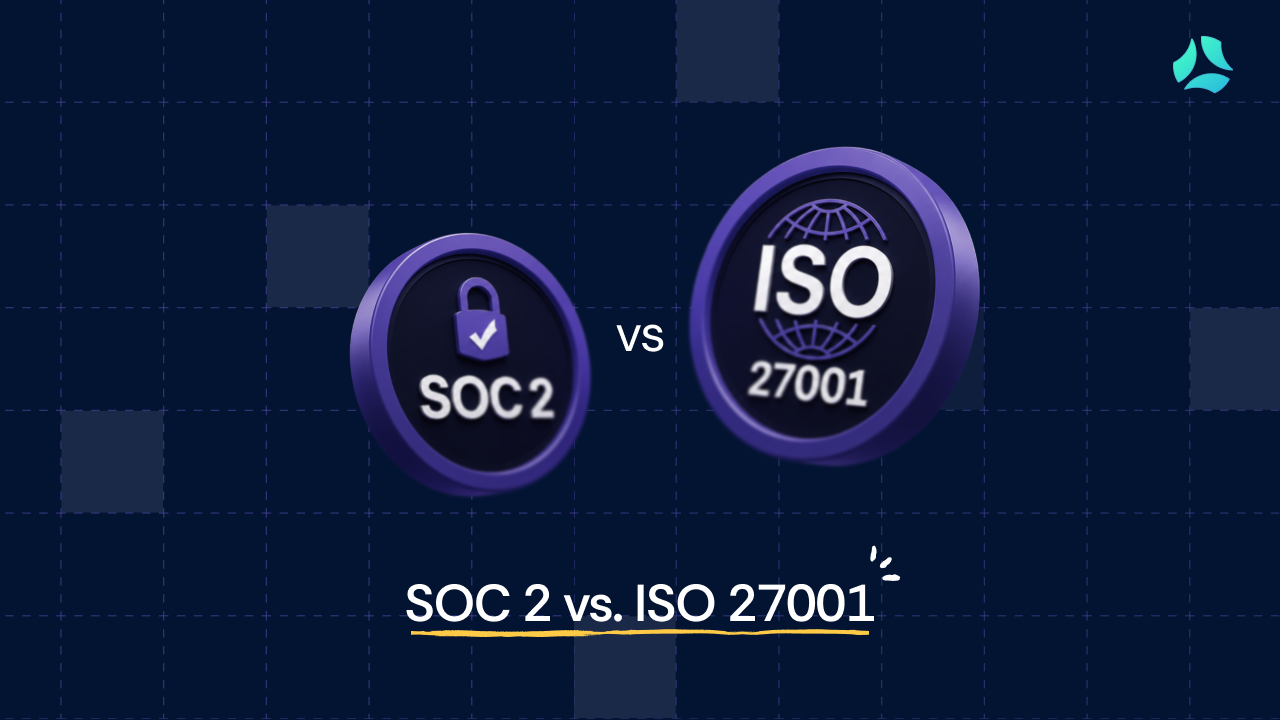


Picture a growth-stage SaaS company that just landed two procurement requests in the same week: one from a U.S. enterprise buyer asking for a SOC 2 report, another from a European client asking for an ISO 27001 certificate. Both deals are real. Neither will move until the security team answers a single question: which framework do we actually need?
This guide answers three things. First, what is the real difference between SOC 2 and ISO 27001? Second, can one replace the other? Third, when does pursuing both make sense? One factual point up front, because it shapes everything else: SOC 2 produces an attestation report issued by a CPA firm, not a certificate. ISO 27001 produces a certificate issued by an accredited certification body. That distinction drives how buyers, auditors, and regulators treat each one.
Key takeaways
- SOC 2 vs ISO 27001: SOC 2 is a U.S.-centric attestation report issued by a CPA firm; ISO 27001 is a globally recognized certification for your information security management system (ISMS).
- SOC 2 fits companies selling to U.S. enterprise buyers; ISO 27001 carries more weight in Europe, Asia-Pacific, and regulated global markets.
- The two frameworks share roughly 70–90% control overlap, so dual compliance is far more efficient than running two separate programs.
- SOC 2 Type II and ISO 27001 are not interchangeable; each satisfies different buyer and auditor expectations.
- A GRC platform that maps shared controls once lets you satisfy both frameworks without doubling your evidence burden.
What is SOC 2? (And what does it actually produce?)
The short answer: SOC 2 is a U.S. attestation report issued by a CPA firm; ISO 27001 is a globally recognized certificate for your information security management system. The rest of this page explains what that difference means in practice.
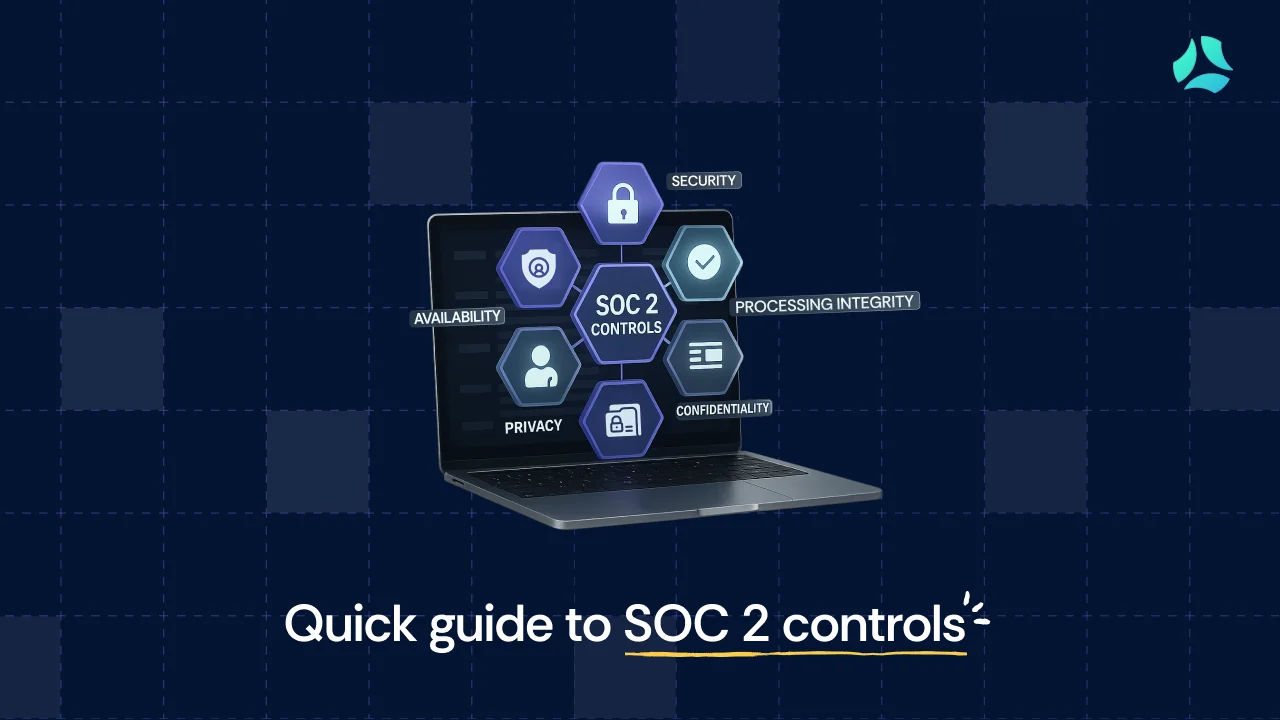
SOC 2 (System and Organization Controls 2) is a framework developed by the American Institute of Certified Public Accountants (AICPA) to assess how well an organization manages customer data against five Trust Services Criteria: security, availability, processing integrity, confidentiality, and privacy. Security is the mandatory baseline; the other four apply depending on your business model.
A company handling large-batch data processing needs processing integrity, while one handling personal data needs privacy. Security, availability, and confidentiality are the common trio most SaaS companies scope, with privacy and processing integrity added when the business model demands them.
Is SOC 2 a certification?
No. SOC 2 produces an attestation report, not a certificate. An independent CPA firm examines your controls and issues a report expressing an opinion on them. You do not become “SOC 2 certified.” You hold a SOC 2 report, or you are SOC 2 attested.
The 2022 revision of the Trust Services Criteria, building on the COSO 2013 alignment established in 2017, sharpened its emphasis on risk assessment and vendor management.
Scope is where SOC 2 programs succeed or fail. As one SOC 2 CPA auditor puts it: scope defined loosely at the start is where audits go sideways, and the system description is the foundation everything else rests on. Getting your SOC 2 control list and system description right early prevents most nasty audit surprises later.
SOC 2 is not legally mandatory. It is commercially driven, most common among B2B SaaS, cloud, fintech, and tech companies selling into the U.S. market, where enterprise procurement teams treat it as table stakes. There are no regulatory penalties for not having it, but a stalled deal is a real cost.
SOC 2 cost breakdown (100-person SaaS, 3 TSC)
These figures reflect practitioner experience on real engagements. The largest variable is whether you run the program manually or on a platform. Done manually, the consultant cost dominates because the assessment of gaps against the framework, cloud findings, and vulnerabilities is labor-intensive and billed by the hour.
Compliance automation folds most of that work in: cloud testing runs against CIS benchmarks automatically, and evidence and policies are generated rather than assembled by hand. Before you commit, a SOC 2 readiness assessment tells you how far your current controls are from the finish line.
SOC 2 Type I vs. Type II: When to skip straight to Type II
Once you know SOC 2 is the right path, the next decision is which report to pursue first. The conventional advice is “start with Type I, then upgrade to Type II.” A SOC 2 Type I report assesses whether your controls are suitably designed at a single point in time. Type II assesses whether those controls actually operated effectively over a period, typically 3 to 12 months.
Type I is faster and cheaper because the auditor verifies less evidence at a snapshot rather than across months. The report enterprise buyers ultimately want, though, is Type II.
In practice, the conventional sequence is fading.
According to Kush Kaushik, Co-founder at Scrut Automation, around 70% of Scrut customers go straight to Type II. Type I still makes sense when your controls were implemented recently, when you need a fast commercial signal to unblock an early enterprise prospect, or when your observation period has not yet elapsed.
Go straight to Type II when your controls have been running for 3 to 6 months, when a customer specifically asks for it, or when you are selling into financial services, healthcare, or government, where a Type I will not pass third-party risk review.
A practical path looks like this: gap assessment in month one, gaps fixed by month-end, controls practiced for three months, audit period running February through April, and a Type II report issued in May. The three-month floor is not arbitrary. Auditors consistently require at least three months of observation because quarterly controls like access reviews and BCP testing need at least one cycle to demonstrate they operate.
In practice, the auditor samples the access review log, confirms it ran on schedule, and checks that inappropriate access was revoked. If the review never ran during the observation period, there is nothing to sample, and the control fails on operating effectiveness, not design.
SOC 2 path selection by operational scenario
Note: Three months is the AICPA-tied minimum observation period for SOC 2 Type II. Six months is the industry-standard recommendation for a report that enterprise buyers treat as substantive. Both figures are accurate; the right floor depends on buyer expectations.
Understanding the engineering time for SOC 2 compliance helps you plan the observation period without derailing your roadmap.
What is ISO 27001?
ISO/IEC 27001 is an international standard that specifies the requirements for establishing, implementing, maintaining, and continually improving an Information Security Management System (ISMS). Published by ISO and IEC, it provides a systematic, risk-based approach to protecting sensitive information.
Unlike SOC 2, ISO 27001 results in a certificate. You achieve ISO 27001 certification, valid for three years, subject to annual surveillance audits.
The current version, the ISO 27001:2022 update, restructured the control set significantly. The 2013 version listed 114 controls across 14 domains. The 2022 revision consolidated these into 93 controls across 4 themes: organizational, people, physical, and technological.
The companion guidance, ISO/IEC 27002:2022, provides implementation detail for those Annex A controls. Clauses 4 through 10 of the main standard, covering context, leadership, planning, support, operation, performance evaluation, and improvement, form the mandatory management-system core.
Certification runs through two stages. Stage 1 is a documentation review: the certification body confirms your ISMS is designed correctly before committing to the full audit. Stage 2 is the main audit, testing whether the system is actually running. Most organizations that fail do so because Stage 1 surfaces design gaps they assumed were implementation gaps.
Audit findings fall into a clear hierarchy. If a control is missing on a small subset of sampled systems, for example, an antivirus present on 9 of 10 machines, that is a minor nonconformance. If the control is absent entirely, that is a major nonconformance, and the organization cannot be certified until it submits an action plan and undergoes a re-audit of that area or the whole organization, depending on the certification body.
ISO 27001 is voluntary, not a legal requirement, but it often functions as a de facto expectation in Europe, Asia-Pacific, the Middle East, and regulated global sectors. Its cost typically ranges from $15,000 to $60,000 depending on organization size, complexity, and certification body, based on publicly available market data from certification bodies and advisory firms.
ISO 27001 also anchors a wider family: ISO 27017 for cloud security and ISO 27701 for privacy, giving you a structured foundation to extend. For the full picture, the ISO 27001 certification guide and this broader ISO 27001 guide walk through the requirements in depth.
SOC 2 vs. ISO 27001 at a glance
Note: Three months is the AICPA-tied minimum observation period for SOC 2 Type II; six months is the more conservative industry standard.
Two differences drive most decisions. The first is a report versus a certificate. SOC 2 gives you an auditor’s opinion on your controls; ISO 27001 gives you a formal certificate that your management system meets an international standard. Enterprise buyers know the difference and ask for the specific one their process requires. The second is geographic recognition: SOC 2 is the U.S. currency, while ISO 27001 is the global one.
Everything else, cost, timeline, and control structure, flows from these two. Start there, and the rest of the comparison resolves itself. For a wider view of how these fit among other compliance frameworks, the same overlap logic applies across the board.
Where SOC 2 and ISO 27001 overlap, and where they diverge
The conservative, on-record overlap figure is 70%; in day-to-day audit practice, it runs closer to 90%. The range exists for a specific reason. Both frameworks cover the same core security ground: access control, incident response, vendor risk, change management, and risk assessment.
Where they part ways is in the ISMS management clauses that ISO 27001 adds on top, Clauses 4 through 10, which cover communication procedures, performance metrics, and continual improvement. A SOC 2-compliant organization often does these anyway; it just is not required to formally evidence them.
SOC 2 and ISO 27001 domain overlap and differences
The table above shows where evidence transfers cleanly. The prose below shows where it does not.
Put plainly: if an organization has done ISO 27001 thoroughly, it will pass SOC 2.
The reverse takes a little more work. Moving from SOC 2 to ISO 27001 means adding four things: a Statement of Applicability, Clause 9.3 performance metrics (four or five ISMS indicators reviewed on a schedule), Clause 7.4 document versioning controls, and the Clause 10 continual improvement requirement. That is the delta, not a second program from scratch.
The reverse divergence matters too. SOC 2’s five-TSC structure breaks out availability, processing integrity, confidentiality, and privacy as discrete criteria, which ISO 27001's unified ISMS does not separate the same way.
For the deeper mechanics, see the SOC 2 and ISO 27001 overlap analysis, and note that shared domains like vendor risk management and access reviews produce evidence you can reuse across both.
Which framework should you choose?
The choice comes down to who your buyers are, where they operate, and what stage your company is in. Seed and Series A companies selling into U.S. markets almost always start with SOC 2. Companies with EU or APAC expansion plans, or ambitions in regulated sectors, should layer in ISO 27001 at Series B or when the first international enterprise deal arises.
Compliance path strategy by business situation
The right answer also depends on who is asking inside your company. For a founder or CTO, SOC 2 Type I is the fastest way to unblock a stalled U.S. deal. For a compliance or GRC manager already running SOC 2, ISO 27001 is the highest-leverage next step, not a restart, because most of the work already transfers. For an infosec leader or CISO at a company with a global footprint, dual compliance is the defensible posture.
One point worth stating plainly: SOC 2 Type II and ISO 27001 are not interchangeable. U.S. enterprise buyers will not accept an ISO 27001 certificate in place of a SOC 2 report, and EU or APAC procurement teams will not treat a SOC 2 report as an ISO 27001 substitute.
If you are navigating overlapping obligations, DORA compliance and HIPAA compliance add their own requirements on top, and a compliance strategy mapped to your buyers keeps you from over-investing.
The case for dual compliance
For companies serving both U.S. and international buyers, dual compliance is a strategic advantage rather than a burden, because most of the work transfers. SOC 2 satisfies U.S. procurement; ISO 27001 carries weight globally and in regulated sectors. Together, they tell a complete assurance story: SOC 2 shows your controls operate effectively over time, ISO 27001 proves you have built a structured, risk-based ISMS.
The efficiency comes from control reuse. The control math from the overlap section holds here: the ISO-to-SOC 2 direction is nearly frictionless. Moving from SOC 2 to ISO 27001 means adding a Statement of Applicability, Clause 10 improvements, Clause 9.3 performance metrics, and Clause 7.4 document versioning. That is the incremental work, not a duplicate program.
The operational shift matters as much as the control math. As Ron Buell, CTO of Sounding Board, described his team’s move from spreadsheets and a third-party consultant, the gain was visibility: seeing exactly which policies and evidence each certification required, at what cadence, which removed the audit-time scrambling that used to catch them off guard. That is the difference between running two programs in parallel and running one program that answers two frameworks.
For teams pursuing this path, dual compliance works best when it is grounded in continuous compliance rather than point-in-time audit sprints.
How to read a SOC 2 report (what buyers should check)
When a vendor hands you a SOC 2 report, the auditor’s opinion is the start, not the finish. With limited time to evaluate a long report, here is where to focus.
Start with the audit opinion. An unqualified (clean) opinion is what you want. A qualified opinion means the auditor found an exception on specific criteria. An adverse opinion means controls failed materially. A disclaimer of opinion means the auditor could not reach a conclusion, usually because samples were unavailable, for example, when no new employees joined during the period, so joiner controls could not be tested.
Next, verify the auditor's peer review status. Go to the AICPA peer review website and confirm the CPA firm is enrolled and passed. Big Four, boutique, and small CPA firms all issue SOC 2 reports, and the validity of the firm matters. Then check the audit period: if the observation window ended many months ago, the report is stale, and you should request a bridge letter confirming the organization is currently under audit.
Read the system description in Section III. It should accurately reflect the vendor’s scope, infrastructure, and subservice organizations, for example, AWS or Azure. If a key cloud provider is not named, that is a gap. Distinguish exceptions from qualifications: an exception on one control within a criteria is not the same as a qualification, which means the entire criterion was unsatisfied.
Finally, check complementary user entity controls (CUECs). These are controls your organization must implement for the vendor's SOC 2 to cover you. AWS provides IAM capability; you own the configuration, named users, MFA, and least-privilege assignments. The report tells you this. Most teams do not read it. If a report includes management comments in Section V, read those too, though they are not audited.
SOC 2 report evaluation checklist and red flags
For a step-by-step walkthrough, see how to review a vendor's SOC 2 report, and connect it to your broader vendor risk management program. Understanding the SOC 2 audit evidence behind each control helps you read what you are looking at.
How to handle SOC 2 exceptions and qualifications
An exception and a qualification are not the same thing. When one control within a criterion fails sampling, that is an exception. When every control within a criterion fails, that is a qualification, and it goes into the auditor's opinion with a description of what was not satisfied.
Take CC6.1, logical and physical access control, one of the longest criteria, with many underlying controls. If hardening standards have a gap, that surfaces as an exception on that control. If every control in the criteria fails, it becomes a qualification.
This mirrors ISO 27001’s finding hierarchy exactly: a minor nonconformance when some samples fail, a major nonconformance when the control area fails entirely, and certification is blocked until it is remediated.
When an auditor spots a potential finding, they often increase the sample size to confirm or rule it out. An auditor who does this work year-round can sense when evidence is thin. If a genuine qualification exists, a larger sample will confirm it, and it lands in the report. Management can add context through Section V comments, but the audit firm will not permit comments that contradict the audit criteria.
The leverage point is narrow: once a qualification is in the report, it ships to customers unchanged. Your only window is the sample-size conversation while the finding is still being validated. An adverse opinion means the auditor found controls failed materially, and this happens most often because evidence appeared fabricated. It is the worst SOC 2 outcome.
For teams building toward a clean report, SOC 2 audit best practices and a well-run compliance audit process are what keep exceptions from becoming qualifications.
How Scrut supports SOC 2 and ISO 27001
Because SOC 2 and ISO 27001 share 70–90% of their controls, the smartest way to run both is to implement the shared controls once. In practice, that means one evidence collection run covers both frameworks. The ISO-only delta, the items covered in the dual compliance section above, gets handled separately.
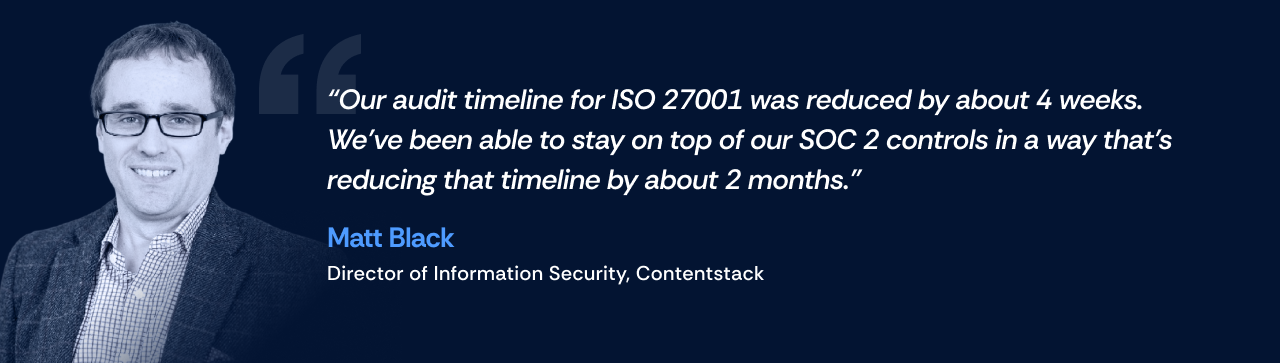
That efficiency shows up in real outcomes. Contentstack cut its ISO 27001 audit timeline by about four weeks and reduced its SOC 2 timeline by roughly two months after moving off spreadsheets. Athenium reduced delays in understanding evidence requirements by greater than 80% once it stopped doing everything manually.
Three outcomes are worth naming:
- Less duplicate evidence work. Scrut maps shared controls once across SOC 2 and ISO 27001. When you collect evidence for access control or incident response, it satisfies both frameworks simultaneously. No second collection run.
- Live audit readiness for both frameworks. The dashboard shows your SOC 2 and ISO 27001 posture simultaneously, and gaps surface before auditors do.
- Scoped auditor access. Evidence is ready and organized; no ad hoc requests during fieldwork.
Whether you are building toward a first SOC 2 compliance platform engagement, adding ISO 27001 automation to an existing program, or running both on one GRC platform, the goal is the same: an audit-ready posture without doubling the work. Scrut keeps you SOC 2 audit-ready and ISO 27001 certification-ready from a single compliance automation foundation.
FAQs
Can I replace ISO 27001 with SOC 2?
Not exactly. SOC 2 and ISO 27001 serve different purposes. ISO 27001 is a globally recognized certification for your information security management system. SOC 2 is a U.S.-centric attestation report evaluating the operating effectiveness of specific controls. If you target international clients or need a structured ISMS, ISO 27001 fits. If you focus on U.S. enterprise SaaS, SOC 2 may be sufficient, but most growing companies eventually pursue both.
Is SOC 2 a certification?
No. SOC 2 produces an attestation report issued by a CPA firm, not a certificate. You do not become "SOC 2 certified." You hold a SOC 2 report and are SOC 2 attested. ISO 27001, by contrast, does produce a certificate.
What are the similarities between ISO 27001 and SOC 2?
Both take a risk-based approach to information security, cover similar domains (access control, incident management, vendor management, and change management), require documented policies and external audits, and treat continuous improvement as core. In practice, they overlap by roughly 70–90%.
How much does it cost to pursue both SOC 2 and ISO 27001?
SOC 2 Type II for a 100-person SaaS typically runs $30,000–$80,000; ISO 27001 typically runs $15,000–$60,000 based on publicly available market data. Because the frameworks share most controls, running both together costs far less than the sum of two standalone programs, since shared evidence and controls carry over.
Which SOC report is closest to ISO 27001?
SOC 2 Type II is the closest equivalent. ISO 27001 certifies your overall ISMS; SOC 2 Type II assesses the operating effectiveness of your controls over a period (typically 3–12 months). SOC 1 focuses on financial reporting controls, and SOC 3 is a general-use summary without detailed findings, so neither aligns with ISO 27001 the way Type II does.

%201.png)


.webp)