

%20(1).png)


If you searched “SOC 2 training,” you're probably one of two people: a compliance or security leader who needs to run mandatory security awareness training as part of your SOC 2 program, or a professional weighing whether certification can put you on the path to becoming an auditor.
This guide serves both, because the phrase means different things depending on who's asking. Here's the tension worth naming upfront. Most companies treat security awareness training as a checkbox: run the session, save a sign-in sheet, move on. But auditors verifying SOC 2 compliance increasingly want evidence that training actually happened and was completed, not paper attendance records.
Below, each audience can jump to what matters for them.
Key takeaways
- SOC 2 training has two distinct meanings: employee security awareness training (a verified SOC 2 control) and certification courses for professionals who want to conduct or support audits.
- Security awareness training is required under SOC 2's Common Criteria. Auditors verify it happened and assess whether an evaluation was completed.
- Auditors now expect electronic completion records, not paper sign-in sheets.
- Becoming a SOC 2 auditor requires working at a licensed CPA firm enrolled in the AICPA peer review program.
- Phishing simulations after training are an emerging best practice for demonstrating behavioral change, not just checkbox completion.
What does “SOC 2 training” actually mean? (It depends on who’s asking)
“SOC 2 training” collapses two very different activities into one search term. The first is employee security awareness training: an internal control that every SOC 2-scoped organization runs to make sure its people understand their security responsibilities. The second is professional development and certification for practitioners who want to assess or prepare organizations for SOC 2 audits.
The confusion is worth clearing up because the audiences never overlap in practice. A GRC manager mandating annual training for 200 employees is solving a completely different problem from an IT auditor studying for a CISA exam.
Training programs of the second kind are offered by professional bodies such as the AICPA and ISACA (the Information Systems Audit and Control Association). Employee security awareness training does not require formal accreditation, but that does not mean auditors accept it on faith.
When an auditor tests the training control, they are looking for concrete evidence: who completed the training, on what date, and with what evaluation result.
Before compliance automation platforms were common, auditors often accepted a paper attendance sheet from an in-office session.
Today, the expectation has shifted toward electronic records maintained in a learning management system (LMS) with timestamps and completion tracking. An auditor reviewing your program in October needs comfort that training completed in January was genuinely attended and understood.
Costs and duration vary widely. Introductory sessions can run a few hours; in-depth certification programs stretch across weeks. Pricing ranges from a few hundred to several thousand dollars, driven by provider, depth, and whether the program includes a proctored exam. The variance largely reflects how much assessment and hands-on practice is built in, not just seat time.
SOC 2 training: Two tracks at a glance
For the full picture of what auditors test against, see the SOC 2 controls list.
Security awareness training as a SOC 2 requirement (employee track)
If you manage a SOC 2 program, this is the section that matters most. Security awareness training is a required control. SOC 2 does not hand you a scripted curriculum, but the underlying principle is consistent across the security-related Common Criteria: your people must understand their security responsibilities, and you must be able to prove they were trained. (Verify the exact control mapping against your SOC 2 controls list before documenting it in your system description.)
At minimum, the training should cover your information security policies, acceptable use of systems and devices, phishing and social engineering awareness, incident reporting procedures, access management responsibilities, and data handling expectations relevant to confidentiality and privacy.
The goal is not trivia. It’s that every employee leaves understanding what they are responsible for protecting and how to escalate when something looks wrong.
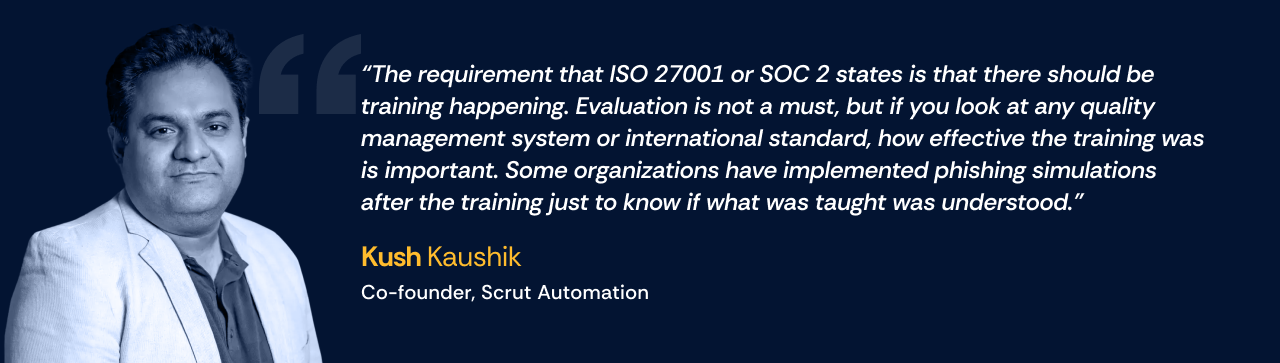
Auditors draw a hard line between “training happened” and “training was effective.” SOC 2’s baseline requirement is that training occurs. Evaluation, a short assessment confirming employees understood the material, is not strictly mandatory.
But if you look at any mature quality management system or international standard, demonstrating how effective the training was is treated as genuinely important. An auditor who can see both completion and a satisfactory evaluation score reaches a stronger conclusion: the control not only ran, but it also worked.
Frequency matters too. Annual training is the typical baseline, but new hires must be trained at onboarding, not simply folded into the next annual cycle. A common evidence gap is a hire date that predates the employee's training completion date by months. Auditors check exactly this, comparing when someone joined against when they completed training.
Some organizations have gone a step further by running a phishing simulation after the annual training. The logic is straightforward: a question-and-answer quiz confirms recall, but a simulated phishing email tests whether people actually changed their behavior. This is not a formal SOC 2 requirement, but auditors view it favorably as evidence that the control was designed to change behavior rather than just document attendance.
What SOC 2 employee training must cover (and what auditors verify)
This is where the delivery mechanism becomes decisive. LMS-based training with automated evidence collection is now the standard expectation because it produces electronic, tamper-resistant records that auditors rely on.
Scrut’s security training and device monitoring capability generates exactly this kind of audit-ready record, so you're not reconstructing evidence when the auditor asks.
For the broader picture of getting ready, see our guide to SOC 2 audit readiness and our 5 best practices for a successful SOC 2 audit.
Are SOC 2 training and SOC 2 audit training the same?
No. They serve different people and different purposes, and the distinction has practical consequences for anyone running a compliance program.
Employee security awareness training exists to satisfy a control. It’s an internal activity you run so your workforce understands its security obligations, and its output is evidence: completion records, evaluation scores, and acknowledgments.
A 60-person SaaS company might assign a 45-minute LMS module to every employee each year, with a short quiz at the end, and store the results as audit evidence.
Auditor training builds the expertise to assess or prepare for those controls. It’s the professional education behind a CISA or CISSP credential that teaches someone how to evaluate whether a control was designed correctly and operated effectively.
An IT auditor pursuing CISA studies how to sample access review evidence and test whether inappropriate access was revoked on schedule.
For the policies that underpin the employee side, see our guide to SOC 2 compliance policies.
What does a typical SOC 2 training program consist of?
A structured SOC 2 training program (the practitioner-education kind) usually moves through five modules, plus a sixth that auditors increasingly expect. What matters is not just what each module covers, but what evidence demonstrates it was completed or applied.
1. Introduction to SOC 2 compliance. Covers the SOC 2 framework, the AICPA’s role, and the difference between Type I and Type II reports. Evidence of completion is a timestamp and a completion record in the LMS.
2. Understanding the Trust Services Criteria. A detailed study of security, availability, processing integrity, confidentiality, and privacy, along with the controls that satisfy them. Auditors look for evidence that the learner can map criteria to specific controls, often assessed through a module quiz.
3. Risk assessment. Identifying and rating risks against the Trust Services Criteria. What auditors want to see is that risk assessment covers the full length and breadth of the scoped system, not just part of it. The evidence artifact is a dated risk register with probability and impact ratings, showing that every area in scope was assessed.
4. Implementation best practices. Establishing policies, documentation, and security measures. The evidence auditors care about is approved policies with version history and approval logs, not just draft documents. But policy existence is not the same as control implementation.
An auditor will also look for evidence that the policy was communicated to employees and that the underlying technical control (for example, MFA enforcement) is actually in place, not just described.
5. Audit readiness and continuous compliance. Evidence collection, continuous monitoring, collaboration with auditors, and post-audit remediation. Auditors look for logs showing recurring activities such as quarterly access reviews and periodic business continuity testing actually happened on schedule.
6. Security awareness and behavioral training. Phishing simulation and social engineering awareness. Increasingly expected even though it's not formally mandated, because it demonstrates behavioral change. Evidence is the simulation result set: click rates, reporting rates, and remediation for those who failed.
On delivery format: LMS-based training with automated evidence collection is now the baseline expectation. Manual sign-in sheets are increasingly insufficient for a Type II audit by a rigorous auditor, because they cannot demonstrate when the activity occurred or that it recurred at the required cadence. Automation platforms produce the trail auditors need for continuous compliance, and you can read more on how automated evidence collection works.
Can I become a SOC 2 auditor after the training program?
No. Completing a training program, even a rigorous one, does not qualify you to issue SOC 2 reports. The single most important and least understood eligibility criterion is this: the firm issuing the report must be a licensed CPA firm enrolled in the AICPA peer review program.
This is not optional. SOC 1 and SOC 2 are attestation engagements, and attestation engagements must be carried out by AICPA-licensed CPA firms enrolled in peer review. In April 2022, the AICPA issued a clarification confirming that independent auditors (sole practitioners not operating within an enrolled CPA firm) are not permitted to issue SOC 2 reports.
If you're planning a career path, this reshapes it: your route runs through employment at a qualifying firm, not through certifications alone.
Not everyone working on a SOC 2 engagement needs to be a CPA. Many of the professionals who test controls hold credentials such as CISA, CISSP, or CIA rather than a CPA license. What matters is that the firm issuing and signing the report is a licensed CPA firm in good standing with its peer review obligations.
Peer review must occur within a three-year cycle, with limited extensions available by request to the AICPA. You can verify a firm’s status directly: the AICPA peer review website lets you check whether a firm is enrolled, whether its peer review has occurred, and whether it passed, failed, or passed conditionally. If you're evaluating firms to work for or to hire, this is the first check to run.
For a deeper comparison of firm types, see our guide on choosing a SOC 2 auditor.
What are some SOC 2 auditor certification courses?
Certifications signal specific expertise, and the right one depends on the role you’re targeting. Costs below are approximate and should be verified with the issuing body before you enroll.
Certified Information Systems Auditor (CISA). The core credential for IT auditors who will test controls. Duration is typically 40 or more hours of preparation. Cost is approximately $575 for ISACA members and $760 for non-members (verify current fees at isaca.org before enrolling).
CISA also requires five years of professional experience in information systems audit, control, security, or assurance. ISACA allows up to 3 years of this requirement to be waived with qualifying education or certifications; verify current substitution rules at isaca.org. Not a fast track for early-career professionals.
Certified Information Systems Security Professional (CISSP). Aimed at security professionals who support audit evidence and build the controls being tested. It signals broad, deep information security knowledge and is a strong indicator that an auditor understands modern technical environments.
Certified Information Security Manager (CISM). Oriented toward security managers responsible for governance and program oversight rather than hands-on control testing. Duration is typically 40 or more hours. Cost is approximately $575 for ISACA members and $760 for non-members (verify current fees at isaca.org before enrolling).
SOC for Service Organizations Certificate (AICPA). Self-paced, aimed at CPAs entering the SOC practice. Cost is approximately $359 for AICPA members and $449 for non-members (verify current pricing at aicpa.org before enrolling).
Knowing which certifications to look for matters most when you’re on the other side of the table, evaluating the firm and team that will assess you. One critical clarification: none of these certifications substitute for CPA licensure when it comes to signing the audit opinion.
A CISA or CISSP holder can test controls and contribute meaningfully to an engagement, but the CPA firm requirement remains separate and non-negotiable. For more on selecting the right firm, see boutique vs. Big 4 auditing firm.
How to choose a SOC 2 auditor (what to look for before hiring)
If you're running a compliance program, you’re far more likely to be hiring an auditor than becoming one. Getting this decision right prevents wasted spend, stalled deals, and a report your enterprise customers won't accept.
Start by understanding the four categories of audit firms. Big 4 firms offer global reach, structured methodology, and the highest fees, best suited to large enterprises. Boutique CPA firms practice much like a Big 4 firm but with smaller teams and lower fees, and they often specialize in SOC 2, making them a strong fit for mid-market SaaS.
Small CPA firms are similar to boutiques but with more variable quality; one firm’s rigor can differ sharply from another's, so due diligence matters most here. Independent auditors (sole practitioners) are not permitted to issue SOC 2 reports following the AICPA's April 2022 clarification.
Audit firm categories: What to know before you choose
Next, verify the firm’s credentials. Check that it holds a valid CPA license, that it is enrolled in the AICPA peer review program, and that its most recent peer review occurred and passed. The AICPA peer review website is where you confirm this. A reputable firm will share its peer review report. If it failed or passed conditionally, it should be willing to explain the concerning areas.
Then look at the auditors themselves, not just the firm. Ask who will actually perform your engagement and review their profiles. Do they hold CISA, CISSP, or ISO 27001 Lead Auditor credentials? Do they understand modern, cloud-native SaaS environments? An auditor who asks you to re-export evidence you already uploaded to your compliance platform, or who can't interpret a cloud-native access log, is a liability regardless of the firm’s name on the letterhead.
Cost is the last variable, and it's more controllable than most teams expect. Firms typically charge less when you use a compliance automation platform, because fewer auditor man-days are spent chasing and verifying evidence. Watch for red flags: a firm not enrolled in peer review, no information security certifications among the audit team, and no prior experience with SaaS or your industry vertical. To reduce the man-days involved, see how to accelerate the SOC 2 audit process.
Can the training be done online or offline?
Yes. SOC 2 training is available in both formats. Many providers offer self-paced online courses, live instructor-led virtual sessions, or in-person corporate training programs. Auditor certification courses are similarly available online and offline, depending on the provider.
For employee security awareness training specifically, online LMS delivery has become the default because it automatically generates the completion records auditors expect, and because it scales to distributed and remote teams without requiring a scheduled in-person session.
Are there any free SOC 2 training resources?
Several credible free resources exist:
- AICPA’s SOC 2 guidance and Trust Services Criteria document. The AICPA publishes an overview of the SOC 2 framework, and the Trust Services Criteria document is publicly available. These are the authoritative sources for what the criteria actually require.
- ISACA free webinars and CISA exam resources. ISACA covers SOC 2 compliance fundamentals through free webinars and publishes exam preparation resources for those pursuing CISA.
- Scrut’s SOC 2 resources. Start with a practitioner view of how SOC 2 supports your broader posture in SOC 2 and your security posture: a CISO's perspective, then move to a practical SOC 2 readiness assessment when you're ready to gauge where you stand.
What are the job titles for a SOC 2 auditor?
Common titles include:
- SOC 2 auditor
- IT compliance auditor
- Security and risk compliance analyst
- Senior IT auditor
- Information security auditor
What do SOC 2 employee training requirements actually look like?
Reframe these requirements from the auditor’s perspective: not “what employees must do,” but “what auditors test for.”
At the baseline, auditors test that training happened and that records exist. Employees should understand the Trust Services Criteria and their own security responsibilities, and there should be documented completion for every person in scope. The minimum is that training occurred and records exist. Better practice adds an evaluation confirming that employees understood the material. Better still,, organizations can use phishing simulations to assess whether employees have applied what they learned in practice.
Two requirements catch companies off guard. First, training must cover new hires at onboarding, not just the annual cycle. Auditors compare hire dates against training completion dates, and a gap here is one of the most common evidence findings. Second, the records themselves must be verifiable. Auditors now expect electronic records with timestamps showing who completed training and when.
A paper sign-in sheet cannot demonstrate that the training occurred on schedule or that a specific person attended, which is why it's increasingly insufficient for a rigorous Type II audit.
Hands-on exercises can reinforce training by giving employees an opportunity to apply what they have learned. In the context of SOC 2, phishing simulations are one practical way to test whether employees can recognize and respond to common security threats.
SOC 2 does not require case-study coursework for every employee. It requires that the workforce understands its obligations and that you can prove it. To operationalize this, see our guide to SOC 2 audit preparation and Scrut's security training platform.
What kind of SOC 2 report should the auditor create?
A SOC 2 auditor prepares either a Type I or Type II report. Both share a five-part structure:
1. Management's description of the system. A detailed explanation of the infrastructure, software, data, people, and processes relevant to the audit.
2. Scope of the audit. Which Trust Services Criteria are evaluated, the audit period (for Type II), the services assessed, and reliance on subservice organizations.
3. Auditor’s opinion. An independent assessment of whether controls were suitably designed (Type I) or operated effectively over time (Type II).
4. Results of testing procedures. The specific tests performed, findings, and any exceptions noted.
5. Additional information (if applicable). Management’s responses or remediation plans.
What this means when you’re reviewing a vendor’s SOC 2 report. If you’re on the receiving end, sections 2 and 3 tell you what was actually in scope and whether the report is fresh or stale. There is no pass or fail in SOC 2. Every organization that undergoes the engagement receives a report. It might have no findings, some findings, or major findings, but you always get a report.
That's why the opinion matters. An unqualified opinion means all tested criteria were met. A qualified opinion means one or more criteria contained exceptions significant enough to affect the opinion. A qualified report is still usable, but it will require explanation to your customers.
Read the specifics carefully rather than treating “qualified” as an automatic disqualifier. Section 5 is where management can respond to exceptions, giving the audited company its right of reply, though the audit firm ensures those comments don’t contradict its findings.
For a structured approach, see our 9 easy steps to review a vendor's SOC 2 report and our overview of the types of audit evidence that underpin those findings.
What actually happens during a SOC 2 audit? (A walk-through)
The audit process is more structured than most compliance teams realize, and knowing the sequence prevents the delays that stall most engagements. Here’s what actually happens, from the perspective of the firm doing the work.
It starts with your system description. Section 3, the description of the system, is provided by your organization, not the auditor. This is a common point of confusion. Section 3 documents the background and overview of services, the scope of the system (products, infrastructure, locations), subservice organizations (such as your cloud provider), physical and logical access controls, the organizational chart, how policies are shared, and network diagrams.
Investing in an accurate Section 3 is the single best thing you can do to avoid surprises, because scoping issues are the primary source of nasty audit findings.
From Section 3, the firm defines controls and test procedures. The audit firm uses your description to define the critical controls within each Trust Services Criteria and the procedures it will use to test them. This is worked out in meetings, remote or in person, between you and the firm.
Behind the scenes, the firm builds work papers. A single SOC 2 audit can generate 400 to 500 internal documents: control testing matrices, sampling work papers, exception logs, exception evaluation memos, and more. You will not see these, and you shouldn't expect to.
They are the firm's internal quality management documentation, which itself gets reviewed under the firm's own peer review program.
Management signs the assertion letter. Based on your Section 3 description, your top management provides a written declaration, on company letterhead and signed, attesting that the organization has followed what the system description says it follows. This is mandatory and cannot be automated. The firm incorporates this assertion into the final report.
Draft report, review, final report. The firm produces a draft with any findings, you review it, and the final report is issued. Findings can be exceptions, qualifications, or, in rare cases, an adverse opinion, typically when evidence appears fabricated.
On timeline: the audit itself, after the observation period, typically takes several weeks, depending on the firm and scope. Where it stalls is predictable: an incomplete Section 3 description, missing evidence for sampled controls, and back-and-forth on exception wording.
For help preparing, see our SOC 2 audit setup guide, how to handle audit evidence documentation, and our step-by-step SOC 2 scope guide.
Where compliance automation changes the training and audit equation
Before compliance automation platforms, training evidence meant a paper attendance sheet from an in-office session. Here’s what changed.
Policy approvals meant a manager replying “approved” to an email with a zip file attached, with no record of whether anyone read the policy or when. Access reviews meant recording your screen every quarter with a visible timestamp and storing the video so that, a year later, an auditor could confirm all four quarters happened. It worked, but it was fragile and labor-intensive, and evidence was often reconstructed after the fact.
After automation, training completion is recorded electronically with timestamps and evaluation scores an auditor can rely on. Policy changes carry an immutable log showing when a policy was drafted, reviewed, and published. Access reviews, business continuity testing, and vulnerability management generate their own continuous, tamper-resistant trail. For the training control specifically, this means the auditor can verify what happened without your team scrambling to rebuild records.
Contentstack reduced its SOC 2 audit timeline by about two months after moving from spreadsheets to Scrut. Athenium's IT manager described cutting the delay in understanding and submitting evidence by more than 80%.
Scrut's platform includes security training and device monitoring that generates the audit-ready records auditors now expect, alongside broader compliance automation for the rest of your evidence trail.
There's a direct cost implication, too. Companies using a compliance automation platform with LMS functionality typically face lower audit fees, because the firm spends fewer man-days chasing and verifying evidence. The comfort level the platform provides to the audit firm translates into efficiency, and efficiency translates into cost. For the mechanics, see how automated evidence collection works.
Make SOC 2 training evidence audit-ready, automatically
Manually chasing training completion records and reconstructing evidence at audit time costs your team weeks. Scrut automates security awareness training delivery, completion tracking, and evidence collection, so your training control is always audit-ready and your auditor gets the electronic records they now expect.
See how it works: book a demo, or explore Scrut’s SOC 2 compliance solution.
FAQs
What is SOC 2 compliance training?
SOC 2 compliance training refers to two things: employee security awareness training that satisfies a SOC 2 control, and professional courses that build the expertise to conduct or prepare for audits. For most searchers, it means the first: mandatory security awareness training your auditor will verify.
Are SOC 2 training and SOC 2 audit training the same?
No. Employee training satisfies an internal control and produces evidence. Auditor training builds the expertise to assess those controls. Completing one does not qualify you for the other.
What does a typical SOC 2 training consist of?
For practitioner education: SOC 2 fundamentals, the Trust Services Criteria, risk assessment, implementation best practices, audit readiness, and, increasingly, a behavioral module with a phishing simulation.
Can I become a SOC 2 auditor after the training program?
No. You must work for a licensed CPA firm enrolled in the AICPA peer review program. Independent sole practitioners cannot issue SOC 2 reports.
Can the training be done online or offline?
Yes, both. Employee awareness training is most often delivered online via an LMS, which automatically generates completion records.
Are there any free SOC 2 training resources?
Yes. The AICPA's SOC 2 guidance and Trust Services Criteria document, ISACA's free webinars and CISA resources, and Scrut's SOC 2 hub content.
What are the job titles for a SOC 2 auditor?
SOC 2 auditor, IT compliance auditor, security and risk compliance analyst, senior IT auditor, and information security auditor.
What kind of SOC 2 report should the auditor create?
Either a Type I (design at a point in time) or Type II (design and operating effectiveness over a period) report, both following the same five-part structure.
Is security awareness training mandatory for SOC 2?
Yes. It is a required control under SOC 2's Common Criteria. Auditors verify that training occurred, that records are maintained, and that any associated evaluation was completed. At minimum it should cover information security policies, acceptable use, phishing awareness, and incident reporting.
What do SOC 2 auditors look for when verifying training compliance?
Electronic records showing who completed training, on what date, and with what evaluation result. Paper attendance sheets are no longer sufficient for most auditors. LMS-based completion records with timestamps provide the assurance needed for a Type II report.
How do I verify that a SOC 2 audit firm is legitimate?
Check three things: a valid CPA license, enrollment in the AICPA peer review program, and a passing most-recent peer review. You can confirm this on the AICPA peer review website. Firms not enrolled in peer review cannot issue SOC 2 reports.
What's the difference between a SOC 2 qualified and unqualified opinion?
An unqualified opinion means all tested criteria were met. A qualified opinion means one or more criteria contained exceptions significant enough to affect the opinion. There is no pass or fail; every organization receives a report. A qualified report is usable but requires explanation to customers.
Does phishing simulation count as SOC 2 training?
Phishing simulation is not formally required, but auditors view it favorably as evidence that training was designed to change behavior rather than just document completion. Running a simulation after annual training demonstrates a higher-quality control.

%201.png)


.webp)