


%20(1).png)


Most teams treat a SOC 2 exception as a failed audit. It is not. SOC 2 does not produce a pass or fail result, and it does not issue a certificate. It produces an attestation report, and the auditor forms one of four opinions on it: unqualified, qualified, adverse, or a disclaimer of opinion.
An exception is a documented control gap inside that report, not a verdict on your whole program. If you have just received an exception flag or you are preparing for your first SOC 2 Type II audit, that distinction matters more than any other.
This guide focuses on SOC 2 Type II exceptions, which are identified during testing over an observation period. Since Type II evaluates the operating effectiveness of controls against the Trust Services Criteria, it is where most exceptions occur. Type I assesses only the design of controls at a single point in time, so exceptions in those reports are fundamentally different and are not covered here.
Key takeaways
- SOC 2 exceptions are instances where a control failed to meet the Trust Services Criteria, whether by design, execution, or missing documentation.
- There are three types: design deficiency, system description misstatement, and operating effectiveness deficiency.
- An exception does not automatically mean a failed audit. Auditors issue opinions, unqualified, qualified, adverse, or a disclaimer, not pass/fail verdicts.
- One isolated exception with a remediation plan rarely moves the needle. A pattern of them across a criterion does.
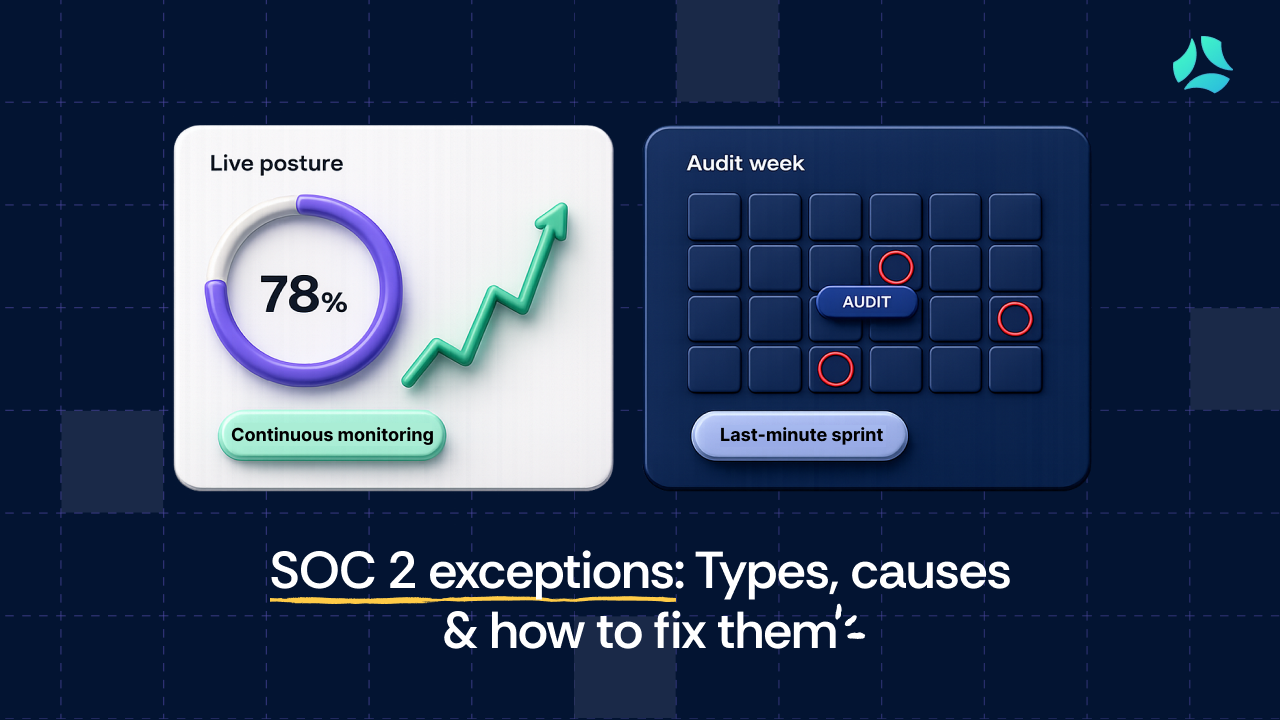
- Preventing exceptions takes continuous control monitoring, not a last-minute audit sprint.
What is a SOC 2 exception?
A SOC 2 exception is any instance where a control either was not designed correctly or failed to operate as intended during the audit period. That is the AICPA-aligned framing, and it is more precise than the loose “non-compliance” label. An exception is tied to a specific control and a specific test, not to your posture in general.
Exceptions surface during SOC 2 Type II because that is where the auditor tests whether a control worked consistently over the whole observation window, not just whether it existed on one date. When a sampled test fails, the auditor documents it as an exception and weighs whether it is isolated or part of a wider pattern.
People often use “exception” and “finding” interchangeably. They are not the same thing, and the difference affects what shows up in your report.
An exception is the narrow, evidence-backed instance. A finding is the wider observation that the auditor may raise around it. One exception rarely moves an opinion. A pattern of them can.
The 3 types of SOC 2 exceptions
The AICPA taxonomy recognizes three exception types. Getting the type right matters because the remediation path for each is different.
1. Design deficiency
A required control is missing, or it was never designed to achieve its stated objective. The gap is structural, not operational. Example: no MFA policy implemented on production accounts. The control that should exist does not, so there is nothing to test for effectiveness.
2. System description misstatement
An error or omission in how the organization describes its systems and services in Section III of the report. This happens through intentional omission or, more often, failure to update the description after a system change. Example: the system description still references an on-premise data center after a migration to AWS.
3. Operating effectiveness deficiency
A correctly designed control failed to work consistently during the observation period. The control looks fine on paper right up until the auditor pulls the sample log. Example: quarterly access reviews were documented, but only 2 of 4 were completed during the period.
One failed sample does not automatically become an exception. The auditor first assesses whether the failure is isolated or systemic.
Here is the distinction that decides how serious it gets. Take CC6.1, logical and physical access controls, one of the longest criteria in the framework, with many controls underneath it. If a single control within CC6.1 fails, for example, a gap in hardening standards, that is an exception.
The other controls in the criteria still hold. But if every control within that criteria fails, it stops being an exception and becomes a qualification, which the auditor names directly in the opinion.
This mirrors ISO 27001, where antivirus running on 9 of 10 sampled systems is a minor nonconformance, whereas antivirus not installed at all is a major one. Check the full SOC 2 control list to see how many controls sit under each criterion.
Does a SOC 2 exception mean you failed the audit?
No. SOC 2 auditors do not issue pass/fail verdicts. They issue one of four opinions, and only two of them signal a real problem.
In practice, three things determine whether an exception moves the opinion: how bad the failure was, whether it happened once or kept happening, and whether anything else caught what the primary control missed. Auditors weigh all three before deciding whether to qualify.
Section 5 of the report, management comments, lets you explain why an exception occurred and what you have done about it. This applies to exceptions and qualifications alike. It does not change the auditor’s opinion, and the audit firm does not test those comments. But the firm does review them to confirm they do not contradict the audit criteria, so this is context for the reader, not a way to relitigate the finding.
The commercial takeaway: a qualified opinion does not end your relationship with clients, but it does require proactive communication. A buyer running their own vendor risk program will read the opinion, see the qualified criteria, and expect you to walk them through the remediation. Silence is what damages the relationship, not the exception itself. If you want to understand where opinions get decided, the full SOC 2 audit process and a proper SOC 2 readiness assessment are where the groundwork happens.
Common causes of SOC 2 audit exceptions
Most exceptions trace back to a handful of recurring causes. Knowing which cause produces which type of exception tells you where to look first.
1. Inadequate or missing documentation
The auditor cannot verify what they cannot see. If a control ran but left no record, it did not run as far as the report is concerned. This produces misstatements and operating effectiveness deficiencies.
2. Controls designed for a previous system state
The environment changed, and the control did not keep up. A control written for an on-premise setup does not map to a cloud environment. This produces design deficiencies and misstatements, and it is one reason auditors check that the full length and breadth of your scoped systems is actually covered, not just the parts that were easy to document.
3. Inconsistent execution of recurring controls
Access reviews, vulnerability scans, backup tests. These fire on a schedule, and a single missed cycle during a busy quarter shows up as an operating effectiveness deficiency.
4. Third-party vendor non-compliance passed upstream
Your vendor’s control failure becomes your exception. When a vendor integral to your controls fails their own obligations, that gap shows up in your report as an operating effectiveness or design deficiency. Strong vendor risk management is what keeps this from happening.
5. Mid-cycle process or infrastructure changes without control updates
A control operating correctly at the start of the period changes partway through, and nobody updates the documentation or re-tests it. This is the most dangerous cause because it can produce all three exception types at once.
6. Insufficient training causing policy violations
When staff do not understand their role in a control, they skip steps. This produces operating effectiveness deficiencies.
The thread running through most of these is manual evidence collection. Teams relying on screenshots and spreadsheets miss recurring control executions during busy quarters, and the gaps only surface when the auditor asks. Continuous compliance monitoring closes that window.
Real-world SOC 2 exception examples
Here is what each exception type looks like when the auditor actually pulls the sample. Each scenario below is illustrative.
Missed access review
Policy requires quarterly reviews, but only 2 were completed in 12 months. The auditor checks the review calendar and the sign-off evidence and flags an operating effectiveness deficiency under CC6.1. What happens next is worth noting: when an auditor sees one result that looks off, they do not just document it and move on.
A seasoned auditor can usually sense when a single result is not a one-off, and they will increase the sample size to see whether the gap is isolated or systemic. The fix: automate calendar triggers and evidence capture so reviews cannot silently slip. Scrut’s automated evidence collection and access review workflows handle this directly.
Unrevoked access after termination
Eighteen days. That is how long a former employee retained admin access to production systems in this scenario, against a policy that required revocation within 48 hours. Auditors flag this one quickly because it maps directly to breach risk, not just compliance risk. The fix is structural: connect your HRIS to your IAM so deprovisioning triggers the moment someone’s departure is recorded, not the moment someone remembers to check.
Missing vulnerability scans
Monthly scans are required, but January and April were missed due to team bandwidth. The scanner logs confirm the gaps, and the control is flagged as partially implemented, an operating effectiveness deficiency. The fix: assign a single control owner and automate scan scheduling so no month depends on someone remembering.
System description mismatch
The report describes infrastructure as hosted on-premise, but the company migrated to AWS six months into the observation period without updating Section III. This is a system description misstatement. The fix: designate a system description owner who reviews Section III on every infrastructure change, so the written description never drifts from reality.
How to prevent SOC 2 audit exceptions
Prevention works best when you organize it around the exception type you are trying to avoid.
Preventing design deficiencies
Design gaps almost always start with a scope that misses part of the environment. Map every system, service, and data flow that touches your service commitments before you define controls. If it is not in scope, no one will build a control for it.
Review control design early. A SOC 2 readiness assessment run a few months out surfaces design gaps while you still have time to fix them. Three months of practice runs before the window opens is the difference between a control that exists and a control that holds under sampling.
Preventing operating effectiveness failures:
Recurring controls fail when humans forget, not when designs are wrong. Automate them. Access reviews, scans, and backup tests should fire on schedule and capture their own evidence, so a busy quarter cannot cost you a cycle. Automated controls testing removes the human memory dependency entirely.
Monitor continuously. Point-in-time checks miss drift the moment they end. Continuous monitoring catches a control failure the week it happens, not the week the auditor samples it.
Run quarterly internal audit rehearsals. Test a subset of key controls mid-cycle to catch drift before the formal window closes. An internal audit checklist turns this from an ad hoc scramble into a repeatable habit.
Preventing misstatements
Assign one owner who updates Section III on every infrastructure or process change. The description never lags reality if one person is accountable for keeping it current.
Ownership underpins all of it. Distributed ownership is how evidence gaps accumulate unnoticed. When compliance is spread across managers in different departments with no single owner, nobody tracks the gaps until the auditor asks. One accountable owner is the cheapest control you can implement.
How to address and remediate SOC 2 audit exceptions
When an exception lands, you have two jobs: respond now, remediate properly.
Phase 1 -Respond (during or immediately after the exception is flagged):
1. Acknowledge the exception clearly. Do not reframe it as a misinterpretation or try to argue it away. Once the auditor has documented an exception, pushing back only slows things down. Accept it and move to context.
2. Show scope and impact. Is this isolated or systemic? Provide the logs, screenshots, and timelines that establish how far the gap actually reaches. This is also where the auditor may increase the sample size, so accurate scope evidence works in your favor.
3. Outline immediate next steps. State what you are doing now and give a remediation timeline. This is also where Section 5 management comments come in, your chance to explain, in the report itself, why the exception occurred and what has changed.
Phase 2 - Remediate (before the next audit cycle):
1. Root cause matters more than speed here. A process gap, an ownership gap, and a tooling gap each call for a different fix. Patch the wrong layer, and the same exception comes back in the next cycle’s sample.
2. Strengthen the control. Tighten the automation, redefine who owns it, or shorten the response window so the next cycle cannot slip the same way.
3. Re-execute the control and capture clear evidence. Run the control correctly this cycle and capture the evidence in a format the auditor can pull without asking. Make sure the audit evidence documentation is complete and retrievable.
4. Document the full remediation path. Record what broke, why, what changed, and which SOC 2 compliance policy or incident response plan was updated. When the same control comes up in the next cycle’s sample, this record is what tells the auditor the gap was real, addressed, and closed.
Continuous improvement for future audits
The teams that stop getting the same exceptions year after year treat the observation period as always-on, not as a sprint before the window opens. The difference between a point-in-time fix and a systemic improvement is whether the exception can recur.
Run a post-audit debrief before the report is filed. Document what broke, why it broke, and what process changed, then feed that directly into the next cycle's risk assessment. A six-month observation period is the industry best practice for a reason: a 6-month window captures 2 quarterly cycles, which is the minimum to demonstrate a recurring control actually runs.
Treat the whole window as continuous compliance, backed by ongoing compliance monitoring, and the next audit stops being an event you brace for.
Three things to take away
- Know which type of exception you received: design, misstatement, or operating effectiveness. The remediation path differs for each.
- A qualified opinion is not the end of the relationship. How you communicate the remediation is what clients actually remember.
- The best prevention is a continuous control environment, not a pre-audit sprint.
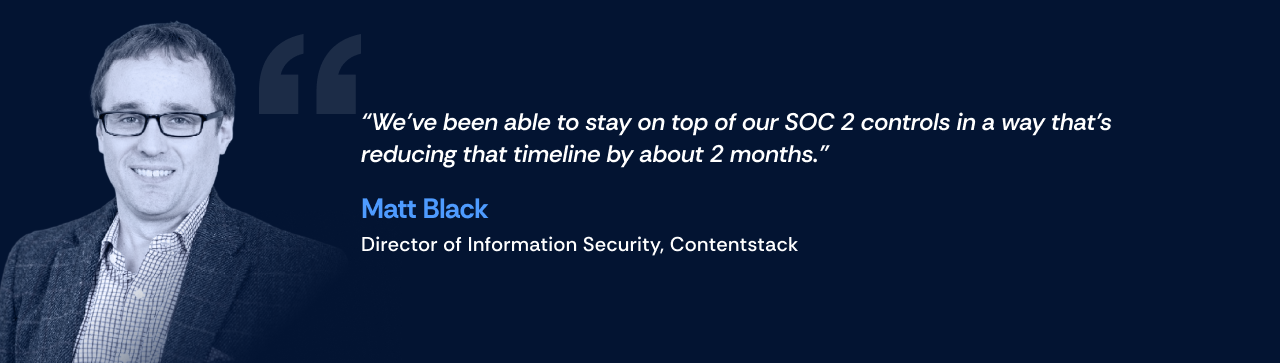
Contentstack saw this firsthand. After moving from spreadsheets to Scrut, their director of information security noted that the team had been able to stay on top of their SOC 2 controls in a way that changed their timeline.
That is what SOC 2 compliance automation is built to do. See how Scrut’s SOC 2 solution helps you catch drift before the auditor does.
FAQs
1. What are SOC 2 audit exceptions?
SOC 2 audit exceptions are instances where an organization's controls and processes deviate from the criteria set by the American Institute of Certified Public Accountants (AICPA). These exceptions can occur due to various reasons, including misconfigured controls, lapses in documentation, or non-compliance with security policies.
2. How can organizations proactively identify potential SOC 2 audit exceptions?
To proactively identify potential audit exceptions, organizations should conduct internal assessments and readiness checks. This includes reviewing control frameworks, conducting mock audits, and continuously monitoring and improving their security practices. By addressing issues in advance, businesses can reduce the likelihood of encountering exceptions during the SOC 2 audit.
3. What steps should organizations take when they encounter SOC 2 audit exceptions?
When organizations encounter SOC 2 audit exceptions, they should immediately address the identified issues. This involves investigating the root causes, developing action plans to rectify the exceptions, and enhancing control implementations. Communication with the auditing firm is crucial to ensure that the exceptions are adequately resolved.
4. What are some common types of SOC 2 audit exceptions?
Common types of SOC 2 audit exceptions may include issues related to data protection, access controls, change management, and security incident response. These exceptions vary by industry and organization, but many share similarities in their root causes.
5. How can organizations minimize the impact of SOC 2 audit exceptions and maintain compliance with SOC 2 standards?
Organizations can minimize the impact of SOC 2 audit exceptions by promptly addressing and resolving identified issues. Transparency in communication with the auditing firm is essential. Furthermore, a proactive approach to security and compliance, continuous monitoring, and regular internal audits can help reduce the occurrence of exceptions, safeguard the organization's reputation, and maintain compliance with SOC 2 standards.

%201.png)


.webp)