

%20(1).png)
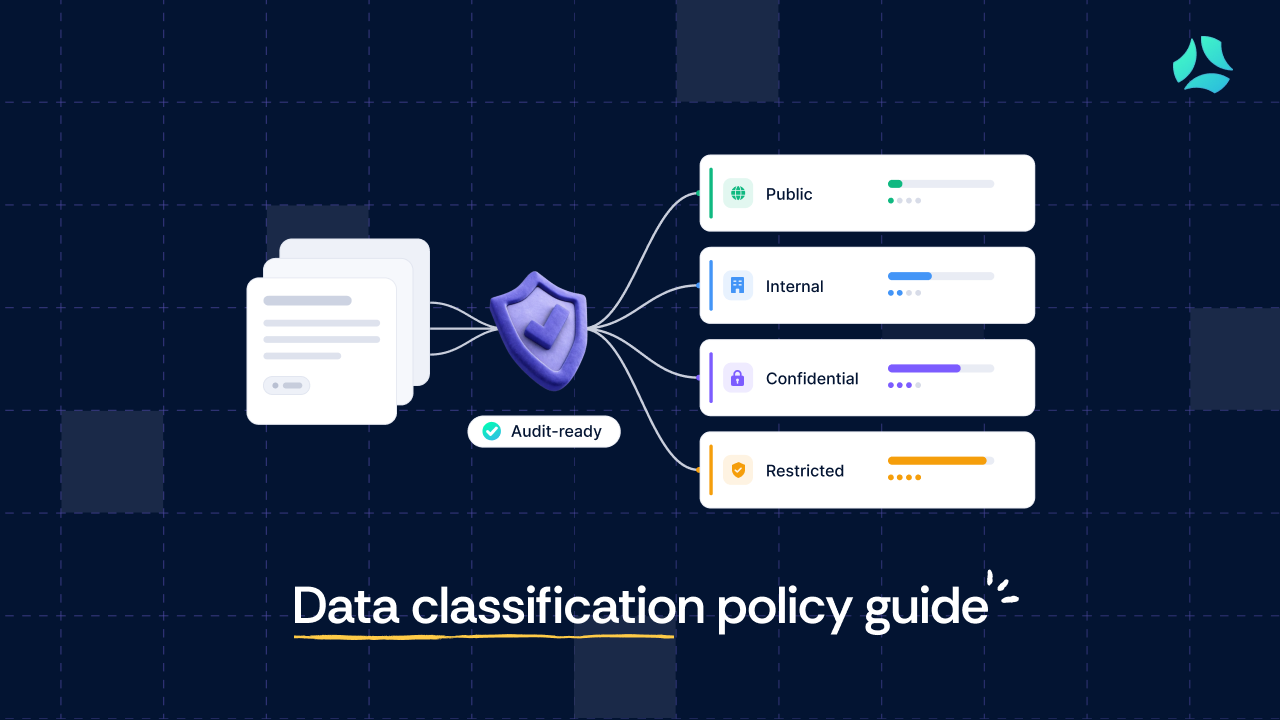


- A data classification policy helps organizations categorize information based on sensitivity and business impact, ensuring that appropriate security controls are applied to customer data, employee records, financial information, credentials, and other sensitive assets.
- Most organizations can build an effective data classification framework using four levels: Public, Internal, Confidential, and Restricted. The policy should define classification criteria, ownership responsibilities, handling requirements, and the controls associated with each classification.
- Data classification supports compliance with frameworks such as ISO 27001, SOC 2, GDPR, HIPAA, and PCI DSS by helping organizations identify sensitive information, assign ownership, implement appropriate protections, and demonstrate consistent data handling practices during audits.
Most startups don’t wake up one morning and decide they need a data classification policy. Usually, the trigger is something else.
A SOC 2 audit. An ISO 27001 project. A security questionnaire from a large enterprise customer. A vendor assessment asking how sensitive data is identified and protected.
Suddenly, someone asks a deceptively simple question: “How do we classify our data?” That’s where things can get messy.
Engineering says source code is the most sensitive asset in the company. Legal is worried about contracts. HR focuses on employee records. Security wants everything labeled confidential.
The challenge isn’t creating classifications. It’s creating classifications that people understand, auditors accept, and the business can realistically maintain.
This guide will walk you through a practical approach to building a data classification policy, including what categories to use, who should own them, how they map to compliance requirements, and how to avoid turning a simple governance exercise into a full-time project.
Start with a simple question: “What would happen if this data leaked?”
Many organizations start by creating classification labels. A better place to start is impact.
If a file, database, or document were exposed publicly, what would happen? The answer usually determines the classification.
This approach keeps the discussion focused on risk instead of semantics.
It also helps avoid one of the most common mistakes in data governance: creating too many classification levels.
For most startups and growing companies, four classifications are enough.
If employees need a cheat sheet to remember the difference between six different labels, the system is already working against you.
The startup-friendly classification model
A practical data classification policy should tell employees two things:
- How sensitive the data is
- What controls should apply to it
The following model works well for most organizations preparing for audits, customer reviews, and compliance programs.
The goal isn’t to classify every individual file perfectly. It is to ensure that sensitive information receives stronger protection than information that carries little risk.
Classification should also consider regulatory and contractual obligations. Data subject to laws or standards such as GDPR, HIPAA, or PCI DSS may require higher classifications regardless of the immediate business impact of a disclosure.
Not all data is created equal (which data actually matters)
One reason data classification projects stall is that teams try to classify everything.
In reality, auditors and customers care far more about a handful of high-risk data categories than every spreadsheet in the company.
Start with these areas:
Customer data
This includes personal information, support records, account information, usage data, and any customer-provided content.
Employee data
Payroll records, performance reviews, background checks, benefits information, and other personnel records typically require stronger protections.
Financial data
Revenue reports, forecasts, investor materials, pricing information, and accounting records often fall into confidential categories.
Security data
Password hashes, encryption keys, certificates, access logs, and authentication information usually require the highest level of protection.
Intellectual property
Source code, product roadmaps, architecture diagrams, research, and proprietary methodologies often represent significant business value.
If you start by identifying these datasets, you'll usually cover the majority of information that auditors and enterprise customers care about.
Whose data is it anyway?
One of the biggest misconceptions about data classification is that security owns it. Security only owns the process. It’s the business that owns the data.
A practical ownership model looks something like this:
For example, HR should classify employee records. Finance should classify financial reports. Product and engineering teams should classify source code and technical documentation.
When ownership sits with the teams that create and use the information, classifications tend to be more accurate and easier to maintain.
How detailed should your policy be?
Many organizations assume a stronger policy means a longer policy. In practice, the opposite is often true.
A useful data classification policy usually includes:
- Classification levels
- Definitions and examples
- Handling requirements
- Ownership responsibilities
- Review and exception processes
That’s it.
If the document requires extensive training just to understand the classifications, it’s probably too complicated.
A policy should help employees make decisions quickly, not force them to interpret legal language every time they share a document.
Organizations should also define when classifications are reviewed and updated as business, regulatory, or contractual requirements change.
What auditors are actually looking for
Organizations often spend weeks refining classification labels when auditors are asking a different question entirely.
They want evidence that sensitive information is identified and protected consistently.
Typically, auditors look for:
- Defined classification categories
- Assigned ownership
- Documented handling requirements
- Access controls aligned to sensitivity
- Employee awareness and training
- Evidence that the policy is being followed
A simple, consistently applied classification model is usually far more effective than an elaborate framework that exists only on paper.
Auditors are not only interested in whether a control exists on paper. They want evidence that it is understood, consistently executed, and can survive personnel changes.
As Jim Routh, Chief Trust Officer at Saviynt, noted in our webinar:
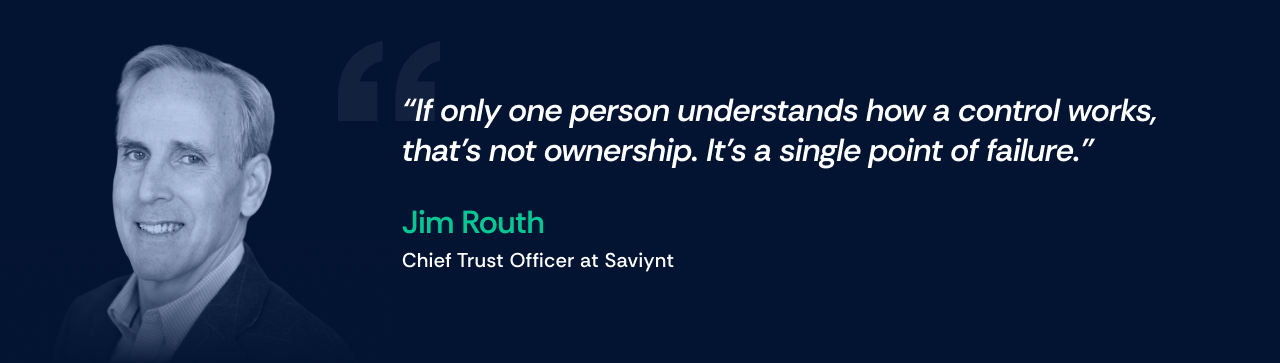
The same principle applies to data classification. Auditors look for evidence that classification decisions, handling requirements, and control responsibilities are embedded in business processes rather than concentrated in the knowledge of a single employee.
What’s enough for SOC 2 and ISO 27001?
This is one of the most common questions teams ask during audit preparation.
The good news is that neither SOC 2 nor ISO 27001 requires a specific number of classification levels.
What matters is whether your organization can demonstrate a reasonable process for identifying sensitive information and applying appropriate protections.
For SOC 2, auditors generally expect organizations to show how sensitive information is identified, protected, and accessed.
For ISO 27001, information classification supports requirements around information handling, ownership, and protection measures.
In both cases, the emphasis is on consistency.
Your classifications should influence real-world decisions such as access controls, retention periods, monitoring, and data handling practices.
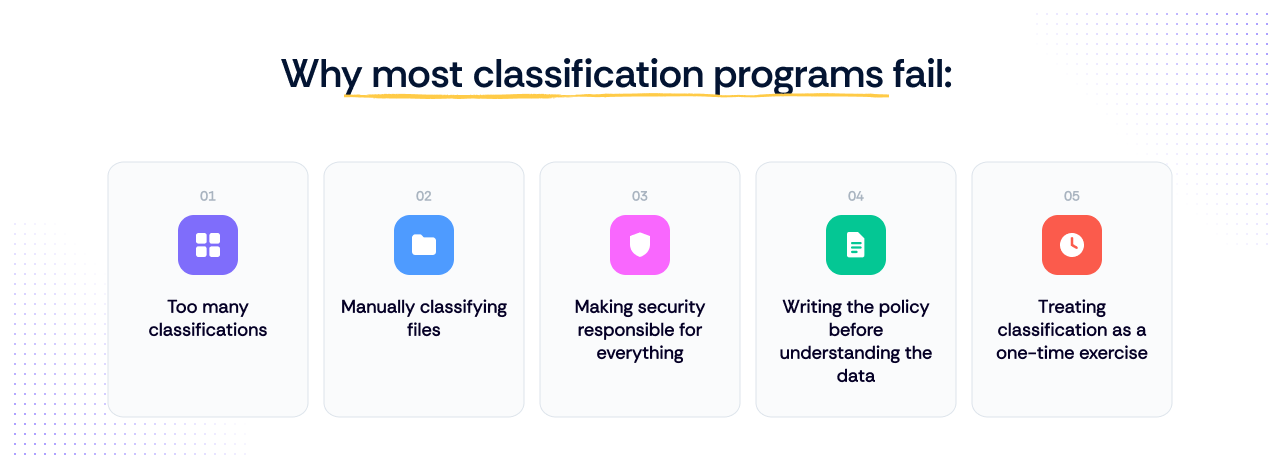
Most classification programs don’t fail because they're too simple. They fail because they're too ambitious.
Common mistakes include:
Creating too many classifications
More labels rarely create more clarity.
Classifying every file manually
This quickly becomes impossible to maintain.
Making security responsible for everything
Security should govern the process, not own every dataset.
Writing the policy before understanding the data
You can't classify information effectively if you don't know what information exists.
Treating classification as a one-time exercise
New systems, products, vendors, and regulations continuously change the data landscape.
From policy to practice
A classification policy should influence day-to-day operations.
That includes:
- User access management
- Data retention and disposal
- Vendor risk assessments
- Security monitoring
- Incident response
- Employee onboarding and training
The most successful programs treat classification as a decision-making tool rather than a compliance artifact.
When employees understand how sensitive information should be handled, the policy becomes part of daily operations instead of another document stored in a shared drive.
Compliance mapping without the headache
Data classification supports multiple compliance programs at the same time.
The classifications themselves are not the objective. The objective is to ensure that the right controls are applied to the right information.
Make data classification sustainable
A data classification policy is often treated as a documentation exercise. In reality, it forms the foundation for decisions about access, retention, monitoring, incident response, and risk management.
The goal isn’t to create the perfect classification model. It's to establish a practical system that helps employees understand what information they handle, enables security teams to apply appropriate controls, and gives auditors confidence that sensitive data is being managed consistently.
Organizations that keep their classification frameworks simple, assign clear ownership, and connect classifications to real-world controls are typically better positioned to meet compliance requirements, respond to customer security reviews, and scale their security programs as they grow.
Scrut helps teams automate evidence collection, map controls to multiple frameworks, and stay audit-ready as their compliance programs scale. Schedule a demo to see it in action.
A data classification policy is a document that defines how an organization categorizes information based on sensitivity and business impact. It establishes classification levels, ownership responsibilities, handling requirements, and the controls that should be applied to different types of data.
To create a data classification policy, start by identifying the types of data your organization stores and processes. Define classification levels, assign data owners, establish handling requirements, and map security controls to each classification.
Most organizations use four classification levels: Public: Information approved for public release Internal: Information intended for employee use only Confidential: Sensitive business information that could cause harm if disclosed Restricted: Highly sensitive information such as PII, payment data, credentials, or health records The exact labels may vary, but the goal is to apply stronger controls as data sensitivity increases.
ISO 27001 includes requirements related to information classification, handling, and protection. While the standard does not prescribe a specific classification model, organizations are expected to classify information appropriately and apply controls based on its sensitivity.
The business typically owns the data and determines its classification. Security teams define classification standards and protection requirements, while IT teams implement the technical controls needed to enforce them. Clear ownership helps ensure classifications remain accurate and consistently applied across the organization.


%201.png)


.png)