


%20(1).png)


A buyer just asked for your SOC 2 report, and now you have a decision to make: produce a Type 1, or go straight to Type 2. The two reports answer different questions, cost different amounts, and carry different weight with the people evaluating you.
Getting the choice wrong means either paying for a report your buyers will not accept, or delaying a deal you could have unblocked in weeks.
This article covers the differences between SOC 2 Type 1 and Type 2, what each one costs, how long each takes, the decision logic for choosing between them, and what to look for when you are on the receiving end of a vendor's report.
Key takeaways
- SOC 2 Type 1 vs Type 2: Type 1 assesses whether controls are designed correctly at a single point in time. Type 2 assesses whether they operated effectively across a 3 to 12-month observation period.
- Type 1 is faster and cheaper, typically 2 to 6 months to obtain, with audit fees around $10,000 to $30,000.
- Type 2 is what most enterprise, financial services, and healthcare buyers require.
- Around 70% of companies pursuing SOC 2 for the first time go directly to Type 2.
- The minimum observation period for Type 2 is 3 months. Six months is the industry-recommended standard.
Overview: SOC 2 Type 1 vs SOC 2 Type 2
Use this table to compare both reports at a glance before you read the details below. Each row maps to a decision a compliance manager makes when reviewing or planning a report.
SOC 2 Type 1 vs. SOC 2 Type 2 comprehensive comparison
Both reports are built on the same SOC 2 trust service criteria. The difference is what the auditor tests and over what window.
What is SOC 2 Type 1?
SOC 2 Type 1 is a point-in-time assessment of whether your controls are designed correctly. If you read a Type 1 report, it will say something like “as of March 1, 2026,” and it verifies that the design of your systems and security controls meets the relevant trust service criteria on that date.
This is where the single most important distinction in SOC 2 lives: design versus operating effectiveness. A Type 1 is a design test. It asks whether a control, if it operated as intended, would address the risk. It does not test whether the control actually ran.
A Type 2, by contrast, tests operating effectiveness: whether the control worked consistently over a defined period. For a deeper walkthrough of how design testing feeds into your audit, see our guide to SOC 2 attestation report preparation.
One clarification worth making up front: the output is an attestation report issued by a licensed CPA firm, not a certificate. There is no such thing as a SOC 2 certificate. Buyers who ask for your “SOC 2 certification” are asking for the report.
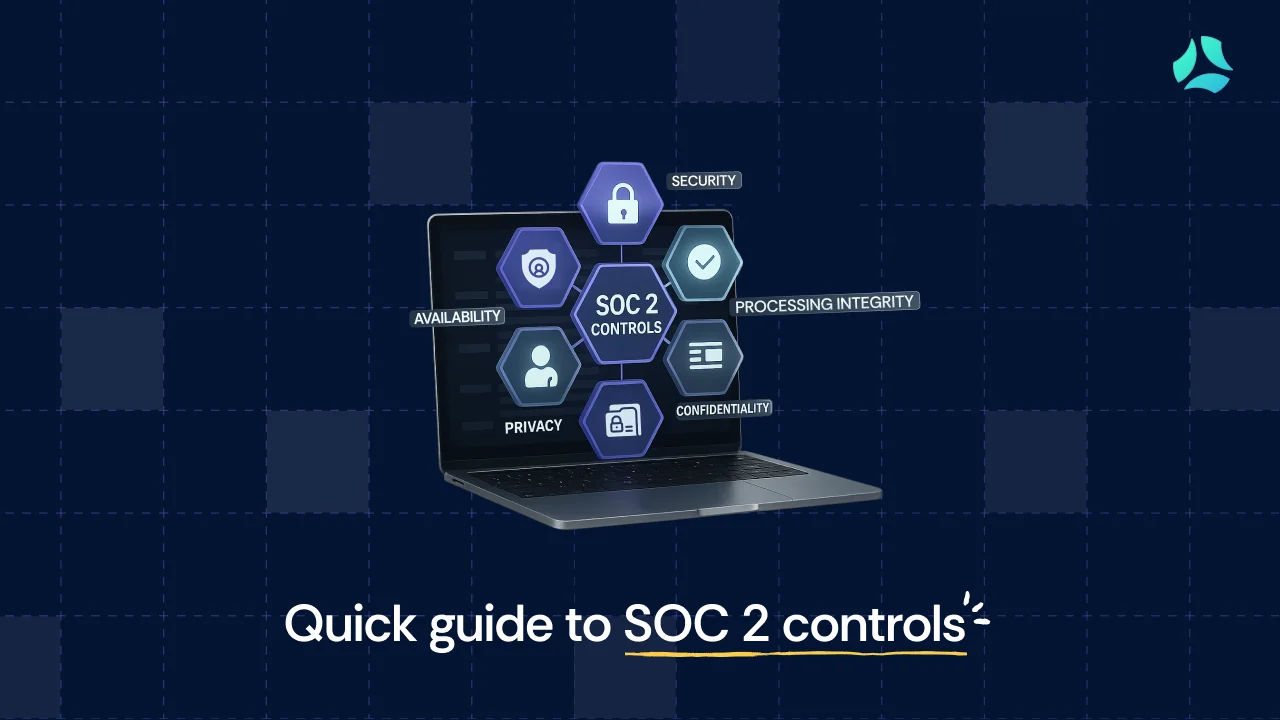
The report covers the five trust service criteria: security, availability, processing integrity, confidentiality, and privacy. Organizations typically pursue Type 1 when their controls have recently been implemented and they need a fast credential to show early-stage enterprise buyers, before a full Type 2 observation period can complete.
How to get a SOC 2 Type 1 report
Getting a Type 1 follows a predictable sequence. The work happens before the auditor ever looks at your environment.
1. Gap assessment. Map your current controls against the trust service criteria you are scoping. This is where you find the holes, including vulnerability findings and cloud misconfigurations, before an auditor does.
2. Control implementation and documentation. Close the gaps identified in step one. Deploy the technical controls, write the policies, and document how each control meets its criterion. A policy on its own is not a control; the control is the mechanism that enforces it.
3. Internal readiness review. Confirm every control is in place and every piece of design evidence exists. This is your last chance to catch a gap before it becomes an auditor's finding.
4. Auditor engagement. A licensed CPA firm evaluates the design of your controls as of a chosen date.
5. Report issuance. The auditor issues the attestation report covering that single date.
Type 1 cost breakdown
Cost depends on the number of trust service criteria you select, your organization’s size, and how many cloud environments are in scope. Here is where the money goes.
SOC 2 Type 1 cost breakdown by component
On trust service criteria and cost: security is mandatory. Kush Kaushik, Co-founder at Scrut Automation, recommends a baseline of at least security, confidentiality, and availability. Adding those two criteria to a security-only scope raises the cost to roughly 1.2x the security-only baseline, which is why most organizations opt for all three rather than security alone.
For a fuller picture of how much SOC 2 compliance costs in engineering time and tooling, and how to run a SOC 2 readiness assessment before you engage an auditor, see our dedicated guides.
Who needs a SOC 2 Type 1 report?
Most buyers who ask for “your SOC 2” mean Type 2. Type 1 is useful in a narrow set of situations, and based on Kush Kaushik’s experience, about 70% of organizations skip it entirely.
SOC 2 started as a U.S. framework and is now widely recognized internationally, though buyers in the EU often prefer ISO 27001. It matters most for companies offering cloud services, SaaS, and other technology solutions, and it applies across technology, financial services, healthcare, and any sector handling sensitive customer data.
Do you actually need Type 1?
Around 70% of organizations pursuing SOC 2 skip Type 1 entirely and go directly to Type 2 after a 3- to 6-month control practice period. Type 1 is most valuable when: (a) you have recently implemented controls and need a credential quickly for a specific deal, (b) your buyer explicitly accepts Type 1, or (c) your control environment is not yet stable enough to survive an observation period.
The single most common real-world use case is a deal deadline. A company with an enterprise contract hanging in the balance cannot always wait six months for a Type 2 observation period to complete. A Type 1 gives them a credible credential to present now, with a committed timeline for Type 2 to follow.
When Type 1 is not enough. Financial services and banking buyers will not pass a Type 1 through their third-party risk assessment; Type 2 is mandatory. Healthcare buyers with their own HIPAA obligations expect Type 2, and larger health systems may also require HITRUST.
Government and public sector procurement treats Type 2 as a baseline, and FedRAMP may apply on top of it. Any buyer running their own SOC 2 program knows the difference and will ask specifically for Type 2. Defaulting to Type 1 because it is the easier option can stall exactly the deals you built the report to win.
If you sell to software buyers, our guide to SOC 2 compliance for SaaS companies covers this in more depth, and you can plan what to include using our SOC 2 scope guide.
What are the requirements of SOC 2 Type 1?
SOC 2 is built on five trust service criteria, but they do not all apply to every organization. Security is the only mandatory criterion. The remaining four are optional and selected based on the services you offer and the data you handle. This is a meaningful distinction for a first-time buyer: you are not obligated to scope all five.
SOC 2 Trust Services Criteria requirement breakdown and examples
The selection logic is practical. No PII? Skip Privacy. No large batch file processing? Skip Processing Integrity. No uptime SLAs? Availability may not be worth the added scope. Selecting only what genuinely applies keeps both cost and scope in check, and keeps the audit tighter, which means fewer auditor hours and a faster report.
To map criteria to specific controls, use our SOC 2 control list, and to build the underlying documentation, see our guide to SOC 2 compliance policies.
SOC 2 Type 1: pros and cons
A Type 1 is a genuine credential, but it comes with real limits. Here is the honest trade-off.
SOC 2 Type 1 advantages and disadvantages
What is SOC 2 Type 2?
SOC 2 Type 2 assesses whether your controls operated effectively over a defined period, not just whether they were designed correctly on a single date. It is the operating effectiveness test, and it is the report most enterprise buyers mean when they ask for “a SOC 2.”
The minimum observation period is 3 months. A 6-month period is the industry-recommended standard, and 12 months provides the broadest assurance. It is worth understanding why AICPA guidance points to a 3-month floor rather than something shorter.
Certain activities only happen on a cycle. Access reviews typically run quarterly. Business continuity testing happens every 6 months, or at least once a year. You cannot demonstrate that a quarterly control operated effectively without at least one full cycle of evidence to sample, which is why a meaningful observation window starts at 3 months.
During the audit, the auditor samples evidence across the observation window and asks operational questions: Were access reviews completed every quarter? Was BCP testing conducted on schedule? Were vulnerability scans run and findings remediated? The auditor is testing completeness of evidence across the period, not looking for reasons to fail you.
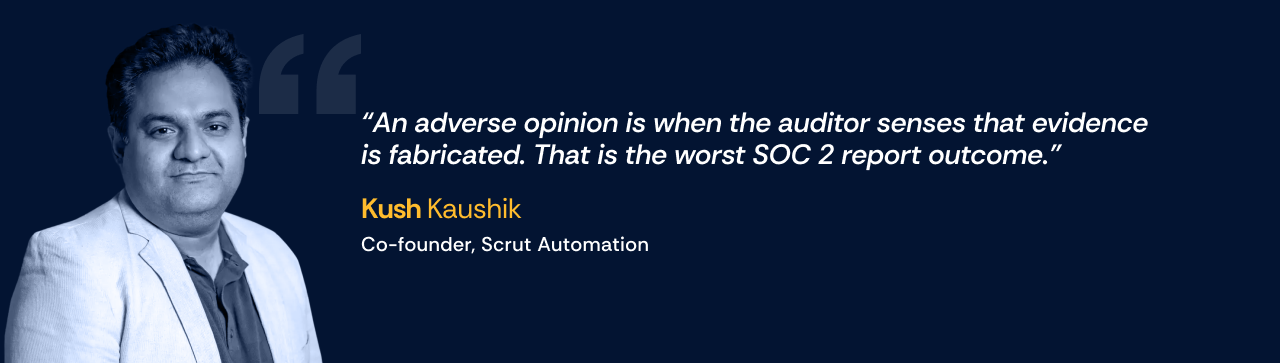
The worst outcome has a name: an adverse opinion.
The trust service criteria that underpin SOC 2 had their revised points of focus published by the AICPA in 2022, aligning the framework with evolving industry and technology practices. For the mechanics of what auditors sample, see our guide to access reviews, and for preparation, our SOC 2 audit best practices.
How to get a SOC 2 Type 2 report
The most common source of confusion is treating the observation period as the whole timeline. There are actually two separate clocks.
Clock one: Getting ready to start. Gap assessment plus control implementation typically takes 1 to 3 months. This is the work of finding and closing gaps before your observation window opens.
Clock two: The observation period itself. This is a minimum of 3 months and typically 6 months. Your controls must be running and generating evidence throughout.
Total time from a cold start to a finished report: 6 to 15 months. Control maturity at the outset is the variable that matters most. A company that already runs its controls well can move fast; one starting from scratch will spend longer on clock one.
Audit fees typically range from $30,000 to $80,000+, depending on organization size, number of TSCs, and auditor tier. A Big 4 firm quoted roughly $50,000 for the assessment alone on a mid-size organization. Boutique AICPA-accredited firms are a legitimate and often more economical alternative for startups and mid-size SaaS companies. Our guide to boutique vs. Big 4 auditing firms breaks down the trade-off.
Before you sign with an auditor, check their peer review status on the AICPA peer review website. Most companies skip this. You can see whether the firm is enrolled, and whether the review resulted in a pass, a conditional pass, or a fail. It is the clearest signal you have into audit quality before signing. For a fuller preparation playbook, see how to master your SOC 2 audit.
Who needs a SOC 2 Type 2 report?
Type 2 is the commercial credential. Which report a buyer accepts depends almost entirely on who the buyer is.
SOC 2 report acceptance by buyer type
You choose which trust service criteria to include, and that choice directly affects cost and scope. SOC 2 Type 2 is not a one-size-fits-all report. A company can scope only security, availability, and confidentiality, and still meet most buyer requirements while keeping the audit tighter and cheaper. Privacy and processing integrity get added only when the business genuinely handles PII or large-scale data processing.
For sector-specific requirements, see our guides to HIPAA compliance and SOC 2 for financial services.
What are the requirements of SOC 2 Type 2?
All Type 1 requirements apply to Type 2. The difference is that Type 2 requires sustained operational evidence, not just design documentation. Having a control is not enough; you have to prove it ran continuously.
For Type 2, the auditor's job is to confirm that evidence exists across the full observation window, not just that a control was configured, but that it ran. Were access reviews completed every quarter? Were vulnerability scans remediated on a consistent cadence? Gaps in the evidence trail, not gaps in the control design, are what produce exceptions.
These are the policies where auditors spend the most time, testing for implementation evidence, not just documentation. The first five draw the most scrutiny; the rest are tested but with less intensity.
- Access control policy
- Acceptable use policy
- Risk management policy
- Vulnerability management policy
- Incident management policy
- Physical access control policy
- Cryptographic and key management policy
- SDLC (software development life cycle) policy
- Business continuity policy
- Vendor management policy
This is not a complete list; it reflects where an auditor's attention concentrates. Some policies, such as a whistleblower policy, apply mainly to large or listed organizations and can be scoped out for a small SaaS company. To build these out, see our SOC 2 compliance policies guide and our template for a vendor management policy.
SOC 2 Type 2: Pros and cons
Type 2 costs more and takes longer, but it is the report that actually opens doors. Here is the trade-off.
SOC 2 Type 2 advantages and disadvantages
If you want to treat the credential as a growth lever rather than a checkbox, see how to turn SOC 2 compliance into a growth strategy.
SOC 2 Type 1 vs Type 2: How to choose the right report
Here is the decision framework. Match your situation to one of the three paths below.
Go with Type 1 first if:
- Your controls were implemented in the last 0 to 6 months and are not yet stable.
- You have a specific near-term deal that requires a compliance credential and cannot wait 6+ months.
- Your buyer explicitly accepts Type 1 as sufficient.
Go directly to Type 2 if:
- Your controls have been in place and practiced for 3+ months.
- Your target buyers are mid-market, enterprise, financial services, healthcare, or government.
- You are at Series B or beyond.
- You are preparing for M&A due diligence.
Skip Type 1 entirely if:
- You can sustain a 3- to 6-month observation period before your first enterprise deal deadline.
- You are in a similar position to the roughly 70% of organizations that go directly to Type 2.
Two paths, illustrated
Path A — Type 1, then Type 2.
- Month 1: Gap assessment and remediation planning.
- Months 2 to 3: Control implementation, then a Type 1 audit as of a point-in-time date. You now have a credential to show early buyers. The controls keep running; this is not a pause, because the Type 2 observation period will start from this same control environment.
- Months 4 to 9: Run the observation period (3 to 6 months), then a Type 2 audit and report issuance.
Path B — Direct to Type 2.
- Month 1: Gap assessment. In a typical engagement, a client comes in on January 1, the gaps are identified, and most are closed by the end of the month, including VAPT and vulnerability findings.
- Months 2 to 4: The organization practices the full compliance framework for at least 3 months. Nothing is issued yet; this is the practice period that builds the evidence trail.
- Month 5: The Type 2 audit runs with an observation period covering, for example, February 1 to April 30, a clean 3-month window. The report issues shortly after.
Path B skips the Type 1 audit fee and the credential milestone, but it gets you to the report the market actually wants faster and cheaper overall. Path A costs more in total and adds an audit event, but it puts a credential in your hands early for a specific deal. The right choice depends on whether you have a near-term deadline that a Type 1 can unblock.
Before committing either way, run a SOC 2 readiness assessment and settle your SOC 2 scope planning. If you are also on the receiving end of vendor reports, evaluating suppliers as part of your third-party risk program, the next section covers what to look for.
What to look for when reviewing a vendor’s SOC 2 report
A compliance manager does not only pursue SOC 2; they also review vendor SOC 2 reports as part of third-party risk. A report can run 200 pages, but you can evaluate it meaningfully in under an hour if you know where to look. Here is the checklist.
1. Check the audit opinion type. There are four: unqualified, qualified, adverse, and disclaimer of opinion. The unqualified opinion is the only clean outcome. Everything else needs a second look.
2. Check the audit period. Is it current? A report more than 12 months old is stale. If the provider is mid-audit and the period does not align with your needs, ask for a bridge letter stating that a new audit is underway and a report will be issued.
3. Verify the auditor's peer review status. Go to the AICPA peer review website and confirm the service auditor is enrolled and whether their review was a pass, conditional pass, or fail. Big 4, boutique, and small CPA firms all vary, and this is how you gauge credibility.
4. Review the system description (Section III). Confirm it accurately describes the services you actually use from the vendor, and that the management assertion description matches the audit report description. Check which people, processes, and systems are in scope.
5. Check for exceptions within the report. A single exception on one control is not a disqualifier. Multiple exceptions clustered in one criterion is a different story; at some point, that pattern approaches a qualification, and you should ask why.
6. Review complementary user entity controls (CUECs). These are controls you must implement for the vendor’s controls to work. The classic example is AWS: AWS provides IAM, but how you configure it, whether you enforce named users, remove generic accounts, and require MFA, is on you. Miss your CUECs, and the vendor’s compliance does not protect you.
7. Check the subservice organizations listed. Which cloud providers and infrastructure vendors does this vendor rely on? Are they identified? You may need their SOC 2 reports, too, and you should review any findings against those subservice organizations and get management sign-off.
For a step-by-step walkthrough, see our guide on how to review a vendor's SOC 2 report, and to build this into a program, our third-party vendor risk management guide.
SOC 2 Type 1 vs Type 2: What exceptions and qualifications mean for your Report’s usability
Once you have a Type 2 report in hand, the opinion letter is what buyers read first. Understanding what exceptions and qualifications mean, and how they differ, determines whether your report opens doors or triggers questions.
An exception occurs when one control within a criterion fails. A qualification occurs when all controls within a criterion fail. Only a qualification appears in the auditor’s opinion letter. An exception is documented but does not, on its own, change the opinion.
If you know ISO 27001, the analogy is exact. An exception is like a minor nonconformance, where some samples pass and some fail. A qualification is like a major nonconformance, where the whole requirement fails. The escalation logic is the same.
SOC 2 audit outcomes, report impact, and commercial usability
A qualified opinion is visible to every reader of the report, so it will surface questions from sophisticated buyers. It does not render the report useless, but you should expect to explain it.
That is what Section V of the report, the management comments provision, is for. Organizations can provide a written explanation for an exception or qualification. The auditor cannot contradict it, but they will ensure the comment does not undermine the audit opinion.
The practical takeaway: if your controls are not stable, do not start the Type 2 observation period. A qualified or adverse report is worse for your commercial credibility than delaying until your controls are sound. Prepare properly first, using our guides to SOC 2 audit preparation and compliance audit best practices.
How Scrut helps with SOC 2 Type 1 and Type 2
Whether you are pursuing Type 1 or Type 2, the operational challenge is the same: keeping evidence organized and controls running without a dedicated compliance team.
For a Type 1, the friction is assembling design evidence and keeping policies and control documentation audit-ready as of a single date.
Scrut centralizes that documentation and automates evidence collection, so when the auditor asks to see your control design, it is already organized rather than scattered across spreadsheets and Slack threads.
For a Type 2, the challenge shifts from a single date to sustained proof across the observation period. Scrut tracks control performance continuously and surfaces gaps before they surface in the audit, so when the auditor asks for evidence, it is already assembled.
To see how this works for your own SOC 2 journey, book a demo.
FAQs
1. Can I replace SOC 2 Type 1 with SOC 2 Type 2?
Yes, and about 70% of organizations do exactly that. Type 1 and Type 2 serve different purposes, but you are not required to complete a Type 1 first. Many companies implement controls, practice them for at least 3 months, and go straight to Type 2. Type 1 makes sense mainly when you need a fast credential for a specific deal.
2. What are the similarities between SOC 2 Type 1 and Type 2?
Both are based on the same five trust service criteria: security, availability, processing integrity, confidentiality, and privacy. Both require internal controls, documentation, and an audit by a licensed CPA firm. The difference is that Type 1 evaluates control design at a point in time, while Type 2 assesses operating effectiveness over a period.
3. How long does a SOC 2 Type 2 audit take?
There are two clocks. Getting ready (gap assessment plus control implementation) takes about 1 to 3 months. The observation period itself is a minimum of 3 months, typically 6. From a cold start, total time to a finished report usually lands between 6 and 15 months, driven by how mature your controls are at the outset.
4. Is SOC 2 a certification?
No. SOC 2 produces an attestation report issued by a licensed CPA firm, not a certificate. There is no such thing as being "SOC 2 certified." When a buyer asks for your SOC 2 certification, they mean the report.
5. Which trust service criteria do I actually need?
Only security is mandatory. Availability, confidentiality, processing integrity, and privacy are optional and chosen based on your services and data. A common baseline is security, availability, and confidentiality. Add privacy if you handle PII and processing integrity if you run large-scale data processing.

%201.png)


.webp)