


%20(1).png)


- Scrut’s 2026 Business Impact Survey highlights how compliance automation can create business value, from improving audit outcomes to reducing manual effort and supporting customer and investor conversations.
- Compliance automation can reduce audit rework. 67% of respondents reported reducing audit findings by 75% or more, while 88% reported smoother audits.
- Automation can free up engineering capacity. 87% of engineering respondents reported reduced manual effort during compliance setup and audit preparation.
- A unified approach helps teams scale across frameworks. 92% of respondents reported managing two or more frameworks or certifications with Scrut.
Compliance costs rarely arrive as one obvious invoice.
They show up as engineers pulled into evidence requests, consultants coordinating recurring work, control gaps found weeks before an audit, and teams collecting the same evidence for multiple frameworks. They also show up when a deal or diligence request stalls because proof is not ready.
Compliance automation does not remove the work. Its value is more practical: it reduces how much of that work has to be chased, repeated, reconstructed, and completed under deadline pressure.
To understand that impact, Scrut conducted its 2026 Business Impact Survey, examining the reported outcomes of organizations using the Scrut Platform to manage compliance. The resulting report, The Business Impact of Compliance Automation with Scrut 2026, examines reported associations between structured, continuous compliance execution and audit outcomes, engineering effort, consultant dependence, customer trust, and fundraising and investor conversations.
How to read the data: These are self-reported outcomes from Scrut customers. Questions were routed to relevant role-based subgroups, so the denominator varies by finding. The study shows reported associations after Scrut was implemented, not controlled causation or guaranteed results.
What are the benefits of compliance automation?
The business case for compliance automation goes beyond saving the compliance team a few hours of administrative work.
When compliance execution becomes more continuous and structured, its impact can extend across the organization, from audit readiness and engineering capacity to enterprise sales and investor conversations.
Scrut’s research highlights several areas where respondents reported meaningful improvements.
1. Fewer findings mean less audit rework
One of the clearest benefits of compliance automation is improving what happens before the auditor arrives.
An audit finding creates more work than the remediation itself. Someone has to investigate it, collect new evidence, update documentation, coordinate the fix, and respond to the auditor again.
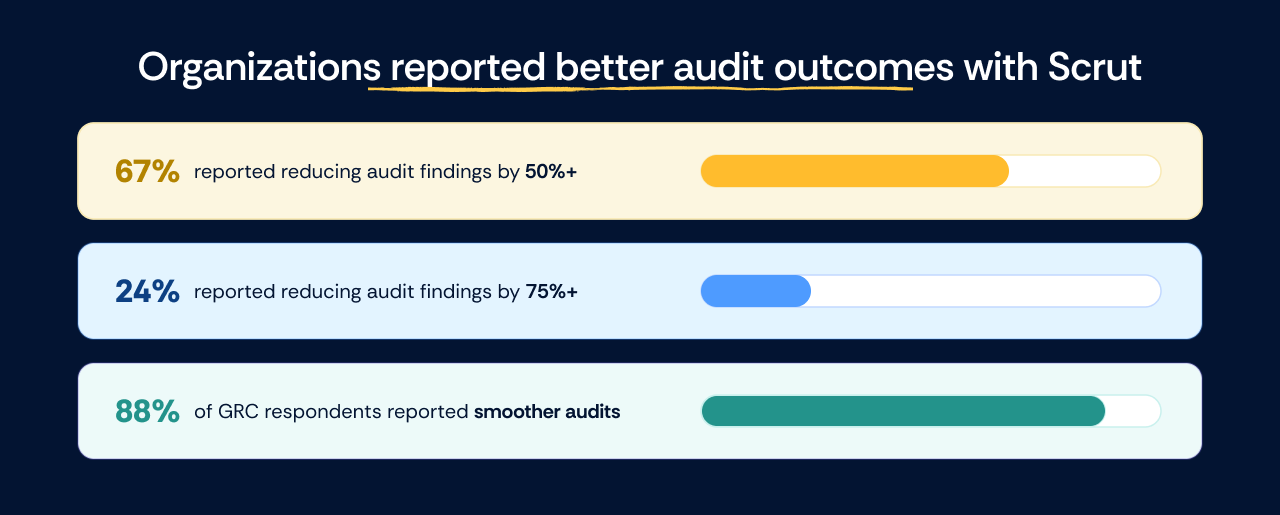
Scrut monitors controls, keeps evidence current, and surfaces gaps early. Teams can address issues before the audit instead of under deadline pressure. Audit preparation becomes a review of maintained work, not a search for missing evidence.
The takeaway: Review your last two audits and the work that went into their preparation. Count the findings, hours spent closing each one, external remediation fees, and elapsed days to closure. That is the baseline that automation needs to improve. You don’t need to automate every task. Automating recurring work can reduce the manual effort involved in your next audit, but the result will depend on your program and audit scope.
2. Engineering respondents reported less effort during compliance setup
For engineering leaders, one of the most important benefits of compliance automation is reducing the amount of engineering capacity consumed by compliance.
Engineering teams spend less time on compliance with automation
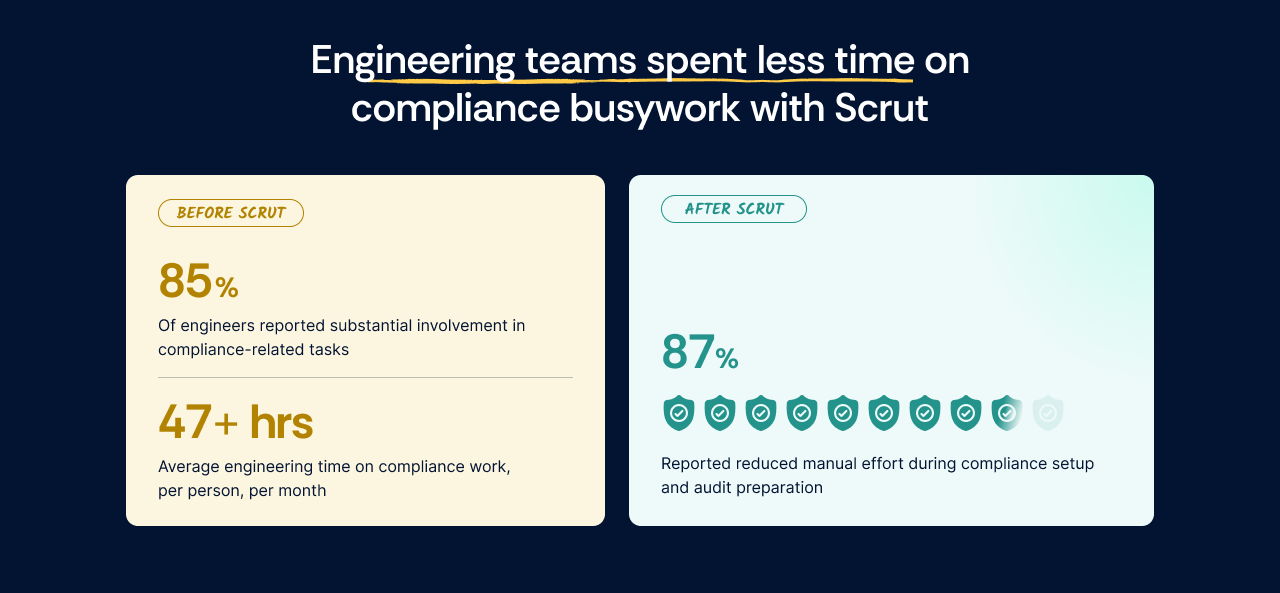
Scrut automates evidence collection, control validation, and repetitive compliance tasks, reducing the engineering time spent on compliance. Teams can focus that capacity on product development, infrastructure, reliability, and security.
For engineering leaders, automation, therefore, isn't just a compliance investment. It can be a way to protect roadmap capacity from recurring compliance work.
The takeaway: Track compliance requests that go to your engineering team for one month (ideally, the month before an audit). Record who handled each request, the time spent, and whether the task was evidence collection, remediation, access review, or an auditor follow-up.
3. Security proof is available earlier in customer conversations
Compliance increasingly plays a role in the enterprise buying process.
Enterprise customers want evidence that their vendors can protect sensitive information and manage security risks. SOC 2 and ISO/IEC 27001 can therefore become important checkpoints during procurement and customer security reviews.
In Scrut's research,
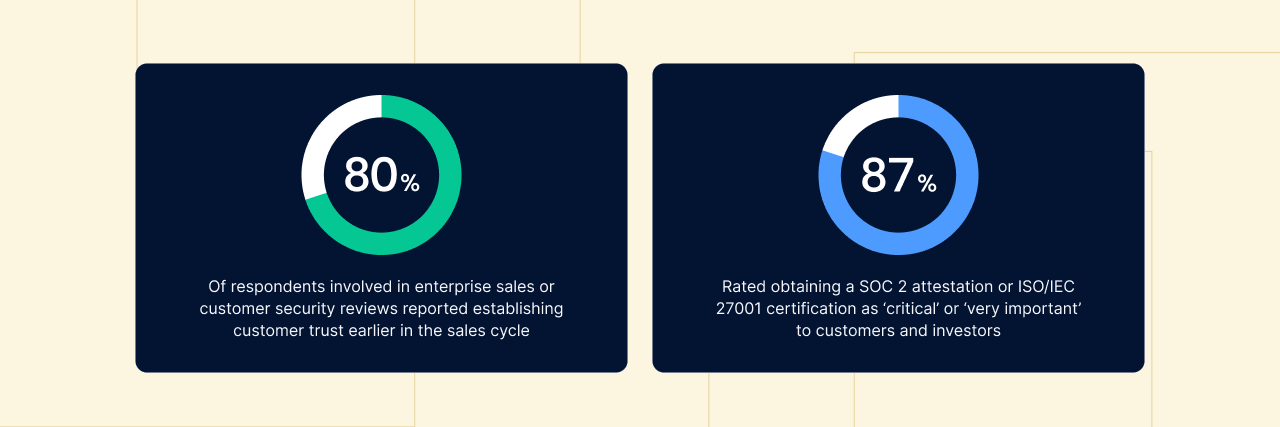
This points to an important (albeit underrated) business benefit of compliance automation: helping establish customer trust earlier when compliance comes up in sales conversations.
When current evidence and compliance progress are readily available, security reviews don't have to become a prolonged exercise in tracking down answers across teams.
For founders and sales leaders, that can make compliance a business enabler rather than a procurement bottleneck.
The takeaway: Track the median length of time taken by your team to answer customer security reviews, the hours spent answering each questionnaire, and the number of deals delayed because evidence or a required credential was missing.
4. Compliance readiness played a role in investor conversations
Customer trust isn't the only business outcome affected by compliance readiness. Compliance can also enter conversations with investors.
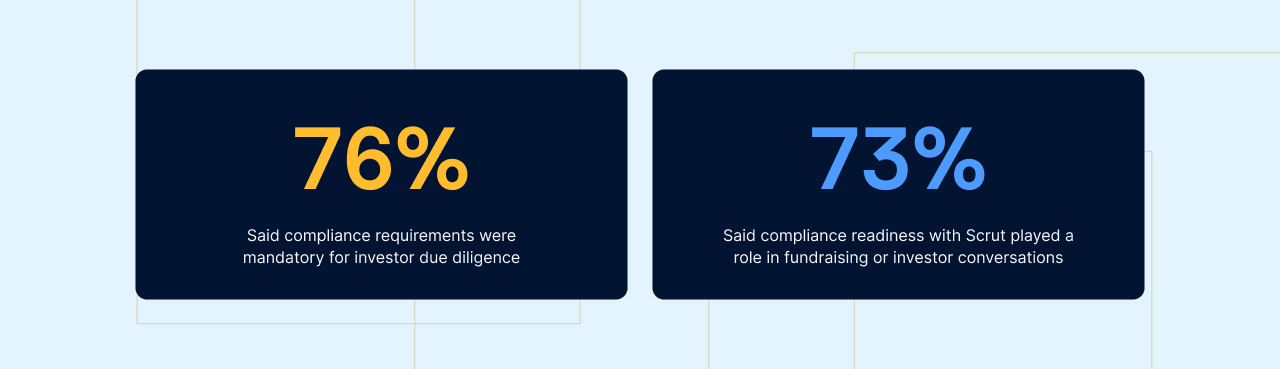
For founders, the implication is less about treating compliance as a guarantee of fundraising success and more about reducing uncertainty during diligence.
A company that can demonstrate its security and compliance posture with current evidence is better positioned to answer questions about how it manages risk and whether its operational processes can scale with the business.
Compliance readiness becomes part of demonstrating organizational maturity.
The takeaway: Compare your planned date for SOC 2 attestation or ISO/IEC 27001 certification with the date the credential is required by a customer, market, or board commitment. The value of finishing earlier depends on what the timing changes for the business.
5. A more scalable approach to managing multiple frameworks
Compliance complexity tends to increase as companies grow.
A business may begin with a SOC 2 attestation and later need ISO/IEC 27001 certification or need to address HIPAA, GDPR, CCPA, or other requirements based on its customers, markets, or regulatory obligations.
In the survey, 92% reported managing two or more frameworks or certifications with the Scrut Platform.
This makes scalability another important consideration when evaluating the benefits of compliance automation.
A structured compliance program can help organizations reuse controls, coordinate evidence, and maintain visibility across requirements instead of rebuilding the same processes for every new framework.
Scrut’s control-mapping and evidence-management capabilities across 70+ out-of-the-box frameworks can help teams reuse controls and coordinate evidence across overlapping requirements.
For GRC leaders, that shift can be particularly valuable as the compliance program expands.
The takeaway: List the frameworks you currently manage and identify where controls, evidence, and policies are duplicated across them. Track how much time your team spends maintaining those overlaps. That gives you a baseline for measuring the value of a more unified approach as your compliance program grows.
Compliance automation can make compliance a business capability
The findings from Scrut's research point to a broader shift in how organizations should think about compliance.
Compliance is often measured by whether a company passed an audit or obtained a certification. Those outcomes still matter, but they don't capture the full business impact of how compliance is managed.
A manual, periodic approach can create friction throughout the organization:
Prepare → Audit → Find gaps → Remediate → Repeat
A more continuous model changes the operating rhythm:
Monitor → Detect → Remediate → Maintain readiness
That shift can affect more than audit preparation. It can help reduce engineering disruption, improve visibility into compliance posture, support customer security reviews, and make it easier to respond to investor diligence.
- For founders, this means evaluating compliance not just as a requirement to satisfy, but as infrastructure that supports growth.
- For GRC leaders, it means building a program that can stay current without continually increasing manual effort.
- For engineering leaders, it means reducing the amount of compliance work that competes with product and infrastructure priorities.
When does compliance automation make the most sense?
The case is usually stronger when:
- Several engineers are pulled into every audit
- Evidence collection depends on screenshots, spreadsheets, and repeated follow-ups
- The company pays consultants for recurring coordination
- Two or more frameworks are being managed at once
- Audit findings create substantial remediation work
- Customer security reviews regularly wait for compliance proof
If you have one narrow framework, few evidence sources, little engineering involvement, and no recurring consultant cost, a platform may not create immediate financial value. Automation is not economical simply because it exists. The current process has to contain enough recurring cost or business friction to remove.
The broader benefit is reducing the friction of staying audit-ready
The strongest case for compliance automation isn't simply that it makes compliance faster.
It's that continuous compliance can reduce the amount of organizational friction created by compliance itself.
Scrut’s survey found reported improvements in audit outcomes and compliance-setup effort, earlier customer trust, and a role for compliance readiness in some investor conversations. It also found that most respondents who provided current framework data were managing multiple frameworks with Scrut.
The exact value will depend on your team, frameworks, evidence sources, and current process. Measure those costs before implementation, then verify which ones fall. That is how the benefits become a business case rather than a list of claims.
Want to see the full benchmarks?
Read the Business Impact of Compliance Automation Report 2026 to explore the research and see what organizations are reporting across audit readiness, engineering efficiency, customer trust, fundraising, and compliance execution.
Read the full Business Impact of Compliance Automation Report 2026



%201.png)