

%20(1).png)
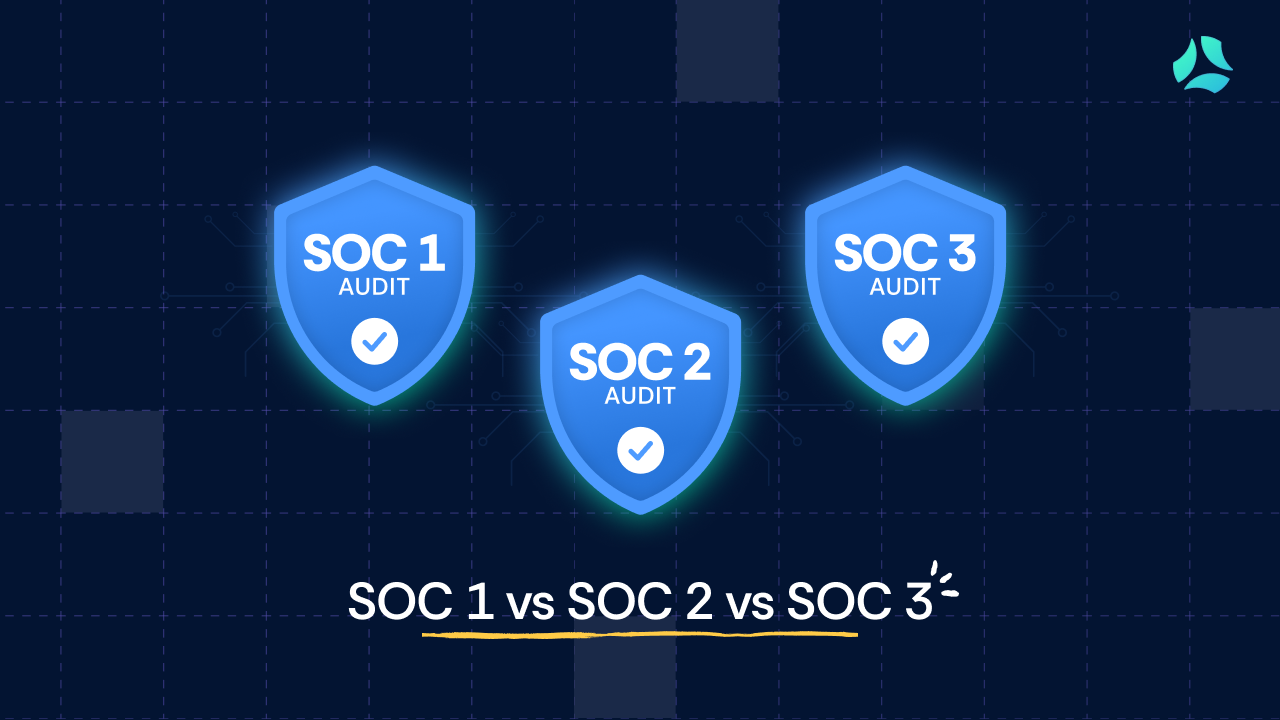


An enterprise prospect sends over their vendor security requirements, and buried in the list is a single line: “Provide your SOC report.” If you are a GRC manager, security lead, founder, or CTO, that one request can stall a deal until you know exactly which report they mean and which one you should pursue.
Here is the point most guides skip: the numbers 1, 2, and 3 do not indicate a sequence, a hierarchy, or a maturity ladder. You do not “graduate” from SOC 1 to SOC 2 to SOC 3. They are three distinct reports for three distinct purposes, and most technology companies only ever need one of them.
Key takeaways
- SOC 1 vs SOC 2 vs SOC 3 serve different purposes: SOC 1 assesses controls over financial reporting, SOC 2 evaluates data security against the Trust Services Criteria, and SOC 3 is a public-facing summary of SOC 2 findings.
- In practice, roughly 95% of technology companies pursue SOC 2, not SOC 1.
- SOC 3 can only be issued after a clean SOC 2 Type II. You cannot obtain it standalone or from a Type 1.
- SOC 1 and SOC 2 each come in Type 1 (point-in-time design) and Type 2 (operational effectiveness over a period). SOC 3 is always Type II-based; there is no SOC 3 Type 1.
- Choosing the right report depends on what data you handle, who your customers are, and what your prospects require before signing.
An overview of the differences between SOC 1, SOC 2, and SOC 3
What is SOC 1?
SOC 1 (System and Organization Controls 1) assesses the controls at a service organization that are relevant to a client’s financial reporting. It evaluates Internal Controls Over Financial Reporting (ICFR) and is built on the SSAE 18 attestation standard.
The distinction between SOC 1 and SOC 2 comes down to one line: SOC 1 evaluates internal controls that can affect financial reporting, while SOC 2 evaluates controls for information security. SOC 1 does not mean your books are audited. It means the controls that could influence a client’s numbers are examined. Consider a payroll provider with a change management failure. A miscalculation flows straight into a client’s financials. That is exactly the risk SOC 1 is designed to surface.
That is why SOC 1 is relevant for a narrow set of organizations: payroll processors, loan servicers, medical claims processors, and IT outsourcing firms whose systems touch their clients’ financial statements. Pure SaaS products that never touch financial reporting rarely need it. If your scope-setting reveals financial-reporting exposure, that same work often feeds directly into a broader SOC 2 readiness assessment.
SOC 1 comes in two types:
- SOC 1 Type 1 evaluates the design of financial-reporting controls at a single point in time.
- SOC 1 Type 2 evaluates both the design and operational effectiveness of those controls over a period (typically 6 to 12 months).
Who needs a SOC 1 report?
- Payroll providers, accounting services, banks, and investment firms relying on outsourced services for financial operations
- Loan servicers and medical claims processors whose processing affects client financials
- IT outsourcing and data center providers with a financial-reporting impact
Cost and timeline
SOC 1 costs vary by audit firm tier and by the number of controls in scope. A Big Four engagement will quote differently from a boutique CPA firm, and a report covering more controls costs more than a narrow one.
Treat any single dollar range you see online with caution; the figure depends heavily on your specific scope. Timelines vary by firm and scope. A Type 1 typically completes faster than a Type 2, which requires a minimum observation period.
How to get a SOC 1 report
The process is straightforward if you have already scoped which financial-reporting controls are in play. The step most organizations underestimate is auditor selection.
1. Engage a qualified auditor. Select a CPA firm to assess your financial-reporting controls. Confirm the firm is enrolled in the AICPA peer review program; without it, the report's validity is questionable.
2. Define the audit scope. Determine which financial-reporting processes and controls are in scope.
3. Prepare controls and documentation. Identify key controls, document procedures, and ensure proper segregation of duties.
4. Undergo the audit. Work with the auditor to evaluate control effectiveness.
5. Receive the report and plan the next cycle. The auditor issues their opinion. If there are exceptions, management comments in Section V can explain remediation. Most organizations move directly into planning the next observation period.
What is SOC 2?
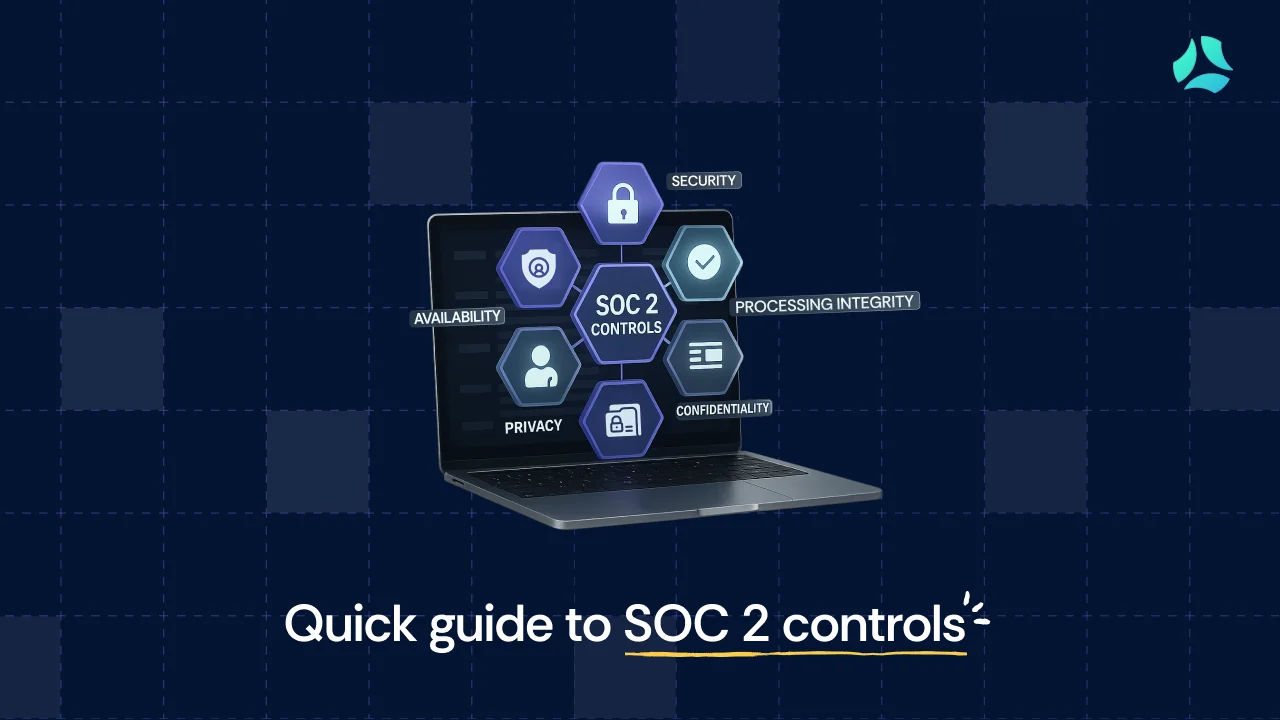
SOC 2 (System and Organization Controls 2) assesses an organization’s controls against the five Trust Services Criteria: security, availability, processing integrity, confidentiality, and privacy. It is the report most technology and cloud companies need, and it is what enterprise buyers almost always mean when they ask for “your SOC report.”
A SOC 2 report must be issued by a CPA firm enrolled in the AICPA peer review program. Independent consultants cannot issue SOC 2 reports. And an important terminology point: SOC 2 produces an attestation report, not a certificate. There is no such thing as being “SOC 2 certified.” You hold a SOC 2 report, or you are SOC 2 attested.
SOC 2 Type 1 vs Type 2
- Type 1 is a point-in-time snapshot of control design. It verifies that your controls are designed correctly as of a specific date. It is faster and cheaper because the auditor tests fewer pieces of evidence, and it gives you a report you can show prospects before they commit.
- Type 2 evaluates operational effectiveness over a defined period (minimum 3 months, typically 6 to 12 months). It proves your controls actually worked over time. It is the commercial credential that enterprise, financial services, and healthcare buyers expect.
Compliance practitioners working with SaaS companies report that roughly 70% of clients go straight to Type 2. If you have implemented your controls only recently, start with a Type 1, show it to clients, and move to Type 2 in the next cycle. A full decision framework follows in the next section.
Trust Services Criteria
Security is the only mandatory criterion. The other four are optional and depend on the commitments you make to customers.
SOC 2 Trust Services Criteria (TSC) breakdown
A common practitioner recommendation is to scope at least security, availability, and confidentiality. Adding availability and confidentiality to security typically raises cost only marginally. Add processing integrity only if you run large batch file processing. Add privacy only if you handle PII. For help mapping this, see our guides on defining your SOC 2 scope and the SOC 2 control list.
Cost and timeline
For a 100-person SaaS company pursuing SOC 2 Type II without a GRC automation platform, costs realistically break down as follows. These are ranges drawn from real engagements, not fixed prices.
A GRC automation platform cuts both auditor hours and consultant costs because gaps are identified automatically and cloud (infrastructure-level) testing runs against benchmarks without a separate manual engagement. See our breakdown of how much engineering time SOC 2 compliance costs for a fuller picture.
Who needs SOC 2?
- SaaS and cloud service providers storing or processing customer data
- Technology and IT companies handling sensitive information
- Financial services and healthcare companies with data-security obligations
Before your first Type II, a SOC 2 readiness assessment surfaces gaps while there is still time to remediate them.
SOC 2 Type 1 vs Type 2: how to decide
Use these scenarios to place yourself:
1. Seed or early-stage with recently implemented controls → Type 1, because your control environment may not be stable enough for a Type II observation window yet. A Type 1 signals maturity while your controls settle.
2. Closing your first enterprise deals → Type 1 is acceptable as a bridge. Most procurement teams will accept it with a committed timeline for Type II. Tell the prospect you are in the observation period and give them a target date for Type II.
3. Selling into financial services or banking → Type 2, because most banks will not onboard a vendor without one. Their vendor-risk frameworks are explicit on this point.
4. Selling into healthcare alongside HIPAA obligations → Type 2, because healthcare buyers need sustained evidence of control effectiveness, not a design snapshot.
5. Series B+ or preparing for M&A → Type 2, because a Type 1 at this stage tells the acquirer your controls have never been tested over time. That affects valuation.
The logic mirrors any mature compliance program: establish the design first, practice it under real conditions, then demonstrate effectiveness over time. HIPAA uses the same progression in its assessment tiers.
For the mechanics of getting through it, see our guides on SOC 2 audit setup and mastering your SOC 2 audit.
What is SOC 3?
SOC 3 (System and Organization Controls 3) is a public-facing report based on the same Trust Services Criteria as SOC 2. Where a SOC 2 report can run 50 to 80 pages for a SaaS organization and disclose specifics like which firewall or antivirus you run, a SOC 3 is a summarized version. It confirms that an antivirus solution is installed, for example, without naming the product.
Most guides skip two things that matter here:
1. SOC 3 is always Type II. There is no SOC 3 Type 1. It is derived from a SOC 2 Type II report, so it inherits the Type II basis.
2. SOC 3 requires a clean opinion. A SOC 3 can only be issued when the underlying SOC 2 Type II carries an unqualified (clean) opinion. If there is a qualification, SOC 3 cannot be issued.
Because SOC 3 is derived from an existing SOC 2 Type II, it is not a separate, standalone audit.
The cost is differential, not additive. You are paying for the incremental work on top of an existing SOC 2 Type II, not a second full audit.
A SOC 3 report also discloses less than a SOC 2. It presents the auditor’s opinion, management’s assertion, and a system description, but not the auditor’s detailed test procedures or test results. That is precisely what makes it safe to publish.
It is useful for SaaS companies. In a subscription model, you often never meet your customer, so a report you can publish on your website and share without an NDA becomes a practical trust signal for prospects who have not yet signed a vendor agreement.
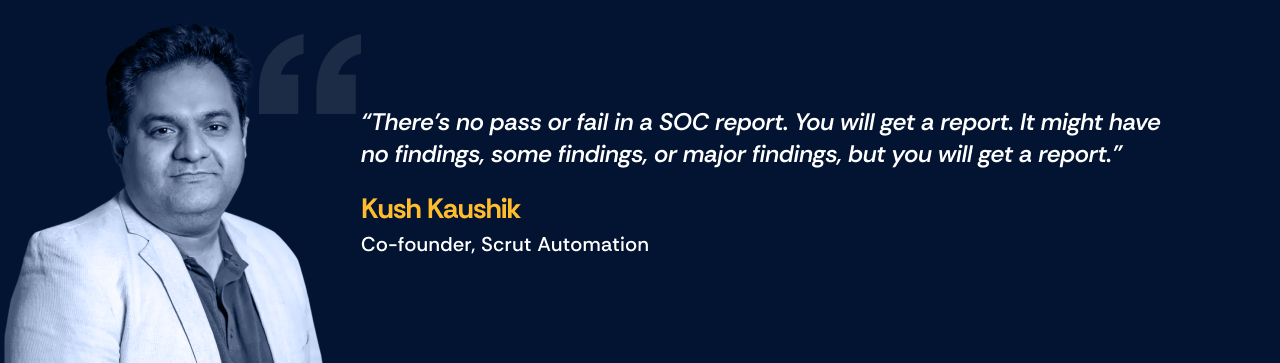
According to Kush Kaushik, Co-founder of Scrut Automation, adoption is still low, with around 5% of organizations pursuing it, partly because awareness is limited. For SaaS specifically, it is worth considering as a way to increase customer trust through compliance.
Will I need both SOC 1 and SOC 2?
Some organizations need both. The payroll processor that also stores HR data is the clearest case. The payroll function affects clients’ financial reporting, which triggers SOC 1. The storage of customer HR data is an information-security concern, which triggers SOC 2.
There is meaningful overlap in the underlying controls. Readiness work done for one report often supports the other, which reduces total effort compared with running two fully independent programs.
The practical rule: if your services do not affect client financial statements, you almost certainly need SOC 2 only. For a wider view of how these fit together, see our compliance frameworks overview.
Receiving a vendor’s SOC 2 report: What to check first
Much of the search traffic here comes from the procurement side: security teams evaluating a vendor’s report, not issuing their own. If a report lands on your desk, here is where to focus.
1. Audit period. Is the report stale? If the period does not align with your current requirement, ask for a bridge letter confirming an audit is underway.
2. Auditor's opinion. Is it unqualified, qualified, adverse, or a disclaimer of opinion? The opinion is the single most important line in the report.
3. Auditor's peer review status. Go to the AICPA peer review website. Confirm the firm is enrolled, that a review has occurred, and whether it was a pass, conditional pass, or fail.
4. System description (Section III). Confirm the management assertion description matches the audit report description and reflects the vendor’s actual product scope.
5. Subservice organizations. Which third-party providers are in scope? If the vendor relies on AWS or another cloud provider, confirm the vendor has reviewed that provider’s findings and presented them to management.
6. Complementary user entity controls (CUECs). These are the controls you are responsible for. AWS provides IAM capability; how you configure it — named users, no generic accounts, MFA enforced — is on you. A vendor’s clean SOC 2 does not cover your misconfiguration.
For a step-by-step walkthrough, see 9 easy steps to review a vendor's SOC 2 report.
How to choose the right SOC framework for your company
Start with three questions: What data do you handle? Who are your customers? What do your prospects require before signing? Your answers map directly to the scenarios below.
1. You provide payroll, claims, or financial data processing → SOC 1 (and possibly SOC 2 if you also store customer data).
2. You are a SaaS, cloud, or technology company storing customer data → SOC 2 Type II.
3. You want a public trust signal without sharing a confidential 50-to-80-page report → SOC 3 (requires a clean SOC 2 Type II first).
4. You are early-stage with newly implemented controls → SOC 2 Type 1 as a bridge to Type II.
5. You handle PII or operate in regulated industries → SOC 2 with the Privacy criterion added. Without it, your report is silent on how personal data is collected, retained, and disposed of, which is exactly what regulated-industry buyers check first.
At the growth stage, SOC 2 and ISO 27001 are a common combination. The control overlap runs roughly 70% to 90%, so pursuing both in parallel is more efficient than sequentially. See the SOC 2 and ISO 27001 control overlap for specifics, or our broader compliance frameworks comparison.
What audit exceptions and qualifications actually mean for your report
A SOC 2 audit does not produce a pass or fail. You will receive a report. It may have no findings, some exceptions, or a qualified opinion. Understanding the difference matters because it directly affects how the report lands with your prospects.
An exception occurs when one or more controls within a criterion fail sampling. Say your logical and physical access controls fall under CC6.1, and there is a gap in hardening standards. If the other controls in that criterion are satisfied, the result is an exception on that control, not a qualification on the criterion.
A qualification is more serious. It occurs when every control within a criterion has exceptions, so the entire criterion fails. The qualification is noted in the auditor’s opinion, along with detailed text explaining what was not satisfied.
The deal impact is real. A qualified SOC 2 report may delay or block enterprise procurement approvals. An exception in a less critical control is often acceptable with a management comment explaining remediation.
Those management comments live in Section V of the report when the audit firm includes it. Not all firms provide Section V. They let the organization explain why a finding was raised, and they apply to exceptions and qualifications alike. The auditor cannot be directed on their own wording, and they will ensure management’s comments do not contradict the audit criteria.
One more consequence to remember: SOC 3 cannot be issued if the underlying SOC 2 Type II carries a qualified opinion. For help avoiding findings in the first place, see best practices for a successful SOC 2 audit.
How Scrut helps automate the SOC 2 compliance process
Designing controls is the easy part of a SOC 2 Type II. Proving they operated consistently across the observation period is where most companies stall. Access reviews happen every quarter, business continuity testing happens every 6 months, and an auditor months later needs evidence that each of those actually occurred, on time, without reconstruction.
Before compliance automation platforms existed, the standard approach was manual and easy to doubt. Policies would get approved over email: someone sends a zip file, someone replies “approved,” and there is no record of who read what or when it was published. Access reviews meant a screen recording with a timestamp, kept in a library, one per quarter for a year, because auditors would not accept a spreadsheet with tick marks. Producing all of that retrospectively, under audit pressure, is where most companies ran into trouble.
Scrut addresses this by maintaining an uneditable evidence trail over time. The practical effect: when an auditor asks whether quarterly access reviews actually happened, the answer is a timestamped log, not a reconstructed spreadsheet. Cloud testing runs automatically against CIS benchmarks. Policy approvals carry dated records. The evidence was captured as it happened, not pulled together the week before the audit. This is where compliance automation does the work the observation period demands.
Customers describe the difference in concrete terms. Matt Black, Director of Information Security at Contentstack, put it plainly:
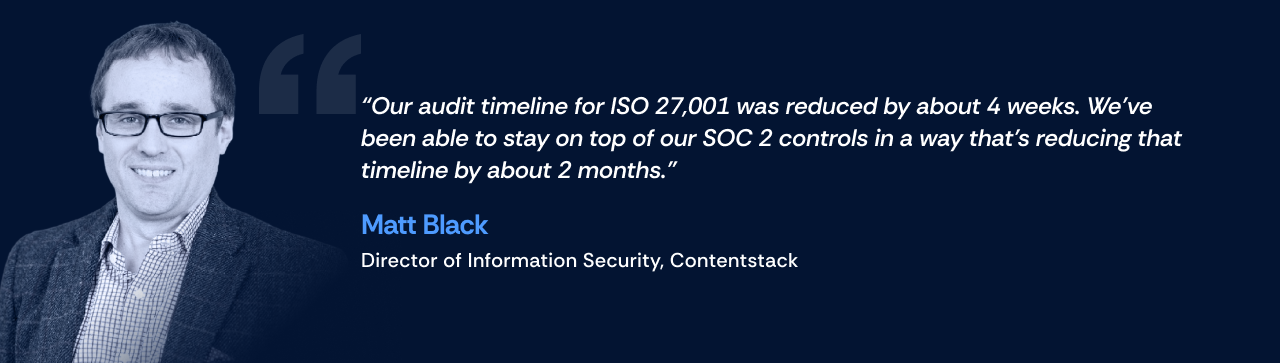
Ron Buell, CTO at Sounding Board, described the same shift: moving from a consultant’s spreadsheet to a system that gave his team clear visibility into which policies and evidence were required, and at what cadence, so audit prep stopped producing last-minute surprises.
To see how this maps to your framework, explore Scrut's SOC 2 solution or the audit center. Book a demo when you are ready to walk through your specific scope.
FAQs
Can I replace SOC 1 with SOC 2 or SOC 3?
No. SOC 1 addresses controls over financial reporting and is designed for organizations that affect client financial statements. SOC 2 and SOC 3 address data security, availability, processing integrity, confidentiality, and privacy. They do not cover financial-reporting processes, so each serves a distinct purpose. Note that all three produce attestation reports, not certificates.
What are the similarities between SOC 1, SOC 2, and SOC 3?
All three are built on the SSAE 18 standard, are issued by a CPA firm, and provide third-party assurance about an organization's controls. SOC 2 and SOC 3 share the same Trust Services Criteria, while SOC 1 focuses on financial-reporting controls.
What is the difference between SOC 2 Type 1 and SOC 2 Type 2?
SOC 2 Type 1 evaluates whether your controls are suitably designed at a single point in time. SOC 2 Type 2 evaluates whether those controls operated effectively over a defined period (minimum 3 months, typically 6 to 12 months). Enterprise buyers, financial services, and healthcare organizations typically require Type 2.
Can you get a SOC 3 report without a SOC 2?
No. A SOC 3 report is derived from an existing SOC 2 Type II report with an unqualified (clean) opinion. You cannot obtain a SOC 3 standalone or from a SOC 2 Type 1.
What is the difference between SOC 1 Type 2 and SOC 2 Type 2?
Both assess how well controls performed over a defined period. The difference is focus: SOC 1 Type 2 evaluates controls relevant to financial reporting, while SOC 2 Type 2 evaluates controls relevant to the Trust Services Criteria.
Do you need a SOC 1 before getting a SOC 2?
No. SOC 1, SOC 2, and SOC 3 are independent reporting types. The numbers do not indicate a sequence. You pursue the report that matches your business model and customer requirements, not a predetermined order.
How long does it take to get a SOC 2 report?
SOC 2 Type 1 can be completed relatively quickly once controls are in place, typically within weeks of a gap assessment and remediation. SOC 2 Type 2 requires a minimum 3-month observation period during which controls must be operating. Most companies target a 6-to-12-month observation window for their first Type 2.

%201.png)


.webp)