


%20(1).png)
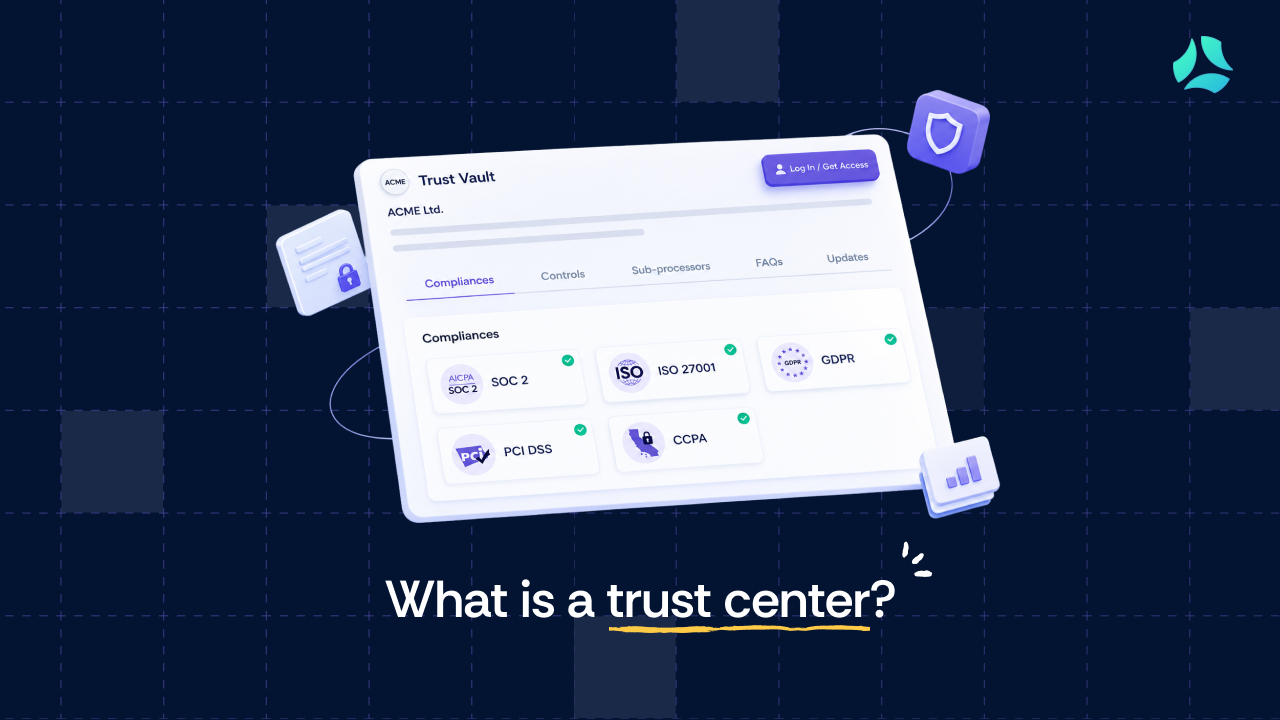


- A trust center is a self-serve portal where buyers access your security and compliance documentation without routing through the compliance team.
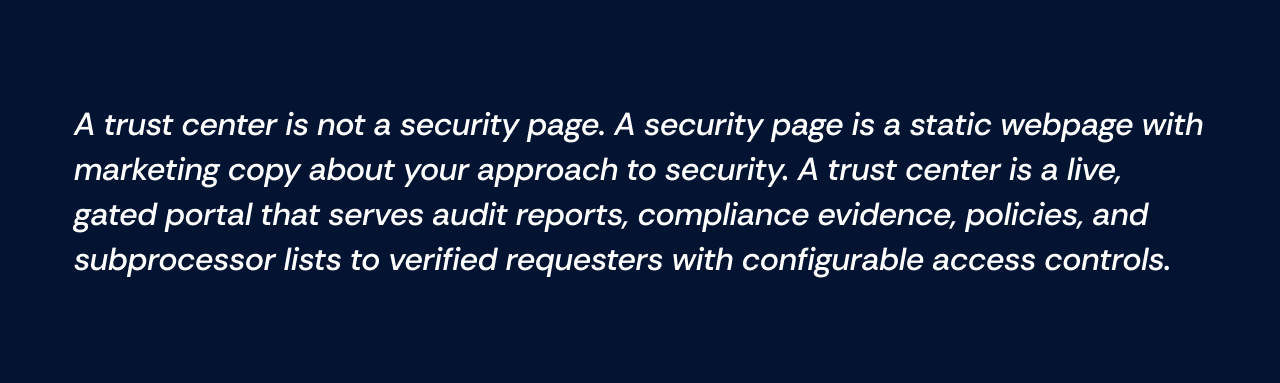
- It is not a static security page. A real trust center includes live compliance status, gated document access with NDA controls, and a subprocessor list.
- The business case is time saved and deals unblocked: every hour not spent manually fulfilling security review requests returns to the compliance program backlog.
- Most teams need one when inbound security review requests start consuming more than a few hours per week, or when a deal stalls on documentation access.
Every compliance practitioner reaches the same point. The SOC 2 audit is done. The ISO 27001 certificate exists. The risk register is nearly under control. And then the helpdesk work starts.
A prospect's security team emails asking for the SOC 2 report. A customer wants to know which subprocessors you use. A new enterprise deal requires your penetration test summary, your encryption policy, and your incident response plan, all before the contract is signed.
Each request takes 20 minutes to field. None of them required compliance expertise. All of them landed in the compliance owner's inbox anyway.
A trust center solves that problem. It is a self-serve portal where prospects and customers access your security and compliance documentation without routing through your team.
This guide explains what one is, what belongs in it, how it differs from just posting a PDF on your website, and how to decide whether your company needs one right now.
What a trust center actually is
A trust center is a centralized, externally-facing portal that displays your organization's security posture, compliance certifications, and supporting documentation to prospects, customers, and partners. It is designed for self-service: a prospect can visit the portal, request access to your SOC 2 report, sign an NDA digitally, and download the document without a single email to your team.
The term is used interchangeably with 'security trust center,' 'compliance trust center,' and 'trust portal.' Different vendors call their versions different things. Scrut calls theirs Trust Vault. Vanta calls theirs Trust Center. The underlying function is the same: give buyers what they need to complete their vendor security review without making the compliance team the bottleneck.
Charissa Davis (Compliance and Delivery Lead, Diesta) describes Trust Vault’s gated access model: the portal can be customized to match your brand, with a public-facing layer and a deeper layer of documentation available to customers who have already signed an NDA or are in the contracting process.
See Scrut Trust Vault in action
What belongs in a trust center
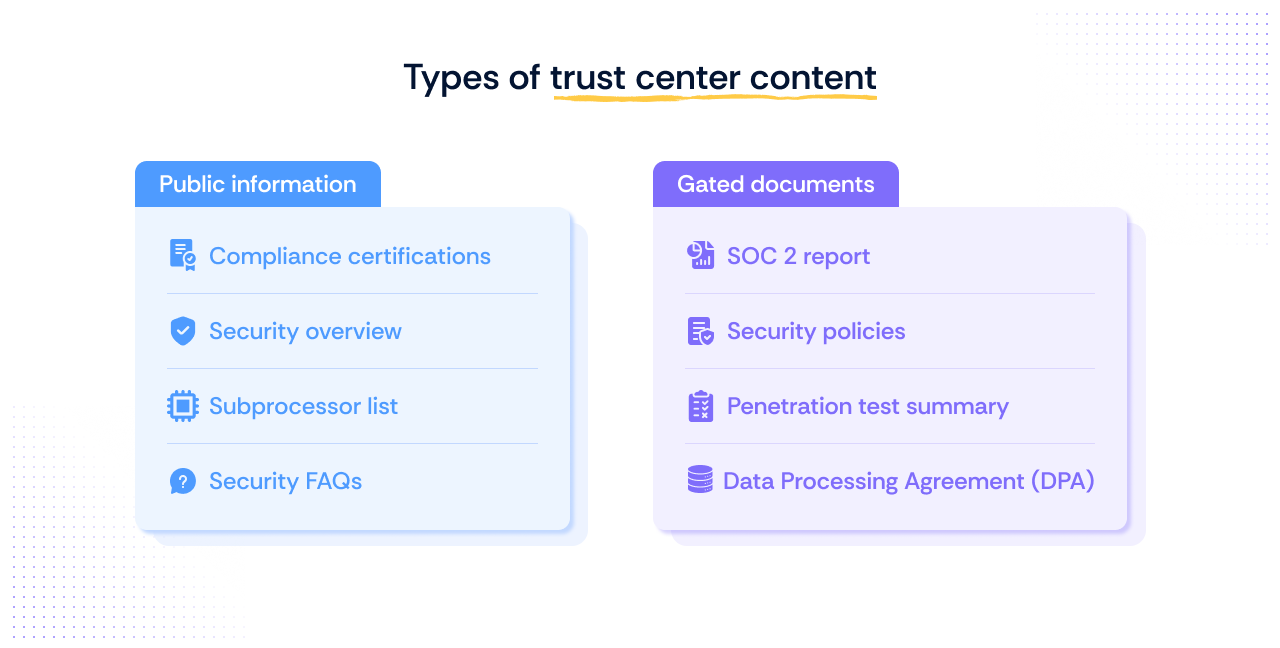
Most trust centers include a combination of public-facing content (visible to anyone without authentication) and gated content (accessible only after identity verification, NDA signing, or approval by your team).
Public content: What anyone can see
- Framework certifications and compliance badges: SOC 2 Type 2 report status, ISO 27001 certificate, HIPAA compliance, GDPR documentation, PCI DSS attestation. Current certification status, not the reports themselves.
- Subprocessor list: Third-party vendors that process customer data on your behalf, with purpose and data location. Keeping this up to date and publicly visible reduces a significant volume of inbound requests.
- Security overview: Your approach to encryption, access controls, incident response, and vulnerability management in plain language. This replaces the first 15 questions of most vendor security questionnaires.
- Frequently asked security questions: The questions you answer most often, pre-answered and kept current. Prospects self-serve on the FAQ before they need to contact your team.
Gated content: What requires access approval or an NDA
- SOC 2 Type 2 audit report: Almost always gated. Enterprise buyers need it; they expect to sign an NDA to receive it. A trust center automates the NDA collection and document delivery.
- ISO 27001 certificate: Often gated, sometimes public. Depends on organizational policy.
- Penetration test summary: Gated. Buyers want enough detail to know the scope and outcome; they should not receive the full report with unexploited findings.
- Security policies: Access control policy, data classification policy, incident response plan, acceptable use policy. Often gated at the enterprise deal stage.
- Data Processing Agreements and privacy documentation: Gated. Required by enterprise procurement and regulated-sector buyers.
The NDA gating step is where a trust center earns its keep over a shared drive. Instead of a human reviewing each access request, confirming identity, collecting a signed NDA, and manually sending a link, the trust center automatically handles collection, digital signature, expiry controls, and delivery. The compliance team sees a log of who accessed what and when.
How a trust center differs from posting a SOC 2 PDF on your website
Many companies, when they complete their first SOC 2 audit, put the report on a Google Drive folder and share the link in response to requests. This solves the immediate problem for about a month. Then the problems start.
The critical difference is not storage. It is workflow. A trust center converts a compliance owner's most repetitive task into a self-serve process. The hours recovered go back to the risk register, the vendor program, and the incident response plan. See how Scrut's Trust Vault approaches this workflow for a product-level walkthrough.
Does your company need one right now?
A trust center is not a day-one compliance investment. It pays off when inbound security review volume makes manual fulfillment a meaningful time drain. Here is how to assess whether you are at that point.
You probably need one if:
- You are fielding more than three to five inbound security review requests per week. At that volume, manual fulfillment is consuming three to five hours of compliance time weekly, all of it on tasks that require no compliance expertise.
- Deals are stalling while buyers wait for documentation. A prospect who has to wait 48 hours for a SOC 2 report is a prospect who may have moved the deal to a competitor who had a self-serve portal ready.
- The same questions keep arriving in different formats. If your top ten inbound security questions appear in every questionnaire, a trust center FAQ eliminates the manual drafting of answers you have already written.
- You have completed your first SOC 2 or ISO 27001 and enterprise deals are now on the horizon. The moment a compliance credential exists, the volume of requests for it begins. A trust center is the infrastructure for fielding that volume.
- Your supply chain has compliance requirements. Nintex, a 15+ year SaaS company, uses Scrut's Trust Vault specifically because enterprise customers want transparency about third-party risk. A trust center is the interface for that transparency.
You can probably wait if:
- You do not yet have a compliance credential to share. A trust center without a SOC 2 report or ISO 27001 certificate is a portal with nothing in it. Build the credential first.
- Inbound security review volume is low. If you receive fewer than one or two requests per week, the overhead of maintaining a trust center exceeds the time saved on fulfillment.
- Your deals are with small businesses that do not run formal vendor security reviews. Trust centers are most valuable in enterprise and mid-market B2B sales, where security reviews are a standard procurement step.
What makes a trust center more than a document portal
The distinction between a document portal (a shared drive with access controls) and a real trust center comes down to three capabilities.
Live compliance status, not a static snapshot
A document portal shows what was true when someone last updated it. A trust center connected to your GRC platform shows what is true now: which controls are passing, which certifications are current, when the last audit was completed. When a prospect's security team visits your trust center, they see your live compliance posture, not a PDF from eighteen months ago.
See how continuous compliance monitoring feeds this for the operational model behind live status.
Workflow automation, not manual fulfillment
NDA collection, access approval, document delivery, expiry management, and access logging are all workflow steps. In a manual process, each one requires a human action. A trust center automates all of them. The compliance owner sets the rules once (who needs an NDA, which documents require approval, when access expires) and the portal enforces them on every subsequent request.
Scrut's Trust Vault auto-fills questionnaire answers from the knowledge base built from completed reviews, so even the security questionnaires that cannot be self-served through the portal move faster. Bureau, an enterprise SaaS company, drove over 800 Trust Vault views and attributed faster enterprise deal progression directly to having the portal available during active sales cycles.
Analytics that connect compliance to revenue
A document portal cannot tell you which compliance programs your prospects care most about, how often your SOC 2 report is accessed, or whether there is a correlation between trust center engagement and deal size. A trust center connected to a CRM can. This data gives the compliance owner something to show the CFO when justifying the investment: compliance activities that correlate with deal movement have a quantifiable business impact.
Building the internal case for a trust center
The target persona for this blog is not the decision-maker. They evaluate and recommend; they do not sign. This section gives them the three arguments to take upward.
The time argument. Every inbound security review request that routes through the compliance owner costs 20 to 45 minutes of time that cannot be billed to the audit or the risk register. At five requests per week, that is two to four hours per week, or 100 to 200 hours per year, on tasks that require zero compliance expertise. A trust center converts that time into self-service. The compliance owner's hours return to the work that actually requires their skills.
The revenue argument. Security reviews are a procurement gate in enterprise sales. A buyer who waits 48 hours for documentation is a buyer who may stall, find a reason to deprioritize the deal, or move to a competitor with faster security review turnaround. According to Scrut's 2026 Business Impact of Compliance Automation report, 80% of organizations using Scrut's compliance program established customer trust earlier in the sales cycle. A trust center is the delivery mechanism for that trust.
The scalability argument. The volume of inbound security review requests grows with the company. A team of 20 fielding five requests per week becomes a team of 100 fielding 25 requests per week, with the same compliance owner and the same hours. A trust center scales the capacity for security review fulfillment without scaling the compliance headcount.
Scrut Trust Vault: How it works
Scrut's Trust Vault is a white-labeled trust center built directly into the Scrut GRC platform. Because it is integrated with the compliance program, the documentation it serves is always current: compliance status updates from the control monitoring layer, subprocessors pull automatically from the vendor inventory, and questionnaire answers draw from the knowledge base built from every completed security review. See the Trust Vault product page for the full feature overview.
For a compliance owner, the integration matters more than the portal itself. A standalone trust center that requires manual updates to stay current becomes another maintenance task. A trust center that updates from the GRC platform stays accurate without additional work.
- Branded portal with custom domain: Share a URL that looks like your company's website, not a third-party portal.
- NDA collection and digital signature: Set which documents require NDA; portal collects digital signature automatically before granting access.
- Expiry controls: Set access expiry on sensitive documents so shared links do not circulate indefinitely.
- Subprocessor auto-update: Pull the subprocessor list from the vendor inventory in Scrut; no manual maintenance.
- CRM integration: Connect Trust Vault activity to Salesforce or HubSpot deals to see which compliance programs buyers engage with and how trust center activity correlates with deal movement.
- Questionnaire knowledge base: Auto-fill responses to inbound security questionnaires from the knowledge base built from completed reviews.
- Access analytics: See who accessed which documents, when, and from which deal or account.
See how Scrut Trust Vault helps compliance teams convert security review requests from a time drain into a self-serve experience. Request a demo.
A security page is a static marketing webpage describing your company's approach to security. It contains no actual documentation, no live compliance status, and no self-serve access to audit reports or policies. A trust center is a live, gated portal that serves actual documentation to verified requesters. A prospect visiting a security page still has to email your team for the SOC 2 report. A prospect visiting a trust center can request, sign an NDA, and download the report without any human intervention from your side.
Practically speaking, yes. A trust center without compliance credentials to display is a portal with nothing in it. The value of a trust center is its ability to serve audit reports, certifications, and compliance-evidenced controls to buyers who need them. If those documents do not exist yet, the trust center has nothing to serve. Build the compliance credential first, then build the portal to serve it efficiently. The sequence matters.
Three ways. First, access control: a trust center enforces NDA collection and identity verification before granting document access; a Google Drive link can be forwarded indefinitely with no controls. Second, audit trail: a trust center logs who accessed which documents and when; a shared Drive link produces no audit trail. Third, live content: a trust center connected to a GRC platform shows current compliance status; a Google Drive folder shows documents as of the last time someone updated them. The operational difference is that a trust center removes the compliance team from the document fulfillment loop entirely. A shared Drive link does not
With a platform like Scrut Trust Vault, most teams publish a basic trust center in hours to days, not weeks. The initial setup involves configuring the portal design (branding, custom domain), uploading the documentation you want to serve, setting access rules (which documents require NDA, which are public), and connecting the subprocessor list. The time investment is front-loaded; ongoing maintenance is minimal when the portal is connected to a GRC platform that keeps documentation current automatically. See the Scrut Trust Vault setup guide for a step-by-step walkthrough.
The compliance owner benefits most because it removes the most repetitive task from their week. The sales team benefits because documentation requests no longer stall deal momentum. Engineering benefits because security questionnaire escalations stop arriving mid-sprint. Leadership benefits because the trust center produces analytics showing which compliance credentials buyers engage with most and how security transparency correlates with deal movement. The persona who will champion a trust center is almost always the compliance owner, but the value is distributed across the team.


%201.png)