


%20(1).png)


GDPR compliance is a legal and operational requirement for any organization that collects, processes, or stores the personal data of individuals in the EU or EEA, and the stakes for getting it wrong are significant.
For CEOs, CISOs, and compliance teams at SaaS companies and data-driven organizations, building a GDPR compliance framework is not optional. Non-compliance carries serious exposure: fines of up to €20 million or 4% of global annual turnover, lasting reputational damage, and operational disruption that directly affects customer trust and revenue.
GDPR compliance is one of the most important compliance standards organizations must meet when operating in or serving EU markets. Embedding GDPR principles into core operations, rather than treating them as a checkbox exercise, is what separates organizations that manage risk proactively from those that respond to it reactively.
This guide covers everything you need to build and maintain a GDPR-compliant program, from foundational requirements and infrastructure decisions to DPO appointments, emerging technology challenges, and how automation accelerates the process.
Summary overview:
- GDPR compliance is a legal and operational requirement for any organization handling EU residents' personal data, carrying fines of up to €20 million or 4% of global turnover for non-compliance.
- Building a GDPR-compliant program requires a structured framework covering data mapping, lawful processing, security controls, DPIAs, DPO appointment, and continuous monitoring.
- Purpose-built GDPR compliance software like Scrut automates evidence collection, cloud scanning, and audit workflows, helping teams stay compliant without the manual overhead.
What is GDPR compliance?
GDPR compliance means meeting the requirements of the EU's General Data Protection Regulation when collecting, processing, and storing the personal data of individuals in the European Union and European Economic Area.
It applies regardless of where your organization is based. If you handle EU residents' data, GDPR applies to you. Compliance covers lawful data processing, transparency obligations, data subject rights, breach notification, and organizational accountability.
Since its enforcement in 2018, GDPR has reshaped data protection practices across organizations in multiple countries. As of 2024, over 2,086 fines have been issued, totaling €4.48 billion, with the €1.2 billion penalty against Meta in 2023 underscoring the risks of non-compliance. Beyond financial penalties, organizations that fail to meet GDPR requirements risk an 8% drop in revenue as a direct operational consequence.
Understanding what GDPR compliance requires starts with its core GDPR guidelines, seven principles that govern how personal data must be handled across every stage of processing.
Understanding which organizations fall under GDPR's scope is equally important. The regulation's applicability is broader than many assume.
Which businesses must comply?
GDPR applies to any organization that processes the personal data of individuals within the EU and EEA, regardless of whether the organization is based there. Even non-EU businesses must adhere to GDPR if they process or monitor the data of EU residents.
Companies outside the EU providing goods or services to EU individuals must align with GDPR compliance, particularly when handling cross-border data transfers.
GDPR compliance at a glance
The 7 core GDPR principles and guidelines
GDPR compliance is built on seven core principles that define how personal data must be collected, handled, and protected. These GDPR guidelines apply to every organization that processes EU residents' data, regardless of size or sector.
- Lawfulness, fairness, and transparency: Organizations must handle personal data lawfully, fairly, and transparently, ensuring individuals understand how their data is being used.
- Purpose limitation: Data should only be collected for specific, explicit, and legitimate purposes and must not be processed in ways incompatible with those purposes.
- Data minimization: Only the data necessary for achieving a stated purpose should be processed. Collecting more than what is needed is a violation in itself.
- Accuracy: Personal data must be accurate and kept up to date. Organizations must have processes to correct or delete inaccurate data promptly.
- Storage limitation: Retain personal data only for as long as it is necessary for the purpose it was collected. Clear retention policies are essential.
- Integrity and confidentiality: Ensure appropriate technical and organizational security measures to protect data from breaches, loss, or unauthorized access.
- Accountability: Organizations must not only comply with GDPR principles but also actively demonstrate that compliance through documentation, policies, and proactive measures.
These principles are the foundation of what GDPR compliance requires and inform every decision organizations make about data collection, processing, and storage.
Who must comply with GDPR?
GDPR applies to any organization that processes the personal data of individuals within the EU and EEA, regardless of where the organization itself is based. Being gdpr compliant is not limited to European businesses; the regulation’s reach is intentionally broad.
For non-EU companies, the cross-border implications are significant. A SaaS company headquartered in the US, a marketplace based in Southeast Asia, or a platform serving European customers from anywhere in the world, all fall within GDPR's scope if they handle EU residents' data.
Organizations in this position are required to appoint an EU representative under Article 27 unless an exemption applies.
Cross-border data transfers add another layer of obligation. Transferring personal data outside the EU or EEA requires appropriate safeguards, such as Standard Contractual Clauses (SCCs) or an adequacy decision from the European Commission.
Why GDPR compliance is critical
GDPR enforcement has teeth. Supervisory authorities across the EU have consistently demonstrated a willingness to impose significant penalties, and the cases against some of the world's largest companies make clear that no organization is exempt. For organizations that treat GDPR compliance as a low-priority obligation, the consequences are well-documented.
Consequences of non-compliance
Under Article 83, GDPR violations can result in fines of up to €20 million or 4% of a company's annual global turnover, whichever is higher. The two most prominent enforcement actions illustrate just how seriously regulators apply this:
In 2023, Meta received a €1.2 billion fine from the Irish Data Protection Commission for unlawfully transferring EU users' personal data to the US without adequate safeguards. It remains the largest GDPR fine issued to date and a clear signal that no organization is too large to face enforcement.
In August 2024, Uber was fined €290 million by the Dutch Data Protection Authority for transferring European drivers' personal data to the United States without the required protections in place. Enforcement actions are not limited to data transfers either. Areas like GDPR cookie consent requirements are among the most commonly cited violations, and regulators have shown a consistent appetite for pursuing them.
Both cases demonstrate that GDPR compliance failures carry consequences well beyond the fine itself. Reputational damage, customer attrition, and sustained scrutiny from regulators are equally significant risks.
Positive outcomes of compliance
Organizations that invest in GDPR compliance consistently see measurable returns across three areas:
- Customer and stakeholder trust: Demonstrating that personal data is handled responsibly builds loyalty and confidence, particularly in markets where privacy is a purchase decision factor.
- Competitive advantage: In privacy-conscious markets, GDPR compliance is increasingly a differentiator. Prospects and enterprise buyers actively evaluate data protection practices before signing contracts.
- Stronger cybersecurity posture: The technical and organizational measures GDPR requires, such as encryption, access controls, and breach response protocols, directly strengthen an organization's overall security program.
GDPR compliance is not just a legal obligation. For organizations serious about long-term growth, it is a foundation for sustainable trust.

Key GDPR compliance requirements
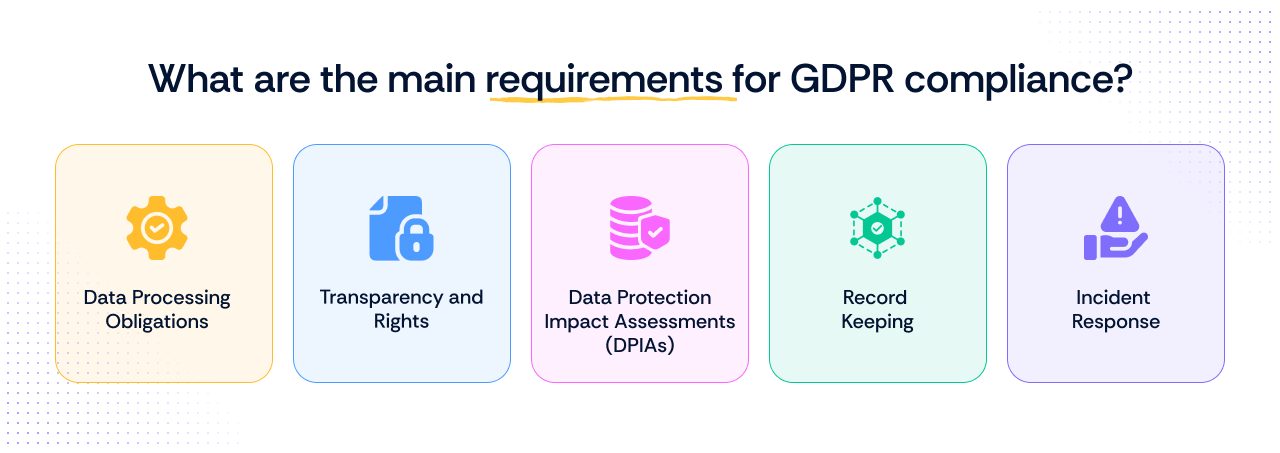
Meeting GDPR compliance obligations means addressing five distinct areas of data handling and organizational practice. The GDPR guidelines below cover what every organization in scope must implement, document, and maintain. And as GDPR compliance increasingly goes beyond a CISO's agenda, ownership of these requirements sits across legal, IT, HR, and operations, not just the security team.
1. Data processing obligations
Every data processing activity must be grounded in one of six lawful bases under GDPR, such as consent, contract performance, or legitimate interests. Consent must be freely given, specific, informed, and unambiguous, with a straightforward mechanism for withdrawal. Additional safeguards apply when processing special categories of data, including health records, biometric data, or political opinions.
2. Transparency and rights
GDPR places significant emphasis on keeping individuals informed and in control of their data. Organizations must provide clear, concise, and accessible privacy notices covering how personal data is collected, used, and shared. Beyond transparency, they must honor individual rights, including access to data, rectification of inaccuracies, erasure (the right to be forgotten), data portability, and the right to restrict or object to processing.
3. Data Protection Impact Assessments (DPIAs)
Data Protection Impact Assessments are mandatory when processing activities are likely to result in a high risk to individuals' rights and freedoms. This includes large-scale monitoring, the use of new technologies, or systematic profiling. A DPIA must evaluate the risks involved, identify measures to mitigate them, and document findings to demonstrate accountability to supervisory authorities.
4. Record keeping
The accountability principle requires organizations to maintain a detailed Record of Processing Activities (ROPA), covering data categories, processing purposes, retention periods, and any data sharing arrangements. Clear data retention policies must be in place, including documented timelines for secure deletion.
5. Incident response
In the event of a data breach, GDPR mandates a 72-hour notification window to the relevant supervisory authority from the moment the organization becomes aware. The notification must detail the scope and nature of the breach, its likely impact, and the steps being taken to contain and remediate it. Where the breach poses a high risk to individuals, those affected must also be notified directly.
How to achieve GDPR compliance: A step-by-step guide
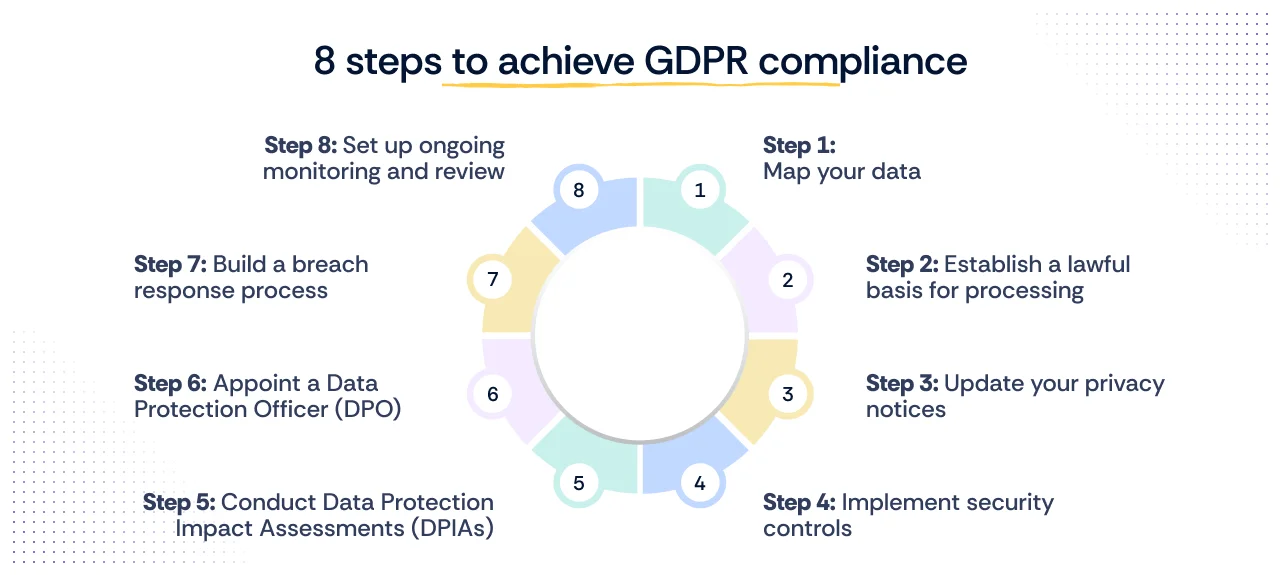
Building a GDPR compliance framework from the ground up requires a structured approach. The steps below apply whether you are starting fresh or tightening an existing program.
Step 1: Map your data
Before you can protect personal data, you need to know where it lives. Conduct a thorough data mapping exercise to identify every type of personal data your organization collects, where it comes from, how it flows internally and externally, who has access, and how long it is retained. This forms the foundation of your Record of Processing Activities (ROPA).
Step 2: Establish a lawful basis for processing
For every data processing activity identified in your mapping exercise, document the lawful basis under which it operates. Whether that is consent, contract performance, legal obligation, vital interests, public task, or legitimate interests, each activity must have a clearly recorded justification before processing begins.
Step 3: Update your privacy notices
Privacy notices must accurately reflect how your organization collects, uses, shares, and retains personal data. Review all customer-facing and internal notices to ensure they are clear, accessible, and aligned with your documented processing activities. Notices should be written in plain language, not legal boilerplate.
Step 4: Implement security controls
GDPR requires appropriate technical and organizational measures to protect personal data. This includes encryption of data at rest and in transit, role-based access controls, regular vulnerability assessments, and documented security policies. Security controls must be proportionate to the risk level of the data being processed.
Step 5: Conduct Data Protection Impact Assessments (DPIAs)
For any processing activity that poses a high risk to individuals' rights and freedoms, a Data Protection Impact Assessment is mandatory. Run DPIAs before launching new products, adopting new technologies, or significantly changing how existing data is processed. Document the risks identified and the measures taken to address them.
Step 6: Appoint a Data Protection Officer (DPO)
Determine whether your organization is required to appoint a DPO under Articles 37 to 39 of the GDPR. If mandatory, appoint someone with sufficient knowledge of data protection law and practice. Even where not legally required, having a dedicated privacy lead significantly strengthens accountability and compliance oversight.
Step 7: Build a breach response process
Establish a documented incident response process that enables your organization to detect, contain, and report a data breach within GDPR's 72-hour notification window. This should include defined roles and responsibilities, internal escalation paths, a breach register, and pre-drafted notification templates for both supervisory authorities and affected individuals.
Step 8: Set up ongoing monitoring and review
GDPR compliance is not a one-time project. Schedule regular audits of your data processing activities, security controls, and third-party processors. Monitor guidance from the European Data Protection Board (EDPB) and national supervisory authorities for regulatory updates. Assign ownership of compliance tasks and build review cycles into your operational calendar.
GDPR compliance best practices
Building a GDPR-compliant infrastructure
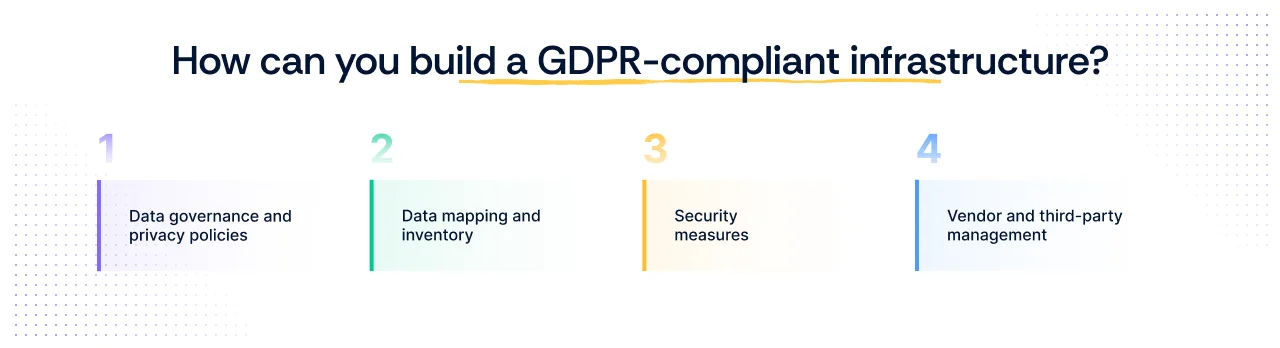
Becoming gdpr compliant is not just about policies on paper. It requires building an infrastructure where data protection is embedded into systems, processes, and third-party relationships. The four pillars below form the operational backbone of any GDPR-compliant organization.
1. Data governance and privacy policies
A strong governance framework is the backbone of GDPR compliance. Develop and implement clear data handling policies aligned with GDPR principles, covering collection, processing, retention, and deletion. Policies should assign clear ownership, define accountability at each stage of the data lifecycle, and be reviewed regularly to reflect regulatory changes. This is particularly important for teams running campaigns or managing customer data, where GDPR directly shapes how marketing activities can be conducted. Privacy policies must be easily accessible and written in plain language for both internal teams and external stakeholders.
2. Data mapping and inventory
A clear, accurate picture of your data environment is non-negotiable. Conduct thorough data mapping to identify all personal data your organization processes, including its sources, locations, and flows within and outside the organization. Maintain a detailed data inventory that tracks processing purposes, lawful bases, and retention periods. This documentation is central to demonstrating accountability and is a prerequisite for completing a GDPR compliance audit checklist.
3. Security measures
Robust security is a direct GDPR requirement, not an optional add-on. Organizations must implement:
- Encryption and pseudonymization: Protect sensitive data during storage and transmission by encrypting it or replacing direct identifiers with pseudonyms.
- Access controls: Enforce role-based access to ensure only authorized personnel can access personal data, and review access permissions regularly.
- Vulnerability management: Monitor and test security systems on an ongoing basis to identify and remediate weaknesses before they result in a breach.
4. Vendor and third-party management
GDPR extends compliance obligations across your entire supply chain. Any processor or sub-processor handling personal data on your behalf must meet the same GDPR standards your organization is held to. This requires:
- Vetting vendors before onboarding to confirm adequate data protection practices are in place.
- Establishing GDPR-compliant Data Processing Agreements (DPAs) that clearly define roles, responsibilities, and breach notification obligations.
- Conducting regular audits of third parties to verify continued compliance, particularly for vendors with access to sensitive or high-volume personal data.
Appointing a Data Protection Officer (DPO)
For many organizations, appointing a Data Protection Officer is a core component of a sustainable GDPR compliance program. Whether mandatory or voluntary, having a designated privacy lead strengthens accountability and ensures that data protection obligations are managed consistently across the organization.
Who needs a DPO?
Under Articles 37 to 39 of the GDPR, appointing a DPO is mandatory for:
- Public authorities: Any organization acting as a public body, excluding courts acting in a judicial capacity.
- Organizations conducting large-scale monitoring: Businesses that systematically monitor individuals, such as behavioral tracking or large-scale processing of sensitive personal data.
- Organizations processing special categories of data: Those handling health records, biometric data, or criminal conviction data at scale must appoint a DPO.
Even where a DPO is not legally required, many organizations operating across multiple jurisdictions or handling significant volumes of personal data choose to appoint one as a proactive GDPR compliance measure.
Role and responsibilities of the DPO
The DPO sits at the center of an organization's GDPR compliance efforts. Key responsibilities include:
- Ensuring compliance: Advising the organization on GDPR obligations and monitoring adherence to them across all processing activities.
- Conducting audits: Regularly reviewing data protection policies, systems, and processes to identify gaps and areas for improvement.
- Training employees: Educating staff across functions on their responsibilities under GDPR, building a culture where privacy is understood as an organizational value.
- Point of contact: Acting as the primary liaison between the organization, supervisory authorities, and individuals on all data protection matters.
In-house vs. outsourced DPO
Organizations can fulfill the DPO requirement either by hiring an in-house appointment or outsourcing the role to an external specialist. Each approach carries distinct trade-offs:
Whether in-house or outsourced, the DPO must have sufficient knowledge of data protection law, operate with independence, and have direct access to senior leadership. The role is not about producing reports for their own sake.
GDPR compliance for emerging technologies
As AI, IoT, and big data reshape how organizations collect and process information, GDPR compliance becomes more complex and more critical. The volume, velocity, and sensitivity of data involved in these systems raise the bar for what organizations must demonstrate to supervisory authorities. For teams managing this at scale, automating GDPR compliance is no longer a nice-to-have; it is the only practical way to keep pace.
1. AI and data privacy
Artificial intelligence introduces unique challenges in managing data subject rights under GDPR:
- Transparency in AI processing: Organizations must be able to explain how personal data is used in AI models. GDPR requires transparency even for complex machine learning algorithms.
- Managing data subject rights: AI applications must respect rights, including access, rectification, and erasure. Where an AI algorithm makes automated decisions, individuals have the right to request human intervention and a meaningful explanation under GDPR Article 22.
- Data minimization: Limit data collection to what is strictly necessary for AI training, in line with what GDPR defines as lawful data usage.
2. IoT and big data challenges
IoT devices and big data systems often process vast amounts of personal information simultaneously, creating compounding challenges for GDPR compliance:
- Data security: Highly interconnected systems increase breach exposure. Strong encryption, access controls, and regular security audits are essential.
- Consent in IoT: Devices must obtain explicit, informed consent from users for data collection, particularly when sensitive personal data is involved.
- Data mapping: With data flowing across multiple devices and platforms, maintaining an accurate inventory of where personal data resides is essential for ongoing compliance.
3. Cross-regulation alignment
Organizations working with emerging technologies rarely operate under a single regulatory framework. Aligning GDPR with complementary standards strengthens the overall compliance posture:
- NIST: The NIST cybersecurity framework provides guidelines for managing cybersecurity risks that directly complement GDPR's data protection requirements, particularly around incident response and access controls.
- ISO 27001: ISO 27001 and GDPR alignment is well established. The standard's information security management requirements map closely to GDPR's technical and organizational measures, making it a natural companion framework for organizations pursuing both.
- DORA: For financial institutions, aligning GDPR principles with the Digital Operational Resilience Act ensures operational resilience while meeting privacy obligations across jurisdictions.
Ongoing GDPR compliance and monitoring
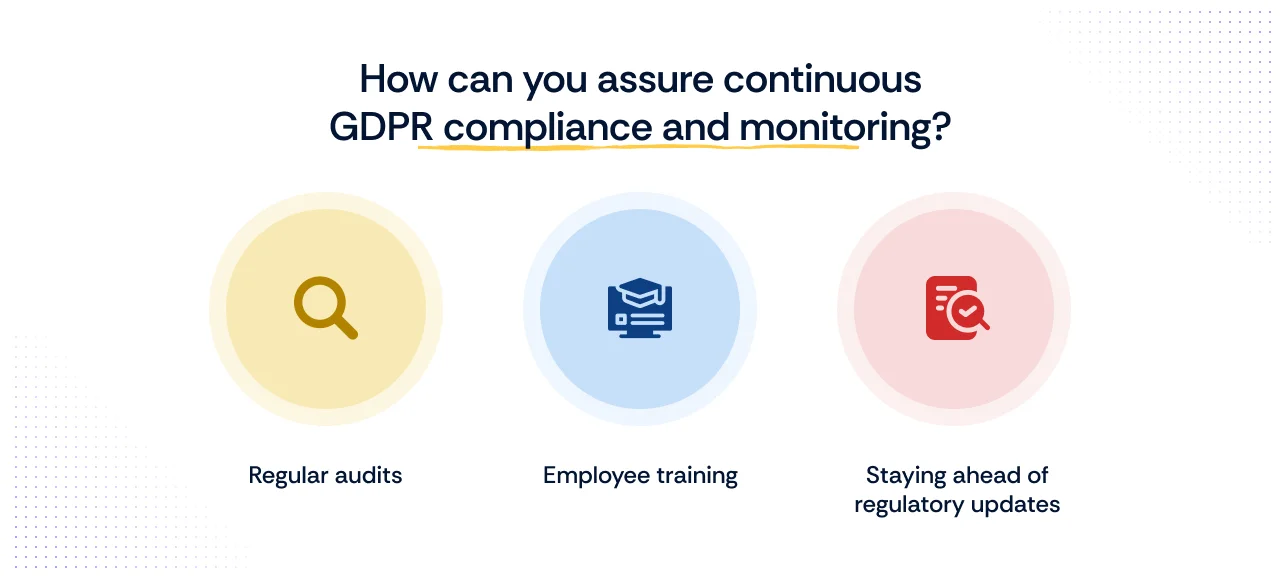
GDPR compliance is not a project with a finish line. It is an ongoing operational commitment that requires your gdpr compliance framework to evolve alongside regulatory changes, business growth, and emerging threats. Organizations that treat compliance as a one-time implementation inevitably fall behind, while those that embed it into day-to-day operations stay consistently audit-ready.
1. Regular audits
Conducting regular audits is the primary mechanism for verifying that your GDPR guidelines are being followed in practice, not just on paper.
- Frequency and scope: Audits should be conducted at least annually, with higher-risk processing activities reviewed more frequently. The scope should cover data processing activities, Records of Processing Activities (ROPAs), security controls, third-party processors, and incident response protocols.
- Documentation: Comprehensive audit records demonstrate accountability to supervisory authorities and form the evidentiary backbone of your compliance program. Organizations looking for a structured starting point can work through a GDPR compliance audit checklist to ensure no area is overlooked.
2. Employee training
A GDPR compliance framework is only as strong as the people operating within it. Building a culture of privacy requires consistent, role-specific education across the organization.
- Privacy and security awareness: Regular training sessions should cover GDPR requirements, including data handling procedures, breach reporting obligations, and individual rights. Teams that understand the reasoning behind the rules are more likely to follow them consistently.
- Role-specific training: Tailor training to each function. IT teams need depth on encryption and access controls. Marketing teams need clarity on lawful bases for data collection and GDPR cookie consent requirements. HR teams need guidance on employee data handling.
- Continuous learning: GDPR enforcement evolves. Training programs must be updated regularly to reflect new guidance from supervisory authorities and changes in how the regulation is interpreted across GDPR countries.
3. Staying ahead of regulatory updates
The regulatory landscape around data protection continues to shift, and organizations operating under a gdpr compliance framework must monitor it actively.
- Monitor updates: Track new rulings, enforcement decisions, and guidance issued by the European Data Protection Board and national supervisory authorities. Regulatory interpretations can change compliance obligations even without amendments to the regulation itself.
- Adapt quickly: When new guidance is issued, update policies, third-party contracts, and data protection measures promptly. Delays in adapting to regulatory changes are themselves a compliance risk.
- Cross-border implications: For organizations operating globally, monitor developments affecting data flows between the EU and non-EU countries, including adequacy decisions and the evolving Schrems rulings that govern international data transfers.
Organizations that embed these practices into their risk management framework treat GDPR not as an external obligation but as an internal standard, one that protects customers, strengthens operations, and builds the kind of trust that is difficult to replicate.
How Scrut helps you achieve GDPR compliance
GDPR compliance software helps organizations manage, automate, and monitor data protection obligations in one place, replacing manual tracking across spreadsheets and email with a centralized, continuously monitored system.
Scrut is an AI-powered GDPR compliance platform built for exactly that. Key capabilities include:
- Centralized compliance management: One source of truth for all GDPR policies, controls, tasks, and evidence, with clear ownership and real-time status across every requirement.
- Pre-built policy hub: Over 50 expert-vetted GDPR-compliant policies ready to adapt and deploy, so teams skip the documentation phase and move straight to implementation.
- Automated cloud scanning: Continuous scanning across AWS, Azure, and GCP surfaces misconfigurations against GDPR requirements in real time, not during an audit.
- Evidence collection automation: Integrations with over 70 tools automatically collect and map evidence to GDPR controls, keeping your posture current without manual effort.
- Continuous compliance monitoring: 24x7 monitoring surfaces gaps as they emerge, so your team spends less time reacting and more time on work that matters.
GDPR compliance does not have to mean months of manual effort or last-minute audit scrambles. Scrut gives compliance teams the visibility and automation to stay ahead of it.
Book a demo and see how Scrut handles GDPR compliance for your organization.

%201.png)