


%20(1).png)


%201.png)
Choose risk-first compliance that’s always on, built for you.
Get insights from top security leaders on how AI is reshaping cybersecurity, governance, and trust across the enterprise

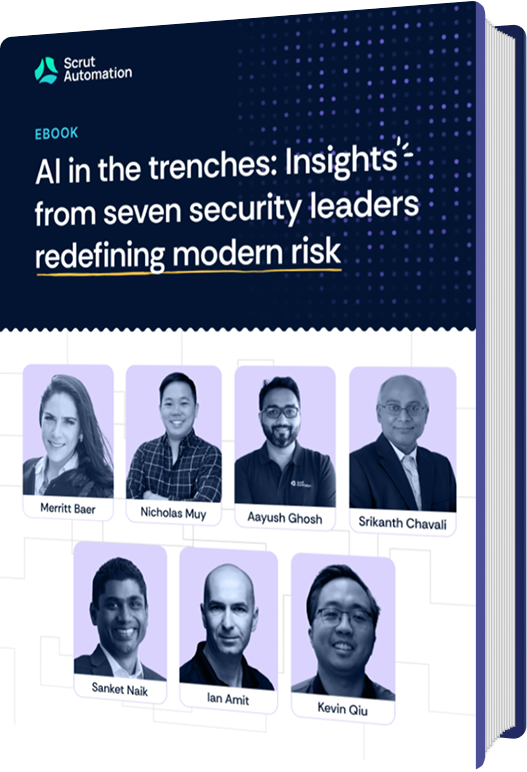
Aayush Ghosh Choudhury is Co-founder and CEO at Scrut Automation. After advising Fortune 500 clients on digital transformation at McKinsey & Company and co-founding a procurement SaaS startup, he set out to reinvent the way organizations manage risk. Aayush serves on the Forbes Technology Council, regularly speaks at industry events like SecuFest and Black Hat, and is a recognized thought leader in AI-driven GRC and security automation.
Nick Muy is CISO at Scrut Automation, where he leads cybersecurity efforts across compliance and AI risk management. With over a decade of experience in AI-powered threat modeling and enterprise security strategy, he has secured Fortune 500 environments and shaped national cyber policy at the U.S. Department of Homeland Security.
Merritt Baer is CISO at Reco and a former Deputy CISO at AWS, where she advised Fortune 100 companies and helped close $2 billion in cloud deals. She has held security roles in all three U.S. government branches and is a trusted advisor to AI and security startups. A Harvard Law graduate, she is a noted speaker, writer, and advocate for inclusion in cybersecurity.
Iftach Ian Amit is the Co-founder and CEO of Gomboc AI, and a 25-year cybersecurity veteran. He has led security at Amazon, Cimpress, Rapid7, and more and was a 2025 SC Awards “Security Person of the Year” finalist. Known for advancing cloud infrastructure defense, he also mentors the next generation through IANS, DEFCON, and BSides Las Vegas.
Sanket Naik is Founder and CEO at Palosade, an AI-driven platform helping enterprises automate security operations at scale. Previously SVP of Engineering at Coupa, he built its global cloud and cybersecurity org from the ground up through IPO. He’s held roles at HP and Qualys and advises early-stage startups.
Srikanth Chavali is Co-founder and CPO at Kitecyber, where he leads cybersecurity R&D to combat first-order threats. With deep expertise in network architecture and TCP/IP security, he has built a team of researchers solving real-world vulnerabilities at scale. He brings over a decade of experience driving innovation in enterprise cyber defense.
Kevin Qiu is a security practitioner with 10+ years of experience across industries. He has helped companies build category-defining trust centers to streamline security reviews. He advises several security startups and mentors professionals entering the field, drawing on his deep knowledge of cloud security, enterprise risk, and trust-led growth.
“The key lies in finding the middle ground: adopting AI responsibly, supported by strong guardrails and governance frameworks.”

AI is here to stay, not just as a trend but as a long-term shift in how we live and do business. It is no longer a question of whether AI should be used but rather how it should be implemented responsibly, securely, and effectively.
As AI systems integrate into developer tooling, automation stacks, and production workflows, new failure modes are surfacing: from prompt injection and context leakage to agent overreach and control bypass.
Governance must evolve to cover model lifecycle integrity, dependency scrutiny, and real-time inference monitoring. Without visibility into inputs, outputs, and downstream actions, AI systems execute unaudited decisions at scale. Safe adoption depends on treating outputs as untrusted by default, embedding containment, validation, and rollback directly into the pipelines AI is accelerating.
In this eBook, we bring together perspectives from seasoned security and technology leaders who are already executing AI responsibly. They share how AI when implemented thoughtfully, can transcend traditional business barriers, reduce risk, and unlock new revenue opportunities.
"AI doesn’t replace best practices; it demands them."

“Execution speed must be matched by assurance. Enterprises embracing AI should also invest in explainability infrastructure and continuous validation, especially when AI outputs touch production systems.”

AI heralds a foundational shift in how companies operate. The old boundaries between departments, roles, and responsibilities are dissolving, giving way to more fluid, cross-functional systems. According to McKinsey’s State of AI report, 78% of organizations have adopted some form of AI, a number that continues to rise. IDC projects global AI spending will reach $500 billion by 2027. In this rapidly evolving landscape, companies must move beyond experimentation toward execution, with governance and oversight built in. Decision velocity is no longer a luxury. It’s a competitive advantage.
As Ian Amit, Co-founder and CEO aptly notes, AI decisions aren’t just fast; they’re high-impact. And when those decisions touch customer experiences, financial operations, or security postures, trust and traceability become non-negotiable. They aren’t afterthoughts but prerequisites for innovation.
AI is also reshaping the foundations of enterprise strategy, forcing leaders to rethink what true differentiation looks like in an AI-native business.
Strategic planning evolves into real-time, data-driven decisioning powered by continuous feedback loops and probabilistic modeling. Talent acquisition prioritizes model literacy and AI integration skills. Value creation shifts from incremental efficiency to scalable innovation driven by AI-first architectures.

AI speeds up execution by automating tasks and reducing decision time from days to minutes.

AI improves how every team works, from Sales, HR, Marketing, Finance, IT, and Procurement.

AI equips leadership with foresight: identifying trends, simulating scenarios, and surfacing early signals.

Companies are embedding AI into core systems to create leaner and adaptive business models.

AI introduces new risks (bias, misuse, and gaps), making strong oversight and governance essential.

Product: User behavior insights driving rapid experimentation; generative tools assisting with UI/UX ideation.

Customer Support: Chatbots and virtual agents delivering 24/7 multilingual support; real-time escalation of high-priority issues.

Finance: AI-assisted forecasting, fraud detection, and automatic reconciliation of complex transactions.

Marketing: Personalized campaigns generated on demand; automated A/B testing; content scaled globally in minutes.

Sales: Lead qualification and prioritization done through predictive scoring; AI copilots drafting emails and scripts.

HR: Intelligent resume screening, sentiment analysis in exit interviews, and attrition risk models.
“AI isn’t just a new technology, it’s new enterprise DNA. Just as the internet enabled any business to be born global, AI turns every idea into instant execution. If it can be thought of, it can be done. That’s how Palosade was born, and we bring that same DNA to help organizations weave AI into their innovations and operating fabric without the fear or risk of malpractice.”

“The impulse with AI is to try and solve every hypothetical risk, which is impossible. A pragmatic approach is essential.”

MITRE’s “AI Trust Gap” notes that while AI can be transformative, it has the potential for misuse. In congressional testimony prepared by MITRE experts, they warn that adversaries are already weaponizing AI to “create polymorphic malware that evades traditional defenses,” underscoring that many existing detection tools simply aren’t built to keep up with code that mutates on the fly.
AI is supercharging cyberattacks. Threat actors are now leveraging generative models and automation to scale deception, precision, and volume:
Traditional cybersecurity defenses rely on static indicators and known attack signatures. In a world of AI-powered threats, these defenses are rapidly becoming obsolete.

Alters behavior mid-attack to evade static detection mechanisms.

AI tailors language and tone to the victim, making attacks harder to flag.

Use coordinated, distributed actions to slip past traditional defenses.
In analyses of encrypted command-and-control traffic (often used by AI-enhanced malware), behavior-based systems detected 82% of sessions, while signature-based tools saw only 18%.
Security teams can no longer rely on historical data alone. The new standard must be real-time, behavior-based detection and automated, context-aware responses.
The emergence of autonomous, self-directed threats marks a new era in cyber risk. We are no longer dealing solely with human-led attacks but with threats that think and act independently.
These AI threats can identify vulnerabilities, bypass controls, and exfiltrate data with minimal human coordination, introducing a new threat category: autonomous compromise.
“Within 24 hours of DeepSeek’s launch, one financial services firm already had 500 employees using it, despite strict AI policies. Shadow AI moves faster than most controls, and traditional tools can’t keep up with the speed of this adoption.”

As AI adoption accelerates across every business unit, governance struggles to keep up. Employees are turning to powerful AI tools, often freely available, without a formal security review or oversight.
According to Gartner’s 2025 Cybersecurity Innovations in AI Risk Management survey, 41% of employees were already using unauthorized “shadow AI” tools in 2022, and the company projects this will grow to 75% by 2027. These unvetted tools often introduce risks such as:
 Freemium LLMs used to process internal memos and confidential dataMarketing teams are adopting AI content platforms without compliance oversightDevelopers embedding AI APIs without validating licensing, data handling, or auditability
Even sanctioned platforms bring new risk vectors. A 2023 Cisco survey found that 60% of IT and security teams say they can’t see the specific prompts or requests made by employees using generative AI tools.
Common risks include:
AI systems degrade over time, a phenomenon known as model drift. This can be caused by shifts in user behavior, system data, or real-world context.
A multi-institution study (MIT, Harvard, University of Monterrey, and Cambridge) found that 91% of machine-learning models exhibit measurable performance decay if left in production without ongoing monitoring or retraining. Risks include:
Unchecked AI is not simply a performance risk; it’s a governance crisis. A well-intentioned LLM assistant can become a data exfiltration vector. A helpful third-party model can introduce biased outcomes or legal liability. Organizations must track AI use, vet vendors and models, implement monitoring tools, and ensure transparency and explainability across all AI initiatives.
“Unauthorized AI tools create new vectors for threats, with shadow AI usage typically exceeding officially sanctioned deployments by a factor of ten.”

"With AI governance becoming a major focus point for security teams, consider using AI itself to quickly identify usage of new AI tools in the design review process. Existing teams are typically understaffed and overworked. Take advantage of AI to more quickly identify potential risks in the design review process before it's too late."
Governance, Risk, and Compliance (GRC) functions were designed for systems that followed the rules. But AI learns, evolves, and sometimes behaves unpredictably. As enterprises race to adopt AI, they need a governance model that doesn’t just mitigate risk but anticipates it.
Legacy controls focus on access, logging, and manual oversight. But AI introduces a new layer of complexity, including non-deterministic behavior, opaque “black box” decision-making, and dynamic model updates that often occur without notice.
GRC leaders must now partner closely with data science, engineering, IT, and legal teams to build AI-specific oversight. This includes:
“The challenge for CISOs is to balance support for AI innovation with comprehensive risk management.”
Even the most advanced models can misfire when they lack context: things like business logic, human nuance, or operational intent that give meaning to complexity.
Real-world misfires make this clear:
In each case, the model wasn’t wrong; it just wasn’t grounded in the right context.
Pattern detection is not the same as understanding. For AI to make reliable decisions, it needs more than data; it needs environmental, procedural, and regulatory context.
This is where GRC becomes a strategic enabler. By embedding policy, ownership, and exception logic into AI systems, GRC leaders give AI the “ground truth” it needs to minimize false positives, reduce alert fatigue, and make smarter, safer decisions.

Identify use cases, assess risk levels, and document assumptions

Include red-teaming, model validation, and ethical reviews

Ensure transparency, access controls, and output logging

Monitor for drift, log usage, and respond to issues quickly
By integrating context, not just control, GRC enables smarter decision-making, faster detection of anomalies, and better alignment between AI systems and the humans they serve.
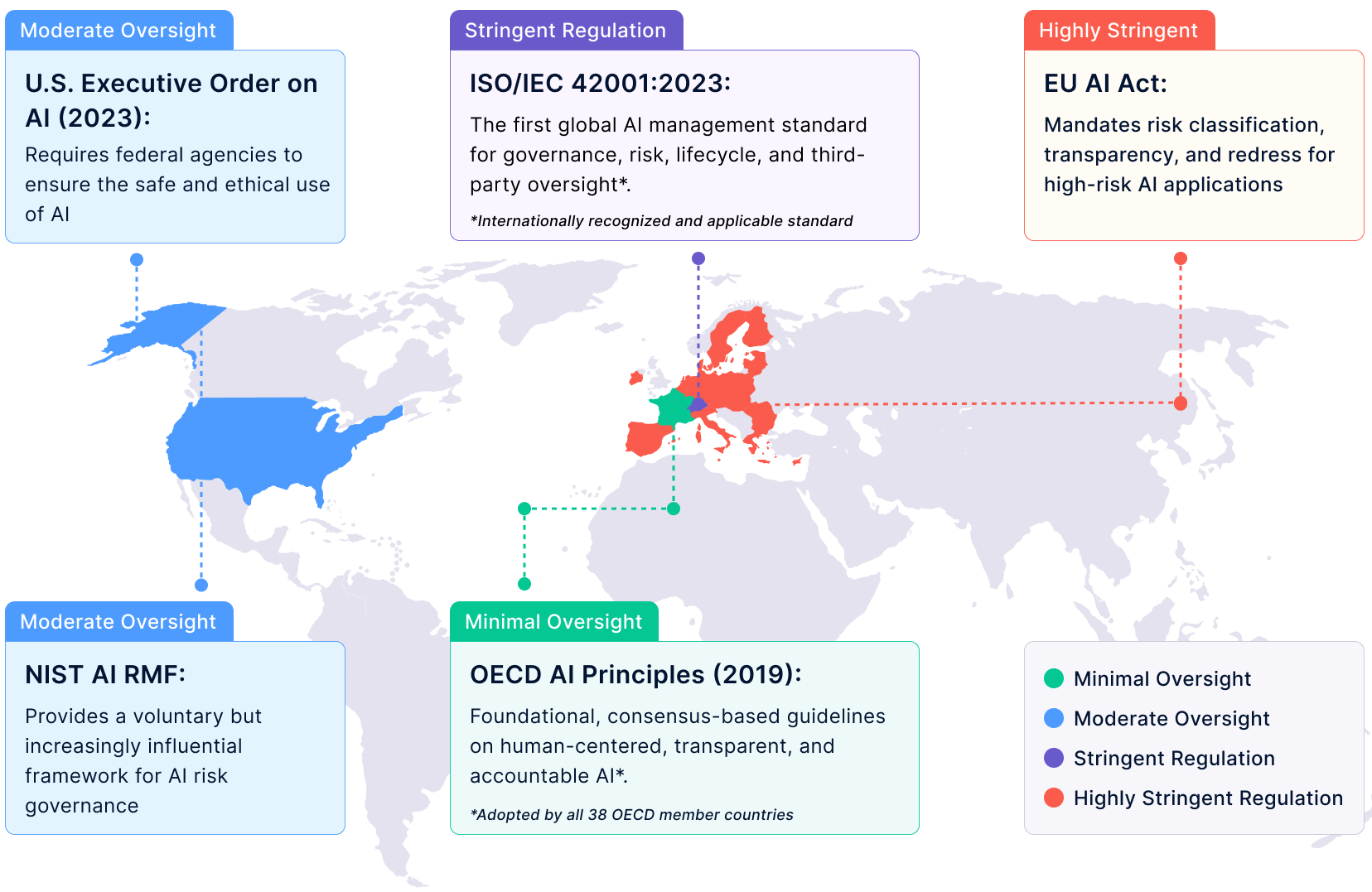
With AI systems touching sensitive data and decision-making workflows, embedding them into GRC frameworks is no longer optional. The global regulatory landscape around AI is evolving rapidly.
Meanwhile, industry-specific regulations like HIPAA, GDPR, and ISO 27001 are being interpreted to apply to AI systems, especially where data privacy, safety, or equity are impacted.
“AI is a brilliant assistant, but it still needs a boss. Without context, safeguards, and accountability, AI can shift from being an asset to a liability. The real power lies in the partnership: machines to scale, humans to steer. Palosade makes that collaboration seamless, governed, and safe, countering risks like non-determinism, hallucinations, and the absence of audit trails.”
Over-automation introduces risk. Over-supervision throttles impact. Everyone agrees that human judgment is essential. But if every action requires human approval, is AI adding value?
The future of cybersecurity and governance isn’t human or machine; it’s both. AI brings unmatched speed and scale; humans bring context, judgment, and accountability.
But getting that partnership right requires redefining roles, controls, and trust boundaries. To resolve this paradox, organizations need a structured way to evaluate what AI can handle independently and what must remain under human control.
“Organizations must develop comprehensive AI governance frameworks while simultaneously building internal capabilities for AI risk assessment and management.”
A practical framework to define boundaries between autonomy and oversight. This model is dynamic, as AI proves itself and as governance strengthens, tasks can migrate between tiers.

Tier 1:
Fully automated
Description:
AI handles low-risk, high-volume tasks with clear rules and minimal variation.
Example use case:
Spam filtering, anomaly alerts, automated log parsing in real time.

Tier 2:
Human-in-the-loop
Description:
AI suggests actions; humans review and approve before anything is executed.
Example use case:
Vendor triage, policy checks, access revokes, triage incident alerts.

Tier 3:
Human-led, AI-informed
Description:
Humans lead complex decisions with AI providing insights and risk context.
Example use case:
GRC audits, breach plans, legal review, AI model approval processes.
These safeguards allow companies to automate without abdicating accountability:
As AI assumes more operational responsibility, security and GRC teams must evolve, not only in tools but in mindset.
"AI agents offer hope: they can identify patterns, contextualize alerts, and streamline investigations, allowing humans to focus on what actually matters rather than chasing false positives."
Forward-looking organizations are retooling their org charts to reflect hybrid teams, blending analysts, ML engineers, GRC leaders, and business owners. In this hybrid model, AI becomes a collaborator, not a black box, not a silver bullet.
The next frontier is not just collaboration; it’s co-evolution. Security teams must grow alongside their AI counterparts, shaping and being shaped by each new generation of tools.
This means evolving from static controls and audit checklists to dynamic oversight, continuous discovery, and cross-functional collaboration. AI fluency, ethical reasoning, and contextual governance aren’t niche skills; they’re becoming core to the DNA of every forward-looking security organization.

Want to see how top CISOs are operationalizing trust in AI? Watch the full "From Black Box to Boardroom" webinar on-demand to learn how leaders from ClickHouse, Bright Security, and Scrut are tackling shadow AI, audit readiness, customer trust, and AI governance in real-world settings.
“As AI permeates every role and workflow, security and governance must do the opposite, converge. Buyers are now the frontline of trust, shifting from tactical acquisition to strategic enforcement. At Palosade, we help organizations embed security, oversight, and alignment at the point of adoption."
For over a decade, the rise of SaaS has empowered business units to buy the tools they want, often with little IT or security oversight. Marketing bought CRMs, sales bought analytics platforms, and HR adopted AI-based screening tools.
But with the rise of AI, that purchasing autonomy is being reined in. Security and compliance teams are reasserting control, not to slow innovation but to protect the enterprise.
Stage 1:
Centralized IT (Pre-cloud era)
All technology procurement flowed through IT. This ensured technical vetting but often slowed down business agility.
Stage 2:
Functional SaaS adoption (Cloud boom)
Business units gained the power to procure their own tools. This accelerated productivity but fragmented security and compliance.
Stage 3:
AI risk re-centralization (Now)
AI’s impact on privacy, risks, and decisions is driving CISOs to regain control. Centralized oversight is now extremely critical.
“The days of black-box AI tools being approved without scrutiny are over. Procurement now demands proof. How does it work? Who’s liable? Teams want model cards, audit logs, and clear proof of policy alignment.”
In fact, 78% of procurement leaders believe AI will disrupt the profession within just 3–5 years, underlining the urgent need for procurement functions to establish rigorous evaluation and governance processes for AI-powered solutions.
As buying patterns evolve, evaluation criteria are also changing. Security teams are now incorporating AI-specific checks into the vendor lifecycle, asking targeted questions such as:
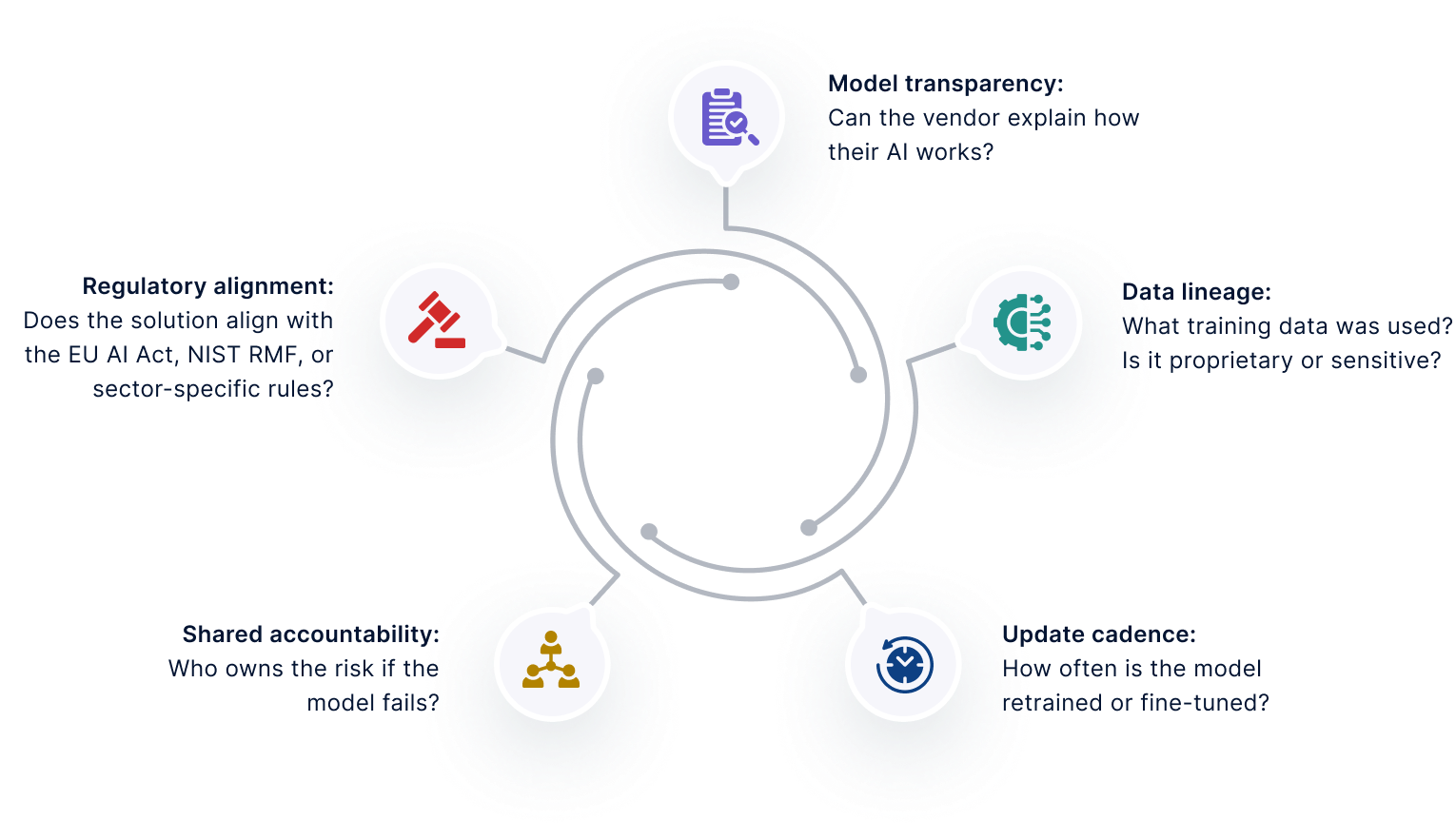
If AI is making decisions, security must shape the criteria by which those decisions and the tools behind them are evaluated. Leading organizations are formalizing this shift: rewriting procurement playbooks to include AI-specific risk assessments, demanding model documentation during RFPs, and requiring sign-off from both functional and security leaders.
“Apply the 80/20 rule: identify the 20% of AI use cases that carry 80% of the potential business risk, whether that’s protecting sensitive training data or ensuring a customer-facing model doesn’t create reputational damage. Focus your resources there first. Don’t let the pursuit of perfect security for every AI tool paralyze your ability to manage the risks that truly matter.”
To prepare for an AI-defined future, organizations must:
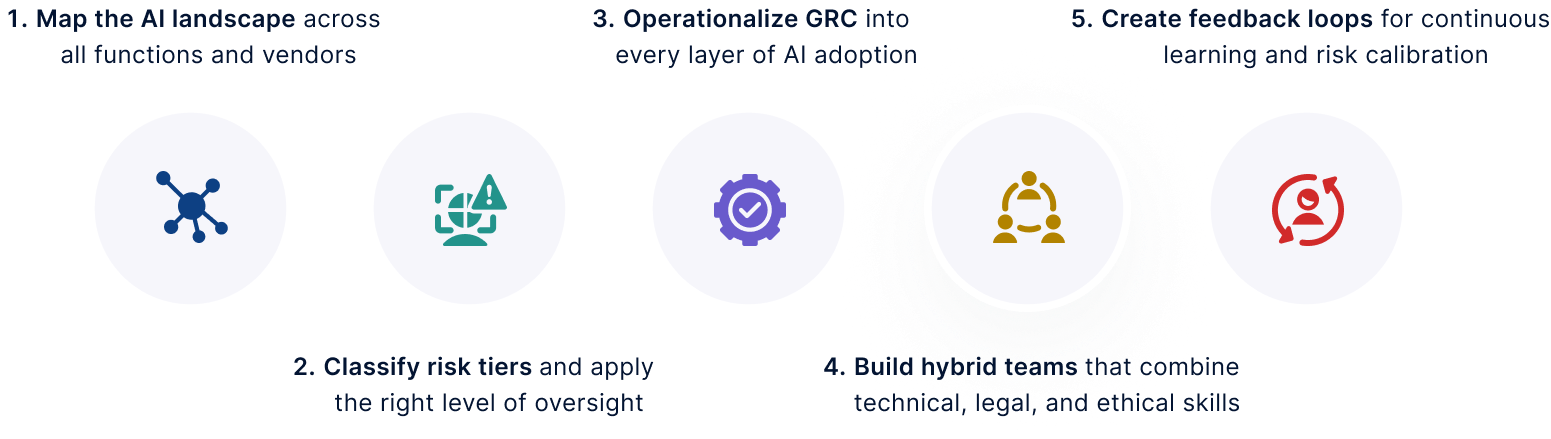
Every contributor to this ebook echoed the same truth in different ways. Visibility, accountability, and adaptability are now non-negotiable. AI doesn’t wait for annual audits or security sign-offs. It evolves in production, learns from live data, and makes decisions that affect everything from compliance to brand trust.
Whether you’re a CISO rethinking your procurement oversight, a GRC leader embedding explainability into policy, or an engineer balancing automation with accountability, the principles are the same.

With Scrut, your security program isn’t just about keeping pace; it’s about setting the pace. Embrace the new kind of GRC that fuels growth and resilience.