


%20(1).png)
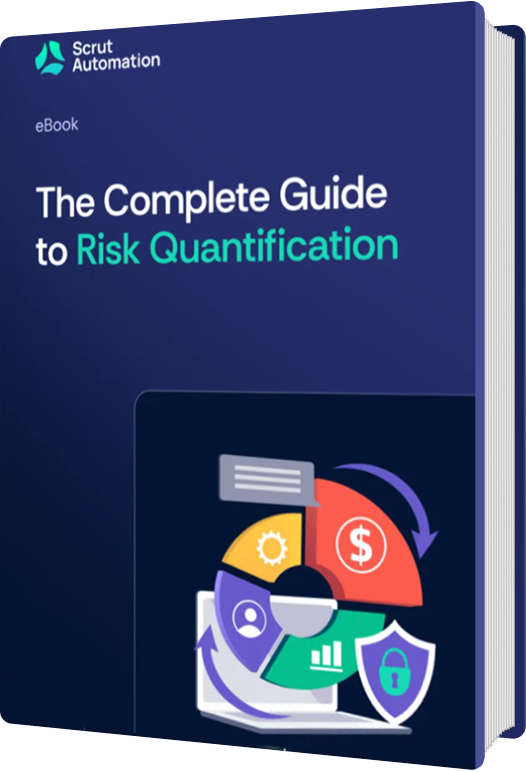
The complete guide to risk quantification
Turn cyber risk into numbers your business can act on
For security leaders, risk owners, and founders who know their top risks but can't defend a budget with a heatmap. Learn how to measure risk in financial terms using data you've already collected.

Description
Security teams speak in maturity scores and severity ratings. Boards speak in dollars. That gap is why security stays perceived as a cost center, why budgets get squeezed, and why the risks that matter most don't always get funded. The simple rule holds: you can't manage what you can't measure.
This ebook is a practical guide to closing that gap. It shows how to reuse the compliance data you've already collected for ISO 27001, PCI DSS, GDPR, HIPAA, or CCPA as risk quantification inputs, so you're not starting from scratch. It compares qualitative and quantitative assessment across cost, speed, and accuracy, walks through a step-by-step checklist from scoping to reporting, flags the nine mistakes that most often undermine quantification efforts, and covers how machine learning strengthens risk analysis. Two real-world scenarios, one enterprise and one SME, show what the outcomes look like in practice.
If your risk register ranks everything high, medium, or low and nobody acts on it, this one is for you.
Here are the insights you will walk away with

The compliance data from ISO 27001, PCI DSS, GDPR, HIPAA, and CCPA that doubles as risk quantification input, so you start halfway through instead of from zero.
A direct comparison across data basis, speed, cost, accuracy, and use cases, and why mature programs use both rather than picking a side.
Seven stages from defining objectives and scope through analysis, mitigation, monitoring, and reporting, built on industry best practices.
The common failure modes, from outdated data and incomplete hazard identification to ignoring systemic risk and treating risk impacts as isolated.
How ML strengthens risk assessment, prediction, and anomaly detection, plus two scenarios showing quantification at work in a large enterprise and a resource-constrained SME.


Get access to the ebook now
These are the questions this eBook will answer
Risk quantification is the process of measuring potential risks in concrete terms, typically financial impact, probability, and severity. In cybersecurity, it translates threats and vulnerabilities into the potential cost to the business, so leaders can compare risks directly, prioritize investments, and make informed mitigation decisions.
Qualitative assessment uses expert judgment and descriptive categories like high, medium, and low. It's fast and inexpensive but less precise. Quantitative assessment uses numerical data and statistical methods to measure risk objectively, which takes more time and data but produces financial figures the business can act on. Most programs need both.
Follow a structured sequence: define objectives and scope, identify risks, classify and prioritize them by impact and likelihood, analyze them with quantitative methods, develop mitigation strategies, monitor continuously, and document results for stakeholders. The ebook provides a full checklist for each stage, plus the compliance data sources to draw from.
Machine learning processes volumes of data no manual assessment can handle, identifying patterns that predict potential risks, detecting anomalies that signal fraud or breaches, and integrating diverse data sources into a single risk picture. It automates the repetitive analysis so risk teams can focus on decisions instead of data processing.
The most damaging ones: relying on outdated information, skipping proper planning, ignoring qualitative insights entirely, leaving out key stakeholders, and treating risks as isolated when they compound and cascade. The ebook covers nine in total, with guidance on avoiding each.