

%20(1).png)
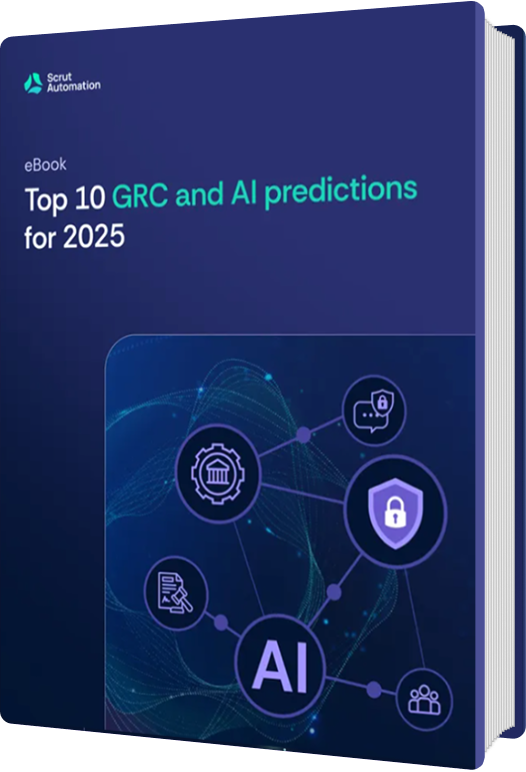
Top 10 GRC and AI predictions for 2025
Where AI regulation, audit standards, and risk practice are heading, and how to get ahead of all three
For compliance leaders, GRC professionals, and security teams who need to plan around AI regulation instead of reacting to it.

Description
AI moved from buzzword to infrastructure faster than most compliance programs could adapt. Gartner estimates that by 2028, 15% of daily work decisions will be made autonomously by AI, up from essentially zero today. The GRC platform market is projected to more than double from $49.2 billion in 2024 to $127.7 billion by 2033. The question isn't whether AI reshapes governance, risk, and compliance. It's which changes hit first and what to do about each one.
This ebook lays out ten specific predictions across the regulatory, professional, and technical landscape: ISO 42001's likely adoption as a harmonized standard under the EU AI Act, a tightening of SOC 2 audit standards, the spread of state and local AI governance laws, the rise of the dedicated AI governance professional, the EU AI Liability Directive, and the shift from qualitative to quantitative risk management, among others.
Each prediction comes with a practical response. Not "watch this space," but gap analyses to run, certifications to pursue, custody controls to build, and frameworks to adopt now, before the deadline pressure starts. The goal is a compliance program positioned ahead of the changes rather than scrambling behind them.
Here are the insights you will walk away with

The EU's harmonized standards under the AI Act won't arrive until enforcement is nearly upon firms, leaving little time to prepare. The ebook explains why ISO/IEC 42001:2023 is positioned to fill that gap, and lays out a five-step preparation path from gap analysis through expert validation.
A subset of audit firms turning into "report mills" has triggered a push for stricter AICPA oversight. The ebook details six expected changes to SOC 2, including AI control criteria, tighter data privacy alignment, more third-party risk emphasis, and a move toward continuous monitoring over point-in-time reviews.
With federal AI legislation unlikely, states and cities are filling the gap the same way data privacy law did: piecemeal. Colorado, New York, Texas, and California lead the charge. You'll get a five-part playbook for navigating multi-jurisdiction compliance without rebuilding your program for every new law.
Two workforce shifts are converging: AI governance is becoming a dedicated role with its own certification track (including the IAPP's AIGP), and GRC professionals are merging with security engineers. The ebook covers the skills, tools, and certifications that keep compliance careers competitive.
Qualitative heat maps are losing ground to methods like FAIR and Hubbard-Seiersen that express risk in dollars. The ebook walks through the six-step quantitative risk assessment process and explains why security teams under margin pressure need to describe their value in terms executives actually budget around.


Get access to the ebook now
These are the questions this eBook will answer
AI is transforming GRC from a periodic, manual discipline into a continuous, automated one. AI now drives compliance monitoring, risk quantification, and reporting, while simultaneously creating new obligations: AI systems themselves must be governed, audited, and aligned with emerging regulations. Gartner estimates 15% of daily work decisions will be made autonomously by AI by 2028, which makes AI oversight a core GRC responsibility rather than a side project.
ISO 42001 is not formally required under the EU AI Act, but it is widely expected to be adopted as a harmonized standard for demonstrating compliance. Because the EU's official harmonized standards are arriving close to full enforcement, aligning with ISO/IEC 42001:2023 now is the most practical way to prepare. Organizations that conduct gap analyses and build AI management systems against ISO 42001 will have far less to retrofit once the harmonized standards land.
Expected changes to SOC 2 include stricter auditor oversight from the AICPA, new criteria for evaluating AI controls, closer alignment with data privacy laws like GDPR and CCPA, updated cloud security guidelines, greater emphasis on third-party risk, and a shift toward continuous controls monitoring instead of periodic reviews. The driver is a crackdown on "report mills," audit firms issuing SOC 2 reports without meaningful scrutiny.
Companies with significant AI adoption increasingly do. AI governance responsibilities have historically been split across security, privacy, legal, and data science teams, but the role is consolidating into a dedicated position, supported by certifications like the IAPP's AI Governance Professional (AIGP). The AI governance market was estimated at $227.6 million in 2024 and is projected to grow at a 35.7% CAGR through 2030, reflecting how quickly the function is professionalizing.
Quantitative risk management uses numerical data and statistical methods to express risk in measurable terms, typically financial impact, rather than qualitative labels like high, medium, or low. Methodologies like FAIR (Factor Analysis of Information Risk) follow a six-step process: identify assets and risks, quantify impact, evaluate likelihood, calculate exposure, develop mitigation strategies, and monitor continuously. It's gaining ground because it lets security teams justify investments in terms executives can weigh against other spending.