

%20(1).png)


Every vendor in the GRC category talks about automation, AI, and faster audits. If you are evaluating platforms right now, you have heard some version of that pitch a dozen times, and you have no reliable way to tell which vendor is actually delivering on it.
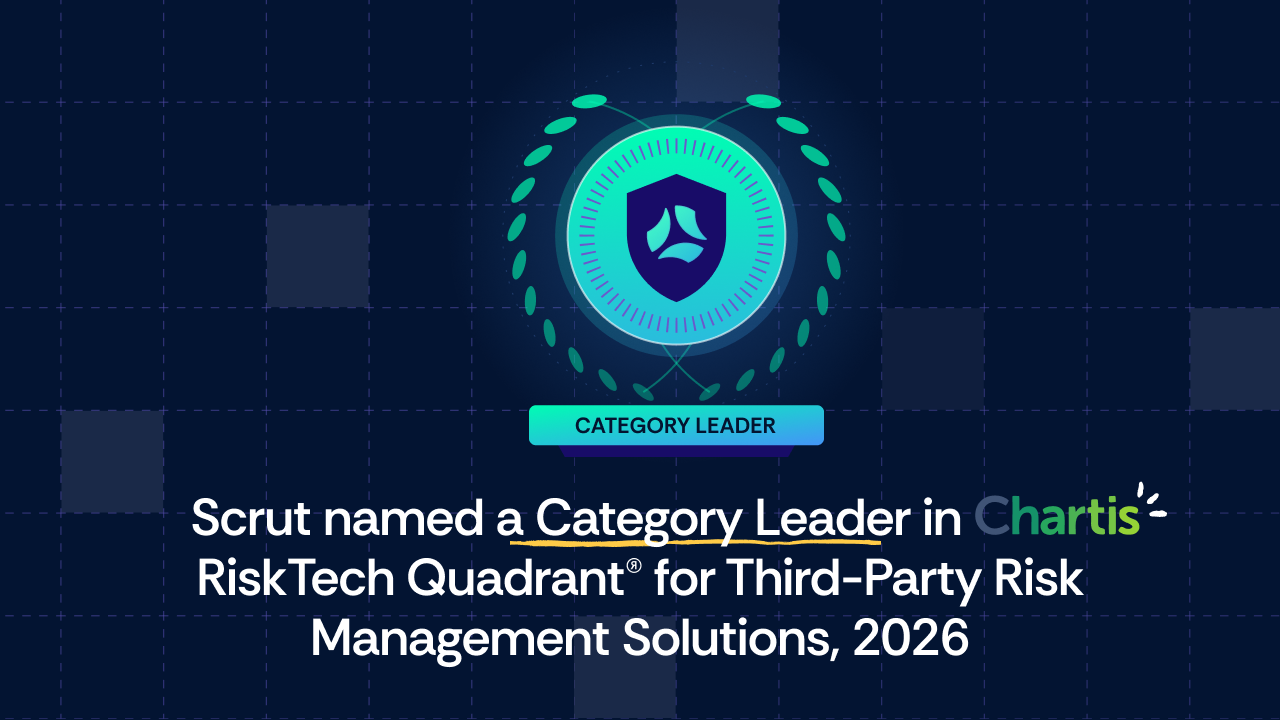
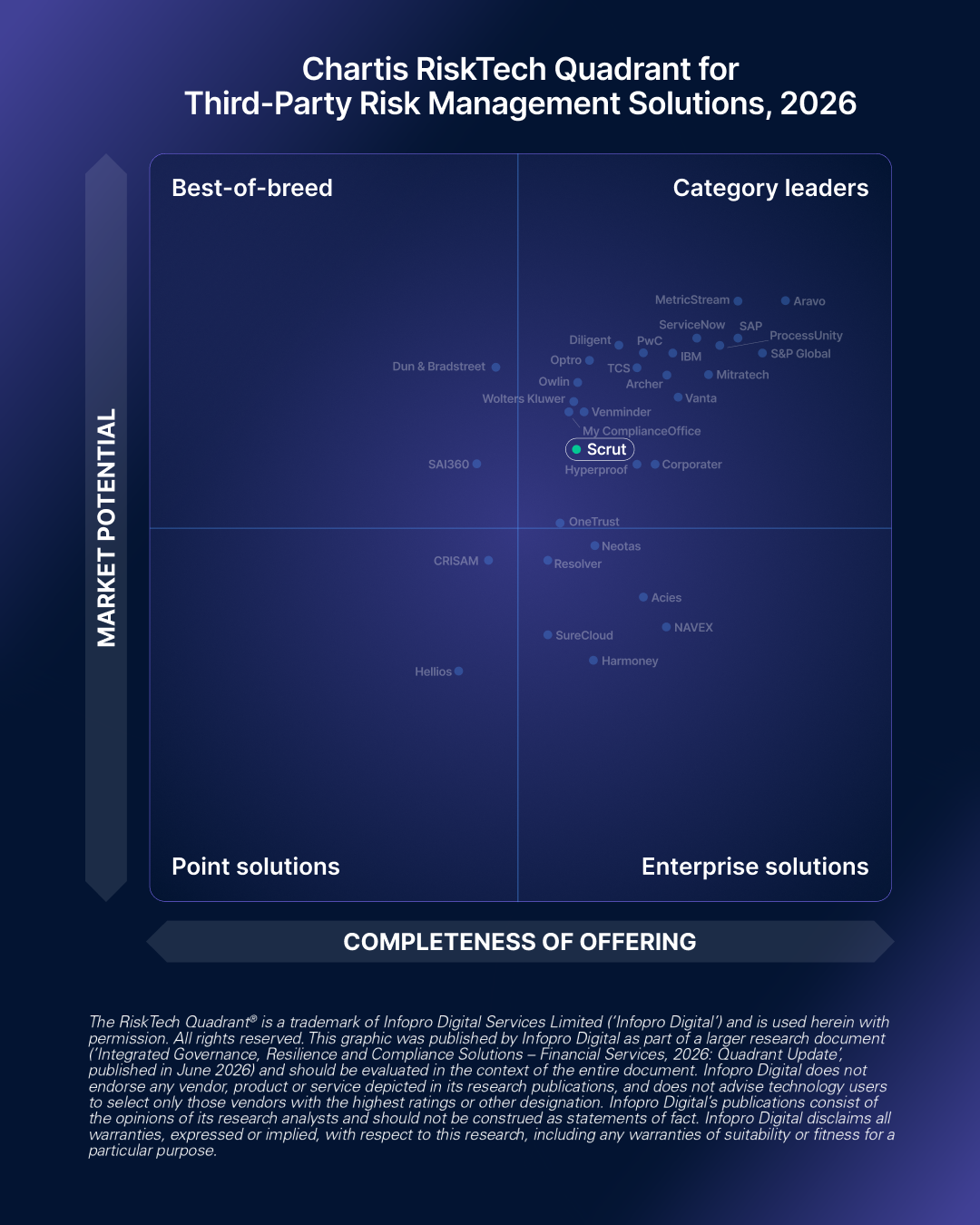
Independent analyst evaluation is one of the few ways to cut through that. Which is why we are glad to share this one: Scrut Automation has been named a Category Leader in the Chartis RiskTech Quadrant® for Third-Party Risk Management Solutions, 2026.
The quadrant appears within Chartis research into integrated governance, resilience, and compliance solutions, and Infopro Digital notes that the graphic should be evaluated in the context of the full document. The assessment evaluates providers on the completeness of their offerings and market potential, with consideration given to data integration, assessment and monitoring, process management and automation, and the interaction between human expertise and AI. Scrut is placed in the Category leaders quadrant, which reflects strength on both dimensions.
What a Category Leader placement means
The quadrant plots vendors on two axes: completeness of offering along the horizontal, market potential along the vertical. Category leaders are in the upper right, so the placement reflects an assessment of both together rather than either on its own. The adjacent quadrants separate them, which is what makes the position specific. A vendor can be assessed as having a complete offering without the corresponding market potential, or the reverse.
Be equally clear about what the designation is not. Chartis assessed the completeness of offering and market potential in third-party risk management solutions. Infopro Digital states that it does not endorse any vendor depicted in its research publications and does not advise technology users to select only those vendors with the highest ratings. The graphic above shows the entire field that was assessed.
So it belongs in an evaluation as one input, alongside your own testing, reference calls, and security review.
What the analyst actually said
The recognition focuses on third-party risk, but the capabilities highlighted by Chartis extend beyond assessment workflows.
Scrut connects vendor data, risks, controls, evidence, and remediation in one system, while Scrut Teammates helps teams identify what matters, recommend next steps, and move findings toward resolution.
Here is how Michael Versace, Research Director at Chartis, summarized Scrut:
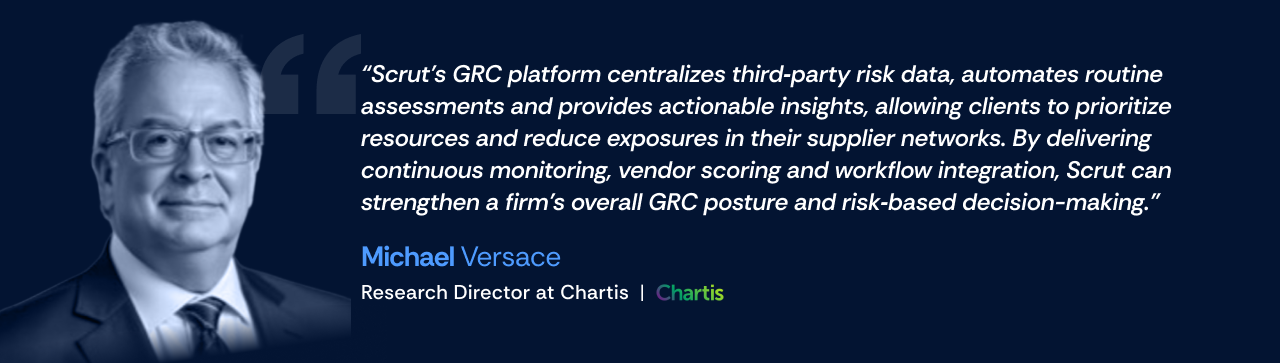
Two phrases there are worth pausing on. The first is "GRC platform." The second is "overall GRC posture." The assessment treats vendor risk not as a standalone tool but as one function of a platform that carries the wider program, which is exactly how the work lands on the teams doing it.
Actionable intelligence for GRC teams
GRC teams are expected to manage more vendors, frameworks, and evidence without adding equivalent headcount. Another dashboard is not enough. Teams need help understanding what matters, what to prioritize, and what action to take.
Scrut’s Unified Control Framework connects controls, risks, evidence, policies, and vendor data across more than 70 frameworks. Scrut Teammates builds on that context to identify gaps, summarize risks, recommend remediation, generate tasks, and track follow-through.
This is what makes the intelligence actionable: Scrut does not just surface risk data. It helps teams turn it into prioritized, accountable work.
Where the manual work actually goes
Every GRC team cannot add another analyst for every new vendor, framework, questionnaire, or evidence source. Basic automation can move work between steps, but Scrut Teammates helps perform the work within them.
It reviews information, identifies gaps, prioritizes findings, recommends actions, and supports follow-through across the areas where manual effort tends to accumulate most.
Vendor assessments. Inherent risk is assessed first, based on vendor usage, CAIQs, and your business context, and Scrut Teammates then generates a questionnaire tailored to that risk level, requesting only the information that matters. Teammates auto-fills responses, identifies risks from uploaded documents, and flags incomplete responses before submission. Vendors work through a dedicated portal with real-time progress updates and automated follow-ups. When risks surface, Teammates generates suggested mitigation tasks and tracks them to resolution. Scrut reports 70% faster vendor assessments, with more than 20,000 vendors assessed to date.
Inbound security questionnaires. The same problem in reverse, when your own deals are gated on answering them. Teammates auto-fills questionnaires from your answer library, Vault documents, and policies, works with CSV uploads, online portals, or editable PDFs, and maintains a searchable answer library so the work compounds instead of repeating.
Policy and evidence gaps. Reviewing policies and evidence for missing requirements and weak documentation, before an auditor finds them, rather than during fieldwork.
Remediation. Identifying which failed tests matter most based on audits, controls, and internal context, suggesting specific fixes, and generating tickets assigned through your existing task management tools.
Continuous monitoring. Vendors are identified automatically via SSO integrations with Google Workspace and Azure AD, or onboarded via a bulk CSV upload. AI-powered threat intelligence monitors online sources and surfaces active breach data and security threats. Dashboards track risk distribution, pending tasks, and compliance status in one place, so the program reflects the current state rather than the last review.
Chartis considered process management and automation among its criteria. The distinction that matters is between automation that starts work and automation that finishes it.
Intelligence embedded in the work
Chartis also considered the interaction between human expertise and AI, and that is the criterion worth reading closely. The question is not whether a platform has AI. It is whether you can explain what it did when someone asks.
Scrut Teammates is not a generic chatbot layered over compliance data. It works from the context already held across controls, risks, policies, evidence, vendors, and remediation activity.
It can identify gaps, validate evidence, support assessments, auto-fill questionnaires, recommend fixes, and generate follow-up tasks, while human owners retain control over decisions and approvals.
The differentiation is not simply that Scrut uses AI. It is that Teammates helps lean GRC teams move from fragmented information to prioritized, traceable execution.
Judge it against your own program
Every GRC vendor sounds the same on paper and claims it costs nothing to make. Independent assessment is one way past that, which is why this one is worth sharing. But the evaluation that decides your shortlist is your own.
To run it, explore the Scrut platform, or schedule a demo to see how Scrut handles your frameworks, your controls, and your evidence.


%201.png)


.png)