GRC ROI Guide: How to Turn Compliance into Revenue Growth
For all the founders, CFOs, and COOs: Learn how to defend spending to the board, and time your investment to unlock enterprise deals without burning runway.
Why cutting corners on GRC can lead to higher long-term costs
Most companies start taking GRC seriously after a customer asks about SOC 2. An enterprise deal stalls in procurement. An investor suggests it is time to formalize security.
Here’s what usually pans out: you look up platform pricing. You get a quote from an auditor. Maybe a pen test. It seems manageable. Then the real costs surface.
Engineering time gets diverted toward evidence collection and remediation, pulling focus away from product development. At the same time, sales cycles slow down as teams scramble to gather the right documentation.
What begins as a single framework often expands into multiple requirements, leading to unexpected scope creep. Renewals end up costing more than the first audit, and internal burnout builds quietly in the background, even though it was never part of the budget.
What first seemed like a manageable compliance investment soon becomes significantly more expensive over time as costs quietly accumulate over the next few years.
Not because any single vendor overcharged. But because of the operating cost of compliance, the internal hours, the compounding frameworks, and the redesign when the first approach does not scale, it never made it into the original model. And the worst part? No one gives you a clear picture of what it actually costs or what “good” ROI even looks like.
The goal is to help you answer one question: Is this the right amount to spend, at the right time, to unlock enterprise revenue without burning runway on the wrong approach?
This guide is built to help you answer that. We will be walking you through the best practices for making a financially sound compliance decision, defending it to your board, and avoiding the structural mistakes that force companies to pay for the same work twice.
Why GRC costs spiral beyond the platform quote
The sticker price of a GRC platform is rarely the final cost.
It is not even the majority of the cost. To manage a budget effectively, a CFO must look past the software invoice and account for the internal labor and compounding complexity that hits the P&L over a 36-month horizon.
The full GRC cost stack: What actually hits your P&L
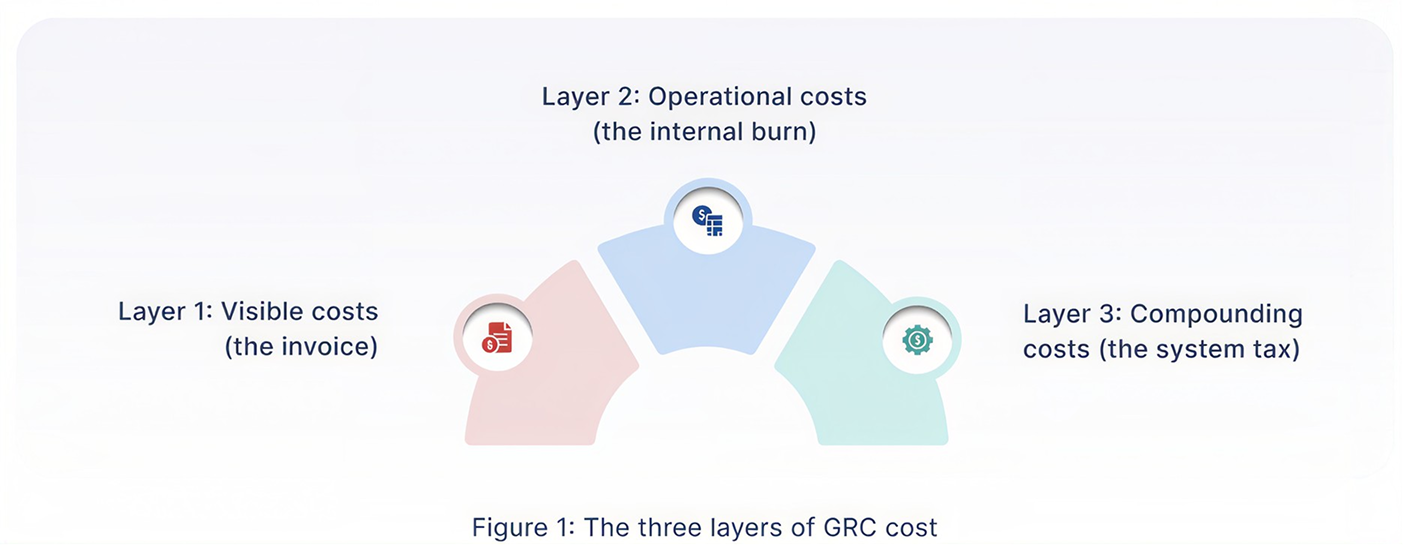
Figure 1: The three layers of GRC cost
Layer 1: Visible costs (the invoice)
These are the numbers that show up on a purchase order. They feel manageable because they are fixed, predictable, and invoice-based.
Most teams budget for GRC as they budget for software.
They look at the platform quote, auditor proposal, and then may add a penetration test.
That’s the visible layer.
GRC Platform Subscription
External Audit Fees
Penetration Testing
Optional Consultant Support
Figure 2: Examples of Visible costs
Layer 2: Operational costs (the internal burn)
This is where the real cost hides. It never appears on a GRC invoice, but it hits your P&L through absorbed engineering time, delayed product work, and leadership bandwidth.
Engineering and DevOps time: Implementing controls, writing policies, gathering evidence, and fixing security gaps uncovered mid-process. If a senior engineer earning $180-220K fully loaded spends 15-20% of their time for six months on compliance work, that is $14-22K in absorbed cost per person, plus the roadmap items that did not ship.
Leadership coordination: Someone, usually a founder, CTO, or VP of Engineering, has to manage the auditor relationship, coordinate internal owners, resolve ambiguities, and make scoping decisions. This rarely gets tracked as a compliance cost, but it is.
Sales cycle delays: While compliance is “in progress,” enterprise deals that require a SOC 2 report or ISO 27001 certification sit in limbo. The cost here is not internal labor; it is deferred revenue.
Layer 3: Compounding costs (the system tax)
Year one feels expensive because the costs are visible.
Over time, the real expense comes from the system continuing to run while complexity grows faster than most teams expect. What starts as a single framework rarely stays that way.
One certification leads to another, and each addition brings more than incremental effort.
Reworking controls that were not designed for reuse across frameworks
Duplicate audits that create repeated cycles of interviews, documentation, and disruption
Tool pricing that scales with headcount, scope, or usage
Ongoing governance overhead, including vendor reviews, risk assessments, and internal audits
Figure 3: Five ways GRC costs grow over time
Costs multiply for structural reasons. Controls get duplicated instead of reused. Audits stack instead of consolidating. Early architecture decisions often need rework as new frameworks are introduced, forcing teams to pay once to implement and again to restructure.
At this point, GRC is no longer a one-time project. It becomes infrastructure. When you approve GRC spend, you are not buying a certification. You are committing to an operating model, and operating models compound.
An initial decision that feels reasonable in the first year can quietly grow into a much larger long-term commitment if reuse and scale are not built into the original plan.
GRC operating models and their 24–36 month cost behavior
There is no universally correct way to build a GRC program. The decision is less about which tool to buy and more about operating design: who does the work, who owns the outcomes, and how the cost behaves (linearly or exponentially) as the company scales.
The five GRC operating models (24–36 month comparison)
Below is a simplified 2–3 year comparison between different operating models
Model
Costs (1–3 yrs)
Best for
Risks
Tool-only
Year 1: Lower external spend; higher internal effort Year 2–3: Costs rise with scope and redesign
Technical teams with strong security knowledge seeking control within a single framework
Engineering burnout and redesign exposure; rework can cost as much as starting over
Tool + Auditor
Year 1: Moderate, predictable certification cost Year 2–3: Ongoing audit fees; scope creep risk
Companies needing fast certification to unblock deals
Audit-driven overbuild; controls designed for audits, not reuse, creating rigidity as frameworks expand
Consultant-led
Year 1: High upfront cost Year 2–3: Recurring advisory cost; lower internal strain
Teams without compliance expertise that need speed without a learning curve
Dependency and knowledge exits once the consultant leaves
In-house GRC hire
Year 1: Salary + tools Year 2–3: Stabilizes as maturity improves
Companies with multi-framework needs and scale to support a dedicated role
Ramp time and key-person risk; productivity takes 3–6 months, and knowledge is concentrated
Hybrid (internal + external advisor)
Year 1: Moderate blended cost Year 2–3: Flexible and adaptable
Companies wanting internal ownership with expert input at key moments
Governance risk: unclear ownership can lead to inefficiency and combined costs without benefits
Figure 4: Five GRC operating models compared across a 24–36 month horizon
The lowest Year 1 cost model is rarely the lowest total cost model. The tool-only approach looks cheapest at kickoff. But if a second framework arrives within 18 months and the first implementation was not designed for reuse, the redesign cost can exceed what a hybrid model would have cost from the start.
Choose your model based on 36-month economics, not Year 1 invoices. If this is your first time getting compliant, talk to your peers to gain firsthand knowledge of what their experience is like. Over 24–36 months, the lowest year-one cost model is rarely the lowest total cost model.
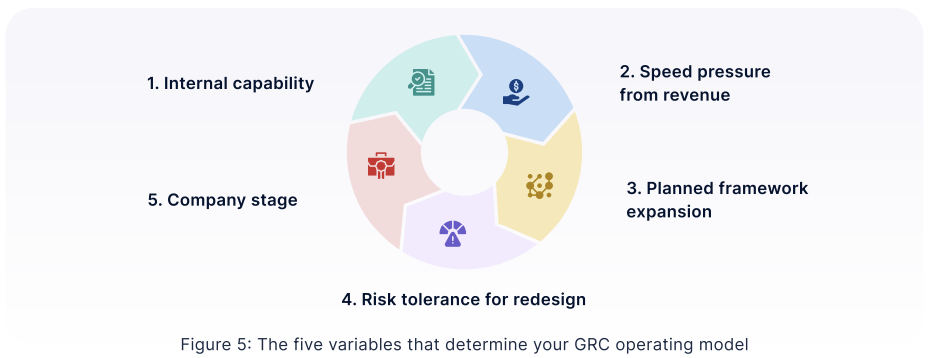
Figure 5: The five variables that determine your GRC operating model
The real decision of whether to invest in a GRC tool hinges on five variables.
Internal capability: If you don’t have strong security or compliance ownership internally, you’ll pay in confusion, rework, and engineering distraction. Capability determines whether cost shows up as invoices or internal burn.
Speed pressure from revenue: If enterprise deals are blocked, speed may matter more than efficiency. If there’s no immediate revenue pressure, you can optimize for long-term scalability instead of urgency.
Planned framework expansion: If additional frameworks are likely within 12–24 months, your first implementation must support control reuse. Designing only for one certification is how teams end up paying twice.
Risk tolerance for redesign: Some models are cheaper now but fragile later. The real question is whether you’re comfortable re-architecting your GRC program in two years.
Company stage: The right GRC investment at $2M in ARR is not the right investment at $20M in ARR.
The operational decisions that inflate GRC spend
Most GRC cost overruns are not caused by vendor pricing. They’re caused by operational friction. Understanding which levers actually control cost, and which are merely myths, is the difference between a lean program and a bloated one.
This chapter covers the six most common pricing myths that make them worse.
What actually drives GRC costs up
Most GRC cost overruns aren’t caused by pricing. They’re caused by operational decisions.
1. Over-scoping too early
Implementing controls designed for a $100M company when you’re at $5M ARR adds unnecessary complexity, documentation, and review cycles. This often happens when teams or consultants default to "best practice" control sets without calibrating to the company's actual risk profile and stage. The result is a compliance program that is more mature than the business needs, and more expensive than the business can sustain.
The fix: Define the minimum viable control set for your current stage. Build what you need now, and design the architecture to expand later without rebuilding. Maturity should track with revenue and risk exposure, not aspiration.
2. Manual evidence processes
If evidence collection depends on screenshots, spreadsheets, and Slack reminders, internal time cost explodes every audit cycle. This is one area where automation makes a measurable, defensible difference, such as the hours spent on evidence gathering, control monitoring, and audit preparation.
The fix: Automate evidence collection and continuous control monitoring early. The ROI on this specific investment is more concrete and trackable than most vendor claims about automation savings.
3. Poor tool integration
When your GRC platform does not connect to your cloud infrastructure, identity provider, HR system, or code repositories, every piece of evidence requires manual extraction and upload. Disconnected systems create duplicate work and reconciliation overhead — especially as headcount grows.
This is a hidden cost that does not appear until the program is running. A platform that looks affordable at purchase becomes expensive at operation if every audit cycle requires 40 hours of manual evidence assembly, which an integrated tool would handle automatically.
The fix: Evaluate integration depth during tool selection, not after purchase. Ask specifically: what connects natively, what requires custom work, and what requires manual intervention at every audit cycle.
4. Audit misalignment
Treating auditors as last-step validators instead of early alignment partners leads to rework, control redesign, and delayed reports.
The fix: Bring auditors into scoping conversations before implementation begins. We highly recommend doing an in-depth internal audit before you even step into an external audit. A one-hour alignment session early can prevent 50-100 hours of rework later. This is not about the auditor telling you what to do. It is about avoiding building controls that do not satisfy the standard you are being assessed against.
5. Framework sequencing mistakes
Stacking multiple certifications before the first stabilizes increases fatigue and redundancy. Each framework is individually manageable. Running SOC 2 and ISO 27001 in parallel while the team is still learning the first process multiplies internal strain and increases rework risk.
The cost of sequential timing (finishing one framework before starting the next) is almost always less than the rework cost of premature parallelization. The exception is when overlapping controls are intentionally mapped, and the team has sufficient bandwidth and experience, which is rarely the case during a company's first certification effort.
The fix: Stabilize one framework before layering another. Use the first framework to build the muscle, the tooling, and the institutional knowledge that makes the second one faster and cheaper.
6. Unclear ownership
When no one truly owns GRC, tasks spill across engineering, security, and operations, multiplying coordination costs.
None of these show up clearly in vendor pricing.
But over 24-36 months, they determine whether your GRC program stays contained or becomes an expanding operational tax.
The fix: Bring in accountable owners with defined authority. They do not have to do all the work. But they must own the outcomes, the architecture, and the coordination. Centralized ownership with distributed execution outperforms distributed responsibility without authority in every measurable way.
The only cost levers that actually work
You don’t control audit pricing as much as you think. You control design and timing decisions.
Tight scoping: Define the minimum viable control set for your current stage. Expanding scope early compounds documentation and maintenance overhead for years.
Framework sequencing: Stabilize one framework before layering another. Parallel certifications multiply internal strain and increase rework risk.
Control reuse by design: Architect controls to map across multiple frameworks from the start. Reuse reduces future implementation costs more than any subscription discount.
Time compression: Dragging implementation extends internal burn and delays revenue unlock. In some cases, spending more upfront to move faster reduces total cost.
Avoid premature optimization: Building enterprise-grade governance too early, or buying tooling designed for five frameworks when you need one, increases rigidity and future migration risk.
Clear ownership model: One accountable owner reduces coordination waste. Distributed responsibility without authority is expensive.
Vendor negotiation timing: Multi-year contracts and renewal leverage matter, especially as headcount-based pricing scales.
None of these eliminates cost. They reduce volatility and prevent compounding mistakes.
GRC pricing myths that get teams ripped off
GRC pricing rarely fails because it’s expensive. It fails because it’s incomplete.
“Automation saves 60%.”
Saves 60% of what? Automation reduces manual coordination. It does not eliminate audit fees, internal ownership, remediation work, or governance maintenance.
Subscription cost equals total cost.
It doesn’t. Implementation lift and ongoing internal hours often exceed the platform fee, especially in year one.
“One-stop shop” means lower total cost.
Bundling platform, auditor, and services simplifies procurement, but reduces price transparency and negotiation leverage.
“We’re cheaper than X.”
Sticker price comparisons are meaningless without modeling 24–36-month costs, headcount growth, framework expansion, and renewal terms.
Multi-framework add-ons are incremental.
They can materially change your pricing tier, especially at renewal.
Before committing to any GRC vendor, ask these 7 critical questions:
?What does this cost at 2x our current headcount?
?What internal hours does this assume?
?What does multi-framework expansion cost (per additional framework)?
?What changes at renewal, and what triggers a pricing tier change?
?What would migration look like in two years?
?What is included vs. what is billed separately (implementation, support, integrations)?
?Why does cheap upfront often cost more later?
When GRC becomes ROI-positive
GRC should be treated as a revenue-unlocking investment, not a sunk cost. By calculating breakeven logic against your enterprise deal flow, you can determine the exact moment compliance shifts from an expense to a growth accelerator.
Reliable evidence beats screenshots
GRC doesn’t generate ROI because it’s efficient. It generates ROI when it does, because it unlocks revenue. The question isn’t “Is certification valuable?” It’s: How much revenue is blocked without it and how soon?
Tool 1: The Breakeven Model
Start with breakeven logic. If your all-in GRC spend over 24–36 months is meaningful, how many enterprise deals does it take to cover that investment?
What’s your average enterprise ACV?
What’s your gross margin?
How many active deals are stalled on compliance today?
Example: SOC 2 breakeven for a growth-stage SaaS company
Deals needed to break even in Year 1: 2-3 net new enterprise wins
If one or two incremental enterprise wins cover the total cost, timing likely makes sense. If you need ten new enterprise customers to break even, and you don’t have that pipeline, you’re probably too early.
Tool 2: The Cost of Delay
Breakeven math works in both directions. If compliance unlocks revenue, then delaying compliance defers that revenue.
Example: What delay actually costs
Scenario: 3 enterprise prospects ($48K ACV each) are stalled on security review. You have not started SOC 2.
6-month delay cost: ~$56,000 in deferred gross profit from those three deals alone
Meanwhile, the GRC program you delayed would have cost: $85,000 over the same period.
The cost-of-delay calculation is the most powerful argument in any board presentation about GRC timing, because it reframes compliance from what it costs to what it costs not to have it.
Where ROI shows up
ROI tends to appear in three measurable ways:
Deals that were previously blocked now close.
Security review cycles shorten.
Contract scope expands after risk concerns are resolved.
But none of this is guaranteed.
Where ROI does not reliably appear
Not every company is at the stage where certification is a growth lever. If you sell primarily to SMBs, operate in unregulated sectors, or lack credible enterprise traction, compliance may not meaningfully drive revenue. Starting too late can stall growth. Starting too early can burn the runway without return.
GRC becomes ROI-positive when revenue pressure exists. Without that pressure, it’s infrastructure, not acceleration. The decision is about sequencing investment against opportunity.
Stage-based GRC economics
The right GRC investment at $2M ARR is not the right investment at $20M. Stage matters more than preference.
1
Early stage (Pre-enterprise motion)
If enterprise revenue is minimal and security questionnaires are rare, formal multi-framework programs are usually premature. Focus on foundational controls and not full certification infrastructure.
2
Growth stage (Enterprise pipeline emerging)
When enterprise deals represent a meaningful portion of the pipeline, structured certification becomes strategic. The goal here isn’t governance maturity, it’s revenue enablement with disciplined scope.
3
Enterprise-focused stage
When larger contracts, renewals, and procurement cycles depend on compliance, GRC shifts from a project to an infrastructure focus. At this stage, scalability and control reuse matter more than upfront savings.
4
International or regulated expansion
Entering new geographies or regulated verticals can quickly change the cost structure. Framework sequencing and architecture decisions made earlier now determine whether expansion is efficient or expensive.
Start now if:
You have an active enterprise pipeline where deals are stalled or slowed by compliance gaps.
Your average enterprise ACV is high enough that 2-4 deals cover the GRC investment.
You are entering a regulated vertical or geography that requires certification to do business.
Investors or board members have flagged compliance as a due diligence concern.
Phase deliberately if:
Enterprise revenue is emerging but not yet a primary motion.
You have some compliance foundations (policies, basic controls), but need to formalize.
Additional frameworks are likely within 12-18 months (design for reuse from the start, even if you certify one at a time).
Delay until revenue pressure exists if:
The enterprise pipeline is minimal, and no customers or prospects are requesting certifications.
The capital would be better deployed on product development or go-to-market.
You are at a pre-revenue or very early stage, with no enterprise motion on the roadmap.
The most expensive timing mistakes go in both directions. Starting too late stalls growth and forces rushed implementations that cost more. Starting too early burns runway on infrastructure that the business cannot use yet. The guidelines above help you determine which risk you are actually facing.
GRC economics are stage-dependent, and so should your operating model be.
How companies accidentally double their GRC spend
Expensive mistakes in GRC are rarely intentional; they result from design debt. This chapter explores common pitfalls, such as parallel framework stacking and unowned governance, that force companies to pay for the same work twice.
Worst-case scenarios: How companies double their spend
Most GRC overruns don’t come from bad intent. They come from avoidable design mistakes.
Scope creep expansion
What starts as one certification quietly expands into multiple frameworks before the first stabilizes. Internal workload doubles. External fees follow.
Audit failure and rework
Misaligned controls or rushed implementation can lead to audit findings that require remediation and repeat evidence cycles, extending both cost and timeline.
Tool lock-in and migration
Choosing a solution optimized for a single framework or short-term speed can force expensive migration when expansion becomes necessary. Paying twice is more common than teams admit.
Parallel framework stacking
Running multiple certifications simultaneously strains engineering and security teams, increasing burnout and error rates.
Unowned governance
When GRC responsibility is diffused across teams, coordination overhead multiplies, and no one optimizes long-term structure.
These failures do not appear in the initial pricing. They surface gradually over time, and by the time they become visible, fixing them requires expensive redesign. Avoiding worst-case scenarios is not about perfection, but about making deliberate, well-sequenced decisions from the start.
Organizational design: The hidden cost multiplier
Ownership clarity
Hiring timing
Execution model
Operating efficiency over time
Figure 6. Hidden cost drivers for GRC
This is where hidden costs stack up over time. While tools get budget attention, organizational design quietly determines how much you actually spend over 24–36 months.
Focus on four cost drivers:
1
Ownership clarity
When GRC ownership is fragmented across engineering, security, legal, and operations, coordination overhead increases. Meetings multiply, evidence requests repeat, and no one optimizes the system end to end.
2
Hiring timing
Hiring too early incurs fixed costs before revenue justifies them. Hiring too late shifts the burden to engineering, slowing roadmap velocity and increasing opportunity cost.
3
Execution model
Centralized ownership with clear accountability reduces rework and control sprawl. Distributed execution without ownership increases friction and duplication.
4
Operating efficiency over time
Over 24–36 months, org structure drives total cost more than tool pricing. What looks efficient in Year 1 can compound into ongoing overhead if ownership and workflows are unclear.
GRC isn’t just a compliance decision. It’s an operating model decision.
Balboa’s GRC processes were fragmented and manual. Policies were created manually, evidence was managed offline, and risk tracking lived in spreadsheets. Vendor data was scattered across teams, and audits relied on email and disconnected workflows, limiting visibility across controls, vendors, and risk.
After Scrut
Balboa moved to a centralized GRC architecture built on pre-mapped controls aligned to SOC 2, ISO 27001:2022, and GDPR. Vendor management was consolidated with structured due diligence, risk scoring was mapped directly to controls, and auditors were given direct access to artifacts and workflows. This created a single, unified view of control status, training, vendor risk, and audit readiness.
The takeaway
The shift improved operational maturity rather than just speeding up compliance. GRC processes became structured, visible, and repeatable, reducing coordination overhead and enabling the program to scale without added friction.
From there, the decision is straightforward:
Start now, but phase deliberately and redesign your operating model with intent. Waiting until revenue pressure builds often leads to reactive decisions and higher long-term costs.
GRC cost optimization is not about cutting spend. It is about avoiding expensive, irreversible mistakes that compound over time.
The investor angle
For companies approaching or preparing for a fundraise, GRC maturity increasingly appears in technical due diligence. Investors are not reading your SOC 2 report line by line.
They are assessing three things:
Whether your security posture will create friction in enterprise sales (which affects their revenue projections)
Whether your data handling practices expose liability that could affect valuation or deal terms
Whether your compliance infrastructure can scale with the business or will require a costly rebuild post-funding
A well-structured GRC investment, presented with clear cost logic and revenue rationale, signals operational maturity to investors.
A reactive, unplanned compliance scramble signals the opposite. If fundraising is on your 12-18 month horizon, factor that signal into your timing decision.
Applying the framework to your company
This guide intentionally compared multiple GRC operating models, including tool-led, consultant-led, in-house, and hybrid approaches. If you have read this far, you are probably in one of three positions:
You are about to start your first compliance program and want to make sure you are scoping, sequencing, and budgeting it correctly from the start.
You already have a program running and suspect you are overspending, overbuilding, or locked into an approach that will not scale to the next framework.
You need to present a GRC investment recommendation to your board and want the cost model and business case to hold up under scrutiny.
There isn’t a single “right” structure. There’s only the structure that fits your stage, revenue pressure, and expansion roadmap. If you’re currently evaluating how to design or restructure your GRC program, and want a second set of eyes on:
24–36 month total cost modeling
Framework sequencing
Tool vs. internal ownership tradeoffs
Redesign risk over time
Scrut works with growth-stage companies in all three situations. We will review your cost assumptions, model the tradeoffs against your specific stage and pipeline, and help you stress-test the plan against the frameworks in this casebook.
Choose risk-first compliance that’s always on, built for you.
Join our community and be the first to know about updates!
Thank you! Your submission has been received!
Oops! Something went wrong while submitting the form.
Choose risk-first compliancethat’s always on, built for you, and never in your way.
With Scrut, your security program isn’t just about keeping pace; it’s about setting the pace. Embrace the new kind of GRC that fuels growth and resilience.


%20(1).png)


%201.png)