


%20(1).png)


As global compliance architectures become increasingly complex and interconnected, the speed at which an organization completes an audit cycle has shifted from a back-end administrative task to a high-stakes indicator of institutional resilience. It has evolved into a key performance indicator (KPI) that reflects the maturity of the entire security organization.
According to Gartner, by 2026, 70% of boards will include at least one member with cybersecurity expertise, a shift that elevates compliance speed from a back-office task to a board-level metric. For a CISO or Head of Security, time-to-compliance is now a critical accountability metric because it directly impacts business velocity and executive confidence.
When compliance processes are slow and manual, they introduce significant operational drag, create friction with leadership, and leave the organization exposed to hidden risks for longer periods. A modern compliance automation solution changes this by replacing recurring manual tasks with continuous monitoring, keeping the organization audit-ready without the quarterly scramble that consumes engineering and security team capacity.
Board members are increasingly asking why compliance remains an annual struggle rather than a predictable, streamlined process. They want to know how confident the security leadership is heading into the next audit or incident.
A strategic, outcome-driven approach to compliance ensures that the organization is always audit-ready, turning a defensive requirement into a competitive advantage.
In this blog, we will discuss the top ten tips that you can implement to achieve faster time-to-compliance without compromising compliance ROI.
10 tips for achieving compliance efficiency and strategic growth
Implementing these strategies allows security leaders to move beyond the manual grind of traditional audits and focus on scalable security operations. By adopting these methods, you can significantly reduce time-to-compliance while ensuring that your security posture remains defensible and aligned with broader business objectives.
Tip 1: Prioritize frameworks/standards that minimize future audit drag
For a strategic leader, framework selection is a compounding decision that dictates the long-term trajectory of the security organization. Choosing a framework/standard based solely on an immediate customer request can often lead to long-term compliance debt if that framework/standard does not align with broader industry standards.
To optimize for a faster time-to-compliance, a CISO must evaluate how overlapping controls can reduce future audit scope and cost.
For example, prioritizing SOC 2 early on can significantly increase market reach in North America, while simultaneously checking off nearly 80% of the requirements for ISO 27001, which is often a prerequisite for international expansion. This strategic mapping allows an organization to reduce the cost of subsequent audits in a considerable manner by avoiding redundant testing.
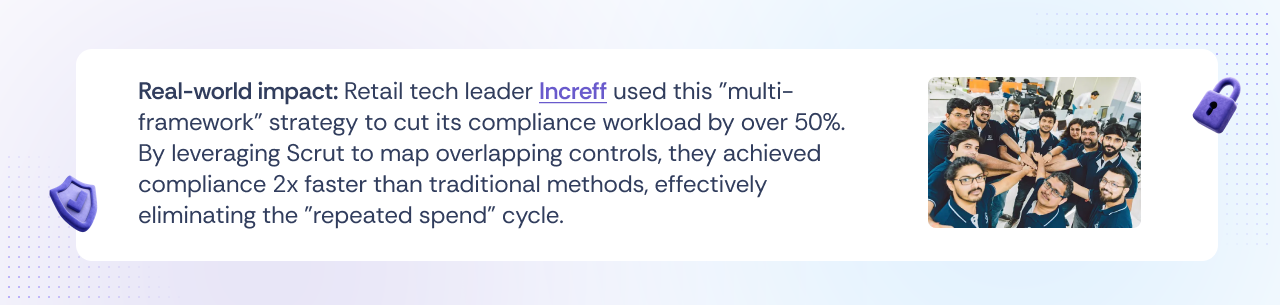
From a performance perspective, the key CISO KPIs for this strategy include a measurable reduction in net-new controls required for each additional framework/standard and a significant drop in audit preparation hours year over year.
What the CISO needs to know
- Framework/standard selection is a compounding decision
- Overlapping controls reduce future audit scope and cost
- Short-term wins can create long-term compliance debt
CISO KPIs and proof points
- Reduction in net-new controls per additional framework/standard
- Time saved when adding a second or third compliance scope
- Audit preparation hours year over year
Board questions this tip answers
- Are we setting ourselves up for repeated compliance spend?
- What happens when customers or regulators demand another framework/standard?
- Are our compliance investments cumulative, or do we restart from scratch every time a new requirement appears?
- When a customer or regulator asks for another framework, what is the real incremental cost and effort?
- Is our compliance program designed to scale with the business, or does each audit create new long-term drag?”
Tip 2: Apply a risk-first lens to accelerate the right controls
A common pitfall in achieving a faster time-to-compliance is treating every control requirement with the same level of urgency. This approach often leads to resource exhaustion and slows down the execution of the most critical security measures.
Focusing on a risk-weighted prioritization improves both speed and defensibility by identifying which assets and processes pose the highest risk to the organization.
This approach aligns with established risk management expectations. NIST guidance emphasizes assessing both likelihood and impact, prioritizing controls based on material risk, and explicitly documenting accepted risk rather than treating every requirement as equally urgent. In practice, this means CISOs are evaluated not on how many controls exist, but on whether the most consequential risks are identified, addressed, or consciously accepted with clear business rationale.
For instance, prioritizing the implementation of multi-factor authentication for administrative access to production databases is a high-risk control that should be accelerated. In contrast, perfecting the formal documentation for an office visitor log might be a lower-risk activity that can be managed later.
This alignment is increasingly expected at the executive level.

As a CISO, your primary accountability lies in how you manage accepted risk, not just the sheer number of implemented controls. Measuring the success of this approach involves tracking the ratio of high-risk controls closed versus total controls completed.
Improving the time to remediate critical findings demonstrates that the security organization is moving with purpose and enhancing its compliance ROI for CISOs.
What the CISO needs to know
- Treating all controls equally slows execution
- Risk-weighted prioritization improves speed and defensibility
- CISOs are accountable for accepted risk, not just implemented controls
CISO KPIs and proof points
- High-risk controls closed versus total controls completed
- Time to remediate critical findings
- Documented risk acceptance decisions
Board questions this tip answers
- Which risks are we consciously accepting, and why?
- What would an auditor or regulator flag first?
- Which risks are we explicitly accepting, and what is the business rationale behind those decisions?
- Are we prioritizing remediation where regulatory and audit scrutiny will be highest?
- If an auditor or regulator reviewed us tomorrow, where would they focus first, and are those areas already addressed?
Tip 3: Standardize controls to strengthen audit and incident narratives
Inconsistent control implementation often leads to fragmented explanations when an organization is under external scrutiny. To ensure a faster time-to-compliance, it is vital to standardize how controls are applied across different business units and technical stacks.
When every team follows a uniform set of procedures, the narrative provided to an auditor or a regulator becomes significantly clearer and credible.
Defensibility in a high-stakes environment depends on this consistency rather than the sheer volume of security measures in place. By monitoring the percentage of standardized versus custom controls, a CISO can gauge the structural maturity of the compliance program.
One of the primary indicators of success is a measurable reduction in auditor follow-up questions, which indicates that the evidence speaks for itself.
This level of audit readiness ensures that different teams are not telling conflicting stories during an assessment.
What the CISO needs to know
- Inconsistent controls weaken explanations under scrutiny
- Standardization improves narrative clarity across audits and incidents
- Defensibility depends on consistency, not volume
CISO KPIs and proof points
- Percentage of standardized versus custom controls
- Reduction in auditor follow-up questions
- Consistency of evidence across teams and systems
Board questions this tip answers
- Can we clearly explain our security posture under pressure?
- Would different teams tell the same story to an auditor?
- If our security posture were challenged under time pressure, could we explain it clearly and consistently?
- How predictable are our audit outcomes, regardless of which teams or systems are reviewed?
- Do smoother audits reflect repeatable controls, or individual effort each time?
Tip 4: automate evidence to eliminate audit-time uncertainty
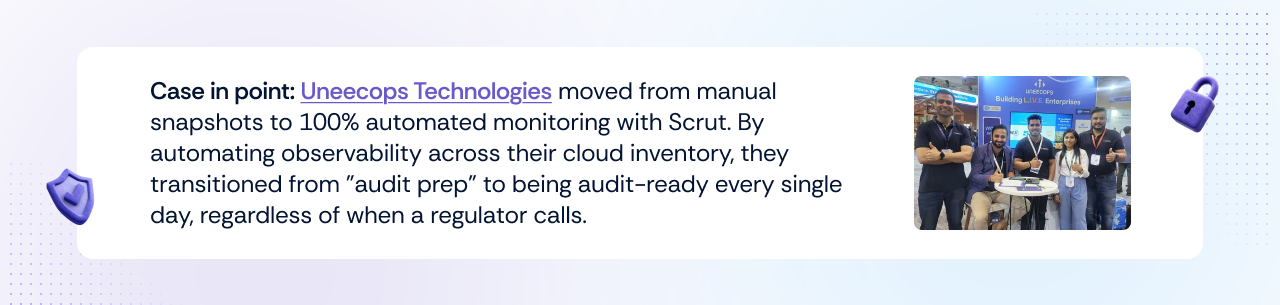
Manual evidence collection introduces a significant timing risk that ultimately falls on the shoulders of the CISO. When an organization relies on human intervention to pull logs or take screenshots, the validity of that data is often limited to a single point in time.

This transition is essential for achieving a faster time-to-compliance, as it ensures that evidence is gathered continuously rather than during a frantic pre-audit scramble. In the eyes of a modern auditor, evidence freshness matters as much as the existence of the evidence itself.
Industry guidance from the Cloud Security Alliance reinforces this expectation, emphasizing continuous controls monitoring as a way to ensure evidence reflects how controls operate in practice, not just how they appeared at a single audit checkpoint.
The success of this strategy is measured by the percentage of evidence collected automatically and the average age of that evidence at the start of an audit. Reducing the lead time required for audit preparation is a tangible way to demonstrate a higher compliance ROI for CISOs.
What the CISO needs to know
- Manual evidence introduces timing risk that the CISO owns
- Automation shifts compliance from reactive to provable
- Evidence freshness matters as much as evidence existence
CISO KPIs and proof points
- Percentage of evidence collected automatically
- Evidence age at audit start
- Reduction in audit prep lead time
Board questions this tip answers
- How confident are we that our controls actually operate today?
- What breaks if the audit date moves forward?
- What real-time evidence do we have that our controls are operating correctly today, not just at the last checkpoint?
- If an audit or customer review were pulled forward, which controls would fail first due to stale or point-in-time evidence?
- How much of our audit readiness depends on manual intervention versus continuously collected proof?
Tip 5: Move from policy ownership to policy execution
Many organizations treat security policies as static documents that exist only to satisfy a checklist, but in a mature security organization, policies are tested against reality rather than intent.
Practitioner guidance from the SANS Institute reflects that policies commonly fail when they are not enforced in practice, noting that lack of enforcement, missing updates, and absent audits undermine a policy’s effectiveness in real environments.
The primary CISO KPIs for this transition include the policy-to-control alignment rate and a reduction in policy-related audit findings. By utilizing the Scrut platform to map high-level policies directly to technical controls, you can ensure that your documentation reflects how the business actually operates.
This alignment reduces the time spent clarifying policy intent during audits and prevents significant credibility loss.
What the CISO needs to know
- Policies are tested against reality, not intent
- Execution gaps are common audit failure points (Thoropass)
- Alignment reduces rework and credibility loss
CISO KPIs and proof points
- Policy-to-control alignment rate
- Number of policy-related audit findings
- Time spent clarifying policy intent during audits
Board questions this tip answers
- Do our policies reflect how the business actually operates?
- Are we exposed because documentation and reality diverge?
- Where do our written policies diverge from how systems and teams actually operate today?
- If an auditor tested execution instead of intent, which policies would fail first?
- Do we have evidence that policies are enforced in practice, not just approved on paper?
Tip 6: Replace audit readiness cycles with continuous readiness
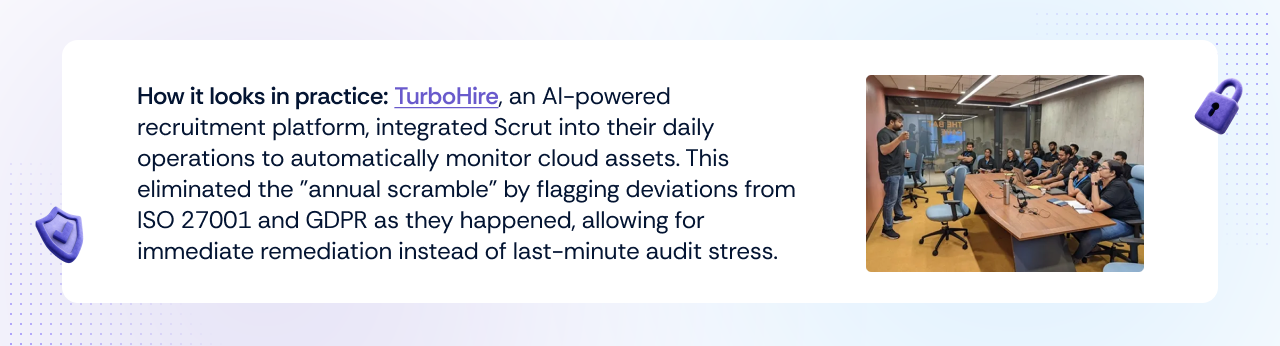
Operating in a cycle of periodic audit readiness signals a fragile security posture that often creates unnecessary stress within an organization. To achieve a sustainable and faster time-to-compliance, a CISO must shift the focus toward a state where security controls are monitored every day of the year.
This expectation reflects how modern audits and regulatory reviews assess security posture, focusing on whether controls operate consistently over time, not whether they were manually validated at a single point during an audit cycle.
This transition involves integrating compliance into the DevSecOps pipeline, ensuring that security checks are not an afterthought but a continuous part of the development and deployment lifecycle.
Such a model stabilizes both technical execution and executive expectations, ensuring that compliance is a byproduct of good security rather than an annual project. Predictability in this area is a significant driver of compliance ROI for CISOs, as it eliminates the massive spikes in resource allocation typically required during an audit window.
Utilizing the continuous monitoring capabilities of Scrut Automation allows for the real-time tracking of thousands of controls across your cloud infrastructure and CI/CD pipelines, which significantly reduces the need for last-minute remediation.
What the CISO needs to know
- Audit-mode compliance signals fragility
- Continuous readiness stabilizes execution and expectations
- Predictability reduces leadership anxiety
- Integration into DevSecOps ensures that compliance scales with code deployment
CISO KPIs and proof points
- Time to audit readiness at any point in the year
- Number of controls continuously monitored across the SDLC
- Reduction in last-minute remediation
Board questions this tip answers
- Are we always audit-ready, or just temporarily compliant?
- What would an audit tomorrow reveal?
- If an audit started tomorrow, what would it realistically uncover?
- Are we consistently audit-ready, or does our readiness depend on timing and preparation cycles?
- How quickly would we detect and respond to compliance drift as systems and regulations change?
Tip 7: Distribute compliance ownership without losing CISO oversight
A centralized approach where the security team manages every single control creates a bottleneck that significantly delays your time-to-compliance. To achieve true compliance scalability, a CISO must distribute ownership across the organization, making engineering, HR, and IT teams responsible for the controls within their respective domains.
However, distributed ownership only improves speed if visibility remains intact. By moving away from control hoarding and toward a model of decentralized accountability, you empower individual departments to maintain their own audit readiness while you maintain strategic oversight.
Success in this model is measured by tracking evidence ownership by function and monitoring service level agreement (SLA) adherence for evidence submission. Utilizing Scrut Automation allows you to assign specific tasks to department heads while tracking progress through a single pane of glass.
This visibility ensures that you can identify and resolve compliance bottlenecks before they impact a framework/standard certification.
What the CISO needs to know
- Centralized compliance slows execution
- Distributed ownership improves speed if visibility remains intact
- Oversight matters more than control hoarding
CISO KPIs and proof points
- Evidence ownership by function or role
- SLA adherence for evidence submission
- Reduction in compliance bottlenecks
Board questions this tip answers
- Who is accountable when a control fails?
- Is compliance dependent on a few individuals?
- If a key person left tomorrow, which compliance activities would stall or fail?
- When a control breaks, is accountability clearly assigned or informally assumed?
- Do we have visibility into compliance ownership across teams, or are we relying on a few individuals to hold everything together?
Tip 8: Reduce compliance tool sprawl to reclaim security bandwidth
Managing a fragmented security stack creates significant integration debt and operational blind spots that ultimately hinder a faster time-to-compliance. When compliance data is scattered across multiple point solutions, the CISO inherits the burden of complexity, leading to weakened reporting and slower audit cycles.
Consolidation is not merely a cost-saving measure but a strategic necessity to reclaim security bandwidth. By centralizing GRC activities into a unified platform like Scrut Automation, you eliminate the friction caused by siloed data and ensure that your security narrative remains cohesive across every framework/standard you pursue.
Tracking the number of tools involved in compliance workflows and the frequency of manual handoffs between systems provides a clear view of your operational efficiency. A reduction in the time spent reconciling data across various tools is a direct indicator of a higher compliance ROI for CISOs.
What the CISO needs to know
- Tool sprawl creates integration debt and blind spots
- Fragmentation weakens reporting and slows audits
- CISOs inherit the complexity cost first
CISO KPIs and proof points
- Number of tools involved in compliance workflows
- Manual handoffs between systems
- Time spent reconciling data across tools
Board questions this tip answers
- Why does compliance still feel complex despite our tooling?
- Are we paying twice for the same outcome?
- Why does compliance still feel complex despite the tools we’ve invested in?
- Where are we duplicating effort or paying twice to achieve the same compliance outcome?
- Is our compliance tooling reducing long-term audit effort, or just adding more systems to manage?
Tip 9: Track compliance progress in a way boards and customers trust
Relying on binary checklists to report on security posture often fails to survive executive scrutiny because it lacks the context of actual risk reduction. For a CISO, achieving a faster time-to-compliance requires a shift toward milestone-based visibility that both the board and external stakeholders can trust.
External partners and customers value the clarity of a mature security roadmap over a high volume of unorganized data points. By presenting progress through meaningful stages, such as control implementation, evidence verification, and internal audit completion, you build institutional confidence and demonstrate a higher compliance ROI for CISOs.
This expectation for clarity is increasingly tied to how security leaders participate in strategic conversations.
A critical tool for this transparency is the Scrut Trust Vault, which allows you to proactively share your security posture with prospects and partners. Instead of dealing with the friction of manual data requests, the Trust Vault provides a centralized, real-time portal where stakeholders can access certifications and security documents.

This capability significantly improves your audit readiness by streamlining external validation and reducing the turnaround time for customer security questionnaires. The success of this reporting style is measured by milestone completion rates rather than just checklist totals.
What the CISO needs to know
- Binary checklists fail executive scrutiny
- Milestone-based visibility improves trust
- External stakeholders value clarity over volume
CISO KPIs and proof points
- Milestone completion versus checklist completion
- Customer security questionnaire turnaround time
- Audit progress predictability
Board questions this tip answers
- How close are we, really?
- Can customers and partners trust our posture?
- How close are we, in concrete terms, to achieving this certification?
- What evidence supports our current compliance status, beyond high-level progress updates?
- Can customers and partners independently verify our security posture without additional back-and-forth?
Tip 10: Invest in platforms built for long-term CISO accountability
The final step in a mature security strategy is recognizing that point solutions often optimize for a single audit rather than long-term accountability. As an organization scales, the scrutiny from regulators and enterprise customers increases, and the tolerance for manual errors or visibility gaps disappears.
To achieve a faster time-to-compliance over the long haul, a CISO must invest in a platform designed to reduce risk exposure systematically over time. Platforms like Scrut Automation support this by enabling control reuse across various requirements, ensuring that the work done today simplifies the obligations of tomorrow.
By centralizing core functions such as continuous monitoring and executive-grade visibility, Scrut transforms compliance from a series of disjointed projects into a sustainable business function. The primary indicators of success for this tip are a decreasing time-to-compliance across multiple frameworks/standards and a clear reduction in the dependence on expensive external consultants.
Monitoring long-term audit cost trends will reveal a more efficient and predictable expenditure model.
What the CISO needs to know
- Point solutions optimize audits, not accountability
- Scale increases scrutiny, not tolerance
- Platforms should reduce risk exposure over time
CISO KPIs and proof points
- Time-to-compliance across multiple frameworks
- Reduction in external consultant dependence
- Long-term audit cost trends
Board questions this tip answers
- Will this still work as we grow?
- Are we building a sustainable compliance program?
- Will this compliance program still hold up as the business grows and requirements increase?
- Are we investing in long-term capability, or just solving for the next audit?
- How resilient is our compliance foundation if scrutiny intensifies from regulators or enterprise customers?
Ready to reduce time-to-compliance without adding complexity?
See how Scrut helps CISOs move faster, stay continuously audit-ready, and demonstrate ROI with confidence.
Time-to-compliance is measured from the moment a framework scope is approved to the point of audit readiness, not certificate issuance. Mature CISOs track milestones such as control implementation, evidence readiness, and risk closure, rather than waiting for audit outcomes.
When done correctly, faster compliance improves security. Speed comes from control reuse, automation, and risk prioritization, not shortcuts. Programs that rely on last-minute fixes may pass audits, but they weaken security and fail under scrutiny.
The most common delays come from manual evidence collection, inconsistent controls across teams, unclear ownership, and tool sprawl. These issues compound over time and usually surface during audits or customer reviews.
Automation reduces recurring audit effort, lowers reliance on external consultants, and improves predictability. Over time, this translates into fewer audit surprises, lower operational drag on security teams, and clearer reporting to leadership.
Yes. Continuous compliance is less about company size and more about operating model. Organizations that automate evidence, standardize controls, and monitor continuously often achieve better readiness with fewer resources than those relying on periodic audit cycles.


%201.png)




.png)