


%20(1).png)


The traditional compliance lifecycle often mirrors a seasonal sprint where teams scramble to gather artifacts just weeks before an auditor arrives. However, this reactionary posture creates a significant hidden tax on organizational resources.
According to the Thomson Reuters Institute 2025 C-Suite Survey, 77% of global leaders now view compliance as a strategic enabler that contributes to overall business objectives, moving away from the view of it being a mere bureaucratic hurdle.
For the modern CISO, the true return on investment is not found in the acquisition of a certificate but in the compounding value of continuous monitoring. The real trade-off involves balancing sustained visibility against the operational drag of manual evidence collection.
“Security is a trade-off. This is something I have written about extensively, and is a notion critical to understanding the psychology of security. There’s no such thing as absolute security, and any gain in security always involves some sort of trade-off.”
Bruce Schneier in his essay “The psychology of security”
While leaders agree that manual processes consume a significant portion of a team's bandwidth on administrative tasks, a dedicated compliance automation platform like Scrut Automation reduces manual effort by 70%, allowing for a decisive shift toward a long-term operating model where continuous monitoring replaces the costly peak-and-trough compliance cycle.
By treating compliance standards as a baseline for continuous control of health rather than a point-in-time event, organizations can reduce the cost of non-compliance, which is estimated to be nearly three times higher than the cost of maintaining steady adherence.
5 ways CISOs measure ROI from continuous monitoring
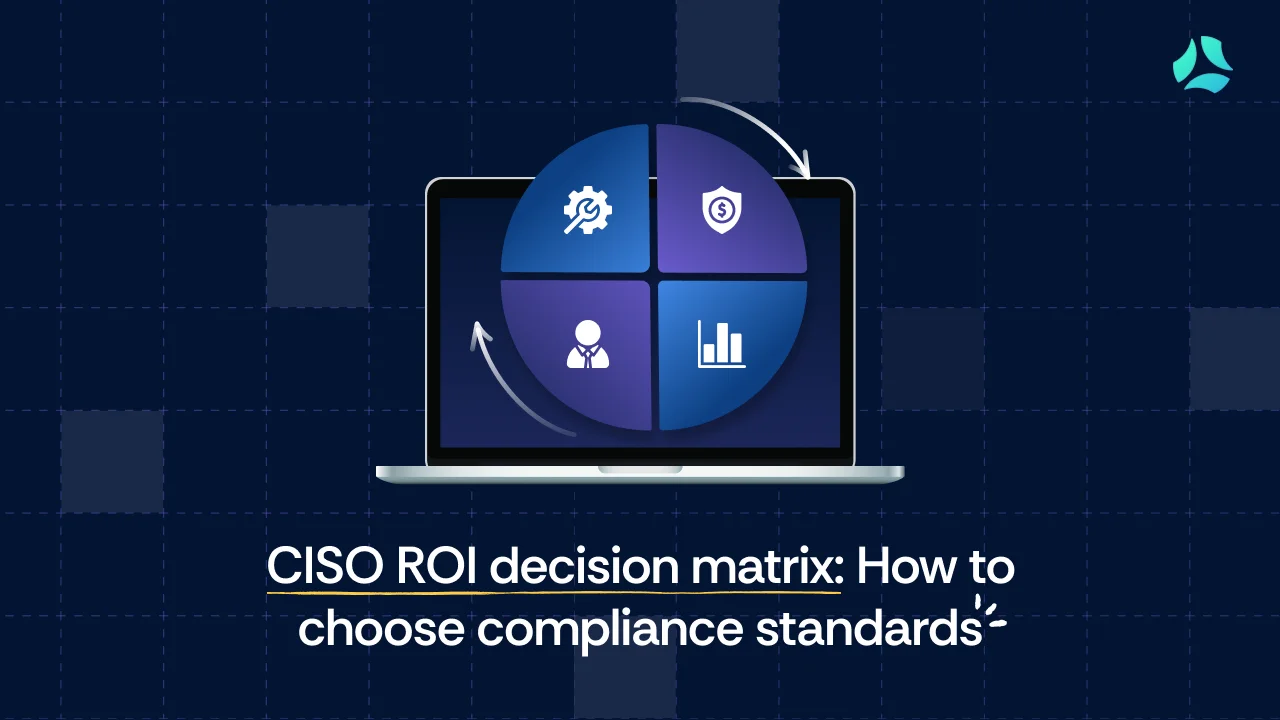
The evaluation of a compliance investment requires shifting from a simple cost-benefit analysis to a nuanced calculation of durable risk reduction. This CISO decision matrix helps security leaders compare compliance frameworks based on ROI, operational efficiency, and long-term scalability.
While manual audits represent a recurring operational expense that resets every year, continuous monitoring transforms compliance into a compounding asset through several key lenses.
“When done well, IT risk management matures from a set of difficult compliance and threat-reduction activities to become a true source of agility and business value.”
George F. Westerman, MIT Sloan School of Management
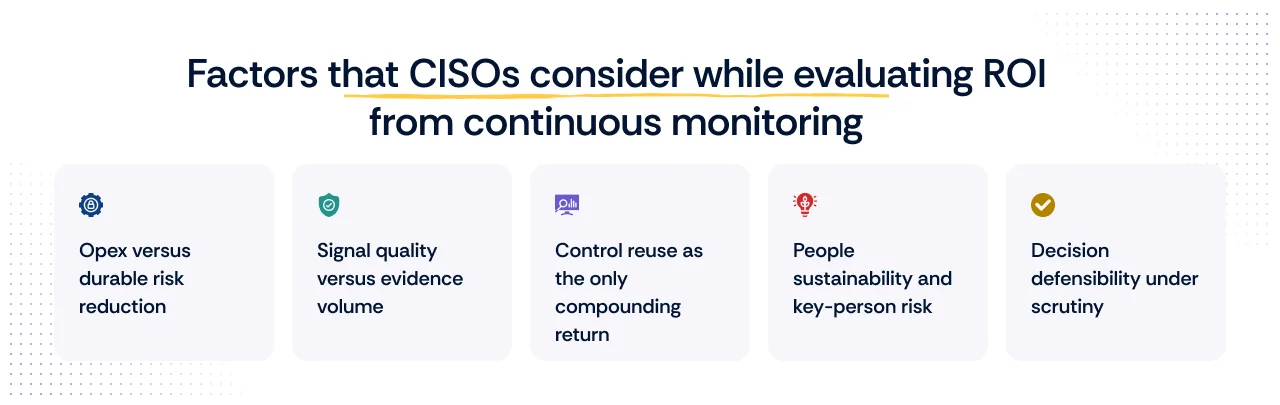
The following dimensions form the core of how CISOs evaluate the ROI of continuous monitoring, moving beyond surface-level compliance metrics to long-term operational value.
- OpEx versus durable risk reduction
Manual compliance cycles trigger expensive spikes in operating expenses (OpEx) as audits approach, only for security to decay once they end. This "peak and trough" model is inefficient, requiring recurring investments in manual labour for temporary results.
In contrast, a continuous approach stabilizes OpEx by converting volatile manual costs into a durable, automated posture. By automating evidence gathering, you eliminate the need for periodic overhauls. This ensures risk reduction is a permanent state of readiness rather than a seasonal expense.
- Signal quality versus evidence volume
Success is no longer measured by the sheer number of spreadsheets or screenshots collected. High-fidelity signals provide actionable insights into control health, allowing teams to address active failures rather than drowning in noise.
- Control reuse as the only compounding return
The ability to map a single security control to multiple frameworks like SOC 2 and ISO 27001 creates exponential efficiency. This prevents redundant testing of the same requirement across different regulatory requirements.
- People sustainability and key-person risk
Modern security departments face significant pressure from staffing shortages. Automation helps mitigate alert fatigue and ensures that compliance knowledge is embedded within the organizational infrastructure rather than residing with a single individual.
- Decision defensibility under scrutiny
Real-time visibility into control status provides the data-driven narrative required by boards and audit committees. This transparency allows the CISO to demonstrate to the CFO that compliance is a verifiable indicator of operational excellence.
How this decision matrix is constructed
To evaluate compliance standards through an ROI lens, we must first establish a consistent baseline. This matrix is designed for the modern, cloud-first enterprise where infrastructure is dynamic, and security teams are finite.
We assume that audits are a recurring necessity and that the primary goal is to minimize the "compliance tax" while maximizing security posture. By shifting away from static checklists, we can view these frameworks as living operating models.
The matrix evaluates each standard based on five critical dimensions of operational efficiency:
- Monitoring depth and frequency: This measures how naturally a standard moves from a point-in-time assessment to a continuous, real-time data stream.
- Automation compatibility: We look at how easily controls can be digitized via API integrations to eliminate manual evidence gathering.
- Control portability and reuse: This assesses the "multiplayer" value of a control, or how effectively one activity can satisfy multiple frameworks simultaneously.
- Change tolerance: This determines how resilient the compliance posture remains during infrastructure shifts, vendor migrations, or internal organizational churn.
- Exit cost: This considers the long-term flexibility of the framework, including the difficulty of pivoting if market demands or business priorities shift.
By applying these dimensions, CISOs can identify which standards act as a force multiplier for their specific technical environment.
The decision matrix at a glance
By evaluating how each framework performs across key dimensions, CISOs can move beyond the checkbox mentality and select models that strengthen operational resilience.
The following matrix provides a high-level comparison of major compliance standards through the lens of long-term ROI.
In this matrix, the highest score is often the wrong goal. A standard that is highly prescriptive, like PCI DSS, offers immense security value but may introduce significant operational drag for a non-payment entity. Conversely, a highly flexible framework like SOC 2 yields high ROI only if the CISO enforces rigorous internal baselines.
For instance, if your infrastructure is 100% ephemeral and cloud-native, a framework with high automation compatibility, such as SOC 2, allows you to leverage a platform like Scrut Automation to replace manual workflows with direct API integrations.
This approach prevents "compliance debt”, the accumulation of manual, disconnected processes that hinder growth.
In contrast, while ISO 27001 provides a robust Information Security Management System (ISMS) structure, it may initially demand more manual governance.
The key is to select the standard that serves as a force multiplier for your specific environment, rather than a drain on your finite team.
SOC 2: Strong ROI when monitoring is designed in early
SOC 2 has emerged as the high-velocity favorite for cloud-first organizations because its Trust Services Criteria are outcome-oriented rather than prescriptive. This flexibility allows it to align naturally with continuous evidence refresh cycles.
Instead of forcing a rigid technical configuration, SOC 2 asks if a control is functioning effectively over a defined period. This characteristic makes it the ideal candidate for API-driven observation.
However, the ROI of SOC 2 is fragile. Where manual testing quietly erodes value is in the Type 2 observation window. Without automation, a security team might spend hundreds of hours manually sampling logs or taking screenshots of firewall configurations to prove consistency.
The best-fit scenario for SOC 2 involves an organization scaling rapidly on public cloud infrastructure. From a cost and effort standpoint, the highest return occurs when a compliance automation platform like Scrut is used to orchestrate these technical controls.
ISO 27001: ROI compounds when treated as a living system
While SOC 2 provides an excellent operational snapshot, ISO 27001 serves as the architectural anchor for global scalability. The return on investment for this standard is found in its risk-led approach.
Rather than forcing a generic list of requirements, ISO 27001 mandates that an organization define its own risk landscape and select controls accordingly. This strategic autonomy ensures that security spend is always aligned with actual business threats, preventing the waste of resources on irrelevant compliance activities.
When a CISO treats the ISMS as a living system, the ROI compounds through organizational consistency. Unlike standards that focus solely on technical proof, ISO 27001 integrates governance into the company culture, making it more resilient to personnel changes or vendor shifts.
Operationally, ISO 27001 outperforms audit-driven standards by providing a foundation for all other certifications. By leveraging Scrut Automation to map these foundational controls, organizations can achieve a "write once, comply many" efficiency.
NIST CSF and NIST SP 800-53: High ceiling, uneven economics
The NIST Cybersecurity Framework (CSF) and the more granular SP 800-53 represent the gold standard for security maturity. Unlike compliance frameworks that focus primarily on prevention, NIST CSF emphasizes a full lifecycle approach, including detection, response, and resilience monitoring.
This provides a significantly higher ceiling for security ROI because it prepares the organization for the inevitability of an incident.
However, this depth comes with a maturity tax. The sheer volume of controls in 800-53 can create a massive administrative burden that quickly outstrips the budget of a smaller security team.
The economics of NIST CSF and 800-53 shift dramatically when mapping and automation are introduced to change the cost curve. By using a platform like Scrut Automation to map these comprehensive controls back to more common standards like SOC 2, a CISO can justify the investment as a "master control" strategy which ensures that every automated check performed for NIST frameworks also satisfies lower-tier audits, effectively lowering the cost per compliance requirement.
PCI DSS and narrow-scope standards: Mandatory rigor, limited leverage
PCI DSS represents a unique category in the decision matrix because its requirements are highly prescriptive and technically uncompromising. The intensity of continuous monitoring is non-negotiable, often demanding real-time logging and frequent vulnerability scans.
While this rigor results in a hardened security posture for cardholder data, the cost reality is that these efforts provide limited leverage. Because PCI DSS 4.0 is so specific to payment environments, many of its controls are difficult to repurpose for broader enterprise security goals.
The ROI of these narrow-scope standards is determined almost entirely by scope discipline. A CISO who allows the cardholder data environment to bleed into the general corporate network will find that compliance costs spiral out of control. Since control reuse is limited by design, these frameworks are typically chosen by necessity rather than strategic flexibility.
To maximize efficiency, organizations must use automated platforms like Scrut Automation to isolate the scope and maintain continuous evidence without draining resources from more flexible, long-term security initiatives.
Sector-specific standards (HIPAA and others): ROI follows exposure
For organizations in highly regulated sectors like healthcare or finance, the ROI of standards such as HIPAA or GLBA is measured primarily through the lens of liability protection. Monitoring depth is driven by the potential for severe enforcement actions and the high cost of data breach impacts on sensitive records.
Similarly, the TISAX framework for the automotive industry or FedRAMP for government service providers creates a barrier to entry return where compliance is the literal price of market participation.
However, because these frameworks are often outcome-based or highly specialized, standalone adoption rarely scales well as a comprehensive security strategy. The most effective approach is to pair these sector-specific requirements with a robust horizontal standard like SOC 2 or ISO 27001.
By leveraging Scrut Automation to map technical evidence across these layers, organizations can fulfill industry obligations without creating a siloed, high-maintenance compliance program.
Where CISOs lose ROI in compliance programs
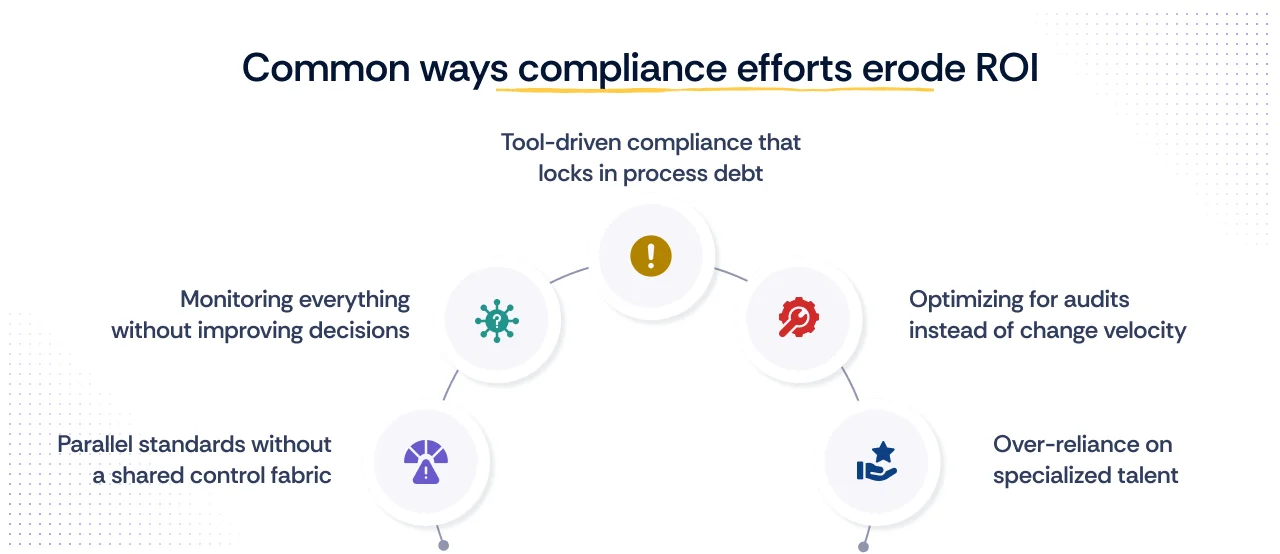
Even with the right standards in place, the return on investment can be neutralized by structural inefficiencies. CISOs often find that compliance costs continue to rise despite investments in new tools. Identifying these value leaks is the first step toward reclaiming operational efficiency.
- Parallel standards without a shared control fabric: Treating SOC 2, ISO 27001, and HIPAA as separate silos leads to duplicating effort. This lack of harmonization ensures that operational costs scale linearly with every new regulation added.
- Monitoring everything without improving decisions: Data for the sake of data creates noise rather than security. If a monitoring system flags a thousand anomalies without providing context for remediation, it creates process debt that slows down engineering teams.
- Tool-driven compliance that locks in process debt: Investing in rigid tools that don't adapt to your technical stack can force teams into outdated workflows. This prevents the security posture from evolving at the same speed as the cloud infrastructure.
- Optimizing for audits instead of change velocity: When a program is built solely to pass a point-in-time audit, it fails to provide daily security value. Compliance should be an accelerator for business growth, not a friction point on the roadmap.
- Over-reliance on specialized talent: Keeping manual monitoring alive through custom scripts known only to one or two individuals creates a single point of failure. If that specialized talent leaves, the institutional knowledge and the ROI of the program collapse with them.
Building your own CISO decision matrix
Designing a custom decision matrix requires pressure-testing standards against your unique business goals before adoption. A CISO must look beyond the brand recognition of a certification and ask if the framework genuinely supports the company's long-term operating model. The goal is to strike a balance between aggressive risk reduction and the daily reality of your security team's bandwidth.
To build a matrix that serves both the boardroom and the server room, consider these framing questions:
- Board defensibility: Does this standard translate into business metrics, such as "uninterrupted revenue streams" or "verifiable market trust," on a slide?
- Operational load: Can 80% of the evidence collection be automated, or will it require a permanent compliance tax of manual effort from your engineers?
- Exit flexibility: If market demands shift next year, how easily can these existing controls map to a new requirement without starting from zero?
Ultimately, the best matrix is one that ensures security actually compounds. By selecting standards with high automation compatibility, such as SOC 2, and managing them through Scrut Automation, you ensure that your team spends their time solving complex security problems rather than chasing documentation.
How can you increase ROI with Scrut?
The transition from point-in-time audits to continuous monitoring represents a fundamental strategic pivot for the modern CISO.
Scrut Automation serves as the essential force multiplier in this equation, unifying the compliance stack into a single, cohesive engine that replaces fragmented manual workflows with a real-time stream of evidence integrated directly into your cloud and developer environments.
To help you navigate this complexity, we developed the Compliance Compass. This tool removes the guesswork by analyzing your industry, growth stage, and technical stack to pinpoint exactly which frameworks will deliver the highest ROI for your specific environment.
This "comply once, satisfy many" architecture creates a shared control fabric where a single automated check fulfills requirements across multiple standards, such as SOC 2, ISO 27001, and HIPAA. The resulting ROI is the total elimination of compliance debt.
Scrut Automation eliminates the "compliance tax" by turning static audits into a dynamic, automated engine for growth. By centralizing your workflows, you can stop managing spreadsheets and start scaling security.
Ready to transform compliance into a compounding asset? Find your framework with the Compliance Compass or Book a demo today to see Scrut in action.
FAQs
1. How does automation actually lower the cost of an audit?
Automation reduces the "billable hours" spent on evidence collection. Instead of a security engineer manually pulling 50 sample logs for an auditor, a platform like Scrut Automation provides the auditor with a read-only view of 100% of the logs via API. This reduces the time spent on manual "back-and-forth" by up to 70%, allowing your team to focus on their core engineering tasks.
2. Can one automated control really satisfy multiple frameworks?
Yes. This is often called "cross-mapping." For example, a control that enforces Multi-Factor Authentication (MFA) is required by SOC 2, ISO 27001, and PCI DSS. Scrut Automation maps that single technical check to the specific requirements of each standard, so you only have to verify it once to satisfy all three.
3. Does "continuous monitoring" mean we are under a 24/7 audit?
Not exactly. Continuous monitoring means your controls are being tested automatically in the background. Instead of finding a failure six months too late during an annual audit, you are alerted the moment a configuration drifts. This allows for instant remediation, which keeps your security posture high and makes the final audit a formality rather than a crisis.
4. Is the ROI of ISO 27001 lower than SOC 2 because it’s more manual?
Not necessarily. While ISO 27001 requires more initial governance and documentation (the ISMS), its ROI is often higher for global companies. It acts as a universal "passport" that is recognized in almost every country, whereas SOC 2 is primarily a North American preference. The ROI depends on where your customers are located.
5. What is "compliance debt" and how does it impact ROI?
Compliance debt is the accumulation of manual, disconnected processes and technical gaps that occur when security is treated as an afterthought. It is essentially the "tax" your team pays for managing compliance through static spreadsheets rather than integrated systems.
- The impact: As your infrastructure scales, manual evidence gathering becomes an exponential burden. This forces your most expensive engineering talent to spend 20% or more of their time on administrative tasks instead of building new features.
- The solution: By using Scrut Automation to build a "shared control fabric," you pay down this debt. Automated monitoring ensures that as your company grows, the effort required to maintain compliance stays flat, allowing your team to remain lean and high-velocity.
6. What is compliance tax, and how does it differ from compliance debt?
While often used interchangeably, these terms represent two distinct ways that inefficient GRC processes drain your ROI. Understanding the difference helps CISOs identify whether they are facing a recurring operational cost or a structural risk.
- Compliance tax is the ongoing, recurring cost of staying compliant. It is the "fee" paid in time and effort to maintain your status. This looks like engineers spending weeks every year manually pulling evidence, or your security lead chasing down task completions. As your company grows, this tax grows linearly—unless you automate.
- Compliance debt is the accumulation of manual shortcuts and technical gaps taken to pass an audit quickly. It is essentially "interest" that accrues over time. For example, using a spreadsheet to track 500 servers instead of an API integration might save time today, but it creates a massive, expensive cleanup project when you eventually scale or face a more rigorous audit.


%201.png)