


%20(1).png)


Large organizations do not fail at GRC because they pick the wrong software. They fail because they roll it out badly.
Whether it is a rushed deployment, vague goals, or a complete lack of buy-in from regional teams, the outcome is almost always the same: wasted budget, frustrated employees, and compliance gaps that keep widening instead of closing.
According to a Mordor Intelligence analysis, financial institutions alone faced more than 1,200 separate rules and 250 regulatory updates per day in 2024. That volume is not going down. It is exactly why structured GRC implementation has shifted from a nice-to-have to an operational necessity.
GRC implementation is the process of deploying a governance, risk management, and compliance program across an organization. It involves selecting and configuring a GRC platform, mapping regulatory requirements to internal controls, onboarding teams, automating evidence collection, and establishing continuous monitoring. Much of that heavy lifting falls to compliance automation software, which connects to your existing systems, pulls evidence on a schedule, and maps it to each framework so the rollout scales across teams without scaling the manual workload alongside it.
A successful implementation unifies policies, risk registers, and audit trails into a single system, rather than leaving them scattered across spreadsheets, shared drives, and disconnected teams.
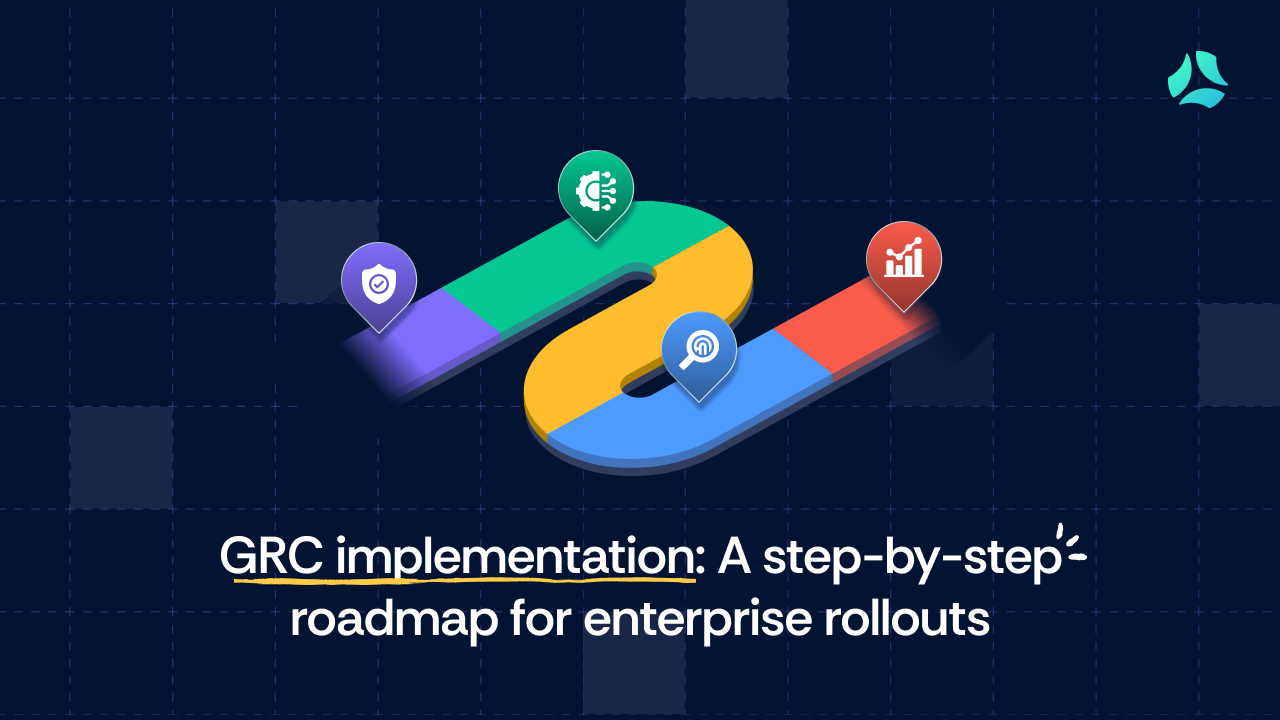
We prepared this guide to walk you through every phase of an enterprise GRC rollout, from the first assessment to long-term optimization.
Pre-implementation assessment
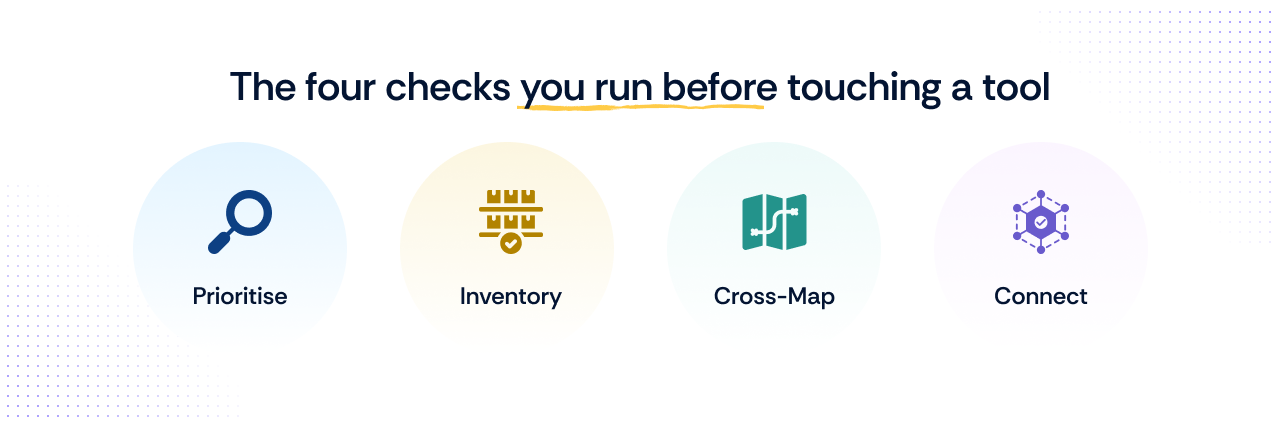
The most common GRC implementation mistake is skipping the assessment entirely and jumping straight into platform configuration. Before you touch a single tool, you need a clear picture of where you stand right now.
Gap analysis
Compare your current policies, controls, and risk processes against the frameworks you need to comply with, such as SOC 2, ISO 27001, GDPR, HIPAA, or others. Document every gap and assign ownership. Prioritize based on regulatory risk and business impact, because a gap that could trigger a fine tomorrow matters more than one that might cause a problem next year.
Current state documentation
Map out what you already have in place: risk registers, policy documents, compliance workflows, audit trails. In most organizations, pieces of a GRC program are already scattered across teams. The goal is to catalog everything before deciding what stays, what goes, and what needs an upgrade.
Regulatory mapping
List every regulation, framework, and standard that applies to your business. If you operate globally, group them by region and business unit. Pay close attention to the overlap between frameworks. Many controls required by ISO 27001 also satisfy SOC 2, and spotting those overlaps early saves you from duplicating work later.
Infrastructure audit
Take stock of your current tech stack. What tools do you use for risk assessments? Where does your audit evidence live? Identifying integration points and bottlenecks now gives you a clear picture of what your GRC platform needs to connect with.
Building your GRC strategy
A solid GRC strategy rests on four pillars: clear objectives, a realistic timeline, the right stakeholders, and an honest budget. Getting any of these wrong creates problems that compound with every phase of the rollout.
Set measurable objectives
"Improve compliance" is too vague. Aim for specifics like "reduce audit preparation time by 40% within 12 months" or "achieve ISO 27001 certification by Q3." Tie your GRC objectives to business goals.
When leadership sees GRC as a driver of growth rather than a cost center, getting buy-in becomes significantly easier.
Secure executive sponsorship
This is non-negotiable. Without a C-level champion, GRC programs lose funding, attention, and priority at the first budget review. Every stalled implementation can usually be traced back to missing executive support.
Plan a phased rollout
Rather than trying to do everything at once, break the implementation into phases spread over 12 or more months. This prevents your team from becoming overwhelmed, and it lets you prove value early before asking for broader organizational commitment.
Budget for three years, not one
Factor in platform licensing, implementation services, internal headcount, training, and ongoing maintenance. Hyperproof's research puts the average annual audit preparation cost at $210,000 per organization.
Those numbers make the ROI case for automation clear, but only if you budget for the full lifecycle. Scrambling for budget mid-rollout is far more expensive than planning ahead.
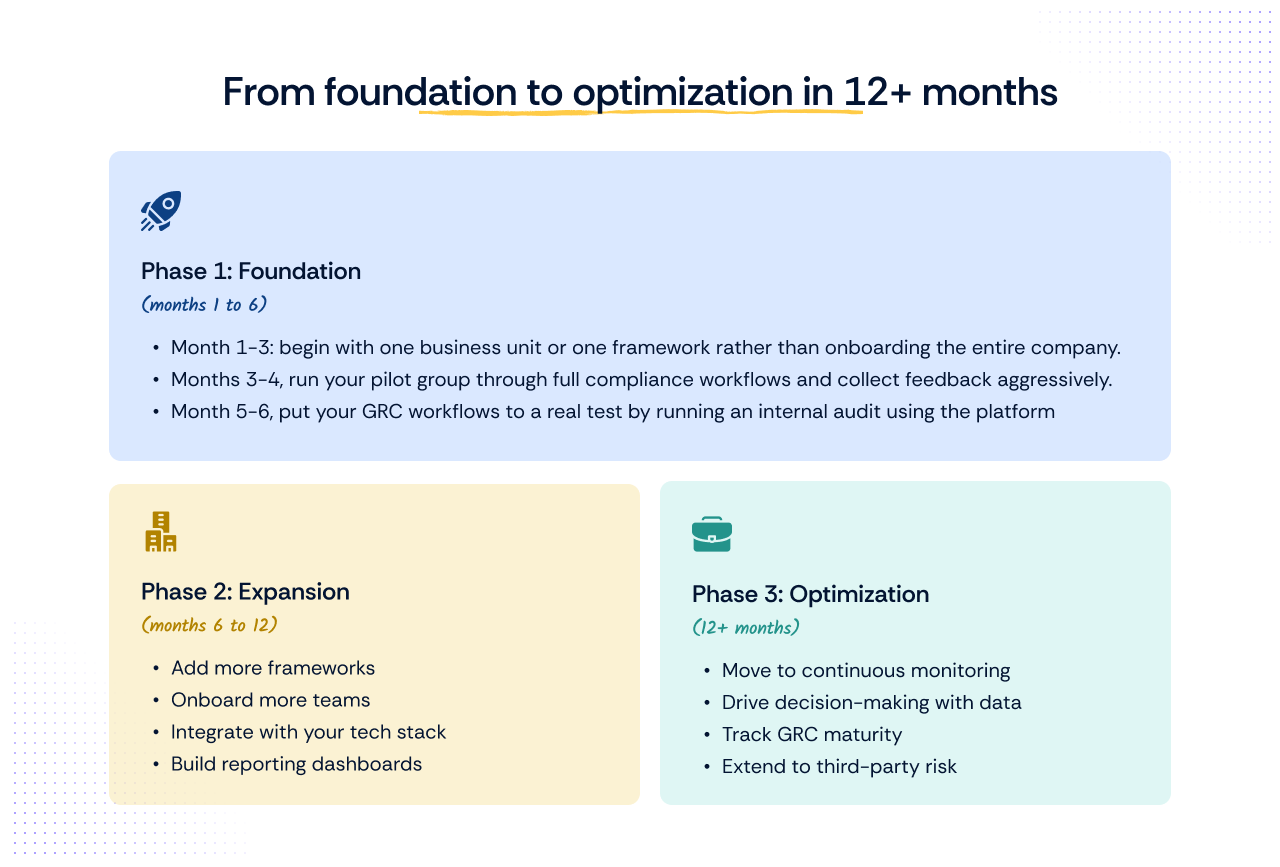
Phase 1: Foundation (months 1 to 6)
The first six months are about getting the basics right. This is the groundwork everything else builds on.
Start by selecting your GRC platform and configuring it for your most pressing compliance framework. Set up your risk register, policy library, and control mapping.
The key is to begin with one business unit or one framework rather than onboarding the entire company at once. A focused pilot gives you room to find problems early and fix them before they scale.
By months 3 and 4, run your pilot group through full compliance workflows and collect feedback aggressively. What is confusing? What takes too long? What is missing? Use these insights to refine configurations and documentation before expanding.
By month 6, put your GRC workflows to a real test by running an internal audit using the platform.
This validates your controls, tests your evidence collection, and exposes remaining gaps. That success story becomes your proof of concept for the rest of the organization.
Phase 2: Expansion (months 6 to 12)
With a working foundation in place, scale what works to the rest of the organization.
- Add more frameworks
If you began with SOC 2, layer in ISO 27001 next. Map overlapping controls to avoid duplicate effort. A good GRC platform handles multi-framework mapping automatically, which alone can save your team dozens of hours per audit cycle.
- Onboard more teams
Start with teams that have the strongest compliance maturity, since they will adopt faster and become internal advocates who help bring others on board. For global organizations, this is where regional differences surface: different privacy laws, different risk appetites, different ways of working. Address them head-on rather than hoping they sort themselves out. We cover the best practices on this below, so read on!
- Integrate with your tech stack
Connect your GRC platform to the tools your teams already use: HRIS systems, cloud infrastructure, project management, and ticketing systems. The more integrations you build, the more automated your evidence collection becomes. Every manual task you eliminate is one that cannot be forgotten, delayed, or done incorrectly.
- Build reporting dashboards
Executives do not need to see every control. They need a clear view of risk posture, compliance status, and audit readiness at a glance. Giving them that visibility is one of the best ways to secure their long-term support.
Phase 3: Optimization (12+ months)
By month twelve, your GRC program should be running across multiple frameworks and teams. The focus shifts from building to improving, and this is where long-term value starts compounding.
- Move to continuous monitoring
Set up automated alerts for control failures, policy violations, and emerging risks. The faster you catch problems, the cheaper they are to fix. Continuous monitoring also means you are always audit-ready rather than scrambling before every review.
- Drive decision-making with data
Which business units have the most control failures? Which regulations cause the most findings? Where are the bottlenecks? Data-driven risk management lets you focus resources where they matter instead of spreading effort evenly across everything.
- Track GRC maturity
Most organizations start reactively, fixing problems after they occur, and gradually move toward a predictive approach, where they spot issues before they materialize. Measuring this progression quarterly demonstrates tangible growth to stakeholders and keeps improvement targets clear.
- Extend to third-party risk
Do not stop at your own organization. Vendor risk assessments, third-party audits, and contract compliance monitoring should all live within your GRC platform.
Managing a growing vendor ecosystem manually is not sustainable, and most regulatory frameworks now expect structured vendor risk management as part of your compliance program.
Choosing the right GRC platform
Your platform choice affects every phase of the implementation, so it is worth getting right from the start. The core criteria that matter most include:
- Multi-framework support. Your platform should support multiple compliance frameworks out of the box. Manual mapping between frameworks is a time sink you do not need.
- Integration depth. Check how many pre-built integrations the platform offers. If it cannot connect to your cloud provider, HRIS, or ticketing system, you will be stuck collecting evidence by hand.
- Scalability. Your GRC needs will grow. Choose a platform that handles more users, more frameworks, and more data without doubling your costs.
- Audit-readiness features. Built-in audit trails, evidence repositories, and auditor-facing dashboards. The easier you make your auditor's job, the faster your audits go.
- Customizable workflows. Every organization is different. Your GRC tool should let you customize risk scoring, approval flows, and reporting without having to open a support ticket each time.
Change management and training
Technology alone does not make a GRC program work. People do. And since people naturally resist change, you need to plan for that resistance rather than be surprised by it.
- Start communication early. Announce the rollout and explain the reasoning before diving into the mechanics. Appoint GRC champions within each department: existing employees who understand the new workflows and can help their peers get up to speed.
- Build role-specific training. Executives need a 15-minute overview of dashboards and risk posture. Compliance analysts need deep training on workflows and evidence collection. IT teams need sessions on integrations and automated controls. Deliver training at the point of need, not six weeks before anyone touches the platform.
- Set up a feedback loop and act on what you hear. The format matters less than the follow-through. And reinforce regularly. Schedule quarterly refreshers and celebrate wins publicly. When a team cuts its audit prep time in half, make sure the rest of the company hears about it.
Global implementation considerations
Rolling out GRC across multiple countries requires a balance between global consistency and local flexibility. The goal is to create a single, connected program that can adapt to regional needs without fragmentation.
- Localize policies, training materials, and platform interfaces so teams can work in their own language.
- Account for time zones when setting deadlines, reminders, and review cycles.
- Map regional regulations to your global GRC framework, including:
- GDPR in Europe
- LGPD in Brazil
- PDPA in Singapore
- Use a single GRC platform, but configure it to support local variations.
- Avoid creating separate, disconnected processes for each country or region.
- Maintain global visibility while allowing local teams to meet their specific requirements.
- Verify data residency requirements early.
- Ensure compliance data does not cross borders without the appropriate safeguards.
Common pitfalls
There are some pitfalls that teams run into. Those are:
- Trying to do everything at once. Do not launch with ten frameworks, every business unit, and every feature on day one. Start small, prove the concept, expand.
- Treating GRC as an IT project. IT plays a role, but GRC is a business program. Ownership belongs with risk, compliance, and executive leadership.
- Skipping executive sponsorship. Without a C-level champion, GRC programs lose budget and priority within months.
- Letting documentation go stale. Policies are living documents. Stale documentation creates a false sense of security that auditors catch every time.
Conclusion
A successful GRC implementation is not just about choosing the right platform. It is about rolling it out in a structured, phased, and measurable way. Enterprises that start with a clear assessment, secure executive sponsorship, and build around one framework or business unit first are far more likely to create a program that scales.
The strongest GRC rollouts move from foundation to expansion to optimization: first centralizing policies, controls, and risks; then integrating teams and frameworks; and finally using automation, dashboards, and continuous monitoring to improve over time.
For large organizations, GRC implementation should be treated as a long-term business transformation, not a one-time software deployment. Start small, prove value early, and scale with discipline. That is how GRC becomes a reliable system for managing risk, maintaining compliance, and supporting global growth.
A full enterprise GRC implementation usually takes 12 to 18 months. The first 6 months cover setup, pilot, and initial audit. Months 6 to 12 focus on expansion across teams and frameworks. Optimization is ongoing after that.
First-year costs typically range from $50,000 to $200,000 for small to mid-sized enterprises. Larger organizations spend more. Budget for at least three years of licensing, training, and maintenance to avoid mid-rollout funding gaps.
Multi-framework compliance, localization, data residency options, time zone-aware workflows, and deep integrations with your existing tech stack. The platform should also provide reliable audit trails across every region.
Trying to boil the ocean. Organizations that launch with every framework and every business unit on day one almost always stall. Start with one framework, one team, prove the model works, then expand systematically.
Yes, but you still need one clear owner. Many companies start with a compliance lead and expand the team as the program matures. GRC automation significantly reduces staffing requirements by handling evidence collection, control monitoring, and workflow management automatically.


%201.png)


.png)