

%20(1).png)
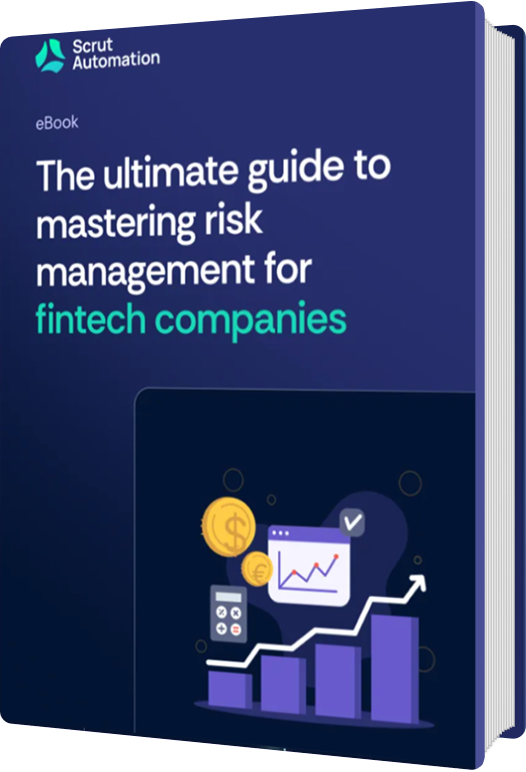
The ultimate guide to mastering risk management for fintech companies
Build a risk management program that keeps pace with regulators, attackers, and your own roadmap
For founders, compliance leads, and risk owners at fintech companies who need a structured approach to risk, not another generic framework overview.

Description
Fintech companies carry a double burden. You face the same market, credit, and operational risks as any financial institution, plus the technology risks of a company shipping software every week. A regulator's expectations don't shrink because your team is small, and attackers don't wait until you've hired a CISO.
This guide walks through the full risk management lifecycle for fintech: understanding the six risk categories that matter (market, operational, financial, compliance, cybersecurity, and strategic), choosing between frameworks like ISO 31000, COSO ERM, NIST CSF, and Basel III, and building the identification, assessment, and mitigation processes that connect them. It also goes deep on the areas where fintech risk concentrates: regulatory compliance, cybersecurity, third-party vendors, and financial exposure.
The through line is culture and repeatability. A risk register nobody updates is decoration. This ebook shows how to embed risk awareness into everyday decisions, measure whether it's working, and use innovation like AI, RegTech, and automation to keep the program running without a dedicated risk department.
Here are the insights you will walk away with

Market, operational, financial, compliance, cybersecurity, and strategic risks, with what each looks like in a fintech context. Understanding these categories is what turns "we should think about risk" into targeted strategies for each type of exposure.
A comparison of the frameworks fintechs actually use: ISO 31000, COSO ERM, NIST Cybersecurity Framework, and Basel III, plus the factors that should drive your choice, from regulatory requirements to company size. Then a seven-step implementation path from scoping through communication and reporting.
Brainstorming sessions, SWOT analysis, risk workshops, surveys, and historical data analysis for identification. Qualitative and quantitative assessment, risk matrices, and scenario analysis for prioritization. Everything feeds a risk register that documents what you found and what you decided.
Avoid, reduce, transfer, or accept. The guide covers how to pick the right response per risk, build action plans with owners and deadlines, and monitor key risk indicators so mitigation plans stay current instead of gathering dust.
How to integrate regulatory compliance into your risk program across jurisdictions like the FCA and SEC. The cybersecurity threats that hit fintechs hardest, from phishing to insider threats, and the controls that counter them. And a full third-party risk management approach covering vendor assessment, due diligence, ongoing monitoring, and contingency planning.


Get access to the ebook now
These are the questions this eBook will answer
Risk management in fintech is the identification, assessment, and prioritization of risks, followed by coordinated efforts to minimize, monitor, and control their probability or impact. For fintech companies, this spans operational failures, financial missteps, regulatory breaches, cybersecurity attacks, and market fluctuations. Effective risk management protects customer data, keeps the company compliant, and positions it as a trustworthy player in the financial ecosystem.
Fintech companies face six broad risk categories: market risks from economic shifts and competitive pressure, operational risks from system outages and human error, financial risks like credit defaults and liquidity issues, compliance risks from regulatory violations, cybersecurity risks from breaches and fraud, and strategic risks from technological change and competition. Each category requires its own targeted mitigation strategy.
The most widely used frameworks in fintech are ISO 31000 for general risk management principles, COSO ERM for integrating risk with strategy and performance, the NIST Cybersecurity Framework for security-focused programs, and Basel III for companies operating close to banking regulation. The right choice depends on your regulatory requirements, business objectives, company size, and the practices already recognized in your segment of the industry.
Compliance is one of the highest-stakes risk categories in fintech because violations carry legal sanctions, financial penalties, and reputational damage. Integrating compliance into risk management means running regular regulatory risk assessments, maintaining compliance programs with policies and training, using automated compliance tools for tasks like transaction monitoring and reporting, and conducting internal and external audits to catch gaps before regulators do.
Fintech companies should manage third-party risk in three stages: identify risks through vendor assessments, risk classification, and clear contractual terms; manage them through due diligence, ongoing monitoring, and regular audits; and mitigate them by limiting vendor access to only necessary data, verifying compliance certifications, and establishing incident response coordination. Contingency plans for vendor failure ensure a single provider can't take your operations down with it.