

%20(1).png)
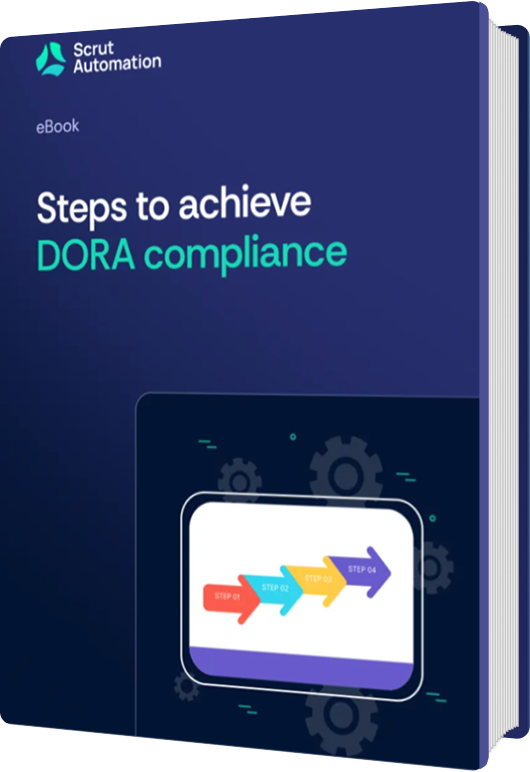
Steps to achieve DORA compliance
A seven-step path to meeting the Digital Operational Resilience Act, from asset inventory to third-party monitoring
For security and compliance teams at financial entities and digital service providers in scope of the EU's DORA regulation.

Description
DORA compliance isn't a single control or a policy document. It's an operational standard: the Digital Operational Resilience Act expects financial entities and their ICT service providers to withstand, respond to, and recover from digital disruptions, and to prove it. That spans everything from knowing what assets you run to reporting major incidents to regulators on a clock.
The problem most teams face isn't understanding why DORA matters. It's sequencing the work. Which capability comes first, what does each one actually require, and where do existing security practices already cover the ground?
This ebook breaks DORA compliance into seven concrete steps: IT asset inventory, cyber hygiene and awareness, vulnerability management and patching, incident detection and response, security monitoring and logging, ICT risk assessment, and third-party risk management. Each step includes implementation guidance, tooling recommendations, and best practices, so the output isn't a summary of the regulation but a work plan your team can execute against.
Here are the insights you will walk away with

You can't protect infrastructure you can't see. The ebook covers the four-part process for a comprehensive IT asset inventory, plus the tooling layer that keeps it current: asset management software, automated discovery tools, and configuration management databases.
Patch management, least-privilege access control, endpoint protection, and encryption at rest and in transit, paired with the human layer: cybersecurity training, simulated phishing exercises, and incident response drills that turn policy into practice.
From assessment and prioritization through patch deployment, compensating controls, and continuous monitoring. The ebook also details the five-stage patch lifecycle, including testing, compliance monitoring, and rollback capability for patches that break business-critical applications.
DORA requires financial entities to report major operational and security payment-related incidents to regulators. The ebook lays out the five-phase incident response plan (preparation, detection, response, communication, post-incident analysis) that makes timely, accurate reporting achievable instead of chaotic.
A five-step ICT risk assessment process aligned with frameworks like NIST CSF and ISO 27001, and a vendor risk program covering identification, assessment, contractual requirements, ongoing monitoring, and vendor-related incident response planning.


Get access to the ebook now
These are the questions this eBook will answer
DORA compliance means meeting the requirements of the EU's Digital Operational Resilience Act, which obligates financial entities and digital service providers to manage ICT risk, report major incidents, test operational resilience, and control third-party risk. The goal is ensuring organizations can withstand and recover from cyber threats and operational disruptions while protecting critical infrastructure and customer data.
DORA applies to EU-based financial entities, including banks, insurers, investment firms, and payment providers, as well as the ICT third-party service providers that support them. If your organization provides critical digital services to EU financial institutions, DORA's requirements reach you through contractual and oversight obligations even if you aren't a regulated financial entity yourself.
DORA compliance can be sequenced into seven steps: take inventory of all IT assets, improve cyber hygiene and awareness, implement vulnerability management and patching, introduce incident detection and response, develop security monitoring and logging, conduct ICT risk assessments, and establish third-party risk management and monitoring. Each step builds on the previous one, starting with visibility and ending with control over your extended vendor ecosystem.
DORA requires financial entities to report major operational or security payment-related incidents to regulatory authorities. Meeting this obligation depends on having incident detection and response capabilities in place first: monitoring tools that catch incidents promptly, predefined containment procedures, clear communication channels for notifying regulators and stakeholders, and post-incident analysis to prevent recurrence.
DORA treats third-party ICT risk as a core compliance area, not an afterthought. Organizations must identify and categorize vendors by criticality and access level, assess their security practices and financial stability, embed security requirements into contracts, monitor vendor compliance continuously, and maintain incident response plans that cover vendor-related security events. Regular audits and contractual reviews keep the program current as vendors and regulations change.