



Choose risk-first compliance that’s always on, built for you.
For founders and early security leads whose practices are solid but scattered. A stage-specific guide to making compliance visible in enterprise deals, investor diligence, and board meetings.

You’ve built something real. Customers are paying. The growth story is working.
Then a Fortune 500 procurement team sends a 200-question security questionnaire. Your VP of Sales flags it as "the big one." Your engineering lead spends two weeks pulling together documentation. The deal slips a quarter.
Or an investor runs diligence and asks to see your risk register. Your GRC lead, if you have one, sends over a spreadsheet last updated nine months ago. The investor doesn't say anything in the meeting. But the follow-up questions start getting harder.
This is the compliance moment most Series B founders hit without seeing it coming. Not a breach. Not an audit failure. Just the slow realization that your security practices are solid but your ability to demonstrate them isn't.
That gap, between what you actually do and what you can prove on demand, is what this guide is about.

Use this guide before your next enterprise deal, board meeting, or Series B close. The 10-question diagnostic below will tell you exactly where your compliance posture stands and where it's quietly costing you deals.
Score each item: 0 = doesn't exist, 1 = partially in place, 2 = fully operational with evidence.
| # | Can you do this today, without a two-week scramble | Score (0-2) |
|---|---|---|
| 1 | Produce a SOC 2 Type II report (or show a concrete timeline to one) | |
| 2 | Show a risk register reviewed in the last 90 days | |
| 3 | Demonstrate that a departed employee’s access was revoked within 24 hours | |
| 4 | Pull access review logs for your production environment from last quarter | |
| 5 | Show a tested incident response plan with named owners and escalation paths | |
| 6 | Produce evidence that security awareness training was completed company-wide | |
| 7 | Show that no production code was deployed without independent peer review | |
| 8 | Provide current SOC 2 reports for your top 3 data-handling vendors | |
| 9 | Demonstrate your disaster recovery plan has been tested in the last 12 months | |
| 10 | Show documented governance for AI tools your team uses |
| Score range | What it signals |
|---|---|
| 0 to 8 | Your program is reactive. This will surface during diligence and slow enterprise deals. |
| 9 to 13 | You have the right foundations, but visible gaps. A structured push closes them before they cost you. |
| 14 to 17 | Operationally solid. Focus now on continuous evidence and removing friction from sales cycles. |
| 18 to 20 | Compliance is a competitive asset. Use it actively in deal cycles and board narratives. |
Early-stage compliance is pragmatic. Engineering implements reasonable controls. Policies get drafted when a customer asks. Security reviews are handled case by case. This approach works when your customer base is small and your sales cycles are short.
Series B changes the rules. Enterprise buyers are no longer just asking if you're secure. They're evaluating whether your organization can be trusted as a long-term vendor, one that won't become their liability.
Investors aren't just checking a certification box. They're assessing whether operational risks are understood and managed deliberately, because unmanaged compliance risks result in financial and reputational risks that land on the cap table.
Three signals reliably separate founders who handle this transition well from those who get caught flat-footed.

Signal 1
Security is structured, not ad hoc

Signal 2
Risk is tracked deliberately, including AI risk

Signal 3
Evidence is logged before someone asks for it
In most early-stage companies, security knowledge lives in people's heads. The engineering lead knows how access is managed. A founding engineer knows how deploys work. The practices are sound, but they're not transferable.
The problem isn't competence. It's that when diligence arrives, the answers to "how does this work?" require tracking down specific people, who give slightly different answers, who reference documents that may or may not be current.
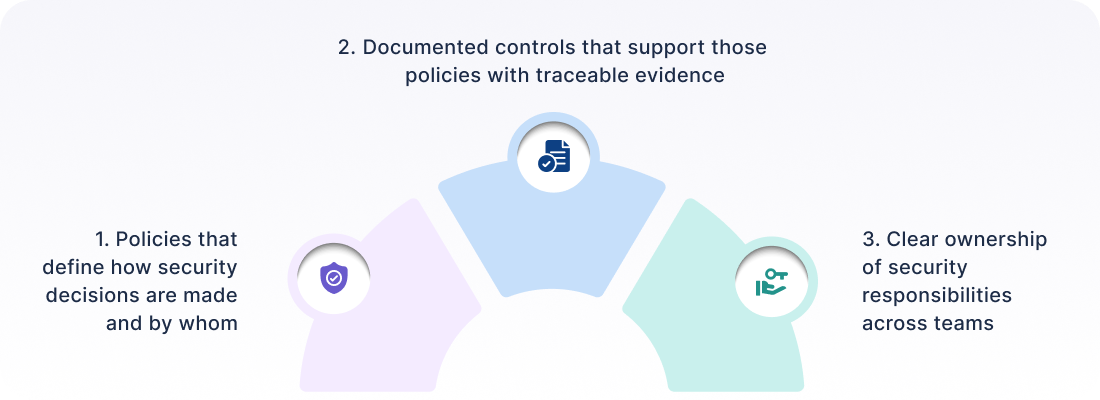
Structure signals that your security program can survive scale. Investors and enterprise buyers aren't just buying into what you've built. They're betting on what your organization will look like in three years. A program that depends on founding-team knowledge doesn't survive hypergrowth.
Every company has risk. What investors want to see at Series B is that you've found yours before they did. A functioning risk register at Series B isn't a compliance artifact. It's a management tool.
A note on AI risk that most founders are underestimating: if your team uses AI tools in engineering, support, or internal productivity, your risk register needs to reflect that. Which AI tools are approved? What data can they access or export? Who reviews AI-generated outputs?
Most Series B companies have a gap here.The tools are being used, but the governance hasn't caught up. The EU AI Act has begun applying obligations in phases, with broader requirements rolling through 2026 and 2027. For companies with European exposure, "we'll deal with it later" is no longer a safe answer.
Series B companies are typically expected to maintain a structured risk register that captures:
| Field | What it represents |
|---|---|
| Risk description and category | A clear explanation of the risk and the area it affects (for example: infrastructure security, data protection, vendor risk). |
| Likelihood and impact assessment | An estimate of the likelihood of the risk occurring and the potential impact on the business, often assessed using a qualitative 5×5 risk matrix. |
| Risk score | A prioritization score calculated by combining likelihood and impact to identify the most critical risks. |
| Mitigation plan and residual risk | The actions taken to reduce the risk and the remaining level of risk after controls are implemented. |
| Risk owner and review cadence | The individual or team responsible for monitoring the risk and the frequency at which it is reviewed. |
| Current status | The current state of the risk (for example: open, in progress, mitigated, or accepted). |
This approach does not eliminate risk. Instead, it demonstrates that leadership understands where risks exist and how they are being managed. That visibility becomes especially important during investor diligence and board discussions, where the question is not whether risks exist but whether they are being managed credibly.
A practical starting point is to identify 10 to 20 risks, score them using a qualitative matrix, and review the register quarterly. Both ISO 27005 and NIST IR 8286A provide well-established templates for structuring this process.
This is the gap that surprises founders most. Your security practices are real. But when a prospect's security team asks for proof, your team spends two weeks pulling it together. The deal slips. The impression is set.
For example, a company may claim that employee access is removed immediately after offboarding. The process might work correctly in practice, but proving it could require digging through email threads, screenshots, or system logs.
During audits, enterprise security reviews, or investor diligence, this creates unnecessary friction.
The difference between a reactive compliance program and a mature one isn't the quality of the controls. It's whether those controls automatically generate evidence as they run. When this evidence exists and is organized, your team can respond to a security review in hours, not weeks.
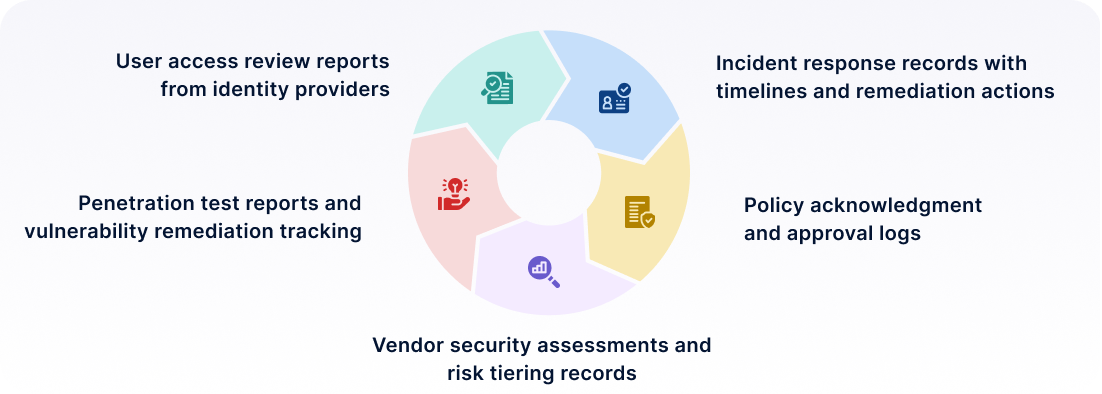
When evidence is consistently captured and organized, teams can demonstrate their security posture without scrambling for documentation. This shift turns compliance from a reactive activity into a reliable operational process.
This is what enterprise buyers, investors, and auditors are consistently evaluating at your stage. Not every item carries equal weight, but each one is a signal. Gaps in any of them create friction in exactly the moments that matter most.
Enterprise customers run security reviews before signing contracts. Investors ask about risk exposure during diligence. Boards want to know how security incidents would be handled if something went wrong.
Most of these stakeholders are not evaluating your entire security program. They are looking for a small set of signals that show whether compliance and security are managed deliberately. When those signals are present, the company looks credible.
The checklist below covers the practices that most clearly demonstrate operational maturity at the Series B stage. It is not exhaustive, but it reflects what enterprise buyers, investors, and auditors consistently evaluate.

Independent validation of security practices

Risk mitigation and monitoring are operational

Controlled access to critical systems

Incident response readiness

Policies that reflect real operations

Evidence that controls actually operate
Enterprise procurement teams and investors rarely audit your controls themselves. They rely on independent validation to confirm your security practices are real. Without this, enterprise deals stall as customers manually evaluate your controls.
That's not a security problem. It's a sales problem.
Enterprise buyers and investors rarely audit every control themselves. Instead, they rely on certifications or third-party assessments to confirm that security practices are documented and consistently implemented.
At the Series B stage, companies are typically expected to have one of the following underway:
 SOC 2 Type II completed or well into the observation period. Type I is increasingly seen as an interim step that triggers immediate follow-up questions about the Type II timeline.ISO 27001 certification in progress or on a concrete roadmap, especially for companies selling internationally, where SOC 2 has limited recognition outside North America.Industry-specific frameworks where applicable. HIPAA with a Business Associate Agreement for healthcare SaaS handling PHI or PCI DSS for companies processing payment data.
The expectation is not that every certification is complete.
What matters is demonstrating that the organization has reached a level of structure where its security practices can withstand external scrutiny and that a credible timeline exists for any certifications still in progress.
Without this signal, enterprise deals often stall during security reviews as customers manually evaluate controls.
Identifying risks is only the starting point. What investors and enterprise buyers look for at the Series B stage is whether those risks are actively managed over time.
In most organizations, this management happens through a risk register that tracks risks, mitigation actions, and ownership across the business.
The question isn't whether a risk register exists. It's whether it reflects your current business and whether leadership actually looks at it. Signs it's just a compliance artifact: last updated during the previous audit cycle, written in framework language, owners who don't know they own anything, and no mention of AI tools your team is already using.
A real Series B-stage company’s risk process should do four things.

First, it should capture risks that actually reflect the business, not template language. That includes identity risk, customer data exposure, infrastructure concentration, incident response gaps, vendor dependencies, weak change control, and now AI-related risks such as unsanctioned tool use, model-driven data exposure, excessive agent permissions, and unreviewed AI outputs entering customer-facing or internal decision workflows.

Second, it should show business impact, not just technical severity. A risk that can delay enterprise deals, create regulatory exposure, or expose proprietary data belongs in leadership conversations.

Third, it should connect to mitigation and evidence. If a risk states that privileged access is not consistently reviewed, the mitigation cannot just say “implement review process.” It should tie to an actual control, owner, review cadence, and proof that the review happened.

Fourth, it should be reviewed. Not annually because a framework says so. Regularly enough to reflect the current business. This is where much of the AI talk falls apart. Companies claim they are embracing AI securely, but when you look at the register, there is no record of AI use cases, no inventory of approved tools, no classification of where sensitive data may be exposed, no testing of model outputs, and no escalation path for AI-related incidents. That is not governance. That is wishful thinking.
NIST’s AI Risk Management Framework is voluntary. Still, it is useful because it pushes organizations to treat AI risk as a governance issue throughout the lifecycle, not as a one-time legal or procurement review. NIST also released a Generative AI Profile to help organizations operationalize those risks more concretely.
If your company is using AI in engineering, support, internal productivity, analytics, or customer workflows, the risk register should reflect that plainly.
The question is no longer just which humans have access to what. It's also which AI tools, agents, connectors, and integrations can reach your systems and your data.
In most Series B companies, the answer to that second question is "we're not entirely sure," and that's a governance gap that shows up in enterprise security reviews.
A serious access model now needs to cover:
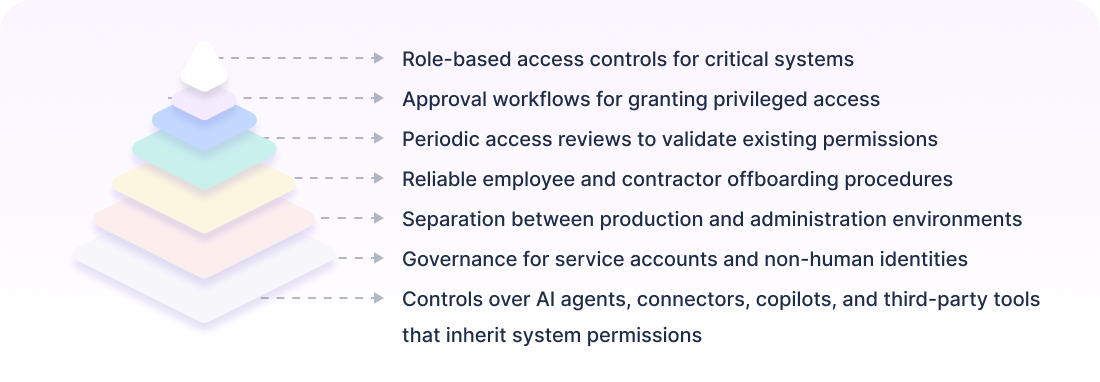
A publishable compliance story at Series B should reflect this reality. It should clearly state that access control now includes both human- and machine-mediated access. It should show how sensitive systems are protected from unnecessary permissions, how high-risk access is reviewed, and how AI-enabled workflows are bounded so that convenience does not quietly become exposure.
Every investor and enterprise buyer will eventually ask: "What happens when something goes wrong?" This isn't a theoretical question. It's an evaluation of whether your leadership team has thought through the operational reality of a security incident, or whether you'd be figuring it out in real time.
A board member asking "how would we handle a breach?" should get a specific, confident answer, not a policy document.
Most Series B companies maintain:

A documented incident response plan

Defined escalation and communication paths

Records of past incidents and remediation actions
During diligence or security reviews, leadership may be asked to explain how previous incidents were handled.
A structured response process demonstrates that the company can quickly contain issues, coordinate internally, and communicate responsibly with customers and stakeholders.
Enterprise security reviewers read policies with one question in mind: Does this reflect reality, or was it written for an audit? A strong Series B policy set isn't comprehensive. It's accurate. Specific tools are named. Real owners are assigned. SLAs match what your team can consistently execute and evidence.
Policies are often created early in a company’s compliance journey. As organizations grow, stakeholders begin to evaluate whether those policies actually reflect how the company operates.
Enterprise security reviewers frequently request policies to understand:
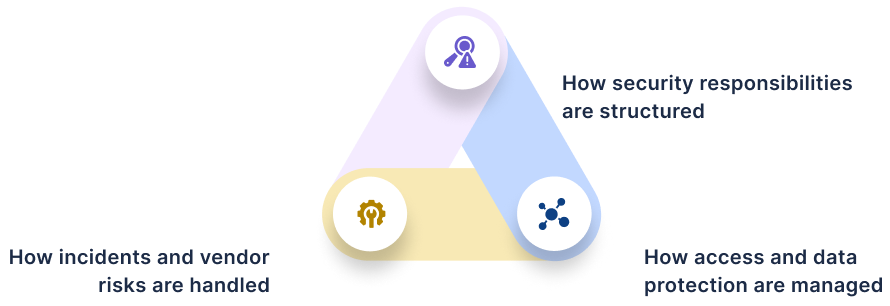
Common policy areas at this stage include:

Security governance

Access management

Data protection

Vendor security
A strong policy set at Series B is not massive. It is accurate.
That usually means your core policies clearly explain how the company handles access control, asset and data management, incident response, vulnerability management, vendor risk, acceptable use, change control, and security governance.
If AI is being used, the policy layer should also specify which kinds of AI use are allowed, which data restrictions apply, who approves new tools, what must be logged, and how exceptions are handled.
This matters for more than neat documentation. The EU AI Act has already begun applying obligations in phases, including prohibitions on certain practices and AI literacy requirements, with broader obligations rolling in on a staggered timeline through 2026 and 2027.
When policies align with operational reality, they become valuable governance tools rather than documents written solely for audits.
The most common gap in Series B compliance programs isn't missing controls. It's missing proof that controls are running.
The test is simple: if a large enterprise prospect sent a security questionnaire tomorrow, how long would it take your team to respond with current, accurate evidence? If the honest answer is "a few weeks and several Slack threads," your compliance program is functioning as a system of record, not a system of proof.
Examples of commonly requested evidence include:
When this evidence is organized and accessible, teams can respond to security reviews, audits, and investor questions without scrambling for documentation.
At the Series B stage, the standard is higher. Evidence should be generated as part of daily operations, not assembled in panic after the question arrives. This typically includes:
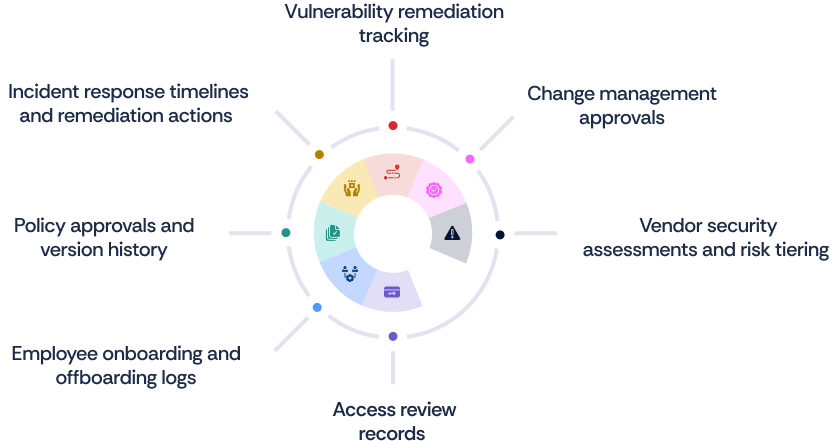
In 2026, organizations also need to capture evidence related to AI usage where relevant. As teams adopt AI tools across engineering, support, analytics, and internal productivity workflows, governance expectations expand accordingly.
Examples of AI-related evidence include:

An inventory of approved AI tools and internal AI use cases

Documented restrictions on what data can and cannot be entered into external models

Approval records for AI integrations, including what systems they connect to and what data they can access
Automation platforms can help collect evidence, maintain control mappings, and reduce manual overhead. That is useful. But evidence quality still depends on whether the underlying control is properly designed, consistently followed, and intelligently scoped.
Bad controls do not become trustworthy because a platform can screenshot them faster. The real test is simple: if a large prospect sends a security questionnaire tomorrow, can your team respond with current, defensible evidence without turning it into an emergency?
If the answer is no, the problem is not just efficiency. It is control reliability.
By the time companies reach Series B, most have already invested significant effort into building a compliance program.
Policies exist. Controls are documented. Evidence is collected. Certifications may even be underway. Yet many organizations still struggle during security reviews, audits, or investor diligence.
Most Series B companies have invested real effort in compliance. The failure mode isn't that the work isn't done. It's that the systems supporting that work were built to document compliance, not to run it continuously.
This distinction becomes increasingly visible as companies scale.
| Compliance tracking | Compliance execution |
|---|---|
| Policies documented | Continuous monitoring |
| Controls recorded | Automated control checks |
| Evidence collected | Evidence generated automatically |
| Certifications in progress | Operational risk response |
Early-stage compliance programs often grow around whatever tools are available at the time.
A spreadsheet tracks risks. Policies live in a document repository. Evidence is stored in shared folders. Alerts appear in monitoring tools. Individually, these systems work. Together, they create fragmentation.
Evidence may exist, but locating it requires manual effort. Risk registers are updated during audits, but not always revisited during day-to-day operations. Access reviews happen when someone remembers to run them, not when the system indicates they are overdue.
The result is a program that records activity but struggles to drive action. This gap becomes visible when external stakeholders begin asking operational questions.
An enterprise buyer may request proof that access reviews happened in the last quarter. An investor may ask how vendor risks are monitored over time. A board member may want to know how quickly the team can detect and respond to unusual activity.
If the answer requires manually assembling documentation, the compliance system is still primarily a system of record.
Forrester’s recent work on GRC platforms identifies the most important shift happening in this space: the move from systems of record to systems of action. A system of record stores and organizes. It's where your policies live and your evidence accumulates. Valuable, but passive.
A system of action uses that information to detect gaps, trigger workflows, and surface work that needs to happen. For Series B companies, this shift matters because compliance expectations at your stage are increasingly about execution, not documentation. Investors don't want to see a policy. They want to see the policy running.
A system of records stores and organizes information. In compliance programs, this often includes:
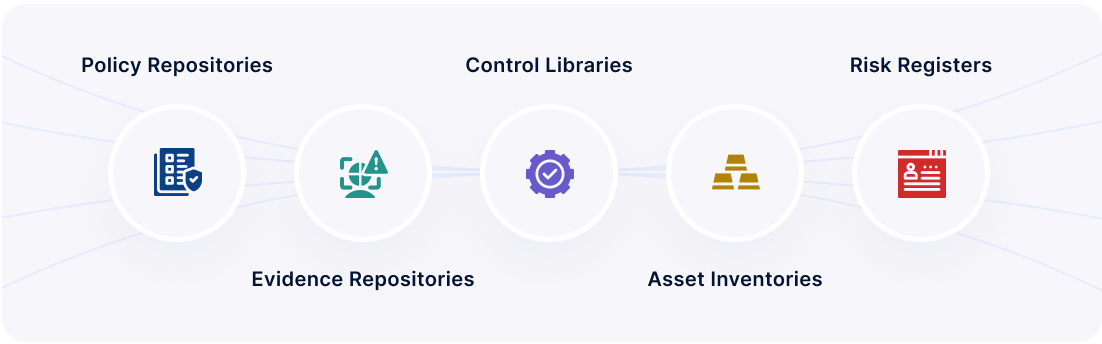
These systems are valuable because they create structure. They help teams document how security practices are designed and how risks are tracked.
But documentation alone does not guarantee that those practices continue operating correctly. That is where systems of action begin to emerge.
A system of action does not simply store information. It uses that information to detect issues, trigger workflows, and surface tasks that require attention.
In a compliance context, this may include:
Instead of waiting for an audit to expose gaps, systems of action help organizations detect them earlier as part of normal operations. For Series B companies, this shift matters because compliance expectations increasingly focus on execution rather than documentation.
Stakeholders want to see that controls operate continuously, not just that they exist on paper.
As compliance platforms evolve toward systems of action, AI begins to play a practical role. The value of AI in compliance is not that it replaces governance processes. It helps teams identify and execute the work those processes require.

Identifying missing evidence for required controls

Highlighting unusual access patterns across connected systems

Monitoring vendor risk signals and surfacing reassessment triggers

Summarizing incident timelines from logs and ticketing systems

Mapping security questionnaires to existing controls and evidence
These capabilities do not eliminate the need for compliance work. They help teams identify where that work is needed and ensure it happens before an external stakeholder asks for it. This becomes particularly relevant as organizations introduce AI into their own operations.
Engineering teams may experiment with AI-assisted development tools. Customer support teams may use AI to draft responses. Internal productivity tools increasingly rely on AI-driven assistants.
Each of these use cases introduces new governance considerations:
Compliance systems that operate purely as documentation repositories struggle to track these dynamics. Systems of action, supported by AI-assisted monitoring and workflows, make it easier to surface and manage them.
When compliance shifts from documentation to execution, the program’s daily experience changes.
When compliance shifts from documentation to execution, the program’s daily experience changes.
 Evidence begins to appear automatically as controls run.Access reviews are surfaced when they are due.Changes in infrastructure or vendor relationships trigger reassessment workflows.Risk registers reflect current conditions rather than static documentation.
Teams no longer spend most of their time searching for evidence or assembling reports. Instead, they focus on verifying that controls operate correctly and addressing issues when they appear.
AI-assisted systems help by identifying signals that would otherwise require manual investigation. They can highlight unusual access behavior, surface incomplete documentation, or summarize operational activity that auditors or customers may request.
Over time, this changes how organizations experience audits and security reviews. Preparation becomes less about gathering documents and more about confirming that existing processes are functioning as expected.
In other words, audits shift from evidence collection to verification.
For companies approaching Series B, this operational model is increasingly becoming the difference between compliance programs that look credible and those that appear reactive.
As compliance platforms continue to evolve toward systems of action, another shift is emerging.
Instead of relying entirely on centralized teams, organizations are starting to distribute compliance work across specialized AI-assisted workflows that continuously monitor controls, surface risks, and gather evidence.
By the time companies reach Series B, compliance expectations begin to show up in everyday business moments:
Enterprise deals trigger security reviews
Investors examine operational maturity during diligence
Boards ask leadership to demonstrate incident readiness
The difference between a compliance program that tracks activity and one that operates continuously becomes visible in these situations. When compliance systems function primarily as systems of record, these requests often trigger last-minute preparation and manual coordination.
When compliance operates as a system of action, the information already exists and the processes behind it are visible.
The difference is easiest to understand through three common scenarios.
A security questionnaire from a target enterprise account lands in your inbox.
Under a traditional compliance model, this often triggers two to three weeks of work. Sales forwards the questionnaire to security or engineering teams. Previous responses are searched for in shared folders. Policies and screenshots are gathered from multiple systems to support the answers. Senior engineers may need to review responses to confirm technical details.
Security reviews become a bottleneck in the sales process, and leadership begins to treat them as a potential risk to closing deals.
Under an operational compliance model, the response looks very different. Evidence is already organized, controls are mapped to supporting documentation, and previous questionnaire responses can be reused and validated quickly. AI-assisted workflows can help generate draft answers based on existing policies, controls, and historical responses.
Instead of assembling information from scratch, teams review and finalize responses that already reflect the company’s operational practices.
What previously required several weeks of coordination can often be completed in a few days. The deal does not slip a quarter, and security reviews stop being viewed as a sales cycle risk.

See how Athenium used AI-assisted compliance workflows to centralize evidence and documentation, making it easier to respond to audits and enterprise security reviews.
During a Series B funding process, investors typically conduct technical diligence on security and compliance practices. Under a traditional model, these requests often trigger a short preparation sprint. Teams gather policy documents, assemble evidence folders, and attempt to summarize the organization’s security posture in a format that investors can review quickly.
The underlying work may already exist, but it is scattered across different systems and repositories. Preparing a coherent view of the program requires manual effort. Under an operational compliance model, the response is far more straightforward.
Instead of assembling documentation under pressure, the company can provide a structured view of its compliance program: the control library, the current risk register, supporting evidence, and records of recent reviews.
The message this sends to investors is not simply that the company has achieved compliance milestones. It demonstrates that security and risk management practices operate continuously and are integrated into the company’s daily operations.
For investors evaluating operational maturity, that distinction is meaningful.
Boards increasingly expect leadership teams to understand and manage operational risk.
A common question is how the company would respond to a security incident or data breach.
Under a traditional compliance model, the answer often references a policy document and a general description of the response process. While the organization may have defined procedures, it can be difficult to demonstrate how those procedures would operate in practice.
Under an operational compliance model, the conversation becomes more concrete.
Leadership can identify the incident commander responsible for coordinating the response. The organization can reference a tested response playbook, documented communication procedures, and records from recent tabletop exercises that simulate incident scenarios.
Instead of describing how the company intends to respond, the discussion demonstrates how the response process already operates.

See how AllCloud used AI-assisted workflows to organize compliance knowledge and reduce reliance on individual expertise when responding to security questionnaires and security reviews.
By Series B, these scenarios occur regularly. Enterprise customers evaluate security posture before signing contracts. Investors examine operational maturity during diligence. Boards expect leadership to demonstrate readiness for operational risks.
When compliance systems function only as documentation repositories, each of these moments creates additional operational pressure. When compliance operates as a system of action, supported by AI-assisted workflows, the organization is able to respond confidently because the underlying processes are already running.
The difference is not simply better documentation. It is the ability to show that compliance practices operate continuously as part of how the business runs.
Compliance at Series B isn’t about having a SOC 2 certificate on your website or a thick policy binder in a shared drive.
It's about being able to answer three questions on any given day, from any investor, enterprise buyer, or board member, without an emergency: What are your security practices? Are those practices actually running? What happens when something goes wrong?
The founders who handle the Series B transition smoothly are the ones who’ve built compliance as an operational system, not a documentation exercise. The ones who struggle discover, too late in a deal cycle or a diligence process, that the gap between what they do and what they can prove is bigger than they thought.
That gap is closable. And the earlier you close it, the more it works for you: in deals, in diligence, and in the boardroom.
AI-assisted compliance platforms are accelerating this shift by helping organizations monitor risks, maintain evidence, and keep controls operating as the business grows.
For Series B companies, the goal is not to build a larger compliance program. It is to build one that works reliably without slowing the company down.
Book a 30-minute walkthrough. We'll map your current posture against the Series B checklist and show you exactly where the gaps are.

With Scrut, your security program isn’t just about keeping pace; it’s about setting the pace. Embrace the new kind of GRC that fuels growth and resilience.