Reviewing vendor SOC 2 reports: What to look for and what to flag
Last updated on
June 5, 2026
7
min. read
Reviewing vendor SOC 2 reports is one of the most important steps in your third-party risk management program. According to SecurityScorecard’s 2025 Global Third-Party Breach Report, at least 35.5% of all data breaches in 2024 originated from third-party compromises.
A breach at one of your vendors can expose your sensitive data just as easily as a direct attack, making vendor risk management a critical part of your security strategy. Evaluating a vendor’s SOC report is not just a formality; it is a critical step in assessing their commitment to security, privacy, and compliance.
Done right, a thorough SOC 2 review can help you identify risks, ensure data integrity, and strengthen your organization’s overall security posture. Here is a detailed, step-by-step guide to reviewing SOC 2 reports confidently and effectively.
Summary overview:
Reviewing vendor SOC 2 reports is a core part of any third-party risk management program. Knowing what each section contains, what type of report to request, and what red flags to watch for helps you make informed vendor decisions rather than rely on unverified security claims.
A structured review process covers more than just the auditor's opinion. It includes validating control effectiveness, assessing Complementary User Entity Controls (CUECs), evaluating incident response procedures, and determining whether the vendor's posture aligns with your organization's specific compliance and risk requirements.
Manual vendor SOC 2 report management does not scale. Centralizing report collection, tracking expiration dates, and linking vendor controls to internal risk frameworks through a platform like Scrut gives your team continuous visibility into third-party security posture without the operational overhead.
What is a vendor SOC 2 report?
Quick definition: A vendor SOC 2 report is an independent audit report that evaluates how a service organization protects customer data. Produced by a certified public accountant (CPA), it assesses controls across five Trust Services Criteria: Security, Availability, Processing Integrity, Confidentiality, and Privacy.
It is typically requested by customers and business partners to evaluate a vendor’s security and compliance practices before entering into or continuing a business relationship. Unlike SOC 1, which focuses on financial reporting controls, SOC 2 has a broader scope, covering the full range of operational and data protection controls that determine how safely a vendor handles your information.
SOC 2 report types: Type I vs. Type II
There are two types of SOC 2 reports, each serving a different purpose depending on where a vendor is in their compliance journey.
Type I evaluates the design of a vendor’s security controls at a specific point in time. It does not assess whether those controls are functioning consistently, making it a useful starting point for understanding a vendor’s compliance posture, but limited in the assurance it provides.
Type II assesses both the design and the operating effectiveness of controls over a defined review period, typically six to twelve months. It offers a far more comprehensive picture of how a vendor actually manages security in practice, which is why it is the preferred report type for vendor risk assessments.
SOC 2 Type I
SOC 2 Type II
Review scope
Point-in-time review
Multi-month review
What it evaluates
Design effectiveness
Design and operating effectiveness
Assurance level
Lower assurance
Higher assurance
Best used for
Preliminary assessment
Preferred for vendor reviews
SOC 1 vs. SOC 2 vs. SOC 3: What’s the difference?
Beyond Type I and Type II distinctions, it helps to understand where SOC 2 sits within the broader family of SOC reports.
SOC 1
SOC 2
SOC 3
Focus
Financial controls
Security and compliance controls
Public summary of SOC 2 findings
Audience
Auditors and finance teams
Customers and security teams
General public
Governing standard
SSAE 18
SSAE 18
SSAE 18
Detail level
High
High
Low
Publicly shareable
No
No
Yes
Report types
Type I and Type II
Type I and Type II
Single report
Best used for
Financial reporting audits
Vendor risk assessments
Marketing and trust pages
For vendor risk assessments, SOC 2 reports provide the most actionable security and control information. SOC 3 reports are publicly shareable but lack the control-level detail needed for a meaningful evaluation, while SOC 1 is scoped to financial reporting and does not address broader security practices.
SOC 2 Trust Services Criteria explained
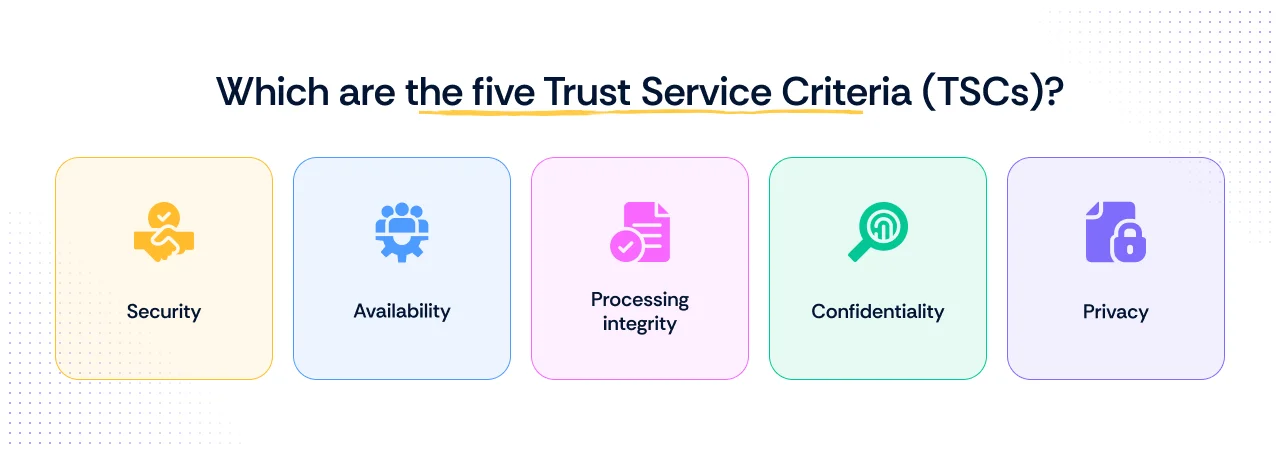
SOC 2 reports analyze whether vendors process data securely. The AICPA prescribes five Trust Services Criteria (TSCs) against which a vendor’s controls are evaluated. Understanding each criterion helps you assess whether a vendor’s report covers the areas most relevant to your organization's risk exposure.
Security: Security, also known as the Common Criteria, refers to the protection of information and systems from unauthorized access. It is the only mandatory criterion in every SOC 2 audit and forms the foundation of the entire assessment.
Availability: This criterion ensures that systems and data are accessible to authorized users when needed to perform specific duties. This criterion is particularly relevant for vendors whose services are operationally critical to your business.
Processing integrity: The third criterion ensures that systems perform their intended functions without delay, errors, or unauthorized modifications. It confirms that data is processed completely, accurately, and on time.
Confidentiality: Confidentiality requires that sensitive data, including customer information and proprietary business data, be encrypted in transit and at rest, and is accessible only to authorized individuals with a legitimate need.
Privacy: The Privacy criterion covers how vendors collect, use, retain, and dispose of personally identifiable information (PII). Vendors must adhere to applicable privacy regulations and must not share personal data without the explicit consent of the individual concerned.
What does a SOC 2 report contain?
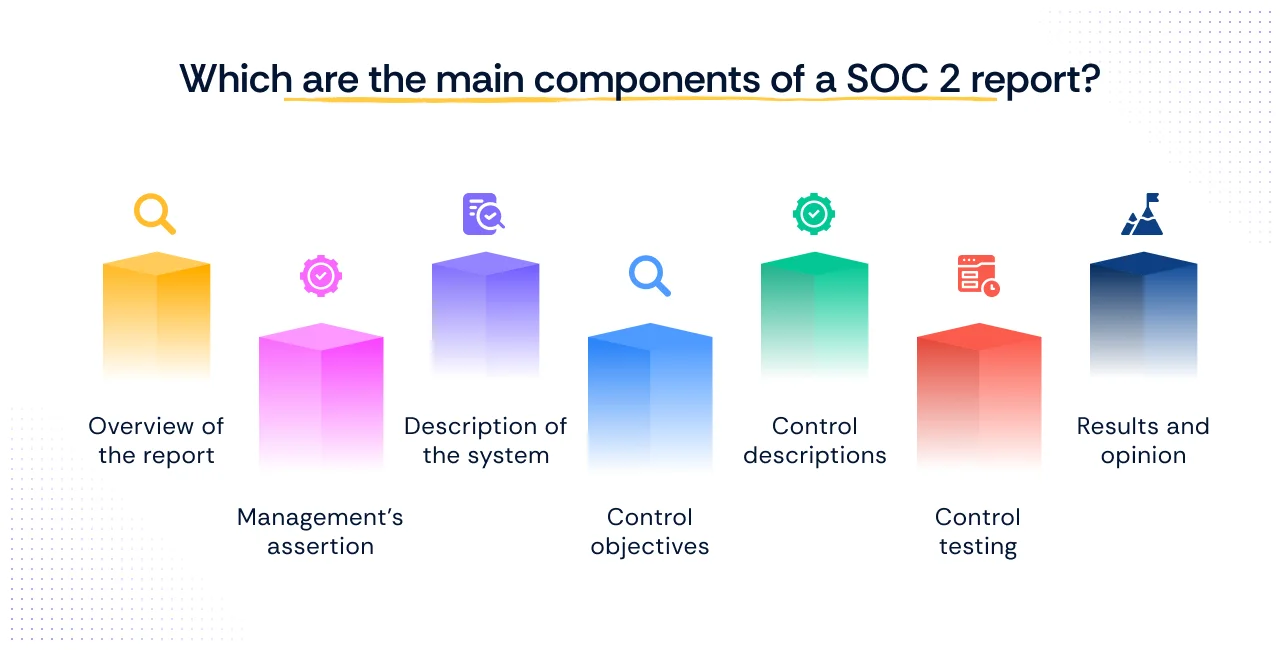
Independent auditors verify the implementation of SOC 2 controls within a service organization. A typical vendor SOC 2 report is structured across the following sections, each serving a distinct purpose in the assessment.
Overview of the report: The opening section covers the purpose, scope, and objectives of the audit, including the time period under review and the Trust Services Criteria that were assessed.
Management’s assertion: The vendor’s management provides a formal statement affirming that its controls are designed and operating in accordance with the relevant Trust Services Criteria. This section establishes the vendor’s accountability for the claims made throughout the report.
Description of the system: This section details the systems and services provided by the organization, including its infrastructure, software applications, data flows, and operational processes that fall within the audit scope.
Control objectives: The specific control objectives that the vendor aims to achieve are listed here, each aligned with the applicable Trust Services Criteria agreed upon at the outset of the audit.
Control descriptions: This section provides detailed descriptions of the controls implemented to meet each control objective, giving reviewers a clear picture of how the vendor operationalizes its security commitments in practice.
Control testing: The auditor documents the testing procedures used to evaluate control effectiveness, including methodologies, sample sizes, and test results. This section is present only in Type II reports and is one of the most important parts of the review.
Results and opinion: The auditor records their independent conclusion on whether the controls meet the applicable Trust Services Criteria, including any exceptions, deficiencies, or qualifications identified during the audit.
The table below summarizes the key sections to focus on when reviewing a vendor’s SOC 2 report and what each one tells you.
Section
Purpose
Auditor opinion
Overall assessment of control effectiveness
Management assertion
Establishes vendor responsibility for stated controls
System description
Defines the scope of the audit
Control testing
Provides evidence of operating effectiveness
Findings
Surfaces exceptions or control deficiencies
CUECs
Identifies customer-side responsibilities that complement vendor controls
How to request a vendor SOC 2 report
SOC 2 reports are issued by independent CPA firms accredited by the AICPA. Vendors typically share them with customers under a non-disclosure agreement (NDA) during procurement, onboarding, or annual security reviews. Knowing how and when to request these reports is an important part of building a repeatable vendor risk management process.
How to get a SOC 2 report from a vendor
Requesting a vendor SOC 2 report does not have to be an ad hoc exercise. The following approaches help standardize the process across your vendor portfolio.
Reach out to the vendor’s security or compliance team directly: Most vendors with a SOC 2 report have a designated point of contact for audit documentation requests. A formal written request, accompanied by a signed NDA if required, is typically sufficient to initiate the process.
Include the report request in your vendor onboarding checklist: Standardizing the SOC 2 report request as part of onboarding ensures that no vendor relationship moves forward without a baseline security review. This removes the need to chase documentation after a contract is signed.
Check the vendor’s trust center: Many vendors publish their compliance certifications and audit report availability through a dedicated trust center or security page. This can significantly reduce the time needed to initiate a request.
Centralize requests through a vendor risk platform: For organizations managing a large number of vendors, routing SOC 2 report requests through a vendor risk management platform helps track report versions, expiry dates, and review status in one place.
What if a vendor doesn’t have a SOC 2 report?
The absence of a SOC 2 report does not automatically disqualify a vendor, but it does require additional due diligence. The following alternatives can help you assess vendor security posture when a SOC 2 report is not available.
Request ISO 27001 certification:ISO 27001 is a widely recognized international standard for information security management. A valid certification from an accredited body indicates that the vendor has implemented a structured security program, though it covers different criteria than SOC 2.
Request penetration test summaries: A recent third-party penetration test report, typically from the past twelve months, can provide insight into known vulnerabilities and how the vendor has addressed them.
Use security questionnaires: Standardized questionnaires such as the SIG (Standardized Information Gathering) or CAIQ (Consensus Assessments Initiative Questionnaire) from the Cloud Security Alliance can serve as a structured alternative for evaluating security practices when formal audit reports are unavailable.
Evaluate the vendor’s risk tier: Not all vendors carry equal risk. If a vendor processes sensitive data or has deep access to your systems, the absence of a SOC 2 report should be treated as a significant risk signal. Lower-risk vendors with limited data access may be acceptable with compensating controls in place.
Add contractual compliance requirements: Where gaps exist, include security and compliance obligations directly in vendor contracts. This may include timelines for achieving SOC 2 compliance, notification requirements in the event of a breach, and rights to audit or request updated documentation at defined intervals.
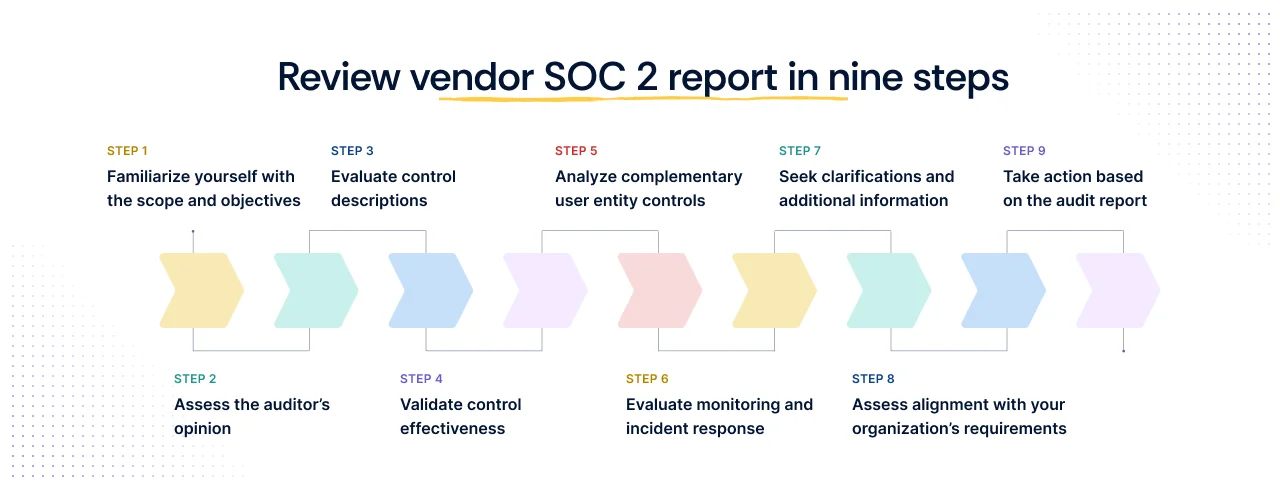
How to review vendor SOC 2 reports: 9 easy steps
Reviewing a vendor’s SOC 2 report requires a systematic approach to fully understand what the report covers and what it means for your organization’s risk exposure. The following steps walk you through the process from start to finish.
Step 1: Familiarize yourself with the scope and objectives
The first step is to understand what the vendor’s SOC 2 report actually covers. Review the systems, services, and processes within the audit scope and confirm they align with the services the vendor provides to your organization.
Pay attention to whether the report is a Type I or Type II, as this significantly affects the level of assurance it provides. Type II reports, which assess operating effectiveness over a defined period, offer a more reliable basis for vendor risk decisions than Type I reports, which reflect only a point-in-time assessment.
Step 2: Assess the auditor’s opinion
The auditor’s opinion section provides an overall assessment of the vendor’s control environment and should be read before any other part of the report. Look for any qualifications, exceptions, or noted deficiencies, as these signal areas where the vendor’s controls fell short during the audit period.
The nature and volume of exceptions in this section will give you an early indication of whether the vendor’s security posture is likely to meet your organization’s requirements.
Step 3: Evaluate control descriptions
Carefully review the control descriptions to assess whether the vendor’s implemented controls align with your organization’s security and compliance requirements. Check for controls related to each of the Trust Services Criteria in scope and evaluate whether the descriptions are specific enough to be meaningful.
Vague or generic control descriptions may indicate that the vendor has not operationalized its security commitments in a consistent or verifiable way.
Step 4: Validate control effectiveness
For Type II reports, look for evidence that the controls described are not only well-designed but also operating as intended. Review the testing procedures, sample sizes, and results documented by the auditor.
Pay close attention to any control deficiencies or exceptions and evaluate their potential impact on your data. A small number of isolated exceptions with documented remediation is very different from repeated failures across the same control area.
Step 5: Analyze complementary user entity controls
Many vendor SOC 2 reports include a section on Complementary User Entity Controls (CUECs), which are controls that the vendor expects its customers to have in place for the overall control environment to function as intended.
For example, a vendor may encrypt data in transit but expect your organization to manage access controls on your end. Review the CUECs carefully and assess whether your organization already has these controls in place or whether any gaps need to be addressed before or during the vendor engagement.
Step 6: Evaluate monitoring and incident response
Review the vendor’s documented processes for security monitoring, incident detection, and incident response. Look for evidence of regular testing, defined escalation procedures, and clear timelines for breach notification.
A vendor with a well-documented and regularly tested incident response program demonstrates a more mature security posture than one that relies on undocumented or ad hoc procedures.
Step 7: Seek clarifications and additional information
If any section of the report raises questions or lacks sufficient detail, reach out directly to the vendor’s security or compliance team. Requesting clarification on specific controls or asking for supplementary documentation is a standard part of the vendor review process and helps ensure that no potential risks are overlooked due to ambiguous or incomplete reporting.
Step 8: Assess alignment with your organization’s requirements
Once you have reviewed the report in detail, assess whether the vendor’s controls and compliance posture align with your organization’s specific security, compliance, and risk management requirements. Consider the nature of the data the vendor handles, the criticality of the services they provide, and the regulatory obligations your organization is subject to.
A vendor handling sensitive personal data under HIPAA or GDPR, for instance, requires a more rigorous alignment check than one providing a lower-risk ancillary service.
Step 9: Take action based on the audit report
SOC 2 audit reports fall into three categories, each requiring a different response.
An unqualified report indicates that the vendor’s controls are well-designed and operating effectively in accordance with the applicable Trust Services Criteria. This is the expected outcome for a vendor in good standing.
A qualified report indicates that the controls are largely adequate but contain exceptions or areas that require improvement. Before proceeding with a vendor carrying a qualified report, assess the nature of the exceptions in relation to the data and services involved.
An adverse report indicates that the vendor’s controls do not meet SOC 2 standards. Engaging a vendor with an adverse report represents a significant risk and should prompt a formal risk escalation before any decision is made.
Get your free vendor SOC 2 review checklist
Stop reviewing vendor reports without a system in place. Download this 76-point checklist to catch every red flag, from expired reports to carve-out gaps, before they become your problem.
Vendor SOC 2 report review checklist
Use the following checklist to structure your review process and ensure nothing is overlooked.
Before you start
Confirm whether the report is a Type I or Type II and understand what level of assurance each provides.
Check the audit period to ensure the report is current and covers a meaningful review window.
Verify the credibility of the CPA firm that conducted the audit by confirming its AICPA accreditation.
During review
Read the auditor’s opinion first to get an overall picture before diving into the details.
Confirm that the audit scope covers the systems and services relevant to your vendor relationship.
Review the Trust Services Criteria in scope and assess whether the right criteria have been included, given the nature of the vendor’s services.
Identify all exceptions and deficiencies and evaluate their severity and remediation status.
Review the CUECs and confirm whether your organization has the required controls in place.
Assess the vendor’s monitoring and incident response procedures for completeness and operational maturity.
After review
Document your findings, including any exceptions, gaps, or unresolved questions, in a structured review record.
Follow up with the vendor on any identified gaps and request a remediation timeline where applicable.
Schedule a re-review aligned with the vendor’s next annual audit cycle or sooner if material exceptions were identified.
Store the report centrally within your vendor risk management system to ensure it is accessible for future reviews and audit evidence requests.
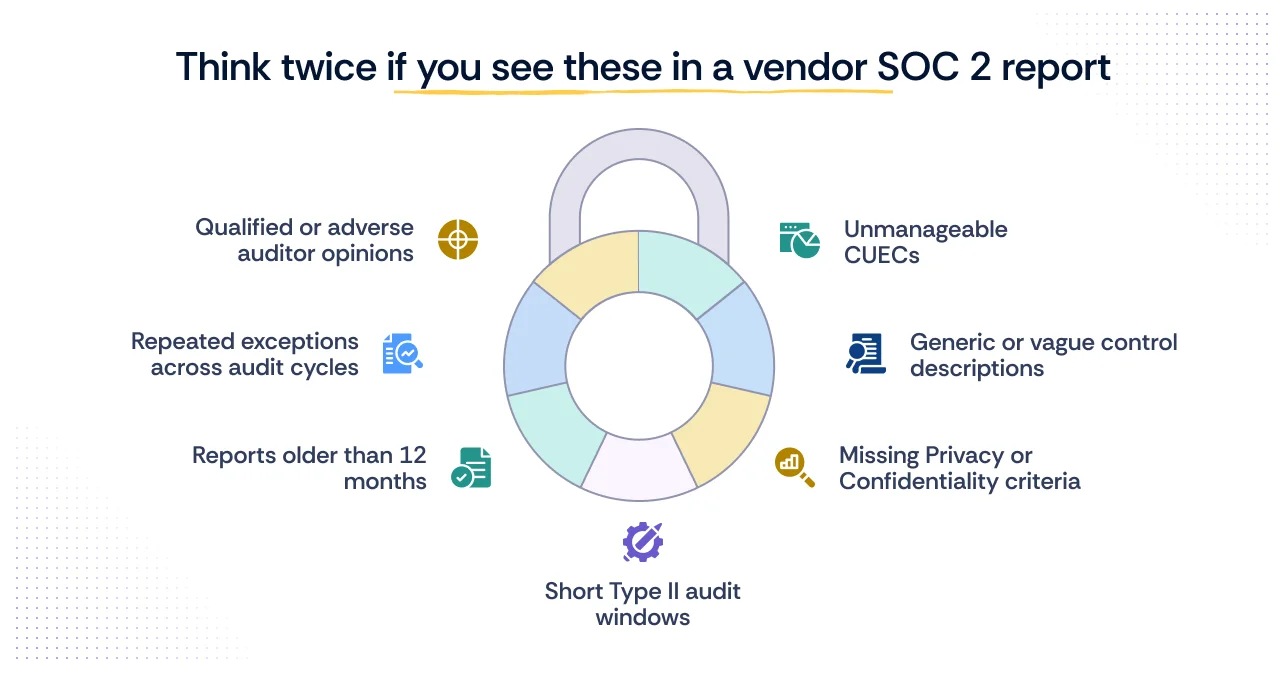
Red flags to watch for in a vendor SOC 2 report
Not every vendor’s SOC 2 report tells a reassuring story. The following are warning signs that warrant closer scrutiny or a formal risk escalation before proceeding with a vendor engagement.
Qualified or adverse auditor opinions: These indicate that the vendor’s controls either have significant gaps or do not meet SOC 2 standards altogether. A qualified opinion requires careful review of the specific exceptions; an adverse opinion should trigger a formal risk review before any further engagement.
Repeated exceptions across audit cycles: A single exception with documented remediation is manageable. The same exception appearing across multiple audit periods suggests that the vendor is not effectively addressing known control failures.
Reports older than 12 months: SOC 2 reports are typically valid for one year. A report that falls outside this window offers no assurance about the vendor’s current security posture and should prompt an immediate request for an updated report.
Short Type II audit windows: A Type II report covering only three to four months provides significantly less assurance than one covering a full twelve-month period. Short audit windows may indicate that the vendor is newly certified and has limited evidence of sustained control effectiveness.
Missing Privacy or Confidentiality criteria: If a vendor processes personal data or sensitive business information on your behalf and their SOC 2 report does not include the Privacy or Confidentiality criteria, there is a meaningful gap in the scope of the audit that may not be visible elsewhere in the report.
Generic or vague control descriptions: Control descriptions that use broad, non-specific language without referencing actual processes, tools, or ownership structures are difficult to evaluate and may suggest that controls exist on paper but are not consistently operationalized.
Unmanageable CUECs: If the vendor’s report places an excessive or technically unrealistic set of control responsibilities on the customer, this can create compliance gaps that are difficult to close and may signal that the vendor has shifted accountability for security controls to the customer rather than managing them internally.
How often should you review vendor SOC 2 reports?
Reviewing a vendor SOC 2 report once at onboarding is not sufficient. Vendor security postures change, audit findings evolve, and new risks emerge over time. A structured review cadence, tied to the risk tier of each vendor, ensures that your organization maintains an up-to-date view of third-party exposure without reviewing every vendor at the same frequency.
Critical and high-risk vendors, particularly those with access to sensitive data or deeply integrated into your operational infrastructure, warrant annual reviews regardless of how clean their previous report was.
For medium-risk vendors, an 18 to 24-month cadence is generally sufficient, provided no significant changes have occurred in the relationship. Low-risk vendors with minimal data access and limited system integration can be reviewed at onboarding and monitored passively thereafter.
Trigger events that require an unscheduled review
In addition to scheduled reviews, certain events should prompt an immediate review of a vendor’s SOC 2 report outside the standard cadence.
A vendor breach occurs: Any confirmed or suspected security incident at a vendor should trigger an immediate review of their current SOC 2 report and a direct request for an incident summary, regardless of when the last scheduled review took place.
Services or data access change: If a vendor expands the scope of services they provide or gains access to additional systems or data, the original SOC 2 report may no longer reflect the full risk surface. A new review aligned with the updated scope is necessary.
The SOC 2 report expires: SOC 2 reports are generally considered current for twelve months from the end of the audit period. If a vendor has not issued an updated report before the previous one expires, this should be treated as a risk signal and escalated accordingly.
Regulatory requirements change: Changes in applicable regulations, such as updates to data protection laws or industry-specific compliance frameworks, may alter what you need to verify in a vendor’s control environment. A regulatory change affecting your organization’s obligations is a valid trigger for reviewing whether your vendors’ controls remain adequate.
Why reviewing vendor SOC 2 reports matters
“With Scrut, all I need to do is review the answers once. The system shows me exactly which documentation it’s using, and I step in only where judgment is required. That’s given me confidence that what goes out is accurate.” Ashish Khadloya, Co-founder, AllCloud
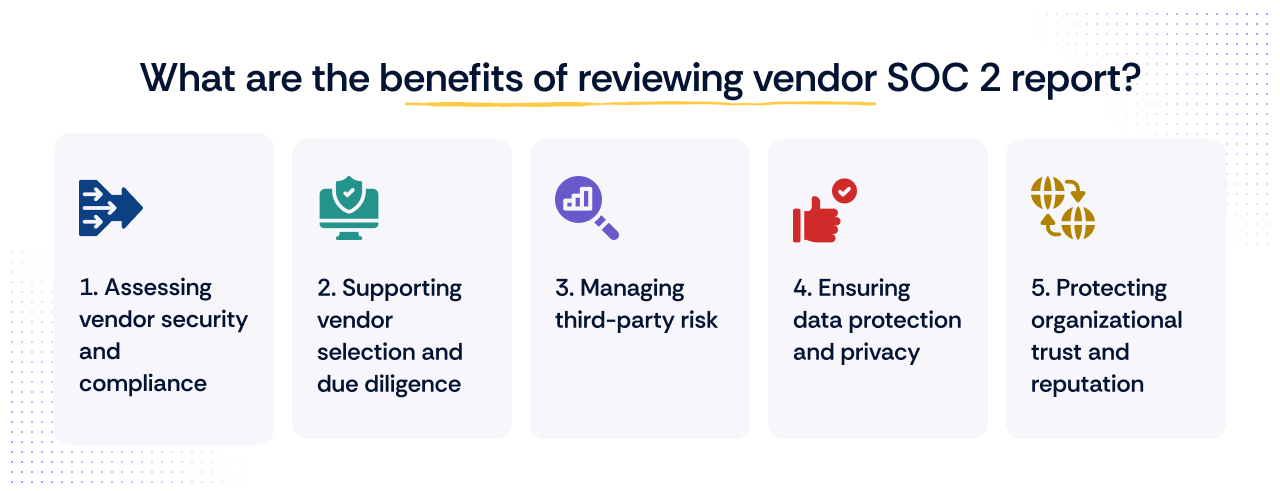
Vendor SOC 2 reports are not compliance paperwork. They are one of the most reliable signals available to assess whether a vendor is managing security in a way that protects your organization. Here is what a structured review process enables.
1. Assessing vendor security and compliance
Reviewing a vendor SOC 2 report allows you to evaluate the effectiveness of their security controls against the Trust Services Criteria and assess their compliance with applicable industry standards and regulatory requirements.
It provides an evidence-based basis for determining whether the vendor has implemented appropriate measures to protect data, rather than relying solely on their own representations.
2. Supporting vendor selection and due diligence
During procurement, vendor SOC 2 reports serve as a practical tool for comparing the security postures of prospective vendors. A vendor that holds a current Type II report demonstrates a documented commitment to protecting customer data and has undergone independent verification of that commitment, which strengthens the due diligence process and reduces the risk of onboarding a vendor with undetected control gaps.
3. Managing third-party risk
Control deficiencies identified in a vendor SOC 2 report provide an early warning of potential risks before they materialize into incidents.
A systematic review process allows your organization to make informed decisions about which vendors to engage, under what conditions, and with what compensating controls in place, rather than discovering gaps after a breach has occurred.
4. Ensuring data protection and privacy
Vendor SOC 2 reports evaluate controls specifically related to how a vendor collects, stores, processes, and disposes of data. Reviewing these controls helps confirm that the vendor is equipped to handle sensitive information in a manner consistent with your organization’s data protection obligations, including those imposed by applicable privacy regulations.
5. Protecting organizational trust and reputation
Your organization’s security posture is only as strong as the vendors it relies on. Engaging vendors who can demonstrate strong, independently verified security controls signals to your customers, partners, and regulators that your organization takes third-party risk seriously.
A vendor-related breach that could have been identified through a thorough SOC 2 review carries both financial and reputational consequences that are difficult to recover from quickly.
How Scrut streamlines vendor SOC 2 report management
Managing vendor SOC 2 reports across a growing vendor portfolio is time-consuming when done manually. Scrut centralizes the collection, review, and tracking of vendor SOC 2 reports so your team always has a current, auditable view of vendor security and compliance status.
Scrut Automation offers an AI platform powered by autonomous agents that operationalize continuous compliance and security. The platform replaces audit chaos with scalable execution, enabling growing businesses to build trust at scale and manage cyber risk effectively.
With Scrut, you can:
Automatically request SOC 2 reports from vendors at defined intervals, removing the need for manual follow-up.
Track report expirations so your team is alerted before a vendor’s SOC 2 coverage lapses.
Centralize vendor evidence in a single location, making it accessible for internal reviews and external audits.
Map vendor controls to your organization’s internal risk framework to identify coverage gaps and prioritize remediation.
Generate vendor risk summaries that give stakeholders a clear, consolidated view of third-party security posture.
Automate vendor security questionnaire responses using Scrut Teammates, which surfaces approved, control-backed answers from your compliance system of record so your team can respond accurately and consistently without starting from scratch each time.
Maintain audit-ready records of all vendor SOC 2 reports, review histories, and follow-up actions throughout the vendor lifecycle.
By staying current with your vendors’ security posture through continuous monitoring rather than periodic spot checks, your organization can move from reactive vendor reviews to a proactive risk management program that scales with your vendor portfolio.
Schedule a demo to see how Scrut can streamline vendor SOC 2 report management for your organization.
FAQs
1. What is a SOC report from a vendor?
A vendor SOC report is an audit document provided by a third-party supplier that explains the controls they use to protect customer data and systems. The most common type used in vendor risk management is the SOC 2 report, which evaluates controls related to security, availability, confidentiality, privacy, and processing integrity.
2. What does a SOC 2 report mean?
A SOC 2 report demonstrates whether a vendor has implemented effective security and compliance controls based on the AICPA Trust Services Criteria. Organizations use vendor SOC reports to assess whether a vendor can securely handle sensitive customer data before and during an engagement.
3. How do you analyze vendor SOC 2 reports?
Start by reviewing the auditor’s opinion, audit scope, and reporting period. Then evaluate which Trust Services Criteria are covered, identify any control exceptions or deficiencies, review the Complementary User Entity Controls (CUECs), and determine whether the vendor’s controls align with your organization’s security and compliance requirements.
4. How do I get a SOC 2 report from a vendor?
You can request a SOC 2 report directly from a vendor’s security or compliance team, typically under a non-disclosure agreement (NDA). Some vendors also make their SOC reports available through dedicated trust centers or security portals.
5. What are the types of SOC 2 reports?
There are two types of SOC 2 reports. SOC 2 Type I evaluates whether security controls are properly designed at a specific point in time. SOC 2 Type II assesses whether those controls operate effectively over a defined review period. SOC 2 Type II reports provide stronger assurance and are generally preferred for vendor risk assessments.
%201.png)