


%20(1).png)
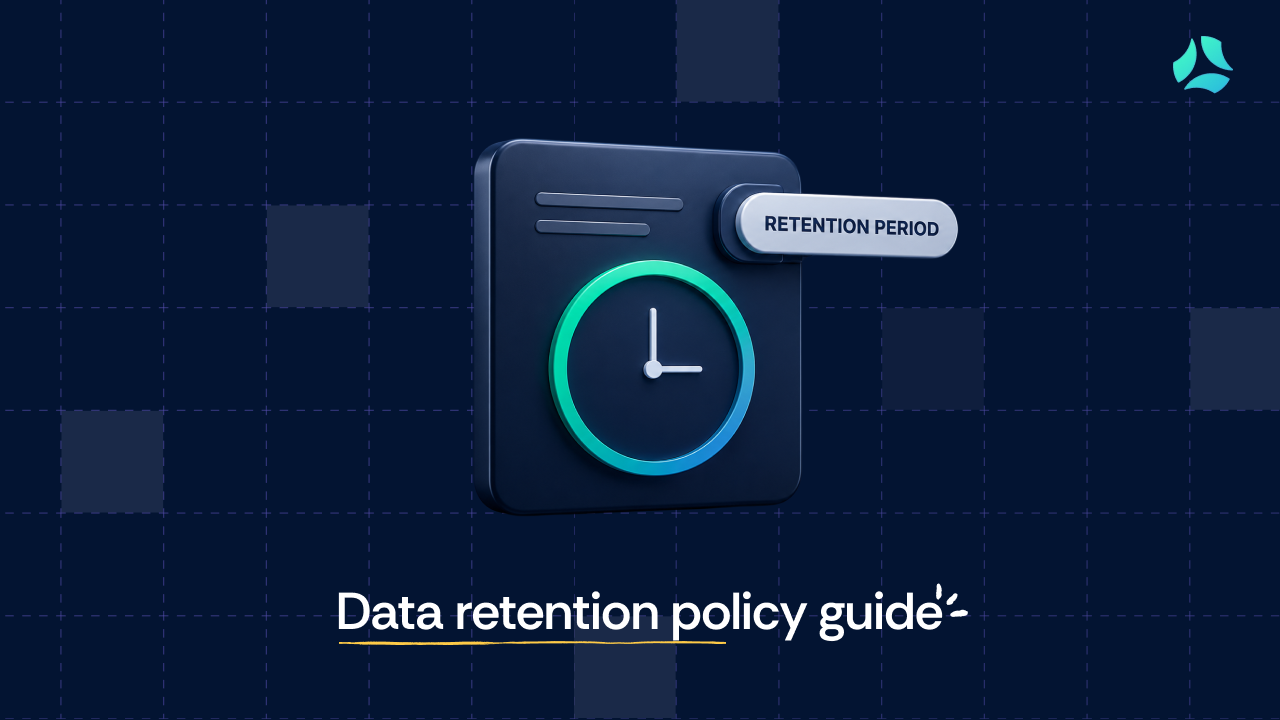


- A data retention policy defines what data an organization keeps, why it is retained, how long it is stored, and when it should be deleted or anonymized.
- Data retention requirements vary by region, with laws like GDPR, CCPA, HIPAA, India’s DPDP framework, and Singapore PDPA applying different rules around storage limits and deletion.
- Effective data retention compliance requires more than documentation: teams need ownership, retention schedules, automated deletion workflows, and evidence that retention rules are followed.
A customer asks you to delete their data. Privacy checks the request. Legal asks whether the record has to be kept for contract reasons. Finance says invoice data cannot be removed yet. Support has ticket history, marketing has old campaign records, and engineering finds backups.
Nobody is trying to keep data for the wrong reason. But nobody can answer the simple question fast enough: what should we keep, for how long, and who can prove it was deleted?
That is the job of a data retention policy. A good policy does not list random time periods in a spreadsheet. It connects purpose, classification, legal obligations, deletion workflows, and evidence. It tells teams when data should be retained, when it should be anonymized, when it should be securely deleted, and when retention must pause because of litigation, audits, or regulatory requirements.
For companies operating across regions, the hard part is that retention rules rarely match neatly. GDPR, UK GDPR, CCPA, HIPAA, India’s DPDP framework, and Singapore’s PDPA all approach retention differently. This guide compares data retention by region and turns the legal language into an operating model your security, privacy, and compliance teams can actually use.
A data retention policy should start with purpose, not storage
The easiest mistake is to ask, “How long can we keep this?” The better question is, “Why do we still need it?”
Retention periods should follow the purpose of collection. If the purpose is account delivery, keep the data while the account is active and for a defensible period after closure. If the purpose is payroll, follow employment, tax, and accounting obligations. If the purpose is marketing, use engagement and consent rules. If the purpose is security logging, define the operational and legal reasons for keeping those logs.
The GDPR storage limitation principle says personal data must be kept in a form that permits identification for no longer than necessary for the purposes for which the data is processed. That principle shows up in different forms across regional data privacy laws. The wording changes, but the operating expectation is similar: do not keep personal data simply because storage is cheap.
Data retention best practices follow a clear operating model
A usable data retention policy should move through five steps: define the purpose, classify the data, set the retention period, automate disposal where possible, and keep evidence. Purpose connects the data to a business, legal, security, or compliance reason. Classification separates customer data, employee data, financial records, health data, children’s data, logs, contracts, and backups. The retention period then reflects legal requirements, business needs, limitation periods, and risk appetite.
This is where retention becomes a control, not just a document. A privacy notice tells users what you do. A data retention schedule tells internal teams what to execute. Evidence proves it happened.
Scrut’s guide to data privacy compliance best practices is a useful companion here because retention only works when privacy obligations are tied to operational controls.
Regional data retention requirements do not fit one global rule
There is no universal retention period for all personal data. Some laws are principle-based. Some set specific recordkeeping rules. Some sector regulations apply to certain documentation but not every underlying record. Some state laws add disclosure or request-tracking obligations.
This table is not legal advice. It is a control design starting point for data retention compliance, especially for SaaS and technology companies that need one operating model across multiple regions.
EU and UK data retention rules are built around storage limitations
GDPR does not provide one fixed retention period for “customer data” or “employee data.” Instead, organizations must define retention by purpose. They need to know why the data was collected, how long that purpose continues, and whether another lawful reason supports retention after the primary purpose ends.
The UK ICO’s storage limitation guidance says the UK GDPR does not set specific time limits for different types of data; organizations decide based on how long they need the data for their specified purposes.
For SaaS companies, that usually means separate rules for account data, billing and tax records, support tickets, product analytics, marketing contacts, security logs, vendor records, recruitment data, and backups. The worst retention rule is “keep until deleted manually.” That creates privacy risk, operational debt, and weak evidence when an erasure request arrives.
Before setting retention periods, teams should also build a clear data map. Scrut’s guide to GDPR data classification can support that first step.
US data retention depends on sector, state, and record type
The United States does not have one federal privacy law equivalent to GDPR for all sectors. That means retention obligations often come from a mix of state privacy laws, sector rules, contract terms, tax rules, litigation holds, and security requirements.
California is one of the clearest privacy examples. Under California Civil Code §1798.100, businesses must disclose how long they intend to retain each category of personal information, including sensitive personal information, or the criteria used to determine that period. The same section also says businesses should not retain personal information longer than reasonably necessary for the disclosed purpose.
California regulations also require businesses to keep records of CCPA consumer requests and responses for at least 24 months. That requirement does not decide how long every data category should be kept, but it does show why request-handling evidence needs its own rule inside the retention schedule.
HIPAA is often misunderstood. HHS states in its HIPAA record retention guidance that the HIPAA Privacy Rule does not set medical record retention periods; state laws generally govern how long medical records must be retained. HIPAA still requires appropriate safeguards for protected health information for as long as it is maintained.
For healthcare organizations and business associates, the practical takeaway is simple: do not use “six years” as a blanket answer for all health data. Separate HIPAA documentation, medical records, billing records, audit logs, and state-law requirements. Scrut’s HIPAA compliance resources can help teams map these obligations to controls.
India’s DPDP framework makes purpose tracking more important
India’s Digital Personal Data Protection Act makes purpose limitation and erasure central to the data lifecycle. The Act requires a Data Fiduciary, unless retention is necessary for compliance with law, to erase personal data when consent is withdrawn or when it is reasonable to assume that the specified purpose is no longer being served, whichever is earlier. It also requires the Data Fiduciary to cause its processors to erase personal data made available for processing.
For companies serving users in India, retention work should focus on mapping each data category to a specified purpose, tracking consent and withdrawal, identifying legal exceptions to deletion, reviewing processor contracts, preparing request and grievance workflows, and keeping logs that prove deletion was handled.
This is not just a privacy team task. Product, engineering, legal, support, and security all touch the lifecycle, which is why India retention readiness should be built into systems and workflows rather than handled as a manual privacy queue.
Singapore’s PDPA makes retention limitation an active obligation
Singapore’s PDPA has a clear retention limitation obligation. Section 25 of the Singapore Personal Data Protection Act says an organization must cease retaining documents containing personal data, or remove the means by which the data can be associated with particular individuals, once retention no longer serves the purpose and is no longer necessary for legal or business purposes.
The PDPC’s Advisory Guidelines on retention also note that an organization may wish to retain contract records for seven years from termination, and longer if investigation or legal proceedings begin within that period.
That gives teams two practical routes. The first is deletion, where the record no longer needs to exist. The second is anonymization, where the business still needs statistical or aggregate value without identifiable data. Anonymization must be real. If the organization can still re-identify the person, the privacy risk remains.
Standards turn data retention into a security and audit control
Privacy law tells you when data should not be kept. Security standards help you prove the lifecycle is controlled. NIST SP 800-88 media sanitization guidance defines media sanitization as a process that renders access to target data infeasible for a given level of effort. It also provides updated guidance for sanitization programs, including cryptographic erase, secure erase, and destruction.
For ISO 27001 programs, retention should connect to information deletion, privacy protection, asset management, access control, logging, supplier relationships, and audit evidence. Scrut’s ISO 27001 controls resources can help teams map retention expectations into an ISMS.
A mature retention control should answer which system owns the data, which policy rule applies, what event starts the retention clock,the legal hold piece deserves its own documented procedure, because a well-run legal hold and preservation process has to suspend scheduled deletion across every system that holds relevant data, notify custodians, and record when the hold is released so normal retention can resume. who approves exceptions, how deletion is performed, how backups are handled, what evidence proves completion, and what happens during a legal hold. Without those answers, retention remains intent rather than execution.
A data retention schedule makes the policy usable
A data retention policy explains the rules. A data retention schedule applies them. The schedule should be specific enough for teams to use without asking legal every time.
The exact periods will vary by region and business model. The structure should not. If your team needs a starting point for policy structure, Scrut’s guide to a data retention policy template can help align retention language with broader compliance documentation.
Common data retention mistakes create avoidable risk
Most retention failures come from weak ownership, not weak wording. Policies name time periods but do not name systems. Data maps ignore backups, logs, and analytics exports. Retention schedules are not reviewed after entering a new region. Marketing databases have no engagement cutoff. Support tools keep attachments forever. Legal holds have no release process. Deletion workflows remove production data but leave warehouse copies. Completed erasure requests lack an evidence trail.
Retention is not only a privacy issue. It is a security issue, a compliance issue, and a trust issue. The more data an organization keeps without a clear reason, the more it has to protect, explain, search, review, and eventually delete.
How Scrut helps teams operationalize data retention compliance
Scrut helps teams turn data retention from a written policy into a monitored compliance workflow. Teams can map retention requirements to frameworks such as GDPR, ISO 27001, SOC 2, and HIPAA; connect policies, controls, risks, and evidence in one place; track control ownership and review cycles; and maintain audit-ready evidence for deletion, access, logging, and policy reviews.
Retention work should not depend on memory. It should run through clear rules, accountable owners, system evidence, and repeatable review. Scrut helps make that operating model easier to sustain.
Choose risk-first compliance that is always on, built for you. Book a demo.
A data retention policy defines how long different data categories are kept, why they are retained, when they should be deleted or anonymized, and who owns each step.
GDPR does not set one fixed retention period. Personal data should be kept only as long as necessary for the purpose for which it was collected, unless another lawful reason supports longer retention.
Data minimization limits what you collect. Data retention limits how long you keep it. Both reduce privacy and security risk.
No. HHS says HIPAA does not set medical record retention periods. State law generally governs medical-record retention. HIPAA documentation and safeguards should be assessed separately.
Include data category, purpose, system owner, retention trigger, retention period, deletion method, exception process, and evidence requirements.


%201.png)



.png)