


%20(1).png)
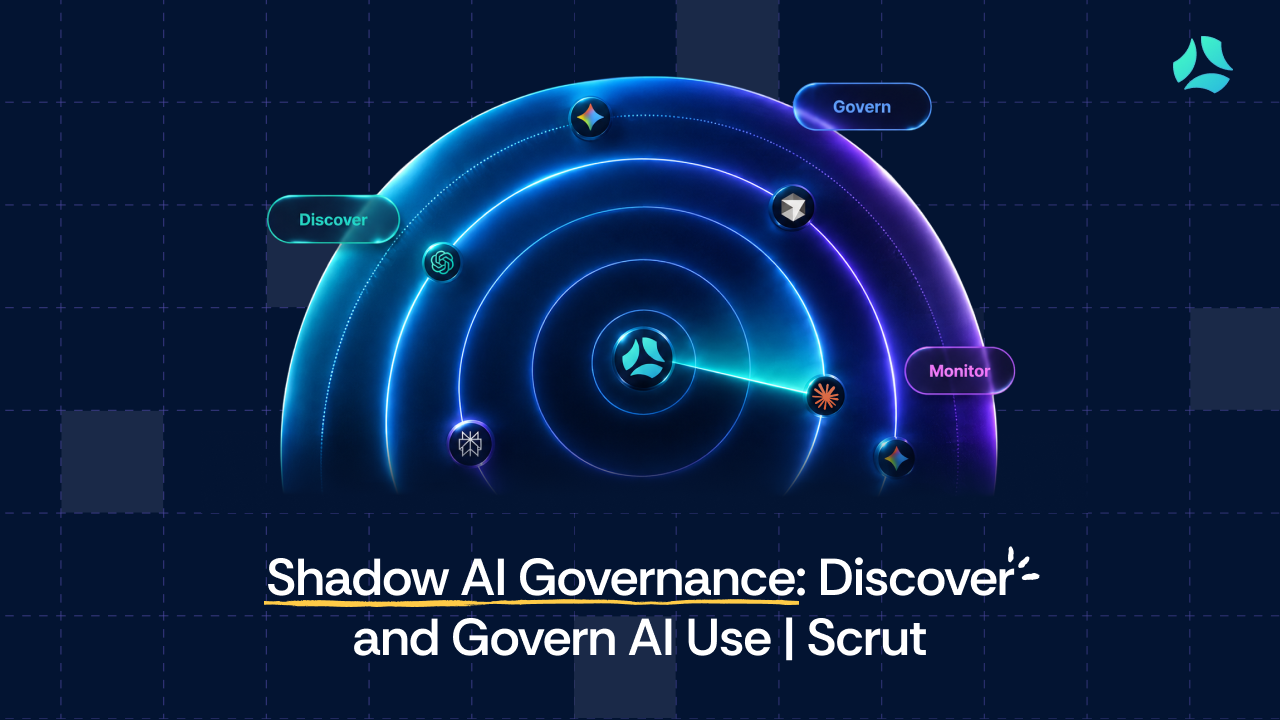


Say hello to Shadow AI Governance in Scrut, built to help security and GRC teams discover AI tools being used across their organization, identify the employees using them, and continuously govern their use.
Shadow AI is the use of AI applications, assistants, and development tools inside an organization without formal approval, security review, or ongoing oversight. It happens when an employee summarizes a customer contract in a public chatbot, or a developer connects an AI coding tool to a company repository. It is rarely malicious. It’s the people working faster than governance can keep up.
IBM's Cost of a Data Breach Report 2026 found that 43% of security incidents now involve shadow AI, more than double the 20% reported a year earlier. Breaches involving shadow AI averaged USD 5.39 million, against a global average of USD 4.99 million. And more than two-thirds of breached organizations still had no governance process in place to limit shadow AI.
We are introducing Shadow AI Discovery & Governance in Scrut, built to help security and GRC teams find the AI applications being used across their organization, understand what kind of tools they are, decide what belongs, and continuously verify that those decisions are being followed.
.png)
Your AI policy cannot govern what you cannot see
Shadow AI refers to AI applications, assistants, agents, and development tools used within an organization without formal approval, security assessment, or ongoing oversight.
An employee may use a public AI assistant to summarize a customer document. A developer might connect an AI coding tool to a company repository. A team may adopt an AI-powered meeting assistant without reviewing its permissions, data retention practices, or security controls.
These actions are rarely malicious. Employees are usually trying to work faster, automate repetitive tasks, or solve problems with the tools available to them.
But when AI adoption happens outside established processes, security and governance teams may not know:
- Which AI applications are being used
- Who is accessing them
- Whether the applications have been reviewed
- Which tools are managed or restricted
- Whether access remains appropriate
- How AI usage is changing across the organization
An acceptable-use policy can define how employees should use AI. But a policy alone cannot reveal whether new applications are entering the environment or whether restricted tools remain in use.
That is the gap Shadow AI Governance is designed to address.
Why Shadow AI requires continuous governance
AI adoption introduces risks that cannot be managed through a one-time inventory or periodic employee survey.
Sensitive data exposure: Employees may unknowingly enter customer information, source code, contracts, internal strategy, or other confidential information into AI tools that have not been reviewed.
Unreviewed applications and providers: Externally hosted AI applications can introduce additional third-party, privacy, and data-handling risk. Teams need a way to identify these tools before deciding whether they can be used safely.
Inconsistent access oversight: AI tools adopted outside standard IT processes may not be connected to single sign-on, access reviews, or established offboarding procedures.
Policy and audit gaps: Organizations may have documented AI policies but lack evidence that those policies are being actively monitored. This makes it harder to demonstrate oversight to customers, auditors, and regulators.
Shadow AI Governance helps organizations move from reacting to isolated incidents to continuously understanding and governing AI adoption.
A note on AI agents
Much of the industry conversation has moved to autonomous AI agents with their own identities and permissions to call tools and APIs. IBM's 2026 report reflects that shift, the costliest incidents it measured were agent-native.
To be precise about scope: this release governs AI applications and AI builders that employees sign into or install, discovered through identity and device signals. It is not agent identity management, and it does not inspect prompts or the content flowing into these tools. Agent-level discoverability is a direction we are actively working on.
How Shadow AI Governance works in Scrut
Scrut connects signals from identity and device integrations to help security and GRC teams identify AI applications being accessed across the organization.
Discovered applications are connected to the employees using them, giving teams the context needed to investigate usage and make informed governance decisions. Teams can then classify applications as managed or restricted based on organizational policy and continue monitoring activity as new tools and users appear. This gives security, IT, and GRC teams a shared view of the organization’s AI footprint, not just the applications listed in an approved software inventory.
01. Discover. Scrut finds applications across connected identity and device sources: SSO integrations such as Google Workspace and Microsoft Entra, and desktop applications through supported MDM integrations or the Scrut Agent.
02. Understand. Discovered tools are automatically identified as AI Apps or AI Builders. A writing assistant and a coding tool with repository access are not the same review, and a generic application inventory treats them identically.
Both matter. They rarely warrant the same level of scrutiny.
03. Govern. Every application gets an explicit decision: Managed (approved), Ignored (reviewed, excluded from active governance), or Restricted (unsuitable for organizational use). Restrictions require a recorded justification, which is what makes the decision auditable later.
04. Act. Scrut identifies the employees associated with a restricted application and notifies them with removal instructions, third-party access revocation for SSO-discovered apps, and uninstall guidance for desktop apps. This is a remediation workflow, not network-level blocking.
05. Verify. Two tests run continuously. All AI applications reviewed and categorized stays failed until every discovered tool has a decision. Restricted applications not in use by employees stay failed while anyone is still using a restricted tool, and pass automatically once usage stops.
Discover the tools. Understand what they are. Decide what belongs. Verify the decision held.
AI is everywhere. Governance should be, too.
The use of AI applications, assistants, agents, and development tools within an organization without formal approval, security assessment, or ongoing oversight. IBM found it involved in 43% of security incidents in 2026, up from 20% the year before.
Shadow IT concerns unapproved applications. Shadow AI adds a data dimension: employees submit proprietary information, customer data, and source code into these tools, and AI builders may connect directly to codebases and internal systems.
Through connected identity and device sources such as SSO integrations such as Google Workspace and Microsoft Entra for SaaS applications, and supported MDM integrations or the Scrut Agent for desktop applications.
The administrator records a justification. Scrut identifies affected employees and can notify them with removal instructions. An automated test stays failed until those employees no longer appear as active users.
No. Shadow AI Governance operates at the application level and does not inspect prompt content. It is not a replacement for data-loss-prevention tooling.


%201.png)