

%20(1).png)
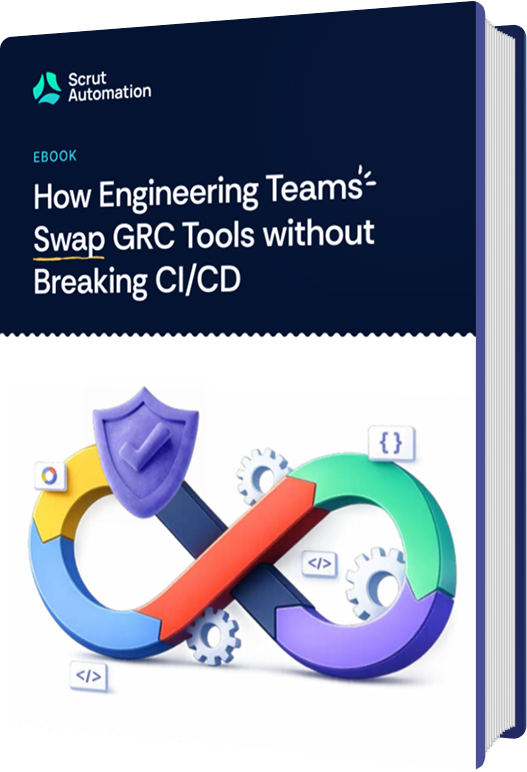
How engineering teams swap GRC tools without breaking CI/CD
Switch platforms without a broken pipeline, a Jira flood, or an evidence gap
For engineering leads and security teams stuck with a GRC tool that drains sprint capacity. A technical playbook for migrating platforms without stalling deploys or invalidating your audit.

Description
The decision to migrate your GRC platform usually starts with a broken integration, a flooded Jira backlog, or a sprint hijacked by compliance cleanup. But switching means reconnecting AWS, GitHub, Okta, and Jira, and doing it wrong means a broken pipeline, 200 false alerts in week one, or a gap in your audit evidence that nobody notices until the auditor does.
This playbook treats the migration like what it is: a production deployment. It maps the seven failure points where GRC migrations actually break, gives you a system-by-system reconnection protocol for cloud, version control, identity, and ticketing, and lays out the Parallel Run Model: a 60 to 90 day overlap where both tools stay active so your evidence never goes dark.
You also get a week-by-week engineering cutover checklist with "done looks like" criteria at every stage, the four rules for preventing alert storms, and the ten migration risk questions to ask any vendor before you commit. The goal: make the transition invisible to your auditor and painless for your engineers.
Here are the insights you will walk away with

Not the big cutover, but the integration and metadata layers: identity sync failures, webhook collisions, permission model drift, evidence continuity gaps, and control mapping inconsistencies.
Auditors are tool-agnostic but obsessed with Period-of-Coverage integrity. Even a 48-hour evidence gap can trigger a qualified opinion. Your migration must prove traceability, repeatability, and crosswalk consistency.
A 60 to 90 day overlap where both tools run together, executed in five phases, so every control keeps generating evidence and validation completes only when the delta between systems is zero or fully explained.
Report-only mode for the first 14 days, a delta audit against your legacy tool, pre-emptive suppression of known exceptions, and no Slack on day one. If Slack fires on day one, you've already lost engineering trust.
From IaC-deployed IAM roles in weeks 1 and 2 to live cutover and legacy decommission in weeks 9 to 12, with concrete verification steps and three critical warnings for the migration lead.


Get access to the ebook now
These are the questions this eBook will answer
When your current platform can't support a framework your sales team needs, renewal costs rise without added value, engineering spends more than 15 to 20 hours a month on manual evidence work, your auditor flags monitoring gaps the tool can't close, or integrations keep breaking. If two or more apply, you have a strong operational case.
Run both tools in parallel. The playbook's Parallel Run Model mandates a 60 to 90 day overlap where the legacy tool and the new platform are both active, so evidence collection never stops and every automated test is validated against a known baseline before decommissioning.
Only if the migration breaks Period-of-Coverage integrity. Auditors don't care which tool you use; they care about continuous, gap-free evidence across the audit period. A migration that proves traceability, repeatability, and crosswalk consistency is effectively invisible to the auditor.
Plan for roughly 12 weeks: weeks 1 and 2 for foundation and shadow mode, weeks 3 to 6 for delta analysis and suppression baselining, weeks 7 and 8 for zero-delta validation and Jira enablement, and weeks 9 to 12 for live cutover and legacy decommission.
Ten migration risk questions, not feature questions. The critical ones: can historical evidence be exported with original timestamps intact, can legacy control IDs map 1:1 to the new taxonomy, can integrations run in shadow mode before go-live, and is there a documented mid-audit protocol. If the vendor can't answer clearly, don't proceed.