

%20(1).png)
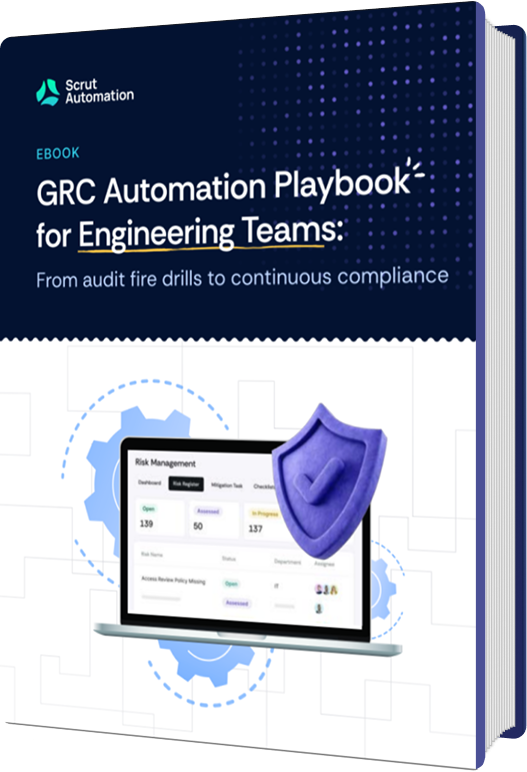
GRC automation playbook for engineering teams
From audit fire drills to continuous compliance
For engineering leaders tired of #SOC2-URGENT Slack channels: A technical playbook for embedding compliance into the systems that already enforce it.

Description
Your systems already do the work of enforcing trust. Access flows through identity providers, code moves through pull requests, and CI/CD pipelines block bad deploys. The problem isn't how security operates. It's how it's proven. GRC still runs on screenshots, spreadsheets, and periodic reviews, so every audit window pulls high-leverage engineers into low-leverage evidence collection.
This playbook proposes a different architecture: integrate GRC into engineering systems so compliance becomes a byproduct of how they operate. It breaks down the audit cycle trap that project-based compliance creates, shows what controls as code actually means in practice (policy as intent, control as enforcement, evidence as signal), and gives you a three-tier model for deciding what to fully automate, where humans approve, and which decisions stay human-led.
Then it gets concrete: a 30/60/90-day rollout plan for a 200-person SaaS company with named owners and effort estimates per phase, the three questions auditors are actually trying to answer, and the failure modes of automation itself, because a control that stays green on a dead data feed is worse than no control at all.
Here are the insights you will walk away with

The audit cycle trap: prep peak, audit passes, effort drops, drift accumulates, next audit panic. A spreadsheet is not a control and a screenshot is not an operating model, especially when 66% of risk functions run on 20 or fewer full-time people.
Translate high-level policies into executable logic through three components: policy (all code must be peer-reviewed), control (a GitHub branch protection rule), and evidence (a signed PR log). Offboarding, IAM changes, and PR merges compared side by side in the manual world versus the event-driven world.
Fully automated for low-risk, high-volume tasks like encryption verification and MFA enforcement. Human-in-the-loop for access reviews and vendor triage. Human-led for risk tolerance, incident learning, and policy exceptions. Tasks migrate between tiers as trust builds.
Days 0 to 30: connect AWS, GitHub, Okta, and Jira, and build the inventory. Days 30 to 60: automate evidence, suppress false positives, run a metrics-driven dry run. Days 60 to 90: give auditors read-only access and measure recovered engineering capacity.
Broken integrations, credential expiry, control drift, and alert fatigue. Plus the two practices that prevent silent failures: meta-monitoring and heartbeat checks that alert when a source hasn't been polled in 24 hours.


Get access to the ebook now
These are the questions this eBook will answer
GRC automation is the practice of connecting governance, risk, and compliance workflows directly to the systems that enforce them, such as cloud infrastructure, identity providers, version control, and CI/CD pipelines, so controls are monitored continuously and evidence is generated automatically. Instead of engineers reconstructing proof through screenshots and log exports, the infrastructure itself demonstrates that systems operate securely.
Compliance as code means translating high-level policies into executable logic that systems can enforce, measure, and validate continuously. It has three components: the policy states intent ("all code must be peer-reviewed"), the control enforces it (a GitHub branch protection rule), and the evidence proves it worked (a signed PR log). Documentation becomes a byproduct of the action rather than a separate reconstruction effort.
Automate repetitive, high-volume technical checks with clear rules: encryption verification, MFA enforcement, and vulnerability scanning on every commit. Keep humans in the loop where judgment matters but systems can do the operational work, like access reviews and vendor security checks. Keep humans fully in charge of risk tolerance, incident learning, and policy exceptions, because those require context about product direction and acceptable risk.
Plan for roughly 90 days. The first 30 days cover connecting core systems (cloud, version control, identity, ticketing) and building a complete inventory. Days 30 to 60 focus on automated evidence collection, alert tuning, and an internal dry run. Days 60 to 90 validate with external stakeholders through auditor read-only access. Expected effort for the first phase is 5 to 10 hours from security and about 2 from DevOps, not a velocity halt.
Auditors place far more trust in system-generated evidence than screenshots, because it carries timestamps, system identities, and verifiable activity logs. Stronger evidence includes logs pulled directly from cloud infrastructure, audit trails from identity providers, and signed commit and PR histories. Auditors are answering three questions: is the evidence reliable, does the system detect problems, and does the organization fix them quickly.