

%20(1).png)


%201.png)
Choose risk-first compliance that’s always on, built for you.
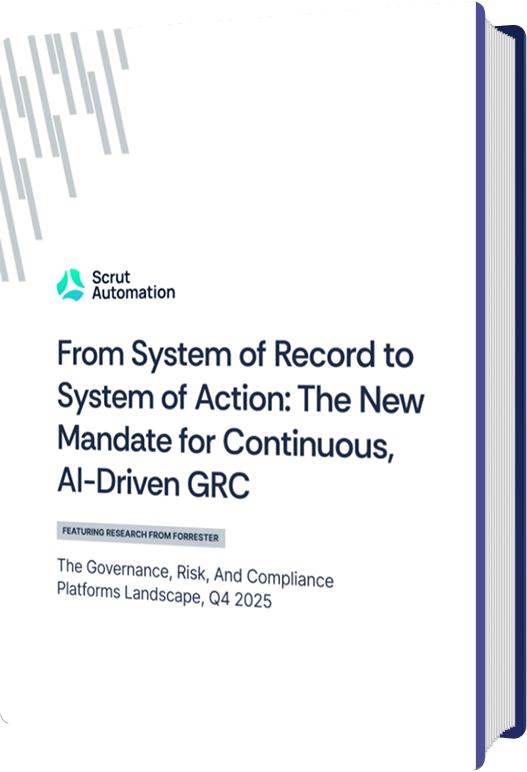
For CISOs, GRC leaders, and compliance owners whose dashboards show every risk but resolve none of them. Learn why execution, not visibility, is the next GRC capability. Featuring research from Forrester's governance, risk, and compliance platforms landscape, Q4 2025.

The era of checkbox compliance is over. Organizations today operate in an environment defined by continuous change, namely cloud-native infrastructure, rapidly evolving threat surfaces, expanding vendor ecosystems, and increasing regulatory scrutiny. In this environment, point-in-time assurance is no longer sufficient.
In 2024, exploitation of vulnerabilities surged 180% year over year, and the "human element" was present in 68% of breaches, reinforcing how quickly control effectiveness can degrade between audit windows and `point in time' checks.
Over the last decade, the GRC industry has successfully addressed the problem of visibility. Dashboards replaced spreadsheets, and centralized systems replaced email-driven audits. Yet this progress introduced a new and more damaging challenge: execution debt. GRC teams now face thousands of alerts, findings, and follow-ups that systems can record but not resolve. The result is growing operational friction, practitioner burnout, and delayed risk remediation.

The next evolution of GRC is a shift from passive Systems of Record to active Systems of Action. This shift is enabled by continuous controls monitoring and agentic AI, systems that do not simply identify risk, but investigate, remediate, and validate controls.
Organizations that make this transition move GRC from a cost center into a strategic operational capability.
Scrut Automation is designed as a workflow-first GRC platform where continuous monitoring, automated evidence collection, and AI-assisted execution are embedded directly into the system of record. Instead of surfacing alerts alone, Scrut automates follow-ups, remediation workflows, and control validation, helping teams reduce manual compliance effort by up to 70%, based on customer data.
Most GRC programs still operate on assumptions built for static environments. Annual and quarterly audits provide a snapshot of compliance, but they leave extended blind spots where risk can emerge and compound. Cloud misconfigurations, access drift, and vendor control changes often occur immediately after audit closure.
At the same time, compliance execution remains highly manual. Evidence collection relies on spreadsheets, ticketing tools, and email threads. This "swivel-chair compliance" slows remediation and introduces inconsistency and error.
Equally problematic, reporting tends to focus on compliance outputs like control pass/fail status or maturity scores without sufficient linkage to business impact (such as financial exposure or operational disruption). This limits leadership's ability to strategically prioritize risk.
In response to manual chaos, GRC vendors centralized information into dashboards. These Systems of Record made risk visible, but visibility alone does not resolve risk. Today, practitioners are confronted with dashboards filled with red indicators. Each alert requires manual investigation, coordination, and follow-up. Over time, the gap between risk identification and resolution widens. This accumulated backlog is execution debt, and it persists partly because many organizations still aren't getting execution lift from AI features.

Execution debt manifests as audit fatigue, practitioner burnout, and delayed remediation, leaving organizations exposed despite having full visibility.
Modern risk environments demand continuous assurance, not episodic validation. Continuous Controls Monitoring (CCM) enables organizations to test controls in real time across infrastructure, apps, and vendors, detecting failures as they occur rather than months later.
This shift transforms audit readiness from a periodic project into a steady-state condition. Controls are validated continuously, evidence is collected automatically, and remediation begins immediately when failures are detected. IBM's 2024 Cost of a Data Breach Report found that organizations using AI and automation extensively in prevention workflows incurred an average of $2.2 million less in breach costs compared to those with no use in these workflows.

Scrut supports continuous controls monitoring across cloud infrastructure, internal IT systems, and vendor ecosystems. Evidence is collected continuously and mapped to control requirements in context, keeping audit readiness as a byproduct of operations across frameworks such as SOC 2, ISO 27001, HIPAA, and GDPR.
Where many GRC programs stall is what happens after a failure is detected. Scrut helps close the loop by shifting the process from monitoring to execution. It can prioritize which failed tests matter most using audits, controls, and internal context, and then drive remediation workflows by drafting and routing tickets, assigning ownership, and pushing work to resolution instead of leaving teams with another queue to manage.
Organizations that adopt continuous compliance models report significantly reduced audit preparation time and fewer last-minute remediation efforts, based on Scrut customer case studies.
Continuous monitoring alone does not solve execution debt. The critical shift is how systems respond to detected risk. Traditional automation relies on rigid workflows, i.e., predefined sequences of steps that break when context changes and still require frequent human intervention.
By contrast, AI agents are goal-driven systems. Given an objective such as "remediate a failed control," an agent determines the appropriate path, selects tools, executes actions, and adapts as conditions evolve. A true System of Action delegates execution rather than documenting failure. Gartner predicts that by the end of 2026, 40% of enterprise applications will be integrated with task-specific AI agents, up from less than 5% in 2025.
McKinsey's 2025 State of AI survey reveals that nearly 9 out of 10 organizations are regularly using AI, yet most have not yet embedded tools deeply enough into their workflows and processes to realize material enterprise-level benefits.

Rather than adding conversational AI on top of static compliance data, Scrut integrates AI directly into its execution and workflow layer. Scrut Teammates is a purpose-built, vertical AI system for GRC that operates inside the Scrut Platform, not on top of it. It is a coordinated set of specialized agents trained on thousands of real-world compliance datasets. This allows Scrut Teammates to make more context-aware decisions, such as understanding the significance of a security incident in relation to your organization's risk appetite or interpreting your compliance obligations. It is designed to move work forward, not just advise. It doesn't stop at offering suggestions; it can take actions directed by a human or operate completely autonomously, based on your configuration.
Agentic AI in GRC moves beyond summarization or document generation. Its primary value lies in execution. Effective GRC agents can:

Execute API calls to update configurations

Assign and track remediation tasks across teams

Collect and validate evidence automatically

Draft audit artifacts and executive summaries
For example, an agent may detect a cloud misconfiguration, generate a corrective infrastructure-as-code change, notify the appropriate engineering team, validate remediation, and update control evidence, all with minimal human involvement.
Level 2 is where most modern "AI-enabled" compliance platforms sit today.

Level 3 is the category Scrut is building and leading. While Level 2 systems help teams understand compliance, Level 3 systems actually operate it.
Scrut Teammates (AI-powered teammate for risk and compliance) supports domain-specific execution, where GRC work stalls typically. For control failures, it can generate remediation tickets with the precise context teams need, including suggested fixes like configuration updates or infrastructure-as-code snippets with pre-filled variables (e.g., Terraform).
For third-party risk, it can assess inherent vendor risk based on usage and business context, generate tailored questionnaires, and flag incomplete responses before submission to reduce back-and-forth. For go-to-market execution, it can accelerate security questionnaires by pulling answers from an approved library and Trust Vault artifacts across standard formats.
As execution becomes more autonomous, trust becomes the limiting factor. The barrier in GRC is not whether a system can generate recommendations; it is whether it can take action in a way that remains explainable, auditable, and accountable.
This is where the human decision-making layer matters. A mature System of Action does not imply "AI runs everything." It implies that execution can be delegated safely within defined guardrails, with humans retaining authority at the points where accountability must remain explicit.
Every decision and action should be backed by traceable sources, clear rationale, and immutable audit logs that show what was done, why, and by whom (AI or human).
Tier 1

Description:
AI handles low-risk, high-volume tasks with clear rules and minimal variation.
Example use case:
Spam filtering, anomaly alerts, automated log parsing in real time.
Tier 2

Description:
AI suggests actions; humans review and approve before anything is executed.
Example use case:
Vendor triage, policy checks, access revokes, triage incident alerts.
Tier 3

Description:
Humans lead complex decisions with AI providing insights and risk context.
Example use case:
GRC audits, breach plans, legal review, AI model approval processes.
Trust is the primary barrier to autonomous execution in GRC. Many AI systems rely on vector databases that flatten context and treat every query as a fresh problem. In contrast, enterprise-grade platforms preserve relationships between assets, controls, owners, and risks.
This structured context, often implemented as a knowledge graph, allows agents to reason with history, ownership, and accountability.

Scrut maintains structured relationships between assets, controls, owners, and risks, preserving historical context as environments evolve. Scrut is designed for high-trust environments where autonomous actions must remain reviewable.
AI-assisted actions operate with configurable human-in-the-loop controls, ensuring auditability, trust, and accountability for high-impact decisions. Scrut aligns with ISO 42001 controls such as privacy-by-design safeguards, opt-in configurability for AI features, and a "non-training" approach that prevents customer data from being used to train models for others, aligning the execution model with the governance requirements teams will be held to.
The practical question to ask isn't "Do you have AI?" but rather "What does your AI actually do for my GRC process?" For AI to matter, it needs to drive workflows forward (e.g., actually create tickets, suggest fixes, or perform checks), not just chat or produce static analysis.
In other words, the AI should meaningfully reduce the team's workload, not add another dashboard to watch.
 54% of respondents in the Accenture Compliance Risk Study acknowledge the strengthening role of AI, with consensus that these technologies enhance efficiency, reduce errors, and automate manual tasks.Ponemon Institute's 2025 State of AI in Cybersecurity report found that 70% of respondents say AI increases the productivity of IT security personnel (an increase from 66% in 2024), and 69% say job satisfaction improved because of the elimination of tedious tasks (an increase from 64% in 2024).According to PwC, 64% of businesses believe compliance technology improves risk visibility, 54% say it accelerates compliance issue resolution, and 43% say it boosts productivity and cost savings.
By reducing manual execution and enabling continuous readiness, Scrut enables organizations to shift GRC investment discussions from license utilization to operational outcomes, such as reduced remediation time and sustained audit readiness.
Step 1

Identify where controls are only tested during audits and where remediation still depends on manual follow-through.
Step 2

Start with cloud security, access management, and critical vendors where continuous monitoring delivers immediate value.
Step 3

Avoid bolt-on AI features. Look for platforms where AI is integrated into execution pathways and can take action, not just generate insights.
The future of GRC is not about seeing every risk. It is about resolving risks continuously. An approach that embraces Systems of Action enables a self-healing GRC model in which controls are validated, failures are remediated, and evidence is automatically updated.
Organizations that operationalize agentic, AI-driven GRC reduce operational burden, improve resilience, and gain strategic clarity. As the market moves beyond visibility, execution becomes the defining capability.

The narrative has changed from "see all your risks" to "resolve your risks while you sleep."
Download to read the full Forrester's governance, risk, and compliance platforms landscape, Q4 2025

With Scrut, your security program isn’t just about keeping pace; it’s about setting the pace. Embrace the new kind of GRC that fuels growth and resilience.