


Choose risk-first compliance that’s always on, built for you.
Learn what evidence each framework requires, how often to collect it, and where your work carries over between frameworks.

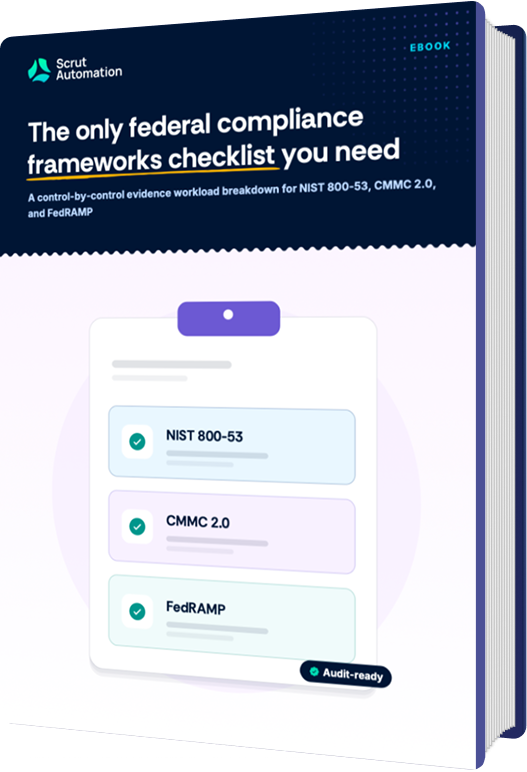
Most compliance practitioners arrive at federal frameworks after succeeding with SOC 2 or ISO 27001. They expect the same basic pattern: understand the requirements, implement controls, collect evidence, engage an auditor.
While federal frameworks follow the same logic, the workload is categorically different.
This eBook is not a ‘what is NIST’ explainer. It exists for practitioners who need to understand the operational evidence load before committing to a framework. Every chapter breaks down what you will actually need to collect, how often, who owns it, and where the workload concentrates.
This eBook doesn’t explain what SOC 2 is for beginners; instead, it tells you what federal frameworks will cost you in evidence work, so you can plan before you start.
Federal compliance is not a single framework: it is an ecosystem of overlapping standards that share a common lineage in NIST SP 800-53. CMMC 2.0 Level 2 maps directly to NIST SP 800-171, which is itself a subset of NIST 800-53 tailored for protecting Controlled Unclassified Information. FedRAMP Moderate draws from NIST 800-53 Revision 5 directly, with agency-specific overlays on top.
In practice this means that evidence collected for one framework often satisfies a control in another, but only when it meets the higher standard. A SOC 2 access review will not automatically satisfy CMMC AC.L2-3.1.1 unless it is documented at the specificity CMMC requires.
One term recurs throughout this eBook that deserves explanation up front: Continuous Monitoring (ConMon). ConMon is the ongoing operational requirement that begins the moment a FedRAMP authorization is granted. It is not a post-audit checkbox.
Every month, the authorized Cloud Service Provider must submit vulnerability scan results, an updated Plan of Action and Milestones (POA&M), and a current asset inventory to the FedRAMP Program Management Office (PMO) in prescribed formats.
The FedRAMP PMO monitors submission cadence, reviews findings, and can revoke authorization for lapsed reporting.
For teams coming from SOC 2, ConMon is the hardest cultural shift: SOC 2 ends when the auditor signs the report; FedRAMP never ends. CMMC has an equivalent ongoing obligation through triennial reassessment and annual self-attestation, though the monthly burden is lower. References to ConMon throughout this eBook mean this permanent operational posture, not a one-time monitoring exercise.
Control counts, evidence specificity, and the cost of gaps
Federal compliance is more demanding than SOC 2 or ISO 27001, not because the underlying concepts differ, but because the evidence requirements, control counts, and ongoing operational obligations are significantly greater. SOC 2 evaluates whether controls exist and operated effectively during the audit period. NIST 800-53, CMMC, and FedRAMP require controls to be implemented, documented, continuously monitored, and defensible to an independent assessor who may interview your engineers. This chapter explains what makes federal compliance a distinct operational challenge.
| What makes federal compliance harder | The practical impact |
|---|---|
| Control count. NIST 800-53 Rev 5 has more than 1,000 controls and control enhancements. FedRAMP Moderate covers 325+ controls. CMMC Level 2 maps to 110 practices. | SOC 2 is typically 60 to 80 controls. Volume alone changes the evidence program required. |
| Evidence specificity. Federal assessors conduct interviews and independent testing. They expect environment-specific control descriptions. | A clean SOC 2 report does not satisfy a CMMC assessor. Template-copied SSP language fails 3PAO review. |
| Consequences of gaps. FedRAMP gaps can deny authorization. CMMC deficiencies can result in contract loss or False Claims Act exposure. | The stakes change how you run the program from day one. |
You have a DoD contract or are bidding on one. You have handled CUI but have never formalized a compliance program. Your gap is scope definition and evidence infrastructure. You do not have a named ISSO. You do not have a formal access review process.
Today, you self-assess and post your score in SPRS. When third-party assessment resumes, a C3PAO will test your controls independently, and your self-assessed score has to hold up. A policy document is not a control implementation.
You have SOC 2 Type II, possibly ISO 27001. A federal agency is interested in your product. Your foundational controls are implemented and evidenced. The gap is documentation specificity, SSP authoring, 3PAO assessment preparation, and the permanent ConMon obligation.
The most common mistake is assuming SOC 2 evidence transfers directly to FedRAMP. It does not. Budget 12 to 18 months from readiness work to ATO.
You have an established NIST 800-53 program and are adding CMMC coverage for a new DoD contract or a new FedRAMP boundary. Your starting position is the strongest of the three. The gap is documentation reformatting (SSP, POA&M format differences) and assessor-specific preparation.
The biggest risk is assuming the overlap is larger than it is. NIST 800-53 evidence must be reformatted for CMMC and FedRAMP assessors.
Evidence types, high-burden control families, and the checklist
This chapter translates framework requirements into operational evidence tasks. For each framework, NIST 800-53, CMMC Level 2, and FedRAMP, the tables below identify the most demanding control families, the evidence they require, collection frequency, and the most common compliance gaps. The chapter concludes with a consolidated evidence calendar outlining what to collect, who is responsible, and how often evidence must be gathered across all three frameworks.
NIST 800-53 is a control catalog, not a compliance program. There is no auditor who issues a pass/fail report. Evidence accumulates continuously. FedRAMP is built on 800-53 and inherits this continuity requirement through ConMon.
NIST SP 800-53 Rev 5 has 20 control families and over 1,000 individual control parameters. No organization fully implements all of them. The selection is based on system impact level.
But even at the Moderate baseline, the evidence burden is substantial. The eight families below generate the largest recurring evidence workload for most cloud-native organizations.
| Family | Controls | Evidence type | Recurrence | Common gap |
|---|---|---|---|---|
| AC: Access Control | 25 | Continuous | Quarterly reviews; monthly logs | Stale access; no documented review outcomes |
| AU: Audit & Accountability | 16 | Continuous | Daily / weekly | Log gaps; incomplete retention |
| CM: Configuration Mgmt | 14 | Continuous | Per-change; quarterly baseline | No documented baseline; unapproved changes |
| SI: System & Info Integrity | 23 | Continuous | Weekly scans; monthly patch report | Unpatched systems; no scan cadence |
| IA: Identification & Auth | 12 | Mixed | Monthly MFA check; per-change | MFA gaps on privileged or service accounts |
| IR: Incident Response | 8 | Mixed | Annual tabletop; per-incident | No documented IR test; missing lessons learned |
| RA: Risk Assessment | 10 | Point-in-time | Annual + triggered | Incomplete asset inventory; no threat model |
| SC: System & Comms Protection | 51 | Mixed | Per-change; quarterly scan | Encryption gaps; segmentation undocumented |
Access reviews in the AC family are the single most recurring and most commonly failed evidence item across all federal programs. The review must document not only that access was reviewed, but that action was taken: accounts terminated, permissions reduced, or access explicitly reaffirmed with a rationale. A spreadsheet showing account names without documented decisions does not satisfy AC-2.
The other 12 families (AT, CA, CP, MA, MP, PE, PL, PM, PS, PT, SA, SR) carry lighter recurring evidence loads, with one exception: CA-7, Continuous Monitoring, which drives FedRAMP ConMon.
CMMC Level 2 maps directly to NIST SP 800-171. A C3PAO conducts an independent assessment of all 110 practices, reviewing documentation, interviewing personnel, and performing independent testing.
The evidence standard is materially higher than self-assessment. Most CMMC Level 2 failures come not from missing controls but from controls that exist on paper and nowhere else.
A policy document is not an implemented control. C3PAOs test controls independently. They conduct interviews. Evidence of intent does not satisfy CMMC Level 2.
| Domain | Practices | Heaviest evidence item | Recurrence |
|---|---|---|---|
| Access Control (AC) | 22 | User access reviews; privileged account logs | Quarterly |
| Audit & Accountability (AU) | 9 | Log review records; retention proof | Monthly / weekly |
| Config Management (CM) | 9 | Baseline configs; change records with approvals | Per-change |
| ID & Authentication (IA) | 11 | MFA proof; credential rotation logs | Monthly |
| System & Comms (SC) | 16 | Network diagram; encryption proof for CUI | Per-change |
| System & Info Integrity (SI) | 7 | Scan reports; patch records | Weekly / monthly |
| Risk Assessment (RA) | 3 | Annual risk assessment for CUI systems | Annual |
| Security Assessment (CA) | 4 | System Security Plan; POA&M | Annual update; monthly POA&M |
FedRAMP (Federal Risk and Authorization Management Program) is the U.S. government’s standardized authorization framework for cloud services used by federal agencies. Unlike CMMC, which governs defense contractors handling CUI, FedRAMP applies to cloud service providers seeking to serve federal agencies. Authorization requires an independent assessment by a Third Party Assessment Organization (3PAO), a System Security Plan (SSP) documenting every control implementation, and an ongoing continuous monitoring program. FedRAMP has three impact levels: Low, Moderate, and High. Moderate is the most common entry point for SaaS companies targeting federal revenue.
FedRAMP Moderate: 12 to 18 months to authorization. SSP runs 150 to 400 pages. After authorization, ConMon is permanent.
| ConMon deliverable | Frequency | Owner |
|---|---|---|
| Vulnerability scan results (FedRAMP format) | Monthly | CSP security team |
| POA&M update | Monthly | ISSO |
| Asset inventory update | Monthly | ISSO / IT |
| Significant change notification | Per-event | ISSO + engineering |
| Annual penetration test | Annual | FedRAMP-approved 3PAO |
| Security Assessment Report (SAR) | Annual | 3PAO / ISSO |
| Incident notification to CISA (formerly US-CERT) and the authorizing agency | Within 1 hour | ISSO / CISO |
ConMon is where most post-authorization failures occur. Organizations get authorized and let ConMon lapse within 18 months. The FedRAMP PMO issues remediation actions. In some cases authorization is revoked.
The calendar below consolidates evidence collection requirements across NIST 800-53, CMMC Level 2, and FedRAMP Moderate into a single reference. Use it to build your recurring cadence before the first assessment arrives, not during it.
Items marked with an asterisk (*) are FedRAMP ConMon-specific deliverables that do not apply to CMMC or standalone NIST programs.
Cadences shown are recommended practice. NIST 800-53 and CMMC let you set most review frequencies yourself, while FedRAMP fixes several, including monthly vulnerability scanning.
| Cadence | Evidence item | Frameworks | Owner |
|---|---|---|---|
| Daily | Log review and alert triage | AU-6 (all frameworks) | SOC / Security Analyst |
| Weekly | Vulnerability scan results | RA-5 / RA.L2-3.11.2 | Security Engineer |
| Monthly | Patch compliance report; MFA compliance check | SI-2, IA-2 (all frameworks) | IT / DevOps / ISSO |
| Monthly * | Vuln scan to FedRAMP PMO; POA&M update; asset inventory update | FedRAMP ConMon | ISSO |
| Quarterly | User access review with documented decisions and actions | AC-2 / AC.L2-3.1.1 (all frameworks) | ISSO / IT |
| Quarterly | Configuration baseline comparison | CM-6 / CM.L2-3.4.2 (all frameworks) | IT / DevOps |
| Annual | Risk assessment; IR tabletop; security training records; SSP update | RA-3, IR-3, AT-2, PL-2 | ISSO / HR / Risk Manager |
| Annual * | Penetration test; Security Assessment Report (SAR) | FedRAMP CA-8, ConMon | 3PAO / ISSO |
| Per-event | Incident documentation; notification to CISA and the authorizing agency within one hour (FedRAMP) or to DoD within 72 hours (CMMC) | IR-5, IR-6 / IR.L2-3.6.2 (all frameworks) | Incident Response Team |
| Per-change | Change record with approval and post-change verification | CM-3 (all frameworks) | Change Management |
Cross-framework overlap, and the unified control mapping example
The honest answer on what carries over: more than you expect structurally, less than you hope operationally. The underlying security practice is the same. The evidence artifact must be documented against the specific language of the new control.
A common control framework maps controls across regulatory frameworks, including NIST 800-53, CMMC, ISO 27001, SOC 2, and HIPAA, into a single control set. Instead of treating each framework as a separate silo, a common control framework identifies overlapping security requirements that appear under different labels across frameworks.
A GRC platform that maps evidence to a common control set lets you reuse a single evidence artifact across multiple framework requirements.
For example, a quarterly access review documented once can be mapped to NIST AC-2, CMMC AC.L2-3.1.1, and FedRAMP AC-2 within a single workflow.
| One quarterly access review, documented once, satisfies: | NIST AC-2 | CMMC AC.L2-3.1.1 | FedRAMP AC-2 |
|---|---|---|---|
| Account inventory | |||
| Review frequency (as defined in your SSP) | |||
| Decision record with outcomes | |||
| Action on findings (disable/reaffirm) |
A GRC platform tags one evidence artifact to all three control references simultaneously. Evidence collected once, available for assessment under any of the three frameworks.
Practical planning before the first submission
Days 1 to 30:
Define what systems are in scope by following the data, not the org chart. Identify the target framework and impact level. Count fully implemented, partially implemented, and not-yet-started controls. Assign a named ISSO with documented responsibility.
Days 31 to 60:
Build the evidence collection structure: folder taxonomy by control family or GRC platform tagging with named owners for each cadence. Draft the SSP outline (FedRAMP) or equivalent control documentation (CMMC). Configure automated evidence collection for technical controls: cloud configuration checks, log retention verification, vulnerability scan imports.
Days 61 to 90:
Implement and evidence the highest-burden controls first: AC-2 (account management), AU-2 (audit logging), CM-6 (configuration settings), SI-2 (flaw remediation). Run the first quarterly access review with complete documentation of decisions and actions taken.
For FedRAMP: engage a 3PAO for an informal readiness review before the formal clock starts. For CMMC: calculate a preliminary SPRS score to understand your current gap.
The figures below are illustrative benchmarks based on publicly available FedRAMP PMO guidance, C3PAO market rates, and practitioner community data. Actual costs vary by scope, tooling maturity, and internal versus external resourcing.
The single most underestimated cost in both programs is ongoing: the ISSO role for FedRAMP, and keeping all 110 requirements implemented and evidenced across the three-year assessment cycle for CMMC.
| Cost category | Startup (<$5M ARR) | Growth ($5M to $50M ARR) | Mid-market ($50M+ ARR) |
|---|---|---|---|
| C3PAO assessment fee | $30K to $60K | $50K to $100K | $80K to $150K+ |
| ISSO time (internal) | 200 to 300 hrs/yr | 300 to 500 hrs/yr | 500 to 800 hrs/yr |
| GRC platform tooling | $15K to $30K/yr | $20K to $40K/yr | $30K to $60K/yr |
| Approx. first-year total | $80K to $180K | $140K to $280K | $220K to $450K |
| Approx. ongoing annual | $40K to $80K | $70K to $130K | $110K to $200K |
| Cost category | Startup (<$5M ARR) | Growth ($5M to $50M ARR) | Mid-market ($50M+ ARR) |
|---|---|---|---|
| Gap assessment / consulting | $15K to $40K | $30K to $75K | $50K to $150K |
| GRC platform (annual) | $10K to $30K | $25K to $60K | $50K to $120K |
| ISSO / compliance staff (internal) | 0.25 FTE | 0.5 FTE | 1+ FTE |
| Annual ongoing (monitoring + updates) | $8K to $20K | $20K to $50K | $40K to $100K |
| Cost category | Startup (<$5M ARR) | Growth ($5M to $50M ARR) | Mid-market ($50M+ ARR) |
|---|---|---|---|
| 3PAO assessment fee | $150K to $250K | $200K to $350K | $300K to $500K+ |
| SSP authoring | $30K to $60K or 300 to 500 hrs internal | $50K to $100K or 400 to 700 hrs | $80K+ or 600 to 1,000 hrs |
| ISSO role (annual, loaded) | $120K to $160K (fractional) | $140K to $180K (dedicated) | $160K to $220K+ |
| ConMon annual | $80K to $120K | $100K to $160K | $140K to $220K |
| Approx. first-year total | $400K to $650K | $550K to $900K | $750K to $1.2M+ |
FedRAMP is a permanent operational commitment. The ongoing ConMon cost surprises most organizations after authorization. Budget for ConMon as a permanent operating cost, not a one-time project.
1. The SSP describes design, not implementation. The System Security Plan states that MFA is enforced for all users. The 3PAO attempts to authenticate without MFA and succeeds on three service accounts. The SSP is found to be inaccurate. Write SSP control descriptions last: implement the control, verify it is working, then describe what you verified.
Prevention: Before your assessment, map every policy statement in your SSP to an evidence artifact. If a policy says MFA is enforced, the evidence package must include a screenshot of your MFA configuration, a user account export showing enforcement, and a log entry showing an MFA challenge. A GRC platform with control-to-evidence linking surfaces these gaps automatically.
2. Access reviews without evidence of action. An organization presents quarterly access review records. The records show accounts reviewed. The C3PAO notes that 14 accounts were flagged across three consecutive reviews and all 14 remain active with unchanged permissions. The evidence record must show decisions made and actions taken, not only that the review occurred.
Prevention: Define a review completion standard before the review runs. The record must capture: who performed the review, which accounts were reviewed, what action was taken for each account (retained, modified, or removed), and the date the action was completed. Automate the follow-up workflow so the access review task doesn’t close until every flagged account is resolved.
3. ConMon lapses after authorization. A CSP receives FedRAMP Moderate authorization. Monthly ConMon deliverables are submitted for six months, then begin slipping. The authorizing agency opens a corrective action process, which can escalate to suspension or revocation of the authorization. ConMon must be documented as a process with named owners and backups before authorization. It must survive the departure of the ISSO who drove the original authorization.
Prevention: Treat ConMon as a product, not a project. Assign a named ISSO with a recurring calendar. Automate vulnerability scan submission where possible. Build the POA&M update into your monthly sprint cycle. Set an internal deadline two weeks before the FedRAMP PMO deadline so you have buffer for unexpected findings.
4. The POA&M that never closes. A CMMC organization’s POA&M contains 23 open items from the initial gap assessment. At the triennial reassessment, 19 remain open with target dates extended four to six times. Every POA&M item needs a named owner, a realistic target date, and a monthly check-in record. Items that cannot be remediated within 180 days should trigger a risk acceptance decision, not another date extension.
Prevention: Review the POA&M every month as a standing task, not only before an assessment. Give every item a named owner and a target date based on a real remediation plan. Record each date extension with a documented reason. When an item reaches 180 days open, escalate it for a formal risk acceptance decision. A GRC platform can track POA&M items against owners and deadlines and flag overdue items automatically.
5. Scope creep discovered during assessment. A FedRAMP candidate defines their system boundary to include three production cloud accounts. The 3PAO discovers a development environment with read access to production data that is not included in the boundary. The assessment extends by four to six months. Define the system boundary by following the data, not the org chart. Map every location where relevant data is stored, processed, or transmitted.
Prevention: Define scope before you write a single control. Follow the data: trace where CUI or federal data enters your environment, where it is processed, where it is stored, and where it exits. Every system that touches that data path is in scope. Use a data flow diagram as your scoping artifact, as 3PAOs and C3PAOs will ask for it.
Federal compliance programs fail most often at the planning stage: wrong scope, underestimated evidence burden, no named ISSO, no ConMon infrastructure.
The frameworks are well-documented. The operational reality is not.

Audit findings cluster in 4 families, access control, audit logging, vulnerability management, and configuration management, across NIST, CMMC, and FedRAMP. That is where your program should start.
Scrut helps teams manage evidence collection, control monitoring, and multi-framework compliance from one platform. Schedule a demo to see how.

With Scrut, your security program isn’t just about keeping pace; it’s about setting the pace. Embrace the new kind of GRC that fuels growth and resilience.