


%20(1).png)


Mid-market security teams face a problem that enterprise teams do not. They carry the same compliance obligations but with a fraction of the headcount and budget.
A 200-person SaaS company pursuing SOC 2 and ISO 27001 simultaneously is answering the same auditor questions as a 2,000-person enterprise. The frameworks do not scale down just because your team is smaller. But your approach to meeting them absolutely should.
Security governance is the set of policies, processes, and controls an organization uses to manage information security risks and meet regulatory requirements. For mid-market companies (roughly 50 to 500 employees), effective security governance means building a compliance program that is automated, lean, and designed to grow with the business rather than requiring constant manual effort. For most lean teams, a compliance automation platform is what makes that possible on a small budget, replacing the headcount enterprises throw at evidence collection with integrations that gather proof and flag gaps on their own.
The goal is not to replicate what enterprises do with smaller budgets. It is to build something structurally different that delivers the same outcomes.
The mid-market GRC challenge
Mid-market security teams typically operate with one to three compliance-focused employees, limited consulting budgets, and tech stacks that were not designed with compliance in mind. At the same time, they face certification pressure from enterprise buyers who will not sign a contract without SOC 2 or ISO 27001, regulatory requirements that keep expanding, and boards that expect risk visibility they have never been asked to provide before.
The numbers back this up. RSM's 2025 Cybersecurity Special Report found that 18% of mid-market companies experienced a breach in the prior year. And compliance teams spend an average of 11 working weeks per year on compliance tasks. For a mid-market team where compliance is one of several responsibilities rather than someone's only job, that workload is not sustainable without automation.
The mistake most mid-market teams make is trying to build compliance the way enterprises do: hire a big team, buy an expensive platform, and engage consultants for everything. That approach breaks on a mid-market budget. The better path is to be strategic about which frameworks to pursue, automate aggressively, and maximize the tools you already have.
Strategic framework selection
Not all frameworks deliver equal business value, and mid-market teams cannot afford to pursue them all at once. The GRC best practice here is to start with the framework that unblocks revenue.
For B2B SaaS companies selling to North American enterprises, SOC 2 is almost always the first priority. It has become a procurement checkpoint that directly affects deal velocity. ISO 27001 typically follows for companies expanding into European markets or pursuing larger enterprise contracts.
The real efficiency gain comes from cross-framework control mapping. A single control, like enforcing multi-factor authentication, can satisfy SOC 2, ISO 27001, and PCI DSS simultaneously. When you verify it once and map it across frameworks, you avoid duplicating work.
The Secure Controls Framework, a free metaframework mapping 1,300+ controls across 200+ regulations, is a practical resource for teams building these crosswalks on a budget.
This is where a proper GRC framework pays for itself: every additional certification costs significantly less than the first when the shared control fabric is already in place.
Prioritize in this order: revenue-enabling frameworks first, then regulatory requirements, then nice-to-haves.
Prioritizing automation over headcount
The most important GRC best practice for mid-market teams is simple: automate before you hire.
For lean security teams, manual compliance work quickly becomes unsustainable. The most repetitive parts of GRC are also the easiest to automate, including:
- Evidence collection
- Control monitoring
- Audit preparation
- Review cycle management
- Risk scoring
Instead of pulling screenshots, exporting logs, and chasing teams before every audit, integrations with cloud providers, identity systems, HR tools, and development platforms can continuously collect evidence.
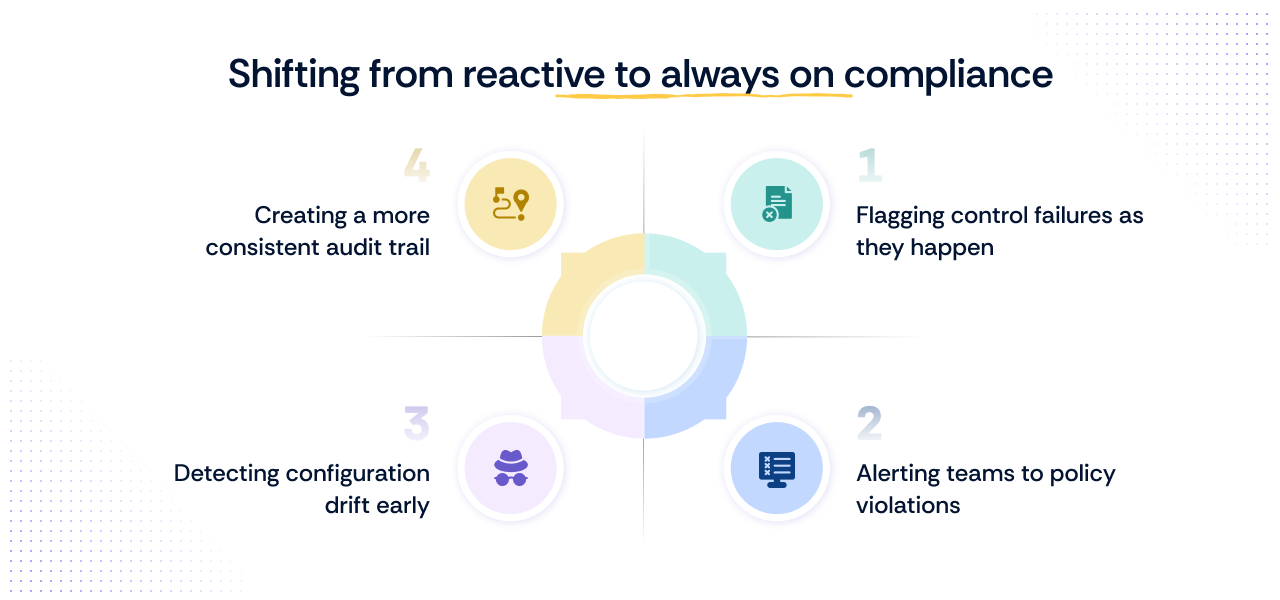
Automation also helps teams move from reactive compliance to always-on readiness by:
- Flagging control failures as they happen
- Alerting teams to policy violations
- Detecting configuration drift early
- Creating a more consistent audit trail
Risk scoring becomes more reliable as well. Automated workflows can assess likelihood, impact, and existing controls using the same methodology every time, giving leadership a clearer view of where risk is increasing.
The goal is not to replace people. It is to remove repetitive manual work so a small team can focus on strategy, vendor reviews, security decisions, and the judgment calls that still require human expertise.
Maximizing existing resources
Before buying new tools, audit what your current tech stack already provides. Most mid-market companies are sitting on compliance capabilities they are not using.
- Cloud-native security tools. AWS Security Hub, Microsoft Defender for Cloud, and Google Cloud Security Command Center all provide security monitoring, configuration checks, and compliance assessments that map directly to common frameworks. If you are paying for a cloud provider, you are already paying for these features.
- Identity provider controls: Okta, Azure AD, and Google Workspace all support conditional access policies, MFA enforcement, and access reviews that satisfy multiple compliance requirements. Configuring these properly is often faster and cheaper than buying a separate tool.
- Development pipeline security: GitHub Advanced Security, GitLab SAST, and similar tools can automate code scanning and dependency checks that satisfy SOC 2 and ISO 27001 development security controls.
- Cross-training your team: In a mid-market environment, compliance cannot be the responsibility of a single person. Training engineers to understand evidence requirements, teaching HR to manage access reviews during offboarding, and showing product managers how their decisions affect compliance posture all multiply your effective compliance headcount without adding payroll.
Affordable GRC tools for mid-market teams
The GRC platform market has matured significantly, and mid-market teams now have strong compliance software options that did not exist a few years ago. The best compliance tools for budget-conscious teams share a few traits: all-inclusive pricing, pre-built framework content, and deep automation that reduces manual work from day one. Here is how the most relevant platforms compare.
Scrut Automation covers 60+ frameworks with all features included in a single price: risk management, vendor risk management, policy management, audit access, and penetration testing. The all-inclusive model matters for mid-market budgets because there are no surprise add-on costs as your program grows.
Cross-framework control mapping and automated evidence collection across 75+ integrations make it particularly efficient for teams managing multiple certifications with lean resources. For mid-market companies navigating AI and compliance together, Scrut also offers a ResponsibleAI framework that layers governance without requiring separate tooling.
There are also other tools, such as:
- Drata offers strong engineering team integrations and a no-code test builder. Good for technically mature teams that want to write custom compliance checks.
- Vanta has the broadest integration ecosystem at 300+ connections. Works well when your tech stack is complex, and you need deep automated evidence collection across many tools.
- Sprinto delivers a strong price-to-feature ratio with built-in MDM and a dedicated lead auditor for every customer. A solid choice for teams pursuing their first certification on a tight budget.
- StandardFusion provides a flexible GRC built for mid-market scale, with risk assessment, policy management, and audit tracking without enterprise-level complexity.
When evaluating, calculate the total cost of ownership over three years, not just the first-year price. Platforms that charge separately for risk management, vendor oversight, and auditor access often cost more in the long run than all-inclusive options.
Cost-saving strategies that actually work
Keeping compliance costs under control does not mean cutting corners. The most effective savings usually come from better scoping, smarter vendor decisions, and more efficient use of existing resources. These strategies help reduce spend while still supporting a strong, audit-ready compliance program.
Negotiate multi-year contracts
Most GRC vendors offer significant discounts, often in the 15 to 30 percent range, for two- or three-year commitments. If you have already validated the platform during a pilot phase, locking in a multi-year rate can protect your budget from annual price increases.
Use consulting strategically, not broadly
You do not need a consultant for every step. Bring them in for gap analysis and audit preparation, where their expertise has the highest impact per dollar. Handle ongoing compliance operations internally by using your platform’s automation and templates.
Start with pre-built policy templates
Writing compliance policies from scratch is expensive and usually unnecessary. Most major GRC platforms provide expert-vetted policy templates that you can customize to reflect your actual operations. This alone can save weeks of consultant time.
Leverage open-source security tools
Tools like OpenSCAP for configuration scanning, ZAP for web application testing, and CIS Benchmarks for hardening guidance are free and can support multiple compliance control requirements.
Use free government resources
NIST publishes practical guidance for smaller organizations, including the Cybersecurity Framework 2.0 Small Business Quick-Start Guide. These materials are a strong starting point and cost nothing.
Building internal capabilities
The most cost-effective long-term GRC strategy is to develop internal expertise rather than rely on external consultants indefinitely.
Designate GRC champions
Within each department, identify people who understand both the business function and the compliance requirements that apply to it. These are not extra hires. They are existing employees who take on a coordination role, bridging the gap between the compliance team and daily operations.
Invest in targeted training
Role-specific training delivers better results than generic compliance awareness programs. Engineers need to understand the controls for secure development. HR needs to manage the lifecycle of access processes. Finance needs to track vendor compliance. Each role has specific, learnable compliance responsibilities.
Document everything as you go
Treat documentation as a continuous process rather than a pre-audit scramble. When a team member solves a compliance problem, document the approach immediately. This builds institutional knowledge that survives employee turnover.
ROI metrics for leadership
Mid-market security leaders often struggle to justify GRC investment to executives who see compliance as a cost center. The most effective approach is to tie compliance and audit performance directly to business outcomes.
The business case writes itself when you look at the data: IBM's Cost of a Data Breach report found that the average breach at companies with fewer than 500 employees cost $3.31 million, and organizations using security AI and automation saved $1.9 million per breach compared to those without.
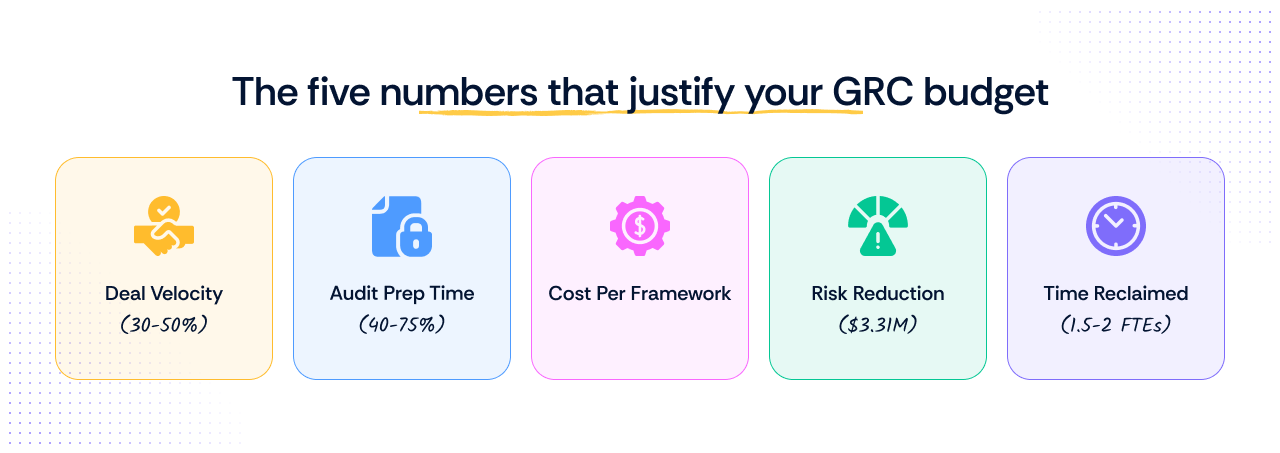
If you want to ensure you are on the right track, pay attention to:
- Deal velocity: Track how compliance certification affects your sales cycle. Companies with SOC 2 or ISO 27001 in place typically close enterprise deals 30 to 50% faster because the security review is already done.
- Audit preparation time: Measure hours spent preparing for audits before and after implementing your GRC program. Reductions of 40-75% are common with automation.
- Cost per framework: Track what it costs in time and money to achieve and maintain each certification. This number should decrease with each additional framework as shared controls reduce duplicative work.
- Risk reduction: Quantify the risks your GRC program has identified and mitigated. Frame these in financial terms: a data breach avoided is worth significantly more than the annual platform cost.
- Employee time reclaimed: Calculate the hours your team no longer spends on manual evidence collection, policy chasing, and spreadsheet maintenance. Convert that to a salary equivalent. This is often the most compelling number for CFOs.
Conclusion
Mid-market security teams do not need enterprise-sized budgets to build effective security governance. The key is to design a GRC program around focus, automation, and scalability. Start with the frameworks that directly support business growth, map shared controls across requirements, and automate repetitive tasks such as evidence collection, monitoring, and audit preparation.
The strongest programs also make better use of what already exists: cloud security tools, identity controls, development pipeline checks, and trained internal champions. Over time, this creates a compliance function that is lean, repeatable, and easier to expand as new frameworks or customer requirements appear.
For mid-market companies, GRC success is not about doing more with less. It is about doing the right things first, reducing manual effort, and turning compliance from a recurring burden into a business advantage.
Security governance is the framework of policies, processes, and controls that an organization uses to manage information security risks, ensure regulatory compliance, and align security decisions with business objectives.
Yes. Cross-framework control mapping means a single control can satisfy requirements across SOC 2, ISO 27001, and PCI DSS simultaneously. With automation handling evidence collection and monitoring, a team of one to three people can maintain multiple certifications effectively.
Automate evidence collection first. It is the most time-consuming part of any compliance program and delivers the most immediate savings. Compliance automation tools can reduce audit preparation time by 40-75%. Continuous compliance monitoring is the second priority, as it eliminates the costly cycle of audit-prep scrambles.
For B2B SaaS companies, SOC 2 is typically the highest-value starting point because it directly unblocks enterprise sales. ISO 27001 follows for companies expanding internationally. Regulatory frameworks such as HIPAA and PCI DSS should be prioritized based on your specific industry requirements.
First-year costs typically range from $30,000 to $100,000 and cover platform licensing, initial consulting for a gap analysis, and audit fees. All-inclusive platforms reduce ongoing costs significantly by eliminating add-on modules and reducing manual labor.


%201.png)



.png)