

%20(1).png)
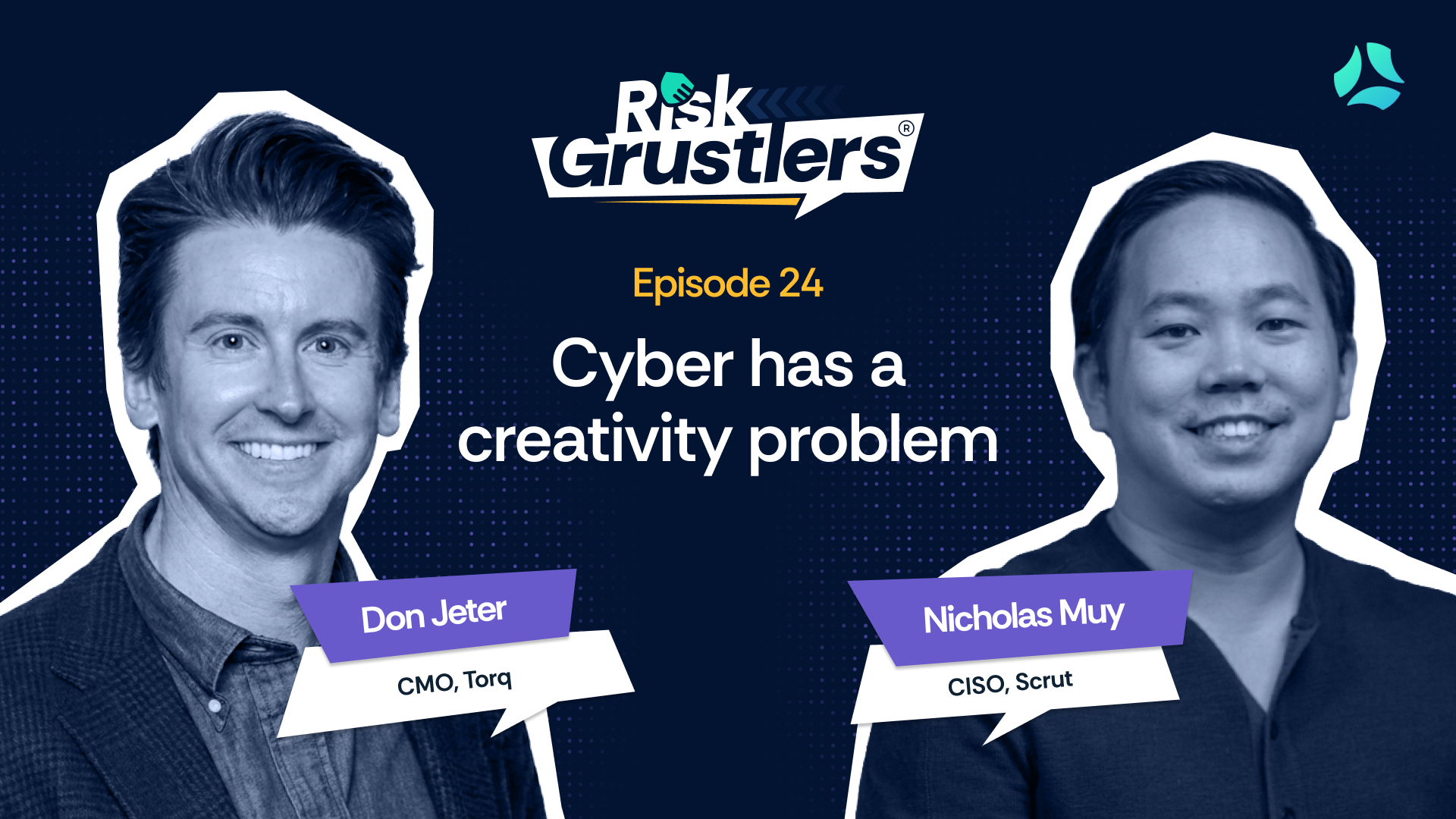


In this episode of Risk Grustlers, Nicholas Muy, VP of Engineering, Platform and Security, and CISO at Scrut Automation, sits down with Don Jeter, CMO at Torq, for a conversation recorded live from RSAC 2026.
The starting point is simple: walk across the cybersecurity expo floor, and a lot of it starts to blur together. The same colors. The same claims. The same “AI-powered,” “AI-native,” “agentic” language. For an industry that sells innovation, cyber can look strangely afraid of originality.
Don breaks down why that happens, and why it matters. In a crowded category, creative is not decoration. It is how a company earns attention, creates memory, and gives buyers a reason to notice it before the product conversation even begins.
The episode gets into why cyber events are theater, why familiarity creates legitimacy, how Torq thinks about brand in the AI SOC race, and why AI makes creative direction more important, not less.
Listen to the full episode here.
Here are some key highlights from the episode
Nick: We are live from RSAC 2026, and after walking around the show floor, I keep thinking: why does so much cybersecurity marketing still feel so unoriginal?
Don: There are hundreds of vendors exhibiting, and it can get bleak. You walk around, and it starts to feel like driving through the suburbs. Everything looks the same: green and blue, green and blue, AI-powered, AI-native, agentic, agentic, agentic.
Generative AI has made it easier to create things. The barrier to entry is lower, and now everyone thinks they are a designer. But just because you can make a lot of things does not mean those things are good.
That is why creative direction and art direction matter more now than ever. The teams that stand out are the ones spending real time on how they want to show up, how they want to sound, what the concept is, and whether it will actually land with the audience.
At Torq, if the idea does not resonate with us, we do not do it. We have to love it first.
Nick: So the issue is not just that people are making more with AI. It is that a lot of it has no real point of view.
Don: Exactly. There is still not a lot of appetite for risk-taking in cyber.
Some vendors do really strong creative work. Aikido has done cool work. Wiz has historically delivered strong concepts and immersive booth experiences. But broadly, the space plays it safe.
Events like RSAC are theater. People are overloaded. Attention spans are short. You are not going to get someone to stop unless the creative feels distinct.
That does not mean being absurd for no reason. It means having enough character to break through a room full of sameness.
Nick: As the person being targeted by all these booths, the ones that stand out to me are not always doing something wild. They are original and consistent. You can see a Wiz installation from far away and know it is theirs.
Don: Wiz is iconic in this space at this point. They built a brand and a community with a deep emotional connection to their audience. CrowdStrike has that kind of fandom too.
Torq is not the first company to push brand in cyber. We look at the companies that came before us and try to build on that.
For us, it is about creating an emotional connection with the audience. Nobody is going to buy our product because we put a huge skeleton in the booth or had Grave Digger there last year. That is not the point.
The point is to create the conditions where trust can be built. When customers come to an event, spend time with us, talk to other customers, and hear from peers who use Torq, the creative has done its job. It got people into a setting where real trust can start forming.
Nick: So the booth does not close the deal. It creates the environment where the deal becomes possible.
Don: Exactly. The creative gets attention. The experience creates the opportunity. Then customers can hear from other customers and learn about Torq in a way that feels human instead of transactional.
That is what the strongest brands in cyber do well. They create trust, build connections, and make people feel like there is something worth paying attention to.
Nick: In a crowded category, that feels like an arms race. What does standing out actually do for a company?
Don: We are in an existential race in a very crowded category. There are a lot of vendors in the AI SOC space, and it is hard to win customers. It is hard to earn logos that people recognize.
In cyber, when new categories emerge, there is often one company that becomes the default. You saw it with Wiz in CSPM. You saw it with CrowdStrike in endpoint. At some point, CISOs start telling their peers, “Just go with that company.”
That is what everyone is racing toward.
When someone walks through a floor with hundreds of vendors, they are in information overload. Their brain starts looking for shortcuts. Familiarity leads to legitimacy.
That is why we try to be loud. We try to be everywhere. Sometimes we try to be absurd because if we cannot get attention and create familiarity, we will not even make the shortlist.
Nick: So brand gets you considered, but product still has to carry the weight.
Don: Exactly. Brand helps create the shortlist. But the product has to close the deal.
We say brand is a moat, but that moat is dug by the product. If the product does not deliver, the brand cannot save it forever.
Nick: AI has made it easier for people to look creative, or almost cosplay as creative. When you are hiring, how do you know who is actually creative?
Don: Everyone is a designer now, or at least everyone thinks they are.
I joke with my designer that I am a designer too, and he hates it. I am not a designer. I just have a very particular taste, and I know what I like.
I have been lucky to work with a small creative team for years. That core team has done a phenomenal job building the brand. When we hire, the first thing we look for is drive and work ethic.
We want people who are personally and emotionally invested in the work. That is not comfortable for everybody, and honestly, it is not for everybody. Startups are a race. Sometimes you are working more than 40 hours. We are upfront about that.
We want people who understand what it takes and have a natural drive to win.
Nick: So it is not only about portfolio polish. It is about whether someone has really bought into making the work better.
Don: Yes. If you do brand well, hiring gets easier because people see it and say, “I want to be part of that.” There is magnetism to it. It feels like a movement.
We look for people who work hard and are creatively interested. I do not over-index on education or the perfect technical background. I care about taste.
Do they watch movies? Do they take in a lot of content? Do they have a point of view? Taste is a big piece of the puzzle.
Nick: How do you test that? How do you know the work ethic and taste are real?
Don: We look at portfolios, but not just formal work assets. Show us things you are proud of. Show us personal projects.
If someone is not making things creatively on their own time, I question how much they really love making things. You need something that shows, “I work hard not just because I have to, but because I like creating.”
That is much harder to fake.
Nick: Especially now, when AI can make surface-level work look better.
Don: Exactly. I would rather have designers who have spent years developing their craft and are now using AI to sharpen it.
We use AI for ideation and to get things started. But the work Torq puts out does not go straight from AI to market. Our designers touch the files. Our illustrators draw the art. The skeletons we use are hand-drawn.
That matters because this is still art at the end of the day. AI can help the process, but it cannot replace the care that goes into the final work.
Nick: The difference shows when people care.
Don: It does. There is a deep emotional connection with the work.
Nobody grows up saying they want to sell B2B software. But people do grow up wanting to create. That is the part we try to protect.
We have also been fortunate to have founders and a board that support this kind of work. That matters more than people realize. You have to trust that you hired the right marketing team and then give them enough room to create.
Most leadership teams would probably say, “This is great, but let us just do the hoodie hacker thing.” Or they would say the audience will not get it.
Our founders have been willing to back the creative direction from the beginning, even when it is not for everyone.
Nick: From the outside, people can assume marketing is just people throwing things at the wall. But when you peel it back, there is a lot of thought behind it. You can automate coordination and busywork, but the core idea, how to break through all the noise, is hard to put into Claude.
Don: Totally. I think that is one advantage humans will have.
We have a deeper, more intimate understanding of ourselves and of other people. That intuition is hard to replace.
There is a human intuition in creative work that we cannot outsource.
The bigger takeaway
This episode is not really about booths. It is about the cost of sameness in a market where everyone is trying to sound innovative.
Don’s point is that AI has made average creative easier to produce, but it has not made good creative easier to recognize. That still takes taste, judgment, risk appetite, and a real understanding of the audience.
For cybersecurity companies, that matters because buyers are overwhelmed. When every vendor claims to be AI-powered, AI-native, and agentic, people need shortcuts. Brand becomes one of those shortcuts. It creates familiarity. Familiarity creates legitimacy. Legitimacy gets you considered.
But Don is clear that a brand cannot replace a product. The creative earns attention. The product has to justify itself.
That is what makes this conversation worth listening to in full. It is a sharp reminder that standing out in cyber is not about being loud for the sake of it. It is about building a brand with enough taste, consistency, and conviction that people remember you before they ever sit through the demo.

%201.png)


.png)