

%20(1).png)


Risk scoring is the process of quantifying potential threats so organizations can prioritize, respond to, and manage them effectively.
Without accurate risk scores, risk management becomes reactive, exposing businesses to internal risks such as operational failures and human error, and external risks like cyberattacks, regulatory changes, supply chain disruptions, and economic instability.
Accurate and up-to-date risk scoring helps organizations identify the threats that matter most, allocate resources effectively, and strengthen decision-making across the business.
This guide explains how risk scoring works, how risk scores are calculated, what a risk scoring model includes, and how organizations assess both internal and external risk using proven frameworks and Key Risk Indicators (KRIs).
What is risk scoring? (And why it matters)
Risk scoring is a structured process of assigning numerical values to risks based on their likelihood and potential impact, helping organizations prioritize threats and allocate resources effectively.
Risk scores give organizations a standardized way to measure and compare risks across business operations, cybersecurity, compliance, finance, and third-party relationships. By quantifying risk exposure, organizations can identify which threats require immediate attention and which can be monitored over time.
Both internal and external risk scores play an important role in effective enterprise risk management strategies. Together, they provide visibility into operational weaknesses, regulatory exposure, cyber threats, and broader business disruptions.
Accurate and continuously updated risk scores help organizations:
- Prioritize high-impact risks
- Allocate resources more effectively
- Support faster and more informed decision-making
- Monitor risk trends over time
- Improve cross-functional communication
- Demonstrate compliance readiness
Effective risk scoring allows organizations to move from reactive risk management to a more proactive and measurable approach, improving resilience and long-term business stability.
What is a risk scoring model?
A risk scoring model is a structured framework used to evaluate and prioritize risks based on predefined criteria. It helps organizations assess the severity of potential threats consistently across different business functions, systems, and processes.
Most risk scoring models include four core components:
Organizations typically use either qualitative or quantitative risk scoring models.
- Qualitative models use descriptive ratings such as low, medium, and high based on expert judgment.
- Quantitative models use numerical values, probabilities, and financial estimates to calculate measurable risk exposure.
Common approaches include:
- Risk matrices and heat maps that visualize likelihood versus impact
- The FAIR model, which quantifies cyber and operational risk in financial terms
- Industry-specific scoring methodologies such as FMEA (Failure Mode and Effects Analysis)
An effective risk scoring model helps organizations standardize assessments, improve decision-making, and trigger appropriate mitigation workflows before risks escalate.
What are the 5 levels of risk rating?
Most organizations categorize risks into rating levels to determine how quickly action is required and how resources should be allocated.
These rating levels help organizations standardize risk prioritization and create consistent response plans across departments and risk categories.
Internal risk and internal risk assessment
Internal risk refers to threats that originate within an organization’s operations, systems, processes, or workforce. These risks can disrupt business continuity, create compliance issues, increase financial losses, and weaken overall organizational resilience.
Unlike external risks, internal risks are often harder to detect because they develop within day-to-day business activities and may go unnoticed without continuous monitoring and effective governance processes.
Common internal risk factors
Organizations commonly assess the following internal risk factors during an internal risk assessment:
- Human error
- Insider threats
- Weak internal controls
- Compliance gaps
- Process failures
- Governance failures
- Inadequate access management
- Poor change management practices
Internal risk scores help organizations quantify the severity of these threats based on their likelihood and potential business impact.
Understanding internal risk scores
Internal risk scores provide a measurable way to evaluate operational weaknesses and prioritize remediation efforts. These scores are commonly used to identify areas where organizations may face increased exposure due to process inefficiencies, control failures, or employee-related risks.
Regular internal risk assessments help organizations:
- Detect vulnerabilities earlier
- Improve operational resilience
- Strengthen governance processes
- Reduce compliance exposure
- Support better decision-making
Mid-level managers are often the first to identify operational risks, but effective risk mitigation requires visibility and support across leadership teams.
How to conduct an internal risk assessment
A structured internal risk assessment process typically includes the following steps:
- Identify critical systems, assets, and business processes
- Detect operational and control vulnerabilities
- Score risk likelihood and potential impact
- Assign ownership and accountability
- Monitor remediation efforts continuously
By continuously evaluating and updating internal risk scores, organizations can proactively manage threats before they escalate into larger operational or compliance failures.
External risk scores: Factors, rating criteria, and examples
External risk scores evaluate threats that originate outside the organization but still have the potential to disrupt operations, finances, compliance, or reputation. Unlike internal risks, external risks are often harder to predict and are typically outside an organization’s direct control.
External risk scoring helps organizations identify emerging threats early, assess their potential business impact, and prepare response strategies before disruptions escalate.
Key external risk factors
Organizations commonly assess several categories of external risk factors when developing external risk ratings.
Economic risks
Economic conditions can directly affect business performance and operational stability.
Examples include:
- Inflation
- Recession
- Currency fluctuations
- Market volatility
Regulatory risks
Changes in laws, regulations, and industry standards can increase compliance obligations and operational complexity.
Examples include:
- GDPR or CCPA updates
- Industry-specific compliance changes
- New cybersecurity regulations
- International trade restrictions
Cybersecurity risks
Cyber threats remain one of the most significant external risk categories for modern organizations.
Examples include:
- Vendor breaches
- Ransomware attacks
- Supply chain attacks
- Third-party vulnerabilities
Environmental risks
Environmental and geopolitical events can disrupt business continuity with little warning.
Examples include:
- Natural disasters
- Geopolitical instability
- Pandemics
- Infrastructure disruptions
What makes an effective external risk rating?
An effective external risk rating considers multiple factors beyond likelihood and impact alone. Organizations often evaluate:
- Speed of onset: How quickly the threat can affect operations
- Detectability: How early warning signs can be identified
- Organizational control: The degree of influence the organization has over the risk
- Financial impact: Potential revenue loss, operational costs, or legal penalties
- Reputational impact: Potential damage to customer trust and brand reputation
By continuously monitoring external risk factors and updating risk scores regularly, organizations can strengthen resilience and improve preparedness against rapidly evolving threats.
Internal risk and external risk: Key differences
Both internal risk and external risk can significantly impact an organization’s operations, finances, compliance posture, and reputation. However, the source, level of control, and assessment methods differ considerably between the two.
Internal risks are generally easier to influence through stronger governance, employee training, and operational controls. External risks, on the other hand, often require continuous monitoring and rapid response planning because organizations have limited ability to prevent them entirely.
An effective enterprise risk management strategy evaluates both internal and external risk together to provide a complete picture of organizational exposure.
How to calculate a risk score: Step-by-step process
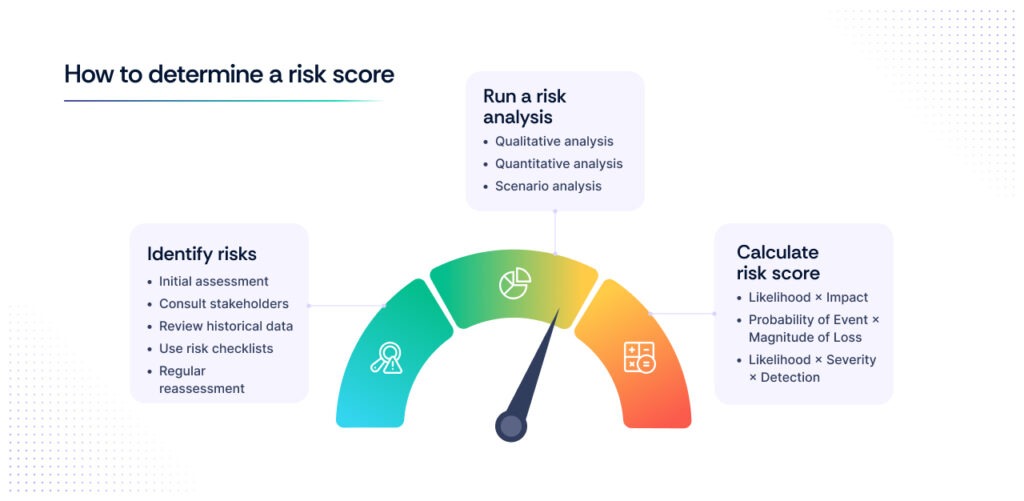
Determining a risk score involves a systematic approach that includes risk identification, risk analysis, and calculation of the risk score. Each of these steps is critical to ensuring that the risk scores accurately reflect the potential threats to your organization.
1. Identify risks
Risk identification is the foundation of an effective risk management process. It involves recognizing potential threats that could negatively impact your organization. Here are the key steps in identifying risks:
- Initial assessment: Begin by brainstorming potential risks with your team. This should include obvious risks as well as more nuanced ones.
- Consult stakeholders: Involve various stakeholders from different departments to gather diverse perspectives on potential risks.
- Review historical data: Analyze past incidents and issues to identify recurring risks.
- Use risk checklists: Utilize industry-standard risk checklists to ensure no common risks are overlooked.
- Regular reassessment: Make risk identification a continuous process by regularly reassessing risks throughout the project life cycle.
2. Run a risk analysis
Once risks are identified, the next step is to analyze their potential impact and likelihood. This involves both qualitative and quantitative assessments.
- Qualitative analysis: Evaluate the severity and consequences of each identified risk. This involves discussions with stakeholders to understand the potential impact on operations, finances, and reputation.
- Quantitative analysis: Assign numerical values to the likelihood and impact of each risk. This can involve statistical models and historical data analysis to estimate probabilities and potential losses.
- Scenario analysis: Develop different scenarios to understand how various factors might influence the impact and likelihood of risks. This helps in understanding the full spectrum of potential outcomes.
3. Calculate risk score
The risk score is a quantifiable measure that combines the impact and likelihood of a risk. There are typically three different formulas used to calculate a risk score, each applied in slightly different contexts depending on the organization’s specific needs and the nature of the risks being evaluated. These formulas include:
Risk Score = Likelihood × Impact
Risk Score = Probability of Event × Magnitude of Loss
Risk Score = Likelihood × Severity × Detection (used in FMEA – Failure Mode and Effects Analysis)
The choice of formula depends on the context and the specific aspects of risk that are most relevant to the organization or industry:
Likelihood × Impact: General risk assessments across various fields.
Probability of Event × Magnitude of Loss: Financial risk management and insurance.
Likelihood × Severity × Detection: Failure Mode and Effects Analysis (FMEA) in engineering, manufacturing, and healthcare.
When are each of these formulas used and by whom?
1. Risk Score = Likelihood × Impact
When used: This is the most common and straightforward method used across various industries for general risk assessments. It’s applicable in project management, operational risk management, information security, and other areas where risks are evaluated based on how likely they are to occur and the potential impact they would have if they did occur.
Example: An information security risk where the likelihood of a data breach is medium and the impact is high.
Steps to calculate:
- Determine the probability of the risk event occurring: This is often rated on a scale, for example—Very Low (1), Low (2), Medium (3), High (4), Very High (5).
- Assess impact: Determine the potential impact or consequence of the risk event. This is also rated on a scale, for example—Insignificant (1), Minor (2), Moderate (3), Major (4), Catastrophic (5)
- Calculate risk score: Multiply the Likelihood by the Impact.
2. Risk Score = Probability of Event × Magnitude of Loss
When used: This formula is often used in financial risk management and insurance. It’s applied when risks need to be evaluated based on the statistical probability of an event occurring and the expected financial loss if the event happens.
Example: Assessing the risk of natural disasters (like floods) for insurance purposes where the probability of the event (flood) is assessed and multiplied by the expected financial loss (damage to property).
Steps to calculate:
- Determine probability of event: Estimate the probability of the event occurring, usually expressed as a percentage or decimal.
- Estimate magnitude of loss: Assess the potential financial loss or other measurable impact if the event occurs.
- Calculate risk score: Multiply the Probability by the Magnitude of Loss.
3. Risk Score = Likelihood × Severity × Detection (FMEA)
When used: This formula is specific to Failure Mode and Effects Analysis (FMEA), a systematic method for evaluating processes to identify where and how they might fail and assessing the relative impact of different failures. It’s commonly used in engineering, manufacturing, and healthcare industries.
Example: Evaluating the risk of a mechanical failure in a manufacturing process where the likelihood of failure, the severity of the potential failure, and the ability to detect the failure before it occurs are all considered.
Steps to calculate:
- Assess likelihood: Determine how often the failure is likely to occur. This is rated on a scale (e.g., 1 to 10).
- Assess severity: Determine the severity of the failure’s impact. This is rated on a scale (e.g., 1 to 10).
- Assess detection: Determine how likely the failure is to be detected before it occurs. This is rated on a scale (e.g., 1 to 10), where a lower number indicates better detection.
- Calculate risk score: Multiply the Likelihood by the Severity and Detection ratings.
Risk scoring process flow
Most organizations follow a structured workflow to calculate and manage risk scores consistently across departments and risk categories.

Best practices for accurate risk scoring
Accurate risk scoring requires more than a one-time assessment. Organizations must continuously update, monitor, and validate risk data to ensure scores reflect changing business conditions, emerging threats, and evolving compliance requirements.
Regularly update risk scores
Risk conditions change over time, making periodic reviews essential.
Organizations should:
- Conduct regular reviews of identified risks
- Update financial, operational, and threat intelligence data sources
- Adjust scores when business environments or regulations change
- Reassess risks after major incidents or organizational changes
Keeping risk scores current helps organizations make more informed and timely decisions.
Continuously monitor risks
Continuous monitoring improves visibility into emerging threats and helps organizations respond faster.
Best practices include:
- Monitoring Key Risk Indicators (KRIs) in real time
- Conducting regular internal audits and control reviews
- Using automated alerts for unusual activity or threshold breaches
- Tracking changes in internal and external risk exposure
Continuous monitoring reduces the likelihood of risks escalating unnoticed.
Encourage cross-functional collaboration
Effective risk scoring requires input from multiple business functions, not just security or compliance teams.
Organizations should involve:
- IT and security teams
- Compliance and legal stakeholders
- Operations and finance departments
- Executive leadership
Cross-functional engagement improves risk visibility and creates a stronger risk-aware culture across the organization.
Use automation and risk management platforms
Manual risk scoring processes quickly become difficult to maintain at scale. Many organizations use risk management platforms to centralize assessments, automate workflows, and improve reporting accuracy.
Modern platforms help organizations:
- Enable continuous monitoring
- Track real-time KRIs
- Centralize dashboards and reporting
- Automate evidence collection
- Map risks to compliance frameworks
Commonly used platforms include RSA Archer, LogicGate, and RiskWatch.
By combining automation with structured governance processes, organizations can maintain more accurate risk scores and respond to threats more efficiently.
Why risk scoring is critical for enterprise risk management
Accurate and up-to-date risk scores are essential for effective enterprise risk management. They help organizations identify high-priority threats, improve decision-making, and allocate resources where risk exposure is greatest.
Organizations with mature risk scoring frameworks can respond to threats faster, improve compliance readiness, and reduce operational disruptions.
Here’s why risk scoring is critical for enterprise risk management:
- Informed decision-making: Risk scores provide measurable insights into potential threats, helping leadership make more strategic decisions.
- Efficient resource allocation: Organizations can prioritize mitigation efforts and investments based on the severity of risks.
- Proactive risk management: Continuous scoring and monitoring help organizations identify emerging threats before they escalate.
- Regulatory compliance: Risk scoring supports compliance with frameworks and standards by demonstrating structured risk assessment processes.
- Business continuity: Understanding risk exposure helps organizations strengthen resilience and prepare for operational disruptions.
- Improved communication: Standardized risk scores create a common language for discussing risk across teams and leadership.
Without structured risk scoring, organizations often struggle to prioritize threats effectively, leading to slower response times and increased operational exposure.
Building a risk-response system around your risk scores
A well-designed risk-response system is essential for managing risks effectively. It involves creating a structured approach to identify, assess, respond to, and monitor risks.
- Risk identification: Continuously identify potential risks through regular assessments and stakeholder consultations.
- Risk analysis: Analyze the potential impact and likelihood of each identified risk to prioritize response efforts.
- Mitigation strategies: Develop and implement strategies to reduce the likelihood and impact of risks. This includes preventive measures, contingency plans, and risk transfer mechanisms like insurance.
- Response plans: Create detailed response plans for high-priority risks. These plans should outline the steps to be taken if a risk materializes, including roles, responsibilities, and communication protocols.
- Monitoring and review: Regularly monitor risks and review the effectiveness of mitigation strategies. Adjust plans as necessary to respond to changing conditions.
Key Risk Indicators (KRIs): Early warning signals for risk scores
KRIs are metrics used to monitor and predict potential risks. They are based on data that indicates changes in risk levels. KRIs help organizations anticipate risks, improve risk awareness, and enhance decision-making. They act as early warning systems, enabling timely interventions.
How KRIs work
- Selection: Choose relevant KRIs based on industry standards, historical data, and specific business needs. Effective KRIs should be measurable, predictive, and actionable.
- Monitoring: Regularly track KRIs to identify trends and changes in risk levels. Use automated tools for real-time monitoring and alerts.
- Analysis: Analyze KRI data to understand the underlying causes of risk changes. This helps in identifying emerging threats and developing appropriate responses.
- Reporting: Communicate KRI findings to stakeholders, including top management, to ensure awareness and support for risk management initiatives.
- Action triggers: Define thresholds for each KRI that, when crossed, trigger specific actions. This ensures a swift and coordinated response to emerging risks.
Risk quantification: Translating risk scores into financial impact
Risk scoring becomes significantly more valuable when organizations can translate risk exposure into estimated financial impact. Risk quantification helps organizations understand not only which risks matter most, but also how much those risks could potentially cost the business.
By converting risk scores into financial terms, organizations can prioritize mitigation efforts more effectively, justify security investments, and improve executive-level decision-making.
The FAIR model
The Factor Analysis of Information Risk (FAIR) model is a structured framework used to quantify cyber and operational risk in financial terms.
The FAIR model helps organizations:
- Estimate probable financial losses
- Measure loss event frequency
- Evaluate threat scenarios consistently
- Support risk-based investment decisions
Unlike traditional qualitative scoring models, FAIR focuses on measurable business impact rather than subjective severity ratings alone.
Monte Carlo simulations
Monte Carlo simulations are commonly used in quantitative risk analysis to model a wide range of possible outcomes.
These simulations:
- Run thousands of risk scenarios
- Estimate probable financial losses
- Calculate risk ranges instead of single-point estimates
- Improve forecasting accuracy for decision-makers
Monte Carlo simulations are especially useful for assessing complex risks with uncertain variables and changing threat conditions.
Loss exceedance curves
Monte Carlo simulations often generate a loss exceedance curve, which shows the probability that losses will exceed a specific financial threshold within a defined period.
Loss exceedance curves help organizations:
- Understand worst-case financial scenarios
- Compare different risk exposures
- Set acceptable risk tolerance levels
- Prioritize mitigation investments
Frequency and magnitude analysis
Quantitative risk models also estimate:
- Loss frequency: How often a risk event is likely to occur
- Loss magnitude: The potential financial severity of the event
This combination provides a clearer understanding of overall organizational exposure and helps leadership evaluate whether current controls are sufficient.
By combining risk scoring with financial quantification techniques such as the FAIR model and Monte Carlo simulations, organizations can build more mature and defensible risk management programs grounded in measurable business impact.
Conclusion
Effective risk scoring is the foundation of proactive enterprise risk management, helping organizations prioritize threats, strengthen resilience, and improve decision-making across both internal and external risk environments.
By identifying, analyzing, and continuously monitoring risks, organizations can build stronger response systems, reduce operational disruptions, and improve compliance readiness. Accurate risk scores help leadership allocate resources more effectively, respond to threats faster, and make more informed strategic decisions.
As risk environments continue to evolve, organizations need scalable and measurable approaches to assess both internal risk and external risk exposure in real time.
At Scrut, we help organizations enhance their risk management processes with our expert tools and guidance. Contact us today to streamline your risk assessment and build a resilient framework. Partner with Scrut for a secure and successful future.
The risk scoring process involves identifying potential risks, analyzing their likelihood and impact, assigning numerical values using a scoring model, and prioritizing risks based on severity. Organizations then use these scores to guide mitigation efforts, allocate resources, and monitor changes over time.
Risk scores are typically calculated using formulas such as: Likelihood × Impact Probability × Financial Loss Likelihood × Severity × Detection (used in FMEA) The method used depends on the organization’s risk framework, industry, and the type of risk being assessed.
The five common levels of risk rating are: Low – Minimal business impact, requires monitoring Minor – Limited operational disruption, periodic review needed Moderate – Noticeable impact, mitigation required High – Significant operational or financial impact, immediate action required Critical – Severe financial, reputational, or compliance damage requiring executive escalation
A risk scoring model is a structured framework used to evaluate and prioritize risks based on predefined criteria such as likelihood, impact, severity, and detectability. Risk scoring models may be qualitative, quantitative, or hybrid, and often use heat maps, risk matrices, or frameworks like the FAIR model.
Internal risk originates within an organization and is generally more controllable. Examples include human error, weak internal controls, insider threats, and process failures. External risk comes from outside the organization and is often less controllable. Examples include cyberattacks, regulatory changes, economic downturns, natural disasters, and supply chain disruptions.


%201.png)




.png)