

%20(1).png)
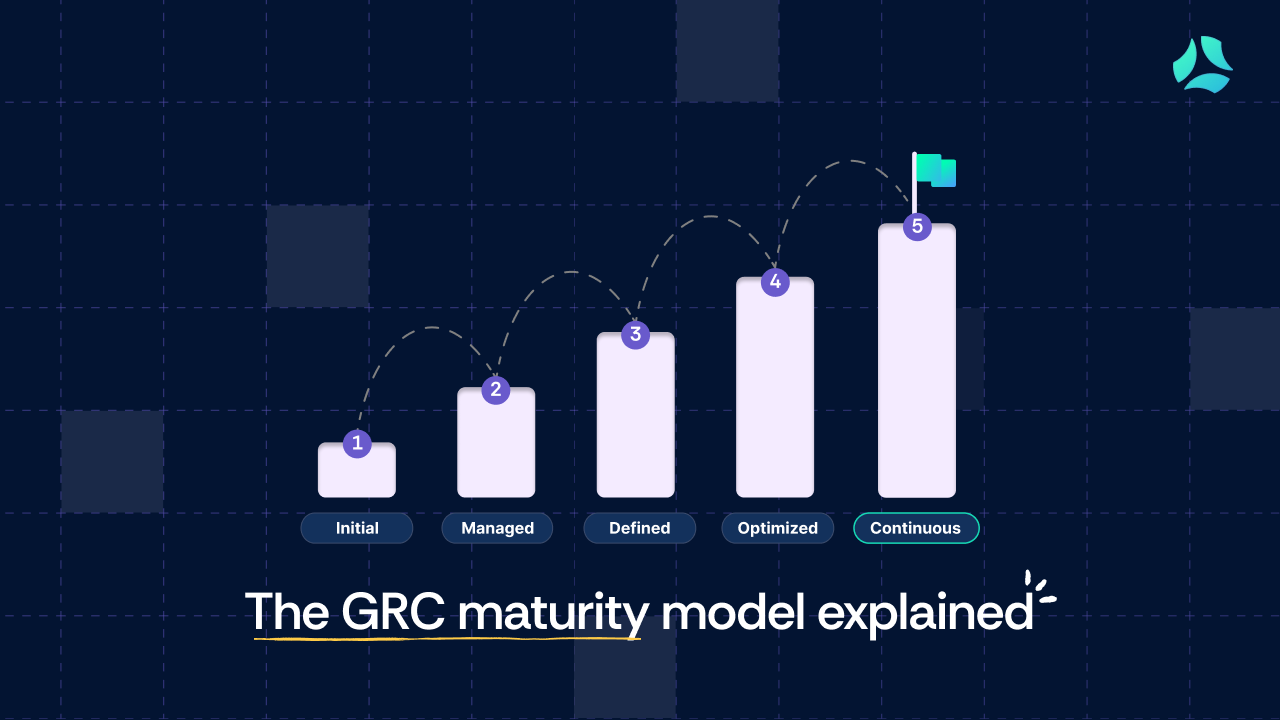


- A GRC maturity model helps organizations assess how effectively they manage governance, risk, and compliance, from reactive processes to adaptive, continuous GRC operations.
- GRC maturity levels typically progress from manual and inconsistent workflows to repeatable, measured, automated, and risk-driven programs.
- Building GRC maturity requires connecting controls, system signals, evidence, and decisions through standardized processes, automation, and continuous monitoring.
An auditor asks for evidence that access reviews happened last quarter. The control exists, the policy exists, and the owner remembers completing the review. But the proof is split across a spreadsheet, an email thread, a ticketing system, and a folder no one has opened since the last audit.
That is where GRC maturity shows up. Not in the number of frameworks your team supports, or the size of your policy library, but in the gap between knowing a control should work and being able to prove, quickly and confidently, that it does. For many teams, the controls are not missing. The flow around them is.
A GRC maturity model helps security and compliance leaders understand that flow. It shows whether governance, risk, and compliance work is reactive, repeatable, measured, or adaptive. More importantly, it gives teams a practical path from manual compliance operations to GRC engineering: a way of connecting controls, system signals, evidence, and decisions so GRC keeps pace with the business.
A GRC maturity model shows why compliance breaks when work scales
A GRC maturity model is a structured way to assess how well an organization manages governance, risk, and compliance as the company grows. At low maturity, GRC work depends heavily on memory and manual effort. Control owners respond when someone asks. Evidence is collected during audit season. Risk registers exist, but they do not always influence decisions.
At higher maturity, the operating model changes. Controls are mapped once and reused across frameworks. Evidence comes from source systems. Risks are scored consistently. Control health is visible before an audit begins. Leadership does not need to wait for a quarterly review deck to understand where the program stands.
The NIST Cybersecurity Framework 2.0 describes four Implementation Tiers: Partial, Risk Informed, Repeatable, and Adaptive. While NIST is focused on cybersecurity risk, the same progression applies clearly to GRC maturity: organizations move from informal and ad hoc work toward practices that are risk-informed, repeatable, measured, and continuously improving.
For a GRC team, the question is simple: can your program absorb change without rebuilding the same evidence trail every audit cycle?
The five GRC maturity levels give teams a practical benchmark
Most compliance maturity model frameworks use four or five stages. The labels differ, but the pattern is consistent. Teams move from reactive work to repeatable workflows, then toward measurement, automation, and continuous improvement.
This is not a maturity ladder a company climbs once. A startup preparing for SOC 2 may move quickly from reactive to repeatable. The same company can feel immature again after entering healthcare, financial services, or a new geography. The risk surface changes, the control environment changes, and the evidence burden changes with it.
That is why governance risk compliance maturity should be assessed against operating reality, not documentation alone. A mature program is not the one with the most policies. It is the one that can prove how those policies are working when the business, technology stack, or regulatory environment shifts.
GRC engineering turns maturity from a score into an operating system
Traditional GRC often starts with frameworks. GRC engineering starts with how work actually moves through the organization.
A practical maturity scaffold looks like this: Controls → Signals → Evidence → Decisions.
A control defines the expected behavior. For example, production access must be approved, reviewed, and revoked when no longer needed. A signal shows whether the control is operating, usually from systems such as IAM, HRIS, cloud infrastructure, endpoint security, Jira, GitHub, SIEM, or vulnerability scanners. Evidence proves what happened and should be current, traceable, and tied to the control requirement. A decision closes the loop when someone remediates an issue, accepts a risk, updates a control, or escalates a gap.
Low-maturity programs break between these steps. Controls live in policies, signals live in tools, evidence lives in folders, and decisions live in meetings. High-maturity programs connect the chain. That is where a modern GRC platform becomes more than a system of record. It becomes a system of action.
Forrester’s public summary of its GRC Platforms Landscape points in the same direction, noting that agentic AI, GRC engineering, and operational AI governance will push GRC platforms toward continuous risk management. The important point is not that AI replaces GRC judgment. It is that mature programs need stronger systems for routing signals, evidence, and decisions through the business.
A GRC maturity assessment should start with friction, not forms
Many GRC maturity assessment exercises begin with a questionnaire. That can help, but questionnaires often miss where GRC work actually slows down. A more useful assessment starts with friction.
Look at where evidence gets stuck, where owners need repeated follow-up, where risk reviews become stale, and where the same control is tested differently for every framework. Ask whether leadership can see control health without asking the GRC team to prepare a report. Ask whether exceptions are approved consistently. Ask whether source systems already hold evidence that someone is still collecting manually.
The OCEG GRC Capability Model is useful because it treats GRC as a capability that can be planned, assessed, and improved. OCEG’s 2025 GRC Maturity Survey, based on 856 global respondents, identified GRC strategy as a primary driver of maturity. That finding matters because tooling without strategy usually gives teams cleaner dashboards for the same broken process.
A strong maturity assessment should not only produce a score. It should tell the team what to change next: ownership, control mapping, risk scoring, evidence collection, workflow automation, reporting, or decision-making.
Each GRC maturity stage needs a different operating model
A reactive GRC program does not need the same roadmap as a managed one. At Level 1, the priority is ownership. Build a control inventory, assign control owners, identify required frameworks, and stop treating every audit as a new project.
At Level 2, the priority is alignment. Map overlapping controls, build a shared risk taxonomy, and connect GRC work to business priorities rather than audit deadlines alone. A centralized risk management module helps when teams need one place to track risk owners, scoring, treatment, and review status.
At Level 3, the priority is repeatability. Document workflows, standardize evidence requests, and reuse mappings across frameworks. This is where GRC automation starts to reduce repetitive work instead of simply digitizing it.
At Level 4, the priority is measurement. Track control health, monitor overdue evidence, measure remediation time, and identify control drift before an auditor does.
At Level 5, the priority is adaptation. Use source-system signals to trigger action, route tasks to the right owners, and use AI carefully for mapping, summarization, questionnaire support, and evidence review while keeping humans accountable for risk decisions.
Gartner’s AI governance research found that organizations using AI governance platforms were 3.4 times more likely to achieve high effectiveness in AI governance than those that did not. The broader lesson for GRC is clear: mature programs operationalize governance where work happens.
A 30/60/90-day roadmap makes continuous GRC practical
A GRC maturity model only helps if it changes the next quarter of work. The first 30 days should be about baselining the current state: frameworks, controls, owners, evidence sources, risks, audit requests, and manual workflows. Days 31 to 60 should focus on standardization by mapping overlapping controls, defining risk scoring, documenting evidence workflows, and removing duplicate requests. Days 61 to 90 should move into automation by connecting source systems, automating evidence pulls, building control-health reporting, and creating exception workflows.
Do not automate too early. If the control is unclear, automation moves confusion faster. If ownership is weak, reminders become noise. If risk scoring is inconsistent, dashboards create false confidence. Start with the operating model, then add workflow, then add compliance automation.
This is also where continuous GRC becomes practical. Continuous does not mean constant meetings or endless notifications. It means the program has enough structure to detect control drift, route work, update evidence, and support decisions before audit pressure builds.
The best GRC maturity programs reduce execution debt
Many teams try to improve maturity by adding more governance meetings, more status calls, more spreadsheets, and more control check-ins. Some governance is necessary. Too much governance becomes a drag.
Mature GRC reduces execution debt: the gap between knowing what should happen and getting it done with evidence. If MFA is disabled, the access control should show the issue. If a cloud asset drifts from policy, the right owner should be notified. If vendor evidence expires, the workflow should trigger before renewal. The program becomes lighter not because the obligations disappear, but because the work no longer depends on manual chasing.
This shift explains why the eGRC market keeps growing. Grand View Research estimates the global enterprise governance, risk, and compliance market at USD 72.42 billion in 2025, with a projected value of USD 203.65 billion by 2033, according to its eGRC market analysis. The growth is not just a software story. It reflects the reality that regulatory complexity is scaling faster than manual compliance teams can.
How Scrut helps teams build GRC maturity without adding manual work
Scrut helps security-first teams move from reactive compliance work to engineered GRC operations. Teams can map controls once across multiple frameworks, automate evidence collection from connected systems, track control health in real time, maintain a centralized risk register, route tasks to the right owners, and prepare for audits with a cleaner evidence trail.
Scrut also supports agentic GRC capabilities for repetitive GRC work while keeping human review in place. The goal is not zero-effort GRC. The goal is structured GRC: fewer duplicate requests, less stale evidence, clearer accountability, and faster decisions when risk changes.
Choose risk-first compliance that stays ready as your business changes. Book a demo.
A GRC maturity model is a framework for assessing how well an organization manages governance, risk, and compliance. It shows whether the program is reactive, repeatable, managed, or adaptive.
Most models move from reactive or ad hoc practices to risk-informed, repeatable, managed, and adaptive programs. The names vary, but the progression is broadly consistent.
Start by reviewing control ownership, evidence collection, risk management, audit readiness, workflow consistency, automation, and leadership visibility. Then compare the current state with your target operating model.
GRC engineering is the practice of designing GRC as an operating system. It connects controls, system signals, evidence, workflows, and risk decisions so compliance work stays current.
Traditional GRC often prepares for audits at fixed points in time. Continuous GRC monitors control health, evidence status, and risk signals throughout the year.


%201.png)


.png)