CMMC continuous compliance explained: A practical checklist
As national defense leans more on digital systems, every network touching controlled unclassified information (CUI) becomes a high-value target for adversaries. This critical risk is reflected in the market, where the global defense cybersecurity sector, driven by the need to secure classified data and advanced weapons systems, was valued at USD 16.45 billion in 2023 and is projected to reach USD 63.38 billion by 2032. The Defense Industrial Base (DIB) must, therefore, be proactive in its approach.
The CMMC Final Rule transforms this industry need into a rigid Department of Defense (DoD) contractor requirement, demanding verifiable CUI protection. The era of preparing for a single audit is over; compliance must be a sustained, daily operation. To ensure CMMC continuous compliance, the Department of Defense enforces a crucial rhythm: CMMC certifications are granted for a three-year cycle but are conditional upon an annual affirmation of compliance submitted to the Supplier Performance Risk System (SPRS).
Moreover, deficiencies noted in a Plan of Action and Milestones (POA&M) must be addressed within a strict 180-day period. This structure forces contractors to adopt continuous monitoring, turning every organization into a vigilant explorer of its own secure environment.
In this blog, you will learn all about continuous compliance in CMMC 2.0.
What continuous compliance means under CMMC
In the context of the CMMC program, continuous compliance represents a fundamental evolution in CMMC maturity. Plainly stated, it is the practice of maintaining full alignment with all required security controls 365 days a year, not just during the frantic weeks preceding an assessment by a Certified Third-Party Assessment Organization (C3PAO). This approach is critical because, as systems evolve and cyber threats adapt, security controls inevitably drift from their validated state, leaving organizations exposed.
The DoD stresses ongoing monitoring and rigorous evidence hygiene precisely to address this drift. Assessed organizations must prove that controls are actively working, generating evidence in real-time to substantiate their compliance status.
The expectations differ based on the level of sensitive information handled:
CMMC Level 1
CMMC Level 1, which protects Federal Contract Information (FCI), requires an annual self-assessment. While the scope is limited to 17 foundational practices, CMMC Level 1 mandates organizations to perform some level of regular monitoring, such as basic vulnerability scanning and patch management, to ensure assessment readiness throughout the year. Although a formal “continuous monitoring program” is not mandated for Level 1 organizations, it does include specific practices under the System and Information Integrity (SI) domain that necessitate regular, ongoing activity.
CMMC Level 2
Protecting the more sensitive CUI requires adherence to 110 practices based on NIST SP 800-171. CMMC Level 2 demands more comprehensive, sophisticated continuous monitoring activities, often utilizing automated tools like Security Information and Event Management (SIEM) systems to provide continuous log analysis and detailed records of incident response procedures.
CMMC Level 3
Reserved for organizations protecting the DoD’s most sensitive CUI, CMMC Level 3 adds 24 enhanced practices from NIST SP 800-172 on top of the 110 Level 2 requirements. Continuous compliance at this tier demands an advanced cybersecurity posture capable of detecting and responding to sophisticated adversaries, including APTs. While the standard does not explicitly require a 24/7 Security Operations Center (SOC), several Level 3 practices call for continuous monitoring, rapid incident response, and proactive threat hunting that many organizations can realistically meet only through round-the-clock SOC operations. The heightened sensitivity of the data drives the corresponding increase in monitoring rigor, particularly for organizations pursuing Level 2 or Level 3 certification.
Core pillars of continuous CMMC compliance
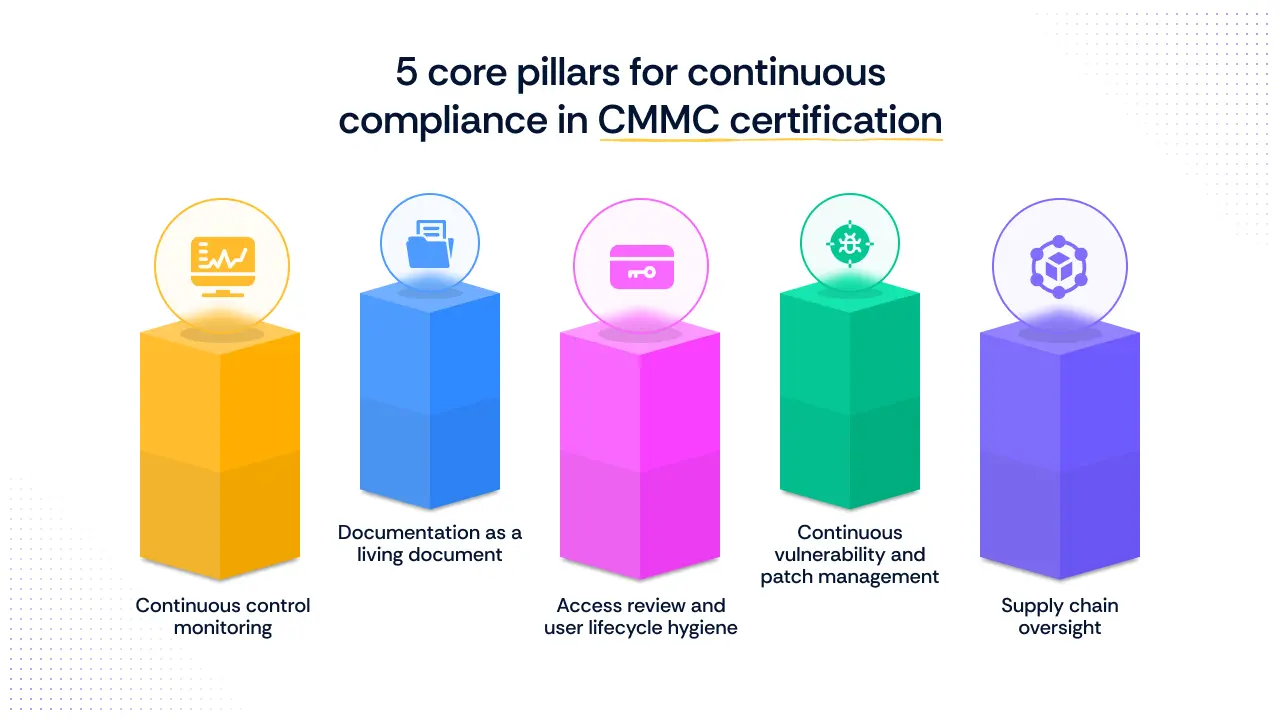
The continuous nature of CMMC compliance is defined by an active, multi-faceted approach to security that integrates five core pillars into daily operations. These pillars ensure that security controls remain effective, documented, and resilient over the life of a contract.
1. Continuous control monitoring
Controls rarely remain compliant once certified. This silent weakening, or "drift," occurs as new software is deployed, configurations change, or user privileges expand. To maintain CMMC practices, reliance on periodic checks is insufficient. Continuous control monitoring (CCM) replaces manual checks with 24/7 monitoring of technical controls across the environment.
Automation tools like Scrut connect directly to cloud services and infrastructure, continuously verifying system configurations, user activity, and firewall rules against required CMMC benchmarks. This enables automated evidence collection, including generating logs, timestamps, and reports in real-time, and immediately alerting teams to any deviation, ensuring that controls are always operating as intended.
2. Documentation as a living document
Documentation for CMMC, specifically the System Security Plan (SSP) and supporting policy updates, must be treated as a living, evolving record of the security program, not static binders prepared only for the audit. The SSP details how CUI is protected and must reflect the current state of the organization’s environment and control implementation.
Similarly, the Plan of Action and Milestones (POA&M) is a crucial living document, actively tracking remediation for non-critical gaps and reflecting progress within the strict 180-day deadline. Any change to the configuration baselines, system architecture, or even personnel requires corresponding documentation updates to ensure accurate representation of the security posture for continuous compliance.
3. Access review and user lifecycle hygiene
Effective CMMC compliance relies heavily on stringent access management. The principle of least privilege dictates that users only possess the minimum access rights necessary to perform their job functions. Regular, often quarterly, user reviews are essential to verify that access remains appropriate and to prevent "privilege creep", the gradual accumulation of unnecessary permissions.
This requires robust Joiner–Mover–Leaver (JML) processes to ensure that new employees are correctly provisioned, internal transfers have outdated access revoked, and, critically, that access for departing staff is terminated immediately. Maintaining rigorous control over privileged access accounts is especially vital, as these represent the highest risk vector for CUI protection.
4. Continuous vulnerability and patch management
Vulnerabilities are constantly discovered, making continuous vulnerability and patch management non-negotiable for system integrity. CMMC practices require organizations to proactively identify and remediate flaws. This involves running automated vulnerability scanning (typically on a monthly or quarterly basis) to discover weaknesses.
The results must then be fed into clear remediation plans. Patches must be deployed promptly, often within days for critical flaws. This process must be prioritized based on risk, focusing first on high-severity vulnerabilities that affect systems storing, processing, or transmitting CUI, thereby closing attack pathways before they can be exploited by threat actors.
5. Supply chain oversight
Your compliance extends to the vendors who handle your CUI. External service providers (ESPs), including Cloud Service Providers (CSPs), introduce inherent risk that directly impacts a contractor’s CMMC compliance. Continuous oversight demands careful vetting and management of these relationships.
For CSPs, adherence to the FedRAMP authorization standard (specifically Moderate or High) is typically required to demonstrate adequate security. Furthermore, organizations must obtain and maintain a shared responsibility matrix (SRM) or equivalent E-SP documentation. The SRM clearly delineates which CMMC practices the provider is responsible for and which controls remain the contractor’s obligation, ensuring no critical gap exists in CUI protection.
How to operationalize continuous compliance in your organization
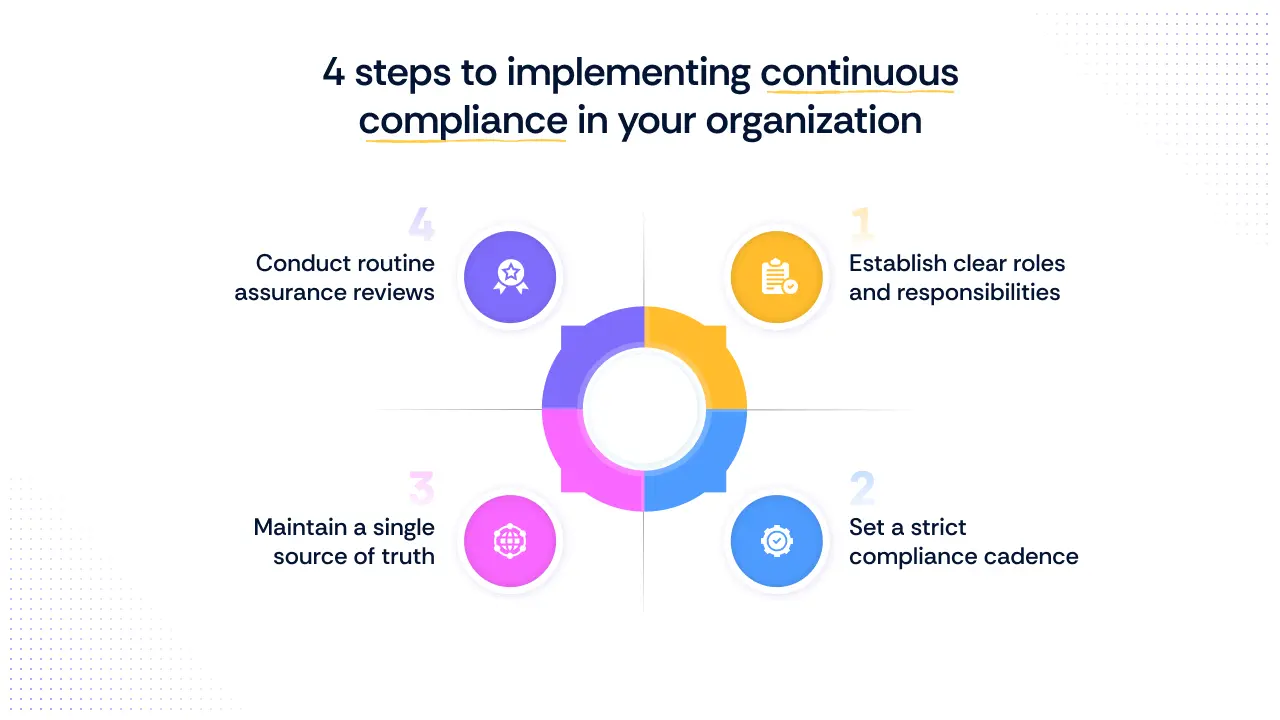
Operationalizing CMMC continuous compliance demands a structured, year-round approach that embeds security practices into the organizational fabric. This moves cybersecurity beyond the IT department and into a whole-of-enterprise governance model. To sustain compliance effectively, focus on these actionable steps:
1. Establish clear roles and responsibilities
- Define control owners: Assign specific individuals or teams as control owners for every CMMC practice (e.g., access control, patch management). This establishes accountability for implementation, maintenance, and evidence generation.
- Implement governance: Formalize a CMMC steering committee (involving IT, security, and legal) to oversee strategy, budget, and risk.
2. Set a strict compliance cadence
- Continuous monitoring: Utilize automated tools for daily/weekly checks on logs, configuration changes, and system activity to ensure configuration baselines are never violated.
- Evidence refresh: Establish a regular cadence for automated and manual evidence collection, ensuring documentation for controls is consistently refreshed and validated in real-time.
3. Maintain a single source of truth
- SSP as the blueprint: The System Security Plan (SSP) must be maintained as a single source of truth, detailing system boundaries and how every CMMC control is met.
- POA&M tracking: Actively update the POA&M to reflect remediation progress within the tight 180-day deadline, ensuring accuracy for the annual affirmations reported to SPRS.
4. Conduct routine assurance reviews
- Internal audits: Schedule routine internal audits (e.g., quarterly for privileged access, annually for general compliance) that simulate the external C3PAO assessment methodology. This helps identify and close compliance gaps proactively.
- Preparation for assessments: Use these internal checks as preparation for the triennial 3-year assessments and the annual affirmations, demonstrating proactive security maintenance rather than last-minute scrambling.
Common pitfalls in maintaining CMMC continuous compliance and how to avoid them
Despite the clear requirements for CMMC continuous compliance, organizations frequently struggle with internal security misconfigurations and undocumented changes that lead to costly failed assessments. The shift from periodic checks to constant vigilance is the biggest hurdle.
The indispensable role of automation in sustaining CMMC
The complexity and volume of the evidence required to sustain CMMC continuous compliance make manual operations nearly impossible, especially for DoD contractor requirements like annual affirmations and 180-day POA&M closure. Automation is the strategic answer to this operational challenge.
Modern compliance tools provide automation that cuts out the repetitive, error-prone tasks that overwhelm security teams. This involves continuous, automated monitoring of systems to immediately detect configuration drift, collecting essential evidence collection artifacts, such as system logs and current configuration settings, in real-time, and mapping that data directly against CMMC practices.
This automated approach simplifies workflow orchestration. Platforms like Scrut Automation leverages deep integrations to connect various security and IT tools, providing a unified dashboard for CMMC continuous compliance. Scrut helps organizations maintain an always audit-ready posture by automating risk assessments, providing template-driven policy updates, and simplifying access oversight through automated reviews.
By turning continuous evidence generation into a predictable process, Scrut automation frees human expertise to focus on strategic risk mitigation rather than chasing compliance documentation, securing CUI protection efficiently and consistently.

FAQs
1. What is CMMC compliance drift?
Compliance drift is the gradual loss of security posture over time, caused by undocumented changes, system updates, or misconfigurations. It renders controls ineffective and is the primary threat to CMMC continuous compliance.
2. How often must we affirm compliance?
All CMMC Levels (1, 2, and 3) require an annual affirmation of continuous compliance, submitted to the SPRS by a senior official. This is mandatory, even if your certification is valid for three years.
3. What happens if we miss the annual affirmation?
Failure to submit the annual affirmation means your CMMC status is no longer considered "current" by the DoD. This immediately jeopardizes eligibility for new contracts and may put existing contracts at risk.
4. Does continuous monitoring replace C3PAO assessments?
No. Continuous monitoring is required for daily validation and annual affirmation, but it does not replace the mandated triennial third-party C3PAO assessments (or government-led assessments for Level 3).
5. What role does automation play in evidence collection?
Automation uses tool integrations to automatically pull log data and configurations as evidence collection artifacts in real-time, eliminating the manual burden and ensuring assessment readiness 24/7.
6. Why are internal audits necessary between CMMC assessments?
Internal audits help identify and remediate security control gaps proactively, preventing failed assessments during the official three-year audit and providing the necessary proof for the required annual affirmation.