

%20(1).png)


The Department of Defense (DoD) requires a unified and verifiable standard of cybersecurity across the vast Defense Industrial Base (DIB). This necessity led to the creation of the Cybersecurity Maturity Model Certification (CMMC) program, which establishes tiered maturity levels to protect sensitive data, such as Controlled Unclassified Information (CUI). For organizations engaging in contracts requiring the CMMC Level 2 certification that protects critical or prioritized CUI, the expedition to assurance is not a self-guided tour; it requires a trusted, independent partner. This pivotal role is fulfilled by the CMMC Third-Party Assessment Organization (C3PAO).
Think of the C3PAO as the certified navigator of your compliance journey. Authorized by the Cyber AB, these independent entities serve as the objective gatekeepers, tasked with rigorously examining an Organization Seeking Certification’s (OSC’s) adherence to the 110 security requirements derived from NIST SP 800-171. Their assessment is the non-negotiable step that validates your security posture before the DoD. However, not all Level 2 contracts require a C3PAO assessment. Some allow self-assessments depending on their contract requirements.
Preparing for this review requires precision, a challenge where automation, such as the continuous evidence collection offered by Scrut, transforms months of manual documentation into perpetual readiness. Understanding the C3PAO’s strict methodology is the first step in ensuring your organization not only meets but confidently exceeds the DoD’s essential cybersecurity standards.
What is a C3PAO in CMMC?
The C3PAO, or Certified Third-Party Assessor Organization, represents the cornerstone of the verification process within the CMMC ecosystem. It is an independent, specialized entity authorized to conduct formal, objective assessments of an OSC’s cybersecurity maturity. The C3PAO definition places them firmly as the objective verifier, the official inspector, for the stringent security requirements established by the DoD.
Role in the CMMC accreditation ecosystem
The C3PAO is the crucial intermediary between the DoD and the DIB contractor. Their primary role is to validate compliance for CMMC Level 2, which requires adherence to the 110 security requirements of NIST SP 800-171 for protecting CUI.
This entire structure is governed by the official CMMC hierarchy:
- The DoD establishes the CMMC framework and mandates compliance.
- The Cyber AB (Accreditation Body) serves as the private, non-profit partner of the DoD, managing the integrity of the CMMC ecosystem. The Cyber AB accredits and authorizes the C3PAOs.
- The C3PAO contracts directly with the OSC to perform the triennial assessment, using certified assessors to verify security practices through examination, interview, and testing.
By engaging an impartial C3PAO, the DoD ensures that CMMC accreditation is achieved through verifiable evidence, strengthening the national security posture across the entire DIB supply chain. This essential validation ensures that the complexity of CUI protection is met with consistent, expert scrutiny, a process Scrut helps to streamline.
What are the primary responsibilities of C3PAO?
A C3PAO's core mission is to act as the DoD’s certified, independent validation arm. For an OSC, engaging a C3PAO for the CMMC Level 2 assessment is the critical step that transforms internal practices into official certification status.
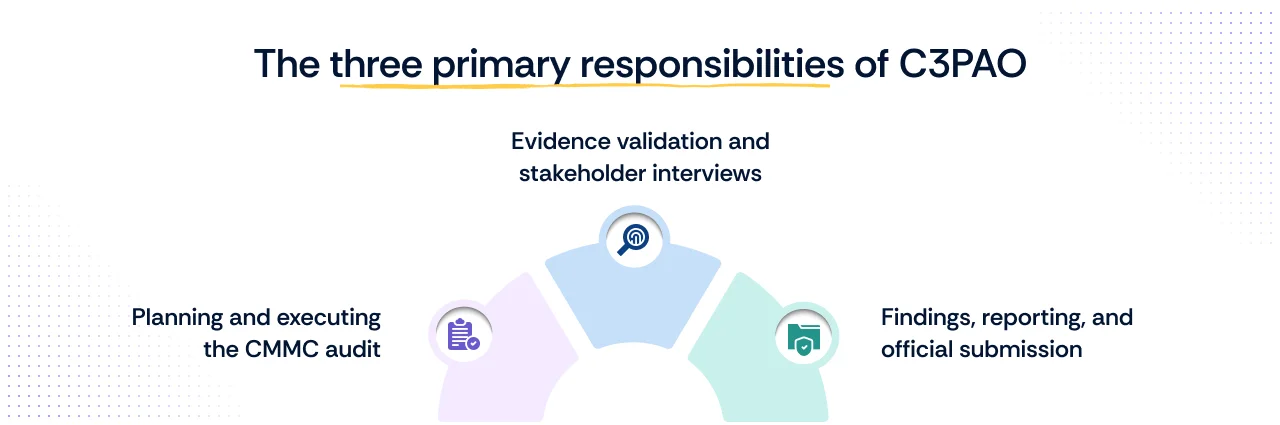
1. Planning and executing the CMMC audit
The primary responsibility is to formally conduct CMMC Level 2 certification assessments. This process, often referred to as a CMMC audit, requires C3PAOs to organize a team of certified assessors to execute a detailed assessment plan. This includes clarifying the CMMC assessment process scope with the OSC and ensuring all systems that store, process, or transmit CUI are included in the System Security Plan (SSP).
2. Evidence validation and stakeholder interviews
The assessors' central duty is rigorous verification. They ensure alignment with NIST SP 800-171 by employing three methodologies: examining documented evidence (policies, logs, artifacts), interviewing stakeholders and personnel to confirm process adherence, and technically testing security requirements to prove operational effectiveness. This ensures controls are not just written down, but are actively working. This is where automation platforms, like Scrut, expedite the process by providing organized, continuous evidence for the C3PAO.
3. Findings, reporting, and official submission
Upon completing the fieldwork, the C3PAO compiles the results. They must provide assessment findings detailing whether each practice is MET or NOT MET. The C3PAO then submits the results for certification via the Cyber AB to the DoD’s designated government system, such as eMASS, leading to the triennial certification. Their commitment to impartiality ensures the final findings are objective and defensible, serving the interests of the entire CMMC ecosystem.
When does your organization need a C3PAO?
Determining when to engage a C3PAO is a direct function of your CMMC compliance requirements and the sensitivity of the information you handle as a defense contractor within the DIB. The need for a C3PAO is directly tied to the level of certification required by your DoD contract.
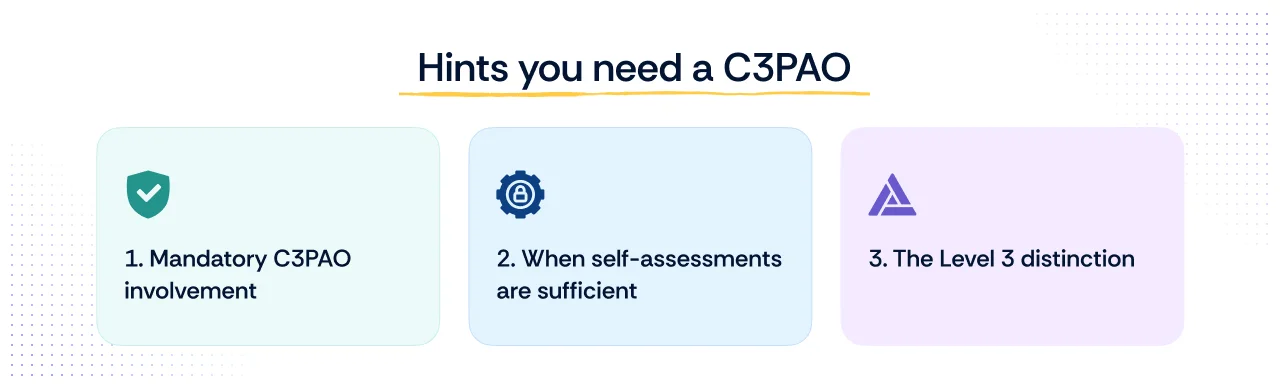
1. Mandatory C3PAO involvement
A C3PAO’s involvement is mandatory for CMMC Level 2 certification when the contract requires access to or protection of prioritized CUI. This typically involves the most critical and complex contracts. Defense contractors falling into this category must undergo a triennial assessment conducted by a C3PAO. This independent, third-party verification ensures objective assurance of adherence to all 110 security requirements of NIST SP 800-171.
2. When self-assessments are sufficient
For CMMC Level 1 (L1) requirements, which focus solely on protecting Federal Contract Information (FCI), a C3PAO is generally not needed. OSCs can meet these requirements through an annual self-assessment, affirmed by senior leadership. Furthermore, a subset of CMMC L2 contracts involving non-prioritized CUI may also permit an annual self-assessment.
3. The Level 3 distinction
It is important to note the distinction for the most advanced tier. CMMC Level 3 (L3), reserved for organizations handling the DoD’s most sensitive programs, will not be assessed by a C3PAO. Instead, the L3 assessment will be conducted directly by DoD government assessors. Understanding these assessment nuances allows the OSC to accurately budget resources and leverage tools like Scrut to prepare efficiently for the required assessment path.
How to choose the right C3PAO
Selecting the right C3PAO is one of the most consequential decisions an OSC will make on its CMMC journey. The C3PAO acts as the certified navigator and gatekeeper, and the compatibility of their expertise with your environment is critical to minimizing cost and friction.
Essential selection criteria
The first and most non-negotiable step is verifying the C3PAO’s accreditation status. The official list of authorized C3PAOs is exclusively maintained on the Cyber AB marketplace. Working with any entity not listed there invalidates the entire assessment process.
Beyond official status, defense contractors should consider several practical factors:
- Industry experience and tech stack understanding: Seek a C3PAO with demonstrated industry experience with organizations of a similar size, complexity, and sector in the DIB. Their familiarity with your specific technology environment is crucial; an assessor familiar with your tools, and even compliance automation platforms like Scrut, can streamline the review of evidence and documentation.
- Availability and timelines: Given the high demand for CMMC Level 2 assessment, many C3PAOs maintain long waitlists. It is essential to inquire about their availability and timelines early to ensure their schedule aligns with your contractual deadlines. A delay here could jeopardize your ability to bid on contracts.
- Cost factors: While C3PAO fees for a CMMC assessment typically range in the tens of thousands of dollars, assess the total value. Look for clear, transparent pricing and consider the long-term cost of an inexperienced assessor who may miss key nuances, leading to failed assessments and expensive re-audits.
Red flags to avoid
The C3PAO must maintain impartiality. Be wary of unaccredited "consultants" posing as assessors or organizations that offer to both provide comprehensive remediation and conduct your official audit. This presents a conflict of interest prohibited by the CMMC program rules. The C3PAO’s role is strictly that of objective assessment.
Steps to prepare for a CMMC C3PAO assessment
Achieving CMMC readiness is an organized expedition, not a last-minute sprint. Before your OSC engages a C3PAO, a comprehensive CMMC pre-assessment and preparation phase is essential to ensure success and minimize the assessment timeline. This CMMC compliance checklist is a roadmap to verifiable assurance.
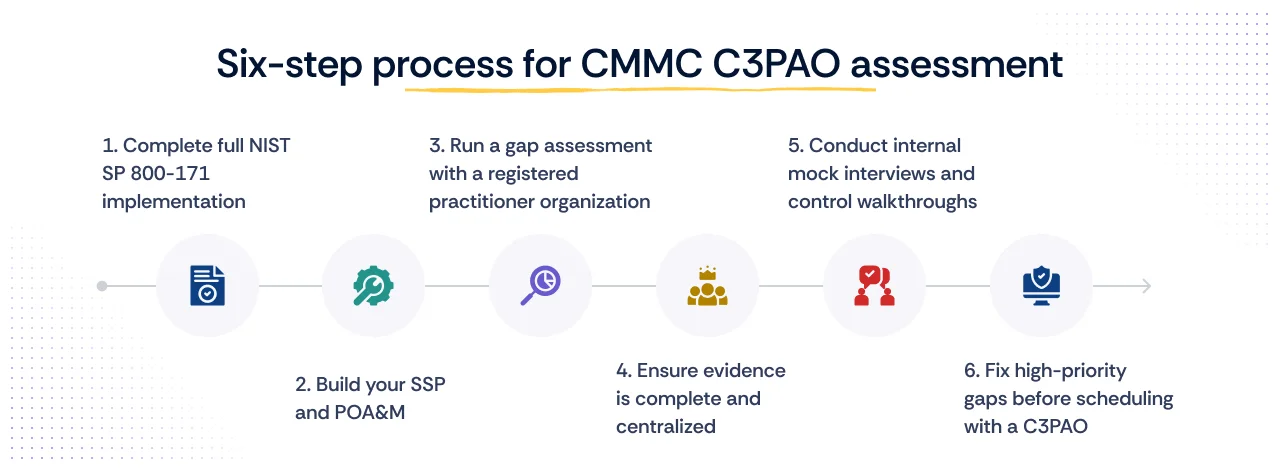
1. Complete full NIST SP 800-171 implementation
The foundational step is the complete implementation of all 110 security requirements stipulated in NIST SP 800-171. The DoD permits the limited use of POA&Ms to address some non-critical, lower-weighted controls under specific limits and conditions. This process requires technical configuration, policy development, and procedural changes across the entire CUI environment. This must be a demonstrable operational reality, not a planning exercise.
2. Build your SSP and POA&M
The SSP is the narrative of your compliance, documenting precisely how your organization meets each NIST control. Concurrently, you should begin drafting your Plan of Action and Milestones (POA&M) to document any known, non-critical gaps that you intend to remediate. The SSP provides the essential framework for the entire C3PAO assessment.
3. Run a gap assessment with a registered practitioner organization
While optional, running a pre-assessment gap analysis with a Registered Practitioner Organization (RPO) is highly recommended. The RPO provides an objective outside perspective on your CMMC readiness, simulating the C3PAO audit and identifying deficiencies that internal teams may have missed.
4. Ensure evidence is complete and centralized
This is often the most challenging requirement: all implemented controls must have verifiable evidence of operation. Evidence must be complete, timely, and organized. Automation platforms, such as Scrut, solve this by continuously collecting and centralizing artifacts, ensuring that your C3PAO team can easily retrieve every required piece of documentation.
5. Conduct internal mock interviews and control walkthroughs
Assurance extends beyond documentation. C3PAO assessors will interview staff and observe security processes firsthand. You must conduct internal mock interviews and control walkthroughs to ensure employees can articulate their roles and processes correctly, providing consistent narratives for the assessment team.
6. Fix high-priority gaps before scheduling with a C3PAO
Address all high-scoring, critical gaps before formally scheduling your C3PAO assessment. Remediation completed during this CMMC readiness phase is far cheaper and faster than remediation done under the pressure of a POA&M deadline or a failed audit.
How the C3PAO assessment process works
The C3PAO assessment is a structured, four-stage journey defined by the CMMC Assessment Process (CAP), designed to ensure a consistent, objective evaluation of an OSC’s security posture. This methodology validates that the organization is not only prepared for the audit but can sustain CMMC compliance over time.
Stage 1: Readiness review and documentation review
The process begins with an essential readiness check. The C3PAO's lead assessor reviews the OSC’s SSP and CUI data flow diagram to confirm that the defined scope is accurate and complete. This is the C3PAO audit stages' initial gate: if documentation is insufficient or the scope is flawed, the C3PAO can postpone or reschedule the assessment. Automation is invaluable here, as platforms like Scrut ensure all documentation is centralized and ready for immediate review before this stage is finalized.
Stage 2: On-site/system assessment (interviews + evidence + technical validation)
This stage marks the formal start of the CMMC Level 2 certification process. The C3PAO team conducts the detailed audit, assessing the implementation of all 110 NIST SP 800-171 practices using three primary methods:
- Examine: Reviewing collected evidence and artifacts.
- Interview: Speaking with subject matter experts (SMEs) to confirm process adherence.
- Test: Technically validating that security requirements are functioning as intended within the system.
This phase is intense, often lasting several weeks, and requires the OSC to provide concise, accurate demonstrations of operational controls.
Stage 3: Findings and remediation window
The C3PAO compiles and formalizes its findings, scoring each practice as MET or NOT MET. The results are presented to the OSC, outlining any deficiencies. If the OSC meets the necessary threshold, they may be granted a conditional certification, allowing a limited remediation window (no more than 180 days) to address permitted deficiencies using a POA&M. The C3PAO provides a quality assurance review before moving to the final step.
Stage 4: Final submission to Cyber AB/DoD for certification
The final stage involves formally reporting the assessment results. The C3PAO uploads the findings, along with any necessary POA&M documentation, to the DoD’s designated system, eMASS. Once the quality assurance review is passed and any conditional POA&M items are closed out (requiring follow-up validation by the C3PAO), the certification is officially awarded by the Cyber AB, securing the organization's CMMC status.
C3PAO vs RPO: What is the difference?
Understanding the distinct roles of the C3PAO and the RPO is vital for planning your CMMC expedition. The following table charts the primary responsibilities and functions of each organization within the CMMC ecosystem.
Common misconceptions and truths about C3PAOs
As the CMMC ecosystem matures, several C3PAO misconceptions often confuse organizations and lead to critical CMMC compliance mistakes. Understanding the true, impartial role of the C3PAO is vital for a successful audit expedition.
Myth 1: “C3PAOs help you fix gaps.”
Reality: C3PAOs do not offer remediation. Their sole role is assessment. Offering to "fix gaps" would create a forbidden conflict of interest. An OSC must use an RPO or internal resources for remediation.
Myth 2: “You can skip documentation if technical controls are strong.”
Reality: This is unequivocally false. C3PAOs assess not only implementation but also documentation maturity (the System Security Plan or SSP). Controls implemented but not provably documented will result in a "NOT MET" finding, regardless of technical strength.
Myth 3: “C3PAOs offer consulting to get you ready.”
Reality: C3PAOs are prohibited from providing CMMC consulting services due to independence rules. They cannot advise on how to meet NIST SP 800-171 security requirements, only whether the controls are met. Their commitment is strictly to objective validation, reinforcing why preparation with tools like Scrut is essential beforehand.
How Scrut simplifies your C3PAO assessment
The independent verification provided by a C3PAO demands continuous operational evidence, a task too complex for manual methods. Scrut acts as the dedicated mission control for your CMMC readiness. Our platform automates the necessary preparation, ensuring you are assessment-ready before engaging the C3PAO.
Scrut eliminates the risk of failure due to missing evidence by continuously collecting artifacts from your systems, guaranteeing every control under NIST SP 800-171 is covered. This centralized evidence repository ensures consistency for both your RPO (consultant) and your C3PAO (assessor), streamlining the documentation review phase. By providing a clear compliance score and management tools for the SSP and POA&M, Scrut helps you focus on remediation rather than documentation, significantly accelerating your path to CMMC certification.
Secure your mission: Start your CMMC readiness now
Do not let manual documentation and scattered evidence jeopardize your contracts with the DoD. Leverage Scrut's automation platform to transform your C3PAO assessment from a period of anxiety into a swift, successful validation. Book a demo now!
FAQs
Are all C3PAOs approved by the DoD?
No. C3PAOs are formally accredited (authorized) by the Cyber AB, which is the official partner of the DoD, not the DoD itself. The Cyber AB ensures they meet rigorous standards for performing CMMC Level 2 certification audits.
How long does a C3PAO assessment take?
The on-site or virtual assessment itself typically takes one to two weeks, depending on the size and complexity of the CUI environment. This is preceded by months of internal preparation.
Can a C3PAO help me fix compliance gaps?
No. C3PAOs must maintain strict impartiality and cannot offer consulting or remediation services for the controls they assess. An Organization Seeking Certification must hire a separate RPO for consulting.
Where do I find the accredited C3PAO list?
The official, up-to-date list of authorized C3PAOs is found exclusively on the Cyber AB Marketplace. Always confirm their status before contracting services.
How much does a CMMC Level 2 certification cost?
The direct C3PAO assessment fee for Level 2 generally ranges from $35,000 to $75,000. However, the total cost, including preparation, remediation, and labor, often totals low to mid six figures.
How often must I use a C3PAO?
Organizations requiring CMMC Level 2 certification must undergo a formal C3PAO assessment every three years, coupled with required annual affirmations in the intervening years.

%201.png)